How Guidebooks Chart Colonial Developments in Taiwan

Tourist handbooks act as useful primary sources when studying nineteenth century East Asian history. Since they were written for outsider, they are usually in Western languages, making them more accessible than most other sources. Furthermore, these guidebooks can offer insight into messages those behind the books wished to send, regarding their own country, the region in question, or the success of colonial projects. A Handbook For Travellers in Japan was written by Basil Hall Chamberlain, a British academic studying Japanese language and culture. Therefore, while not being directly influenced by the Japanese government, Chamberlain was likely tuned in to current event surrounding the nation, specifically around the island of Taiwan, which had been annexed by Japan in 1895. Between his handbook published in 1901 and a new edition published in 1907, subtle changes help show how the colonial government was consolidating control across the island, and how from a European perspective this impacted the potential for tourism in Taiwan.

In both versions, the general description of the island remains unchanged. However, in the 1907 edition a small passage had been removed. This described Taiwan as “a very unsettled state, owing to frequent risings of the Chinese”. Its removal could indicate that the Japanese government was eager to display the success of its actions in Taiwan to Western nations. Later in the 1907 guidebook, Chamberlain says that both the West and North of the island are fully accessible, “though in some parts it is advisable not to travel after dark”. This represents a significant change from just 6 years earlier, where Chamberlain noted that “practically only the capital and the larger ports are accessible”. That these are two of the most obvious edits between the guidebooks shows that the Japanese government wanted to make it clear that their operations on “civilising” Taiwan had been successful, and that more of the island was safe for travellers to visit.

The greatest difference between the two editions is an entirely new section on rail travel in Taiwan. While completely absent from the 1901 edition of the guidebook, the 1907 edition mentions that rail travel now connects Taipei in the North with other cities in the South of the island. The addition signifies the rapid construction of land routes across the island, likely constructed to provide additional security for Japanese administrators. Nevertheless, this method of travel had now become open to the public, and represented a new way to experience the island compared to travel by steamer, frequently complained about in both editions for missing the most scenic parts of the island.

Aline Demay argued that “tourism is a major and indispensable player in colonial policies”. Chamberlain’s guidebooks seem to indicate that the opposite is also true. Upon annexing Taiwan, the Japanese government’s aims were to open up the island to travel by colonial authorities, and to remove the threat of attack from both Chinese rebellions and from the indigenous people living in the highlands. By doing both of these, Taiwan also became an achievable destination for European travellers, though some intrepid spirit would still be necessary to visit much of the island. The creation of rails, vital for colonial policy, would turn out to be equally vital for enabling European tourism across the island.

Sources

Chamberlain, Basil Hall, A Handbook For Travellers in Japan, (1901, London).

Chamberlain, Basil Hall, A Handbook For Travellers in Japan, (1907, London).

Demay, Aline, Tourism and Colonization in Indochina (1898-1939(, (2014, Cambridge).

The Rhetoric of Anti-Conquest in the Dutch’s Island of Paradise

This blog post will explore how Mary Pratt’s argument of imperial nations using an ‘anti conquest’ narrative to disguise their colonial presence is applicable to the Dutch colonial force’s advertisement of Bali as an ‘island of paradise’. As Pratt explains in the chapter ‘Narrating the anti-conquest’ within her book Imperial Eyes: Travel Writing and Transculturation, ‘anti-conquest’ refers to the strategies of representation that European bourgeoisie subjects use to secure their innocence whilst simultaneously asserting European hegemony.1To demonstrate the concept, Pratt explores how naturalists used a rhetoric of ‘anti-conquest’ within their travel writings of the Cape Colony to legitimise imperial powers’ actions and takeovers of the region.2As this blog post will show, in the early 20th century, the Dutch government also adopted an ‘anti-conquest’ rhetoric within their depiction of Bali as a tourist destination through brochures advertising the nation as an ‘island of paradise’ to disguise and hide their aggressive takeover of the island.3

The Dutch conquest of Bali was a lengthy and bloody battle, with the Balinese people proving a tough force to defeat. When Bali was eventually conquered following the death march of the Balinese rajas after the puptans of 1906-8, the Dutch invaded Bali and killed off or exiled much of the population, destroying everything. As Adrian Vickers explores in Bali: A Paradise Created, the Dutch massacres contrasted significantly to the ‘liberal imagination of the Netherlands’ thus, in the aftermath the Dutch government was concerned with how their actions would impact their international standing.2 As a result, the Netherlands were eager to find a way to present their new colony internationally whilst not exposing the nation’s colonial atrocities. This can be seen through their advertisement of Bali as an international tourist destination which can be analysed as an example of Pratt’s concept of an ‘anti-conquest’ rhetoric.

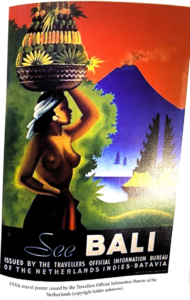
In 1914, only six years after the Klungkung puptan, the first tourist inducements to visit Bali were published. They began with the Dutch steamship, the KPM, issuing the first tourist brochures of Bali. These brochures advertised Bali as the ‘Garden of Eden’, an island that featured ‘jungle scenery,  palm trees and rice fields’ untouched by modernism.4 The brochures communicated an image of Bali that did not refer to any violent or imperial expansionist policies. Instead, they portrayed the Dutch colonisers as the ‘protectors of culture’. The account and ‘gaze’ of Bali that was transmitted as an official discourse suggested and publicised that the Dutch’s presence was uncontested. As one can see from the brochures (see figure. 1 and figure. 2), they intently focus on landscape and nature descriptions. They use visual imagery to remove both the Dutch as European antagonists from the image of Bali and the presence of any indigenous Balinese settlers that opposed the Dutch’s presence. This depiction aligns with Pratt’s ‘anti-conquest’ as the examples of travel writing she explores emphasis that the ‘anti-conquest’ consists of rhetorics that narrate a sequence of sights and seeing that focus on the landscape and minimises the European presence.5 Alongside the ‘anti-conquest’ rhetoric guiding the international ‘gaze’ away from the possibility of any colonial atrocities, Vickers notes that the advertisements were also seen as a way to ease the Dutch’s consciences. It not only allowed them to control the international narrative and image of the island but within official circles helped secured the nation’s innocence.

Figure 1: 1930s travel poster from KPM

Figure 2: 1930s travel poster issued by the Travellers Official Information Bureau of the Netherlands

The brochures not only featured natural landscape and scenery, they also included a significant focus on half-naked Balinese women. This further illustrates the tourist brochures aligning with Pratt’s concept of ‘anti-conquest’. As Pratt explores, the ‘female figure of the “nurturing native”’ has often been a key in sentimental versions of the anti-conquest.6 This figure of the half-baked Balinese woman was so key to the KPM’s tourist advertisements that Bali became known as ‘a land of Woman’.7 Again, this evidences the advertisements promoting a gaze of Bali that depicted the island as a utopia hiding the exploitation or violence that underpinned the Dutch’s presence reinforcing how the advertisements should be seen as an example of Pratt’s concept of ‘anti-conquest’.

In conclusion, as Pratt highlights, it is ‘only through a guilty act of conquest can the innocent act of the anti-conquest be carried out’.8 In the Netherlands’ attempts to absolve themselves of the guilt and potential international backlash that existed from their bloody imperialist conquest, they used tourist brochures to promote a gaze of Bali rooted in the rhetoric of ‘anti-conquest’. Their advertisements of Bali focussed on natural images and the exotic, attractive nature of Balinese women which minimise or avoided the publication of their aggressive European presence and maintained the innocence of Dutch hegemony.

  1. Mary Louise Pratt, Imperial Eyes: Travel Writing and Transculturation (London: Routledge, Taylor & Francis Group, 2017), 58. [↩]
  2. Ibid. [↩] [↩]
  3. Adrian Vickers, Bali: A Paradise Created (Victoria: Penguin Books, 1989), 130. [↩]
  4. Ibid., 131. [↩]
  5. Pratt, Imperial Eyes, 60. [↩]
  6. Ibid., 96. [↩]
  7. Vickers, Bali: A Paradise Created, 132. [↩]
  8. Pratt, Imperial Eyes, 66. [↩]

Space and the Concept of edo-guro-nansensu in the Early Works of Edogawa Rampo

Edogawa Rampo was a rather fascinating man. He deserves to be admired for his dedication to his craft, which saw him almost single-handedly translate the concept of detective fiction to Japan1. His fascination with the West allowed him to hone his craft through imitation, then invention, putting his own spin on the books he read, and which saw him create his name through a combination of homage and some very clever wordplay.

He is perhaps best known, though not in the West, where his namesake still reigns supreme, for his locked-room murders. In a translation of Rampo’s early work, William Varteresian argues that Rampo’s skill lay in just how he managed to do this. In discussing one of his earliest stories, The Case of the Murder on D Hill, he states that Rampo wrote it deliberately  “as a response to critics who argued that it was impossible to set the secret incidents and mysterious dealings which formed the core of the modern Western mystery in the open, wood-and-paper houses of Japan”.2

It was obviously a success. However, reading through Rampo’s early work, the theme that stood out the most to me was not the specific elements of the locked-room mystery as a trope, but the common thread of the personality types that he employed, both for the victims and perpetrators of crime. In the collection of short stories published before the invention of his long-running detective, Akechi Kogoro, he wrote a series of unrelated mysteries, published in English as Japanese Tales of Mystery and Imagination. Rather than the typical detective fiction of a murder and resolution, these instead read as more akin to Roald Dahl’s Tales of the Unexpected. At a total of nine stories, it is a relatively short read, and yet they are the kind of stories that linger long after the reader has finished. From the beginning, they establish a gruesome fascination with the human body, warped and twisted both mentally and physically. Each one ends abruptly, with no resolution, and, in the case of The Cliff, quite literally on a cliff-hanger.

These stories belong to a sub-genre known as ero-guro-nansensu, or ‘erotic, gruesome nonsense’. Varteresian argues that this fascination with ero-guro-nansensu allowed Rampo to “explore the extremes of ugliness” in his work, and that “[his] concern is always more for the sensational effect of bizarre appearances and chilling deeds than for social realities.”3

Varteresian ties this fascination with the bizarre to the timeframe that Rampo lived through. Born in 1894, Rampo lived through the upheaval of the first half of the twentieth century in Japan. A time of massive upheaval and westernisation, he argues that Rampo’s fascination with and observations on the West is precisely what allowed him to create a new genre of detective fiction. By playing on the ‘newness’ of all things Western, Rampo was able to create a new and unsettling style of writing. His familiarity with all things Western meant that he was able to depict Western rooms, clothing, objects and even speech with ease, things which would not necessarily have been familiar to his readers. This creates a kind of superiority in his writings, almost an arrogance at deliberately including knowledge that he knew not all of his readers would understand.

To the modern reader, many of his descriptions are, as Varteresian puts it, “horrifically insensitive”, but it is exactly this that makes it effective4. Rampo himself considered these stories the weakest of his work, and this becomes clear when comparing it to his later work. Sadly, very little of his work has ever been translated, and so this and The Early Cases are some of the only works available in English. Interestingly, despite this dissatisfaction in Japanese Tales, he oversaw the English translation of it himself, working painstakingly line-by-line with the translator, James Harris, to ensure that the resulting work was as close to the original Japanese as possible5.  However, with the recent rise in popularity in Japanese works throughout the West, there is hope that Rampo’s work may be translated in the future, where he can be placed in equal renown of his Western counterparts.

  1. Edogawa Rampo, The Early Cases of Akechi Kogoro trans. William Varteresian, (Fukuoka 2014), pg ix [↩]
  2. Ibid, pg xi. [↩]
  3. Varteresian, Japanese Tales, pg. xvi [↩]
  4. ibid [↩]
  5. Edogawa Rampo, Japanese Tales of Mystery and Imagination trans. James B Harris, (Tokyo, 1956), pg. iii [↩]

Emulating Imperialism: Japan at the 1904 World’s Fair

In the late nineteenth and early twentieth centuries World’s Fairs were opportunities for nations across the globe to display and showcase their achievements and project their power. They became spaces where East Asian nations began pushing to represent themselves on their own terms, taking control of narratives which had largely been created by Western countries. A Handbook of Japanese exhibits at the 1904 St. Louis World’s Fair offers insight into how the nation sought to use the Exposition to project a specific image of itself, as a country both steeped in history, and as aggressively modernising as any of the Western powers.

The last section of the handbook is dedicated to describing the Japanese exhibits at the World’s Fair. In it, Hajime emphasises the natural beauty of the garden that had been created for the Japanese exhibition, saying that placements of trees and other features “add beauty to the garden and make the views from within superior to any in the Fair Grounds” (Hajime, p. 114). Within this description of the exhibition, Hajime highlights the age of the features within it, from the Bonsai trees, “many centuries old”, to the buildings, each designed after aristocratic buildings at least two hundred years old. Hajime’s words make it clear that the exhibit was trying to equate Japan’s history with those found in Europe, displaying the beauty and rich culture that could be seen within the nation’s past.

Within the exhibit however, displays were described to show how modern, and similar to the West Japan had become. Within the education tent were photographs of gymnastic exercises, explicitly described as “similar to those practiced in Europe and America” (Hajime,  p. 116). The exhibition also took care not to give visitors unintended impressions from its exhibits. While the electricity exhibit was small, Hajime asked that “this must not be taken to mean that electricity for all purposes is not in general use throughout the Empire” (Hajime,     p. 121). The intended impression of the overall exhibit was of a nation with a background as culturally rich as any European nation, but one which had been able to keep up with the rapid pace of modernisation, putting it on equal footing with any Western power.

Despite Japan’s clear interest to use the exposition to represent themselves on their own terms, Hajime’s handbook presents a clear contradiction here. He mentions a Formosa exhibit, focused on Taiwan, describing the island as “ceded by China to Japan” (Hajime,               p. 120). By 1904 the island had become a Japanese colony, and as such was unable to represent itself at a World’s Fair such as this. Therefore, while Japan was struggling to display itself to the West, the nation ultimately took control over how its colony presented itself on the same stage. In addition, within Korea exhibitions would later be used to display the importance and success of assimilation (Henry, 2014). These contrasted a weak past with a more powerful present courtesy of Japan – the same stereotype Japan had been trying to overcome when presenting itself to the West. Overall, the imperial nature of such exhibitions meant that, as Japan emulated Western powers with its displays, contradictions such as this arose.

Raizman and Robey argued that, despite being designed to promote international unity, World’s Fairs were spaces where nations could present themselves to the international community (Raizman and Robey, 2017). Japan, like other East Asian nations chose to use these expositions to reject stereotypes of the nation as being underdeveloped compared to the West. Hajime’s handbook of the exhibition emphasises the impressiveness of both Japan’s past and present. The exhibition placed Japan on equal footing to the West following national humiliation in the 1895 Triple Intervention, where Western powers stopped Japanese expansion into China. While future events like the Russo-Japanese War would showcase Japan’s military strength, expositions were a softer way of expressing the nation’s newfound power.


Sources

Hajime, Hoshi, Handbook of Japan and Japanese Exhibits: at World’s Fair, St. Louis, 1904.

Henry, Todd, Assimilating Seoul, (2014, Berkeley).

Raizman, David and Robey, Ethan, ‘Introduction’ in, Raizman, David and Robey, Ethan, Expanding Nationalism at World’s Fairs, (2017, London), pp. 1-14.

The Presented Spatial Dynamics of Chinese Communes During the Cultural Revolution

‘People’s Communes’, or ‘人民公社’ were one of the key elements of the ill-fated Chinese Great Leap Forward of the late 1950s and early 1960s. Alongside the ‘Four Pests Campaign’  (除四害) and the ‘Backyard Furnaces’ (土法炼钢), the People’s Communes are one of the most well known aspects of the Great Leap Forward. An ambitious project of collectivization, it consisted of combining small agricultural communities into communes, eradicating private ownership and basing life around communal facilities and work. While the economic failings of the People Communes – both in their theory and practice – are well understood, one the most interesting, yet understudied elements of these Communes are their spatial dynamics.

Using a small sample of contemporary posters based around the subject, I want to explore two key themes that seem to be common in the presented spatial dynamics of the People’s Communes.

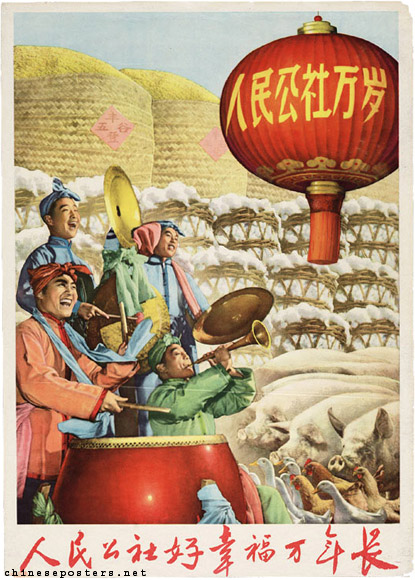
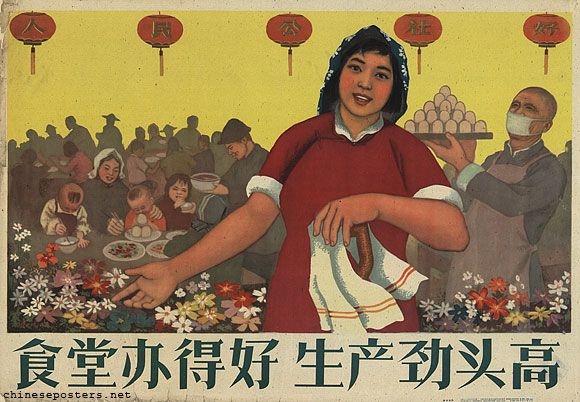
The first theme – one that is overwhelmingly present in nearly every propaganda poster relevant to the People’s Communes – is that of material plenty, of bountiful harvests and overflowing stores of foodstuffs. This theme is evident even in posters that are disconnected from agricultural topics. For example, the poster ‘When the dining hall is well-run, the production spirit will increase’ designed by Hu Yuelong, which focuses on the communal dining halls of the People’s Communes, features a large platter of food being brought to the already eating denizens of the hall.[1] However the poster which emphasizes this aspect of the People’s Communes the most is ‘The people’s commune is good, happiness will last for ten thousand years’, created by an unknown designer.[2] While the band of people takes prominence in the foreground of the image, they are physically dwarfed by agricultural produce, which dominates the background of the poster.[3] Huge, overflowing baskets of wheat and wool tower towards the sky, while the ground itself is obscured by a swarm of pigs and chickens.[4] The image’s sense of perspective also gives the sensation of the barrels continuing beyond the confines of the poster – creating an overall impression of boundless plenty, of an environment that can provide the many with even more.[5]

‘The people’s commune is good, happiness will last for ten thousand years’ 

‘When the dining hall is well-run, the production spirit will increase’


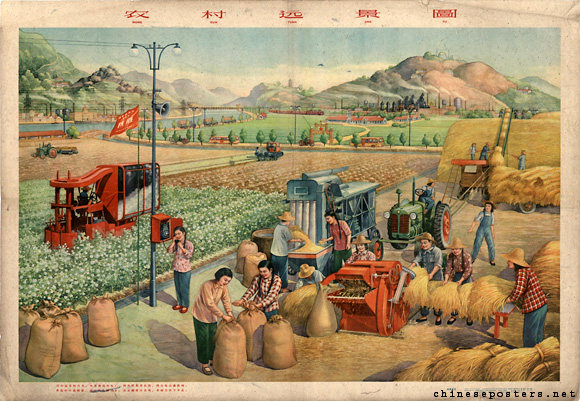
The second theme is that of generational harmony and cooperation – of the old and the young living and working together in harmony. This is a slightly more subtle theme, rarely if ever the primary point of the singular poster, but is near ever present, a consistent element throughout many of the posters. Hu Yuelong’s ‘When the dining hall is well-run, the production spirit will increase’ once again provides an example – with young children in the background, an older man in the middle ground, and a young adult woman in the foreground of the image.[6] Of particular note is the older man and the young adult woman, who appear to be both workers in the dining hall, with the older man carrying food, and the young adult woman carrying a tea cloth – creating an impression of the generations working, eating and living together.[7] The poster ‘The future of the rural village’ created by Zhang Yuqing provides another example of this theme, showcasing a future where farmers work in tandem with mechanized equipment in a rural setting.[8] The image creates an impression of old and new working together in multiple ways – the first being the rural, almost traditional setting of the image, with rolling hills under blue skies – being populated by artifacts of modernity – an electrical pole, a telephone, and mechanized farming equipment.[9] Another way in which the image furthers this theme is in the clothing of the people depicted in the image. Their clothing is for the most part modern – with jeans, overalls, and patterned shirts being prominent – but stands in contrast with their hats, which appear to be more traditionally styled, resembling ‘dǒulì’ or ‘斗笠’ style hats.[10] Theme of harmony between generations is more esoteric in its presentation in ‘The future of the rural village’, but is still present, speaking more to concepts of older traditions and new innovations working harmony, while ‘When the dining hall is well-run, the production spirit will increase’ is more concerned with harmony across human generations.


‘The future of the rural village’


Obviously, it would be foolish to take the presented themes discussed here at face value – not only because it is just a small slice of the larger concept of the People’s Communes, but because the lived experience of these Communes differed tremendously from the ideas that drove them. Still, there is use in examining the presented spatial dynamics of them as it allows us to assemble a more complete image of the planning and mindset that informed the Great Leap Forward as a whole – something, that in my opinion, requires further investigation.

[1] Hu Yuelong. When the Dining Hall Is Well-Run, the Production Spirit Will Increase. December 1958. Print, 53×77 cm.

[2] Unknown. The People’s Commune Is Good, Happiness Will Last for Ten Thousand Years. 1960. Print, 75×54 cm.

[3] Unknown. The People’s Commune Is Good, Happiness Will Last for Ten Thousand Years.

[4] Unknown. The People’s Commune Is Good, Happiness Will Last for Ten Thousand Years.

[5] Ibid.

[6] Hu Yuelong. When the Dining Hall Is Well-Run, the Production Spirit Will Increase.

[7] Hu Yuelong. When the Dining Hall Is Well-Run, the Production Spirit Will Increase.

[8] Zhang Yuqing. The Future of the Rural Village. April 1959. Print, 53.5×76.5 cm.

[9] Zhang Yuqing. The Future of the Rural Village.

[10] Ibid.

Peaceful Competition at the Panama Pacific International Exposition

This blog post will investigate the Chinese pavilion at the Panama-Pacific International Exposition in 1915 to illustrate how as David Raizman and Ethan Robey explored in their book, Expanding Nationalisms at World’s Fairs, during the 20th century, nations began to focus on forms of soft power such as design and production rather than arms to demonstrate their power.1 This post explores the expense, positioning, and critique of the Chinese pavilion at the Panama International Exposition to illustrates how nations used their pavilions at expositions as emblems of themselves in formal politics and general society.

The international political context of the Panama-Pacific International Exposition in 1915 was characterised by the opening of the Panama Canal. The canal’s opening shifted global power dynamics by increasing competition in the Pacific. It had made the Pacific easily accessible to China and a space China could begin to compete in. This change in China’s position in the world power standings was subsequently reflected through the excessive grandeur of Chinese pavilion at the Panama exposition. The opening of the pavilion was filled with exorbitant pageantry featuring Qing officials giving various opening day speeches to an extensive crowd.2 As the exposition souvenir guide points out, China ‘appropriated $750,000 and her native artisans to build her pavilion’.((The Souvenir Guide Publishers, Panama-Pacific International Exposition 1915 Souvenir Guide, San Francisco, 1915, 15.)) This expense notably exceeded what other nations, excluding the host, spent on their pavilions. This immense effort that China put into their pavilion illustrates how the Chinese considered the international exposition a crucial place to demonstrate their new power and increasing global presence. This is further implied by how this pavilion contrasted significantly to the previous Chinese pavilion at the international exposition at St Louis in 1904. This was critiqued for the lack of Chinese national symbols and poor exhibition technique and management. It held such minimal significance in China that it was not even organised by Chinese officials but by European and American Chinese Customs Service employees.3This striking difference between the two China pavilions reflects the difference in China’s international position reinforcing how pavilions had become an emblem for nation power within the realm of international politics.

Figure 1. The Souvenir Guide Publishers, Diagram showing Exposition ground plan, Palaces, Courts, Pavilions and Concessions 1915, map, https://babel.hathitrust.org/cgi/pt?id=uc1.31175035173163&view=1up&seq=3&q1=diagram, 20.

The importance of international expositions as a place to display national prestige is also evidenced by how the spatial organisation of expositions reflected the global standings of nations. As Raizman and Robey emphasise, in other expositions, the placement of nations represented the ‘sliding scale of humanity’, and physical objects, such as the central transept at the Great Exhibition in London in 1951, were used to resemble the ‘equator’ and the divide between the West and the East.4The ground plan of the Panama exposition shows the China pavilion in an area characterised by Western nations. It is opposite the pavilions of significant American states such as New York City and is neighboured by Canada. This location aligns with China’s desire to be seen by the international community as a state that held power equivalent to that of the US. Furthermore, the size of the Chinese pavilion is comparable to that of other Western nations, whilst nations that would be defined as being in the ‘East’ such as India and Persia, had smaller spaces. This highlights how the size of pavilions was also used to represent for a nation’s power reinforcing how increasingly not only weaponry represented global power.

The final feature of the Chinese pavilion at the Panama expositions that illustrated how pavilions came to represent nation’s global reputation is seen through the criticism towards the pavilion’s attraction of the Underground Chinatown. At the Underground Chinatown, visitors could view caricatures of opium addicts, performances in opium caves and gambling halls.5 The attraction was met by protests from Chinese officials and the Chinese American community before it was eventually shut down. The critique focussed on the racial and cultural humiliation and, most significantly, how the attraction risked China’s reputation within the international community.6  Within the exposition, they did not want to be considered a ‘lost nation’ for fear of the broader global implications this would create.6 This concern on the impact of China’s international reputation was broadcast in both local American Chinese-language newspapers and Western newspapers. This extensive critique not only from Chinese officials but also, the expatriate community and Western journalists and its focus on the international reputation illustrates how pavilions had become seen as an emblem of the nation.

Overall, the excessive expense of the Chinese pavilion, central positioning and concern that the failings of the pavilion would change the world’s perception of China, illustrate how during the early 20th century new ways to present international power had been created. National pavilions at international exhibitions became representations of countries’ global standings that impacted nationals at home and abroad.

  1. David Raizman and Ethan Robey, Expanding Nationalisms at World’s Fairs: Identity, Diversity, and Exchange, 1851-1915 (Abingdon, Oxon: Routledge, 2018), 8. [↩]
  2. Ibid., 185. [↩]
  3. Raizman and Robey, Expanding Nationalism, 176. [↩]
  4. Ibid., 28 [↩]
  5. Ibid., 188. [↩]
  6. Ibid. [↩] [↩]

Protests Against Modernisation: How Japanese Authors Document Transportation Infrastructure

Trains and rail lines feature prominently in Japanese literature on modernization and growth, but writers are often critical of the ways in which new modes of transportation transform the areas around them.  In Murakami Haruki’s introduction to Sanshiro by Natsume Soseki, he describes the parallels between his life and the novel’s namesake, sixty years apart.  In 1908, Sanshiro travels for two days to reach Tokyo by steam train, while Murakami makes a similar trip in under four hours on the bullet train.1 Despite the difference in time and circumstances, their reactions to trains and descriptions of them in literature are strikingly similar.  Both Soseki and Murakami associate trains with the perils and confusion of modernity and the challenges posed by rapid technological change.  These literary depictions are not only allegorical, but reflect the reality of political protest against the consequences of modernizing transportation.

In Murakami’s 2014 novel, Colorless Tsukuru Tazaki and His Years of Pilgrimage, the train-obsessed Tsukuru sees trains and stations as spaces of possibility, beginnings, and endings, but the theme of transport is also associated with the character’s personal trauma and struggles with living in a modern world.  In the novel, trains provide snapshots of “modern” life and the struggles which come with it: “There was still some time before the train opened its doors for boarding, yet passengers were hurriedly buying boxed dinners, snacks, cans of beer, and magazines at the kiosk. Some had white iPod headphones in their ears, already off in their own little worlds. Others palmed smartphones, thumbing out texts, some talking so loudly into their phones that their voices rose above the blaring PA announcements… Everyone was boarding a night train, heading to a far-off destination. Tsukuru envied them. At least they had a place they needed to go to.”2 While trains symbolize the character Tsukuru’s internal turmoil, Murakami also uses physical proximity to trains to describes his own personal experiences of living in poverty.  He remembers that “ the National Railways’ Chūō Line ran by just below the window, which made it horribly noisy… We used to have long freight trains running by until the sun came up.”3 Not only do trains represent inner emptiness in his novel, but in his own life they are a physical manifestation of his financial circumstances in the 1970s.

Despite the separation between Murakami and Soseki, both authors associate the noise of trains with modernity, and characterize it as an unwanted inconvenience.  In contrast to Murakami’s noisy home, Sanshiro describes his University campus as being “extraordinarily quiet. Not even the noise of the streetcars penetrated this far.”4 While the expansion of transportation is often presented as a symbol of progress in historical accounts, Murakami and Soseki question whether the benefits of modernized transportation are truly positive for all.  In Sanshiro, a member of the University faculty exclaims, “They’ve built so damned many lines the past few years, the more ‘convenient’ it gets, the more confused I get.”5 His comment reveals the conflict between the convenience of modernization and the disorientation it generates.

The metaphorical associations between new modes of transportation and “confusion” in literature not only reflect the attitudes of certain communities towards government efforts of modernization, but are also effective forms of political protest.  In Nishiguchi Katsumi’s semi fictional account of the Japanese National Railway’s proposal of a new line connecting Tokyo and Kyoto, he describes the reactions of Kyoto residents who “are drawn in at first but gradually realize that they are about to lose their homes.”6 This is a process that repeats throughout history from the introduction of steam trains in 1872, street cars in 1903, and bullet trains in 1964, all of which rapidly changed the areas they connected and crossed.7 These continuous efforts to modernize transportation heavily impacted communities, but often their negative effects are overlooked in official discourse and historical narratives.8

Literary representations of transportation not only demonstrate its symbolic power, but they also document the impact on communities and the attitudes of citizens, serving as a form of protest.  In Sanshiro, “One streetcar line was to have run past the Red Gate, but the University had protested and it had gone through Koishikawa instead.”4 The University’s ability to lobby the government into redirecting the train line demonstrates the influence of powerful organizations to shape infrastructure, while also revealing the places which are powerless to avoid the disruption of their communities.  While the University remains quiet and undisturbed, other communities will be transformed and perhaps destroyed by the “noise” of modernization.  Nishiguchi’s account provides a case study of this situation fifty years later in 1958.  JNR’s plan for the proposed the line connecting Tokyo and Kyoto overlooked those “for whom the personal costs would be highest: people evicted from their homes and workplaces or condemned to life under the shadow of busy elevated tracks.”9 

While literature often seems detached from reality, the views of Soseki, Murakami, and Nishiguchi reveal that negative attitudes towards modern transportation networks existed for more than a century.  Rather than criticizing “modernisation” itself, their works address the human costs which exist in any fast-paced movement of modernisation. They provide insight into the effects of rapid technological advancement on communities with little political power and document the perspectives of those who don’t feature in historical narratives.

  1. Natsume Soseki, Introduction to Sanshiro (United Kingdom: Penguin Books Limited, 2009). [↩]
  2. Haruki Murakami, Colorless Tsukuru Tazaki and His Years of Pilgrimage (London: Random House, 2014), 285. [↩]
  3. Soseki, Introduction to Sanshiro. [↩]
  4. Soseki, Sanshiro, Chapter 2. [↩] [↩]
  5. Ibid. [↩]
  6. Jessamyn Abel, “Invisible Infrastructures of Protest in Kyoto,” in Dream Super-Express: A Cultural History of the World’s First Bullet Train (Redwood City: Stanford University Press, 2022), 20. [↩]
  7. Ailsa Freedman, “Introduction,” in Tokyo in Transit : Japanese Culture on the Rails and Road (Stanford: Stanford University Press, 2011), 5-6; Abel, “Invisible Infrastructures of Protest in Kyoto,” 34. [↩]
  8. Abel, “Invisible Infrastructures of Protest in Kyoto,” 20-21. [↩]
  9. Abel, “Invisible Infrastructures of Protest in Kyoto,” 39. [↩]

Coffee Evenings in the Hong Kong MTR

The Hong Kong Mass Transit Railway, or MTR, seems to have been rapidly integrated into the day-to-day life of the city since the opening of the Modified Initial System route in 1979. The MTR Corporation’s Annual Report from 1979 is proof enough of this, giving the impression in no uncertain terms that the Corporation was pleased with how the system had been received by the general public.[1] Since then, the system has continued to expand both in size and popularity, with the Modified Initial System being expanded into the Tsuen Wan and Island lines over the course of the 1980s, and the Tseung Kwan O and Airport Express lines over the course of the 1990s, and so on going into the 21st century. One curious, and underreported element of the MTR’s expansion during this period is their method of gathering customer feedback. Instead of the more conventional approaches to gathering feedback, the MTR made use of so-called ‘Coffee Evenings’ hosted at MTR stations, starting in 1991.[2] These took the format of sit down events, taking part in the early evenings, where members of the public would be able to offer their opinions on the MTR to management staff.[3] The issues described as being commonly raised are not especially surprising or of particular interest – being matters such as air conditioning, cleanliness, and service announcements.[4]

What is of particular interest to me is how these events were specifically conducted – what atmosphere they carried, and how the management of the MTR corporation attempted to present themselves with. Unfortunately, the available information on these events is sparse at best – the only information on them that I could find online is documentation from the MTR Corporation itself, in the form of press releases transcribing announcements relating to the events, and the ‘Staying On Track With Your Views’ series, which are annual reports where the MTR responds to the feedback they have received. The limitations of these sources in finding out what these events looked and felt like are obvious – including especially negative or dramatic experiences would not be in the interest of the MTR Corporation, and positive feedback is likely to be focused on disproportionally. Still, these booklets are still useful in presenting the idealized image of the MTR’s Coffee Evenings.

An example of this image can be found in the 1993 edition of Staying On Track With Your Views, which uses a photo of a Coffee Evening as its front page.[5] The atmosphere presented in the photo is friendly, calm, and approachable – with what appears to be relaxed conversations taking place[6]. Plants are scattered around the area, and people of all ages – from children to businessmen – are present, creating an environment not unlike that of a coffee shop.[7] This relaxed and approachable tone is also conveyed in the letter included in the booklet – it ‘cordially invite(s)’ the public to provide feedback, and even includes a phone number that can be used to this end.[8]

As previously mentioned, any further analysis of the MTR’s Coffee Evenings is unfortunately hampered by the lack of available material, especially with regards to material that provides alternative viewpoints – to put it in short, only half of the story has been told. Further investigation is absolutely warranted – given how quickly the MTR seems to have embedded itself into Hong Kong, a more thorough examination of these feedback sessions would perhaps shine a light on the dynamics and lived experience of the MTR in this period, and how the corporation and the public engaged with each other.

[1] Mass Transit Railway Corporation. Annual Report of the Mass Transit Railway Corporation, 1979. 6.

[2] Mass Transit Railway Corporation. Press Release, 1995. 5.

[3] Press Release, 1995. 2.

[4] Ibid. 6.

[5] Mass Transit Railway Corporation. Staying On Track With Your Views, 1993. 1.

[6] Staying On Track With Your Views, 1993. 1.

[7] Ibid. 1.

[8] Ibid. 22.

The Ideology of Architecture

“The design of urban space was no less than a project to socially engineer humanity: architects and urban planners saw the built environment as an instrument to shape the moral values and practices of the populace.”1 

The idea that architects use physical space to shape habits, values, and ideologies is a powerful claim.  In Vietnam, French colonial architecture and socialist architecture took opposing approaches to this manipulation of space.  From the earliest stages of colonial activity in Vietnam, hygiene went hand in hand with colonial authority.  More than half a century later, in the aftermath of the Vietnam war, East German architects were similarly concerned with health, but their approach to designing built environments was very different.

In colonial Indochina, health was a primary concern for the French.  Early manuals written for French settlers promoted hygiene through housing and “offered systematic rules to tropical living.”2 They not only dictated the orientation, materials, and layout of houses, but insinuated the superiority of western sanitation practices through their pseudo-scientific claims about tropical diseases.  Houses built according to these manuals were not only meant to be physically distanced from the indigenous populace for “hygienic” reasons, but to symbolize their distinctiveness through their outward appearance.  As the population of French colonialists grew, the “hill station” of Dalat was established in the mountains of central Vietnam in order to promote the health of colonial soldiers, officials, and elites.  The justification for this project relied on assumptions about the dangers of “tropicality” (which included the inhabitants of the tropics), and allowed the French to build a segregated European area designed to improve (European) health.3 Segregated facilities existed not only in the mountains, but in the infrastructure of cities as well.  The sewer system of Hanoi, a project spurred by the same prejudiced assumptions about tropical diseases, only served the “European quarter” demonstrating how “colonial sewers were part of a larger urban system in which race dictated access to the blessings of modernism.”4 Sanitation, and assumptions about the superiority of western hygiene practices, became a symbol of colonial power asserted through infrastructure and architecture.  

Paul Doumer, L’Indo-Chine Française, Souvenirs (Paris: 1905), https://catalogue.bnf.fr/ark:/12148/cb34137199k, 70.

Paul Doumer, the Governor-General of French Indochina from 1897 to 1902, published an account of his travels which contrasts the built environment of French areas with other parts of Indochina.  His description of the hospital in Hanoi (a physical monument to modern western medicine) describes its “construction mixte” (mixed construction), neither tropical nor European architecture designed to promote airflow and provide sun protection.5 He includes an image showcasing the the “Palais du Gouvernement” in Saigon which he describes as ideally constructed for “un climat ou il faut pour vivre beaucoup d’air, beaucoup d’espace” (a climate where, in order to live, one needs a lot of air and space).6 His architectural account aligns with assumptions that tropical climates were inherently dangerous to Europeans and that indigenous sanitation practices, infrastructure, and architecture were inferior to western ones.  As a result, colonial houses, hill stations, sewer systems, hospitals, and government buildings physically and symbolically separated French and indigenous forms of hygiene.  The built environment was not only a symbolic assertion of colonial sanitary superiority, but excluded the Vietnamese populace from benefiting from these allegedly superior practices.   

Christina Schwenkel, “Traveling Architecture: East German Urban Designs in Vietnam,” in International Journal for History, Culture and Modernity 2, no. 2: (2014), 164.

In contrast to colonial architecture, in the aftermath of the Vietnam war, “soviet block” architecture dictated hygiene in different way.  In her study of urban Vietnam and East German architecture, Christina Schwenkel compares the the destruction of the Vietnamese city of Vinh to that of Dresden during WWII, and argues that the strategies for rebuilding East Germany were later used in Vietnam.7 In response to vast housing shortages resulting from extensive bombing, complexes like the Quang Trung “Wohnkomplex” in Vinh used the concept of prefabricated housing and Soviet style uniform blocks to provide safe, clean, and modern housing for those whose homes had been destroyed.  In contrast to colonial architecture which was designed to symbolize European superiority, mass housing complexes and “socialist architecture” designed housing in collaboration with Vietnamese architects with the immediate needs of Vietnamese residents in mind.  Despite differences in historical context and approach to design, the goals of socialist German architects reflected those of colonial French architects.  Like the French, German architects saw “modernity” as buildings which “facilitated the flow of air and natural light through the apartments,” and shifted “away from communal living in cramped spaces with shared, outdoor facilities.”8 While complexes like Quang Trung were developed with Vietnamese experts and designed for Vietnamese people, they reflect the same hygiene principles as those emphasized by French colonial architects.  Schwenkel notes that while the project was a collaboration, German architects, “like their colonial predecessors, were the latest in a historical trajectory of non-indigenous architectures and foreign styles of dwelling.”9 Unlike traditional Vietnamese housing which typically separates the “service area” from the “living area,” the layout within the complex followed more Western styles which promoted a more utilitarian use of space.10 

Despite the focus on the immediate needs of Vietnamese citizens and the creation of living spaces designed to promote the health of its residents the Quang Trung “Wohnkomplex,” like French colonial architecture, reflected the agenda of socialist urban planners.  “The state’s social engineering of living space thus focused on the intimate materialities of dwelling to produce new moral and urban socialist citizens.”11 Both the Palais du Gouvernement and the “Wohnkomplex” come with ideological associations built into their very appearance.  

  1. Christina Schwenkel, “Traveling Architecture: East German Urban Designs in Vietnam,” in International Journal for History, Culture and Modernity 2, no. 2: (2014), 159. [↩]
  2. Laura Victoir, “Hygienic Colonial Residences in Hanoi,” in Harbin to Hanoi: The Colonial Built Environment in Asia, 1840-1940 (Hong Kong: Hong Kong University Press, 2014), 234. [↩]
  3. Eric T. Jennings, “Health, Altitude, and Climate,” in Imperial Heights: Dalat and the Making and Undoing of French Indochina (Berkeley: University of California Press, 2011). [↩]
  4. Michael G. Vann, “Of Rats, Rice, and Race: The Great Hanoi Rat Massacre, an Episode in French Colonial History,” in French Colonial History 4: (2003), 193. [↩]
  5. Paul Doumer, L’Indo-Chine Française, Souvenirs (Paris: 1905), https://catalogue.bnf.fr/ark:/12148/cb34137199k, 115. [↩]
  6. Doumer, L’Indo-Chine Française, 70. [↩]
  7. Schwenkel, “Traveling Architecture,” 163. [↩]
  8. Ibid., 165-168. [↩]
  9. Ibid,. 166. [↩]
  10. Ibid., 167. [↩]
  11. Ibid., 161. [↩]

Chinese Domestic Spaces: an analysis of how washing machines liberated women and raised living standards

The domestic space within Chinese households has changed drastically because of socialism and communism, but not all credit can be given the to the change of politics. Instead, credit must be given to the washing machine, which significantly reduced the time in which household chores took women in particular to complete. Although the introduction of the washing machine was an economic development created by the government, the extent in which it allowed women to become liberated could arguably not have been a part of the economic plan. However, consumption overpowered the gender dynamic set out within Chinese households and the washing machine and other household products such as the sewing machine and electric cooker succeeded in making households less restrictive.1

These types of changes became more common within East Asia because of the west’s consumerism influencing countries such as Japan, China and even the Philippines. These new inventions were not only taking over the world but also the domestic roles within households.  ‘The daily American newspapers, such as the Manila Daily Bulletin, Manila Times, and Cable news quickly delivered new ideas to Philippine cities through foreign products and lifestyles.’2 Change was beginning to take root within private spaces, a place which had been somewhat difficult to change through colonisation, but western products had unintentionally shifted the foundations of domestic spaces. Through the use of advertisements these western products enabled households to normalise the convenience and necessity of buy washing machines because they were labelled as sanitary and affordable.

‘The pasig river laundry is bound to go out of business. No one can afford to be without the Boss washing machine. It does the work, saves the clothes, is sanitary and economical.’3

By the 1980’s washing machines and televisions became an expected gift within wedding ceremonies because they were classed a essential products for a newly weds first home. This meant that even rural communities within China were experiencing the western influence and the extent of which this influence was modernising China. Not only that but by introducing televisions to the household, there would be no escape from advertisements. Newspapers, magazines, and televisions would become an essential product for the government to boost their economy through ensuring that people would be convinced to buy these products. However, as stated, it could be argued that the result of promoting these products was not to influence a change within the domestic space, which would shift the expectations placed on women. The washing machine was intended to benefit women and make their housework less time consuming, but the free time in which it provided enabled women to create lifestyle changes. They became restless and looked for employment and because they were able to watch television, a whole new world opened up to them.

‘The need for increased production and availability of consumer durables has been overtly linked by the political leadership to women’s liberation and to the widespread desire among the Chinese citizenry to raise their standard of living.’4

The issue that China perhaps did not predict by boosting their economy through western products was that by allowing households to purchase and watch television, they were enabling them to observe other lifestyles within different spaces throughout the world. This enabled a new demand for better living conditions and social standards. Therefore, the changes presented within the domestic space caused people to become restless because they wanted the same changes to happen outside the home. Furthermore, was even more predominant during Chinas decollectivization period which resulted in less work for villagers because of their work being mostly farm based. The lack of social activity outside of the home resorted in villagers remaining in the home. ‘Noticeably, Xiajia residents spent their increasingly abundant spare time almost entirely in their homes, either in front of the television or at a mahjong table, because there was so little to do in the community.’5 The lack of activities within communities caused households to become dependent on televisions and therefore, this enabled the influence of consumerism to take hold of households which would change not only the expectations place on gender, but also the traditional layout of Chinese homes. How they cleaned, cooked and socialised shifted because products such as the washing machine, television and electric cooker changed the dynamic of housework.

  1. Jean C. Robinson, Of Women and Washing Machines: Employment, Housework, and the Reproduction of Motherhood in Socialist China (The China Quarterly, 1985) pp.40-43. [↩]
  2. Kiyoko Yamaguchi, The New “American” Houses in the Colonial Philippines and the Rise of the Urban Filipino Elite (Philippine Studies, 2006) p.419. [↩]
  3. The Cablenews (1905) p.3. [↩]
  4. Jean C. Robinson, Of Women and Washing Machines: Employment, Housework, and the Reproduction of Motherhood in Socialist China (The China Quarterly, 1985) p.45. [↩]
  5. Yunxiang Yan, Private life Under Sosialism: Love, intimacy, and family change in a Chinese village 1949-1999 (Stanford University Press, 2003) p.29. [↩]