Natures Resistance: The Spatiality Aspects of Trees Within Urban Areas

‘It probably would be safe to bet that more people take pictures of cherry blossoms than any other subject in Japan – but of all the millions of pictures captured, only a small percentage capture the subtle beauty on film. ‘1

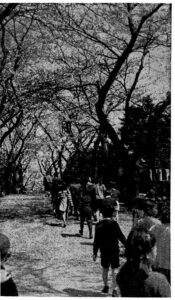
The space which Cherry blossoms occupy is difficult to categorize because of its temporality.  Therefore, springtime in Japan has become a favourite time for tourists to visit the country and flock around cherry blossom trees in full bloom.  As a consequence of the cherry blossoms’ appeal to both tourists and the Japanese, many of the spaces which these trees occupy have become public spaces such as parks and pedestrian routes. Despite modernity taking over and urbanizing Japan, sacred parts of nature have ensured that modernity has had to be built around them, rather than over them. This is similar to the alun-alun in Malang, which is a large space occupied by the banyan tree. The alun-alun holds similarities because the sacredness of the banyan and the beauty of the cherry blossom ensuring that these spaces cannot be remodelled into a product of modernity. Not only that, but the act of cutting down these types of trees was and still is associated with superstition and uneasiness. Therefore, tourism and superstitions have aided in the progress of creating these green spaces into a social setting in which tourists or locals could benefit from.

However, much like the alun-alun in Malang, there is difficulty in defining what the spaces in which trees such as the Banyan and cherry blossom occupy are. The people who gather in these spaces are not there to primarily consume or socialize, but as a result of planting such trees, products of consumption and space for socializing are created. Therefore, defining such spaces becomes complicated due to the conflictive uses of the space. Without the cherry blossoms, these spaces become pathways, parks, and green spaces, but the temporality of the trees allows these spaces to transform into a place to consume, observe, socialize, and entertain.
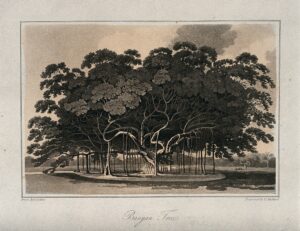
Although the alun-alun is different in its purpose, the banyan tree aids in how spaces can be defined differently depending on how it is used. ‘The banyan tree, which was once considered sacred in the context of Javanese culture, was deprived of its aura as the crowd of modern-day tram passengers used it casually as a tram shelter.’ 2 Therefore, what the banyan tree provides is a safe place for indigenous Javanese to step out of the exclusiveness that westernization has brought to society and seek sanctuary under the banyan trees in the alun-alun. Sacred attachments to nature allow spaces such as the alun-alun and those which cherry blossom trees occupy, to strengthen the cultural value which modernity has threatened.

‘However, if the indigenous people could not take part in the colonial social activities inside the buildings surrounding the alun-alun, they could at least defy the Western life-style.’3 Furthermore, this ability to escape into a space that functioned outside of westernization and modernity was aided by the banyan trees which allowed not only shelter but a connection to culture and history that was being overshadowed by a changing society. Although this is perhaps an environmental factor, the trees construct how a specific space can be used for social and leisure means.

‘In Hindostan, where it reaches the greatest perfection, a famous tree stood on the banks of the Nerbudda. It was said that formerly 7,000 men could find shelter beneath its shade.’4 

The result of this has meant that urbanisation has had to be shaped in a way that accommodates trees such as the cherry blossom and Banyan because they are rooted into local culture and history. In cases such as the banyan, superstition has protected them because of the act of cutting it down being to risky. Therefore, enabling a unique space to be formed around them. However, in terms of the Cherry blossom, there are multiple factors which have enabled their survival, which are centred on culture and tourism.
  1. Pacific Stars and Stripes, Cherry Blossoms expected to lure millions to Parks (Tokyo, 1961) p.7. [↩]
  2. Purnawan Basundoro, The Two alun-alun of Malang (Brill, 2015) p.282 [↩]
  3. Ibid, p.281 [↩]
  4. Scientific American, The Banyan Tree (1890) p.215 [↩]

Vending Machines: Understanding Spaces of Consumption within Japan and the Risk that Vending Machines Posed

In a 1963 news article, a debate was struck regarding vending machines in Japan. Specifically, why America had chosen to create an exhibit based on the vending machine idea. The fundamental point of this exhibit was to showcase industrial achievements, but what confuses the audience and author of the article is why America chose vending machines as one of its biggest achievements. ‘In view of past exhibits when America showed the world such developments as space capsules and cars that float on a cushion of air, why did the U.S choose vending machines to display in Tokyo?’ 1 The expectation for this exhibit was to allow people to understand certain achievements by being able to hold them within their own hands. The other expectation was to catch the interest of Japanese businesses and ensure that vending machines would become a part of Japanese consumption.

The exhibit showcased the vending machine as an invention that could practically do everything from cooking food to dry cleaning clothes. Therefore, creating a new space of consumption that took away human interaction, allowing businesses to run a low-cost vending machine venture with almost no employees. However, in comparison to the introduction of department stores to Japan, this space of consumption meant that customers were left with no employee interaction, therefore, dismissing former expectations within a space of consumption.

‘In selling food, companies again position products less for personal pleasure than as a means for their customers to appropriately fulfil social expectations.’2

Vending machines posed a risk of disrupting Japanese values and expectations because it took away the standards placed on businesses to ensure customer satisfaction, and due to having no human contact these standards could not be met. Therefore, what this created was a generational shift, in which young people were expected to use these machines and housewives were encouraged to stay away and use supermarkets.

‘Housewives still buy many of their beverages from the supermarkets, and older people are just beginning to use can vending machines. Older people didn’t use the machines as much because they didn’t feel comfortable with them. They felt service was too impersonal.’3

This is similar to the stereotypes placed on department stores because of the association between being an adult and the step up to adulthood. Therefore, what this highlighst is that spaces of consumption are not just built on socialization and the exchange of goods, but they are also shaped into a generational environment that might be used to encourage family ideals. This is perhaps why newspapers would mention housewives and their resilience to avoid vending machines and remain committed to using supermarkets. Young people were not attacked by the media for using vending machines, but what is presented is a stereotype that young people use these machines because they have not yet matured and come to understand the value of customer service.

Consequently, however, vending machines also became associated with crime because they lacked human interaction, therefore, allowing them to be broken into or smashed because they could not provide change.4 Without the necessary security to keep these machines safe, they became easy targets for thievery. Not only was the lack of human interaction a factor which caused a large amount of crime, but it was also because of what vending machines began to offer as a result of popular demand. Cigarettes were just as popular as drinks and food and therefore, created a different influx of customers which diminished the former stereotype of vending machines being primarily for young people. The consequence of this allowed this space of consumption to become associated with the class and status of its customers not only because of crime, but also because of what was being consumed and how it was being purchased.5

  1. Pacific Stars and Stripes, Vending Machines Dispense bit of America (Tokyo, 1963) p.6 [↩]
  2. Katarzyna J. Cwiertka, Consuming Life in Post-Bubble Japan: A Transdisciplinary Perspective (Amsterdam University Press, 2018) p.37 [↩]
  3. Pacific Stars and Stripes, Drink Machines a Big Business (Tokyo, 1984) p.7. [↩]
  4. Pacific Stars and Stripes, Starting a Coin-Operated Rampage (Tokyo,1991) p.66. [↩]
  5. Pacific Stars and Stripes, Shoplifting No Bargain for AAFES Customers (Tokyo, 1973)p.26. [↩]

Escaping Modernity: Conceptualising the Timelessness of the Teahouse

‘Thus, teahouses were not places that automatically produced instant friendships or provided sanctuary for the “hodge-podge of humanity” that made the stress of the real world give way to a remarkable sense of serenity and harmony, as some observers have suggested.’ ((Qin Shao, Tempest over Teapots: The Vilification of Teahouse Culture in Early Republican China (The Journal of Asian Studies, 1998) p.1015.))

The concept of the teahouse has drastically changed as a result of modernity; however, this has enabled this type of establishment to survive in a modern world. The consequence of this is that tradition co-exists with modernity, meaning that although the interior of a teahouse might remain traditional, the concept of the teahouse has had to make room for different social standards. Qin Shao states in their article Tempest over Teapots: The Vilification of Teahouse Culture in Early Republican China that Teahouses became a safe haven for people who could not comprehend their changed society which had become fast-paced, and work-driven. Therefore, this enabled the teahouse to form a multi-functional establishment that valued tradition, but also could become community driven.  Although there is evidence of Teahouses reaching a limit of how far they will go for their community, this limit does not exceed their ability to create a small space that seems almost immune to modernity.

‘While resting at a teahouse on my way to Chuzenji a poor woman carrying an infant came into the teahouse to ask if she might be allowed to sleep that night in the woodshed, as her house had been carried away and she did not know where her husband was – he might be dead. She said she would beg a little rice from her neighbours, but had nowhere to sleep. The landlord curtly refused this request.’1

This observation from a customer within a teahouse might suggest that it was not the teahouse that changed to conform to its patron’s needs, but it was the community that forced teahouses to become less about class and status, enabling a space to be created which provided a timeless environment for people who were victims to a fast-paced society. ‘The rapid change of that time brought social and political dislocation to many people. Previous class boundaries were being shaken and reconstructed. Teahouses both reflected and shaped such reconstruction.’2

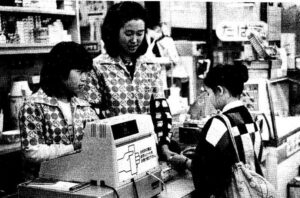
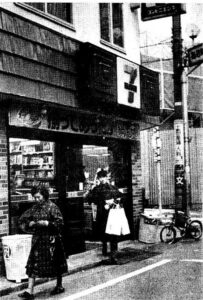
Spaces such as convenience stores which provided the same basic requirements such as consumables and a table to eat on, however, this difference between both establishments is time. Standing at a bench and eating promotes the concept of a rushed environment. It would be uncommon to remain standing at the table once the task of eating was complete. Therefore, what differentiates a social space like the teahouse to others such as the 7-eleven convenience store in Japan, cafes and restaurants around the world is that tearooms normalised the concept of occupying time rather than allowing time to become a construct of these social spaces.

((Pacific Stars and Strips, 7-Eleven is Blooming in Japan (1985) p.19))


‘The teahouse appealed to these and other city dwellers for other reasons as well. It was perhaps one of the most affordable public social spaces. For three to ten copper coins, one could easily pass two to three hours.’3

Modernity brought about a culture of speed and efficiency. Whether that was through travel, work or leisure, many places ensured quick service, disenabling people to waste time. Taking away seats within food based establishments is a product of modernity promoting a time conscious society. Therefore, the resilience of the teahouses allowed its customers to achieve something which modernity has all but erased and that is to harmonise with their surroundings. Being able to sit down and remain stationary for a period of time is perhaps why many people sought teahouses as an escape from society.


  1. North China Herold, The Typhoon at Nikko (1902) p.966-967. [↩]
  2. Qin Shao, Tempest over Teapots: The Vilification of Teahouse Culture in Early Republican China (The Journal of Asian Studies, 1998) p.1015. [↩]
  3. Qin Shao, Tempest Over Teapots: The Vilification of Teahouse Culture in Early Republican China (The Journal of Asain Studies, 1998) p.1018. [↩]

Educating Japan: How the Public Health Train was able to Meet the Demands of a Time Conscious Population.

Trains within Japan are an important factor in life because they meet cultural standards which ensure efficient time and promote a work lifestyle. However, due to how integrated trains have become in the everyday life of Japan, they have become spaces which people use for socializing and practicing social etiquette. Trains are also a vital source of advertising and educating, therefore, therefore, allowing the idea of the ‘Public Health Train’ to be established. In 1947, the public health train was used as an exhibit to educate people on issues such as nutrition, dental hygiene, and how diseases can spread. What this train also provided were details of employment within the medical field.1 This train would tour Japan, which allowed an estimated number of 900,000 people to view the exhibit and be granted a better understanding of their own health. Although this train only toured Japan for two years, it changed how space within trains can be used, not only for transportation, but as a source of vital information.

Not only was the space within the train used for education, but by placing this type of exhibit within Japanese train stations, it ensured that it was within the route of workers and students who would have perhaps missed the opportunity to view the exhibit if the exhibit had been placed elsewhere. Therefore, what can be argued is that the public health train was only successful because it met the cultural demands of Japan. By placing the exhibit within a train station, it became accessible to busy workers and students who were expected to comply with strict time schedules.

‘An impressive and colourful ceremony was held November 1 at Harajuku Station, Tokyo, Japan, in commemoration of the opening of the Public Health Train exhibits. The train then moved out to its first three-day stand at Tokyo Central Station and was host to more than 15,000 persons during this period.’2

Alisa Freedman’s Tokyo in Transit: Japanese Culture on the Rails and Road highlights what could be referred to as the waiting culture within Japanese train stations because of how accustomed people had become to using train stations as meeting points and primary methods to get to work or school.3 Therefore, what can be noted is why features such as shops, restaurants, and exhibits were normalized within this space. The notion of waiting allowed this space to be used in a way that would occupy people who were waiting.

Train stations within Japan were and still are a space that occupies perhaps the largest amount of people waiting and this is perhaps why using an exhibit within the form of a train seemed most appealing to its audience. This type of exhibit might have worked within America’s subways or Paris’s metro stations, but not as successfully as in Japan and this is because spatial factors have ensured that cities have room to accommodate the popularity of cars as a means of transport, therefore creating a decline within the usage of trains. Whereas Japan’s narrow streets disenable the prospect of cars becoming high in demand. Therefore, allowing trains, buses, and bicycles to remain the main mode of transport.

  1. Public health and welfare in Japan (1939-1949) p.77. [↩]
  2. Weekly bulletin, Supreme Commander for the Allied Powers. Public Health and Welfare Section (1947) p.7. [↩]
  3. Alisa Freedman, Tokyo in Transit: Japanese Culture on the Rails and Road (Stanford University Press, 2011) p.11. [↩]

Chinese Domestic Spaces: an analysis of how washing machines liberated women and raised living standards

The domestic space within Chinese households has changed drastically because of socialism and communism, but not all credit can be given the to the change of politics. Instead, credit must be given to the washing machine, which significantly reduced the time in which household chores took women in particular to complete. Although the introduction of the washing machine was an economic development created by the government, the extent in which it allowed women to become liberated could arguably not have been a part of the economic plan. However, consumption overpowered the gender dynamic set out within Chinese households and the washing machine and other household products such as the sewing machine and electric cooker succeeded in making households less restrictive.1

These types of changes became more common within East Asia because of the west’s consumerism influencing countries such as Japan, China and even the Philippines. These new inventions were not only taking over the world but also the domestic roles within households.  ‘The daily American newspapers, such as the Manila Daily Bulletin, Manila Times, and Cable news quickly delivered new ideas to Philippine cities through foreign products and lifestyles.’2 Change was beginning to take root within private spaces, a place which had been somewhat difficult to change through colonisation, but western products had unintentionally shifted the foundations of domestic spaces. Through the use of advertisements these western products enabled households to normalise the convenience and necessity of buy washing machines because they were labelled as sanitary and affordable.

‘The pasig river laundry is bound to go out of business. No one can afford to be without the Boss washing machine. It does the work, saves the clothes, is sanitary and economical.’3

By the 1980’s washing machines and televisions became an expected gift within wedding ceremonies because they were classed a essential products for a newly weds first home. This meant that even rural communities within China were experiencing the western influence and the extent of which this influence was modernising China. Not only that but by introducing televisions to the household, there would be no escape from advertisements. Newspapers, magazines, and televisions would become an essential product for the government to boost their economy through ensuring that people would be convinced to buy these products. However, as stated, it could be argued that the result of promoting these products was not to influence a change within the domestic space, which would shift the expectations placed on women. The washing machine was intended to benefit women and make their housework less time consuming, but the free time in which it provided enabled women to create lifestyle changes. They became restless and looked for employment and because they were able to watch television, a whole new world opened up to them.

‘The need for increased production and availability of consumer durables has been overtly linked by the political leadership to women’s liberation and to the widespread desire among the Chinese citizenry to raise their standard of living.’4

The issue that China perhaps did not predict by boosting their economy through western products was that by allowing households to purchase and watch television, they were enabling them to observe other lifestyles within different spaces throughout the world. This enabled a new demand for better living conditions and social standards. Therefore, the changes presented within the domestic space caused people to become restless because they wanted the same changes to happen outside the home. Furthermore, was even more predominant during Chinas decollectivization period which resulted in less work for villagers because of their work being mostly farm based. The lack of social activity outside of the home resorted in villagers remaining in the home. ‘Noticeably, Xiajia residents spent their increasingly abundant spare time almost entirely in their homes, either in front of the television or at a mahjong table, because there was so little to do in the community.’5 The lack of activities within communities caused households to become dependent on televisions and therefore, this enabled the influence of consumerism to take hold of households which would change not only the expectations place on gender, but also the traditional layout of Chinese homes. How they cleaned, cooked and socialised shifted because products such as the washing machine, television and electric cooker changed the dynamic of housework.

  1. Jean C. Robinson, Of Women and Washing Machines: Employment, Housework, and the Reproduction of Motherhood in Socialist China (The China Quarterly, 1985) pp.40-43. [↩]
  2. Kiyoko Yamaguchi, The New “American” Houses in the Colonial Philippines and the Rise of the Urban Filipino Elite (Philippine Studies, 2006) p.419. [↩]
  3. The Cablenews (1905) p.3. [↩]
  4. Jean C. Robinson, Of Women and Washing Machines: Employment, Housework, and the Reproduction of Motherhood in Socialist China (The China Quarterly, 1985) p.45. [↩]
  5. Yunxiang Yan, Private life Under Sosialism: Love, intimacy, and family change in a Chinese village 1949-1999 (Stanford University Press, 2003) p.29. [↩]

Tackling Tropical Climate: Understanding how diseases became the gateway to artificial climate

Eric Jennings chapter ‘Health Altitude, and Climate’ and his discussion surrounding malaria prevention methods within tropical climates brings forth another conversation regarding how contagious diseases may have been prevented within the same conditions. ‘Finding a viable escape from malaria and other tropical maladies was no trivial matter. Mortality for European soldiers and officials in Indochina remained on the order of 2 to 3 percent at the turn of the twentieth century.’1 Victims of malaria were able to be sent back to France or over to Japan, but in terms of contagious diseases other precautions would have needed to be examined. An example of this would be the bubonic plague which was a major concern for the speed in which it could spread. As Jennings argues, hot climates are a major concern for bacteria growth because they thrive within those conditions. However, the difference between these two diseases is malaria becomes a concern when those vulnerable remain within the same environment, but for the bubonic plague and other contagious diseases, the biggest concerns are formed when the infected move away from their previous environment.

Trading ships were a predominant cause of contagious diseases being spread between countries. the close compact environment creates the perfect conditions for spreading diseases. In these cases, the most common precaution was to quarantine ports and to exterminate rats. ‘Southern Metropolis is cleaning up and ridding city of rats since plague scare.’2 Therefore, these instances throughout history give rise to concern regarding enclosed and densely populated spaces, especially when these spaces encounter a lack of sanitation protocols. Exposure to mosquitoes and rats that are contained within an environment in which malaria and the bubonic plague can thrive can become a matter of life and death, therefore, climate and environment as Jennings states was a vital aspect to research in order to understand the basic necessities for being able to remain within a tropical environment.

‘The new knowledge which enabled us to obtain ideal atmospheric conditions within buildings in tropical lands will have an even more remarkable effect of the transformation of these regions.’3

This coincides with Jennings other argument which centres around artificial climate. This type of climate allowed both the indigenous and Europeans to remain within a monitored space, which enabled them to remain healthy and away from any risks. Although Jennings only focuses on malaria, artificial climate has also proven useful of contained contagious diseases because the colder climate and high altitude created the perfect environment for not only deterring mosquitoes but for pausing bacteria growth.

‘He observed that children who had never left the plateau appeared healthy, while those who had travelled beyond it were sapped by malaria.’4

These findings enabled the tropics to become liveable, while also influencing other forms of artificial climate to take root within public and private environments because of bed nets and air conditioning. ‘Captain Tyler put forward the idea for improving the condition of hot, damp air, which he showed could be done by lowering the temperature of a room below dew point; in effect, providing a hospital ward or sick room with artificial climate.’5 Therefore, examples such as this highlight the evolving understanding of tropical climate and how studying altitude and climate can improve the understanding of health and hygiene. However, Jennings also provides a downside to these artificial climates due to the interior of these space being liveable, but once the occupants moved away from these spaces, they immediately became exposed to the raw climate conditions. It meant that space was still limited within the tropic, but it is undeniable that artificial climate still managed to create safe spaces to monitor and research malaria from a distance. Therefore, although diseases delayed progress within the tropics in terms of building settlements and expanding economies, what they did provide was a breakthrough within medicine and environmental control.

  1. Eric T. Jennings, Imperial heights: Dalat and the making and undoing of French Indochina (University of California Press, 2011) p.35. [↩]
  2. The Cable News – American, Iloilo Fighting for Her Health (1912) p.3. [↩]
  3. Hong Kong Telegraph, Artificial climate (1938) p.12. [↩]
  4. Eric T. Jennings, Imperial heights: Dalat and the making and undoing of French Indochina (University of California Press, 2011) p.42. [↩]
  5. Hong Kong Daily Press, Shanghai’s Damp Atmosphere (1912) p.8. [↩]

Modern vs Traditional: Analysing sanitation efforts within China’s messy urban areas

‘China’s cities seem especially—in many respects increasingly—inhospitable to community self-determination and participation in environmental design’1

Urban Planning has proven to be difficult when accommodating a large population and according to Daniel Abramson within his article Messy Urbanism and Space for Community Engagement in China, there is a common theme of these urban areas becoming messy because of the lack of community engagement within urban development. However, to understand how messy urbanism is approached and improved, sanitation efforts enable a better insight as to how developers have been able to boost community spirt, while also cleaning up living spaces and streets. By the 1950’s China seems determined to clean up its urban spaces, and connect the public through the concept of being involved in improving sanitation together.

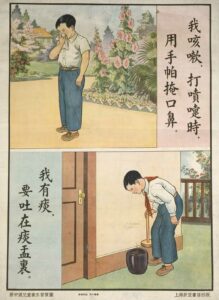
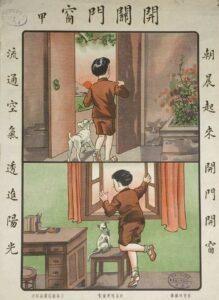
There are sanitation posters targeted at both children and adults to help them learn how to improve their hygiene and avoid the spread of diseases. These posters also provide insight towards Daniel Abramson’s argument which states that China would not follow the West in spreading out its population to smaller scale areas to avoid messy urbanism, instead he states that modernity was the point of interest rather than urbanity, and they were determined to push the cities into a modern state of living. Therefore, these posters from 1930 to 1950 show the progression of educating urban populations to enable the possibility of ridding the cities of messy urbanisation, while also allowing China to push towards its modern goal. To do this they needed social control of the population to enable these plans for larger streets and skyscraper buildings to become reality. Sanitation would change the state of minds and allow the community identity to accept the modernisation of their city. Below are two examples of how sanitisation was promoted towards children to catch germs and improve the living conditions of their homes.

Translation: I cover my mouth when I cough, and I spit into spittoon2

Translation: Let air circulate – open windows and doors in the morning3

‘Architectural chaos therefore also reflects a continuity and strength of community composition and identity. The coexistence of built-environmental disorder with community social order is extremely contradictory to the minds of professional planners and officials in China.’4

Furthermore, these plans to modernise China and allow space for wide streets and less enclosed living spaces could only go so far without demolishing Chinas traditional architecture. Instead, the traditional and modern began to coexist, which almost contradicted the idea of reducing messy urbanism. However, what can be argued is that through sanitation development and education, China improved its community values and enabled living spaces to change without changing. Those who lived within messy urban areas began to understand how to look after themselves and others to avoid spreading diseases, which would have been and still is a large concern within overpopulated areas. By regulating hygiene behaviours and introducing new sanitation protocols, messy areas could still modernise, while also being able to accommodate such a large population.

  1. Daniel Benjamin Abramson, Messy Urbanism: Understanding the “Other” Cities of Asia (Hong Kong University Press, 2016) p.218. [↩]
  2. Hygiene Education for Children (U.S National Library of Medicine, 1950) [↩]
  3. Hygiene Education for Children (U.S National Library of Medicine, 1935). [↩]
  4. Daniel Benjamin Abramson, Messy Urbanism: Understanding the “Other” Cities of Asia (Hong Kong University Press, 2016) p.225 [↩]

The Utopian vison of the Japanese Empire: An evaluation of Manchuria and Taiwan under Japanese occupation

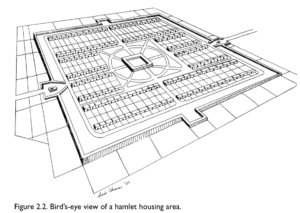
Utopian planning for large, populated spaces such as towns and cities are usually based around the idea of a booming economy and an equal social space. Utopia is usually expected to be an idea of peace and prosperity, but for Manchuria and Taiwan when they were under Japanese occupation, this idea of utopia was built on nationalism, which aimed to create a safe space for Japanese immigrants all while keeping everyone else out. David Tuckers, ‘city planning without cities’ responds to the idea of utopian space, by explaining how areas within Manchuria were planned with the concept of wide streets, sturdy housing, and well-placed sanitation efforts. However, what is interesting his analysis is that he continues on to explain that these spaces were to be created within defensible walls, all while enabling each household to have defences on hand If their ‘walled space’ were to be attacked. These walled spaces can be highlighted within the diagram bellow, which allow an understanding of just how organised these controlled spaces were.

‘Inside the wall is a ring of defensive open space, then a perimeter defensive road around the housing.’1

Therefore, what this concept of utopian spaces highlights is how much control and order has been built into urban planning. The extent of this control and order can be witnessed within the Japanese empire, especially within Manchuria and Taiwan where there was a high chance of being attacked by China or  native populations. However, the installation of control is different when comparing Manchukuo and its supposed ‘blank slate’ or ‘white page’ to the Formosa Island within Taiwan,  due to Japan having different protocols to initiate control.

‘The Japanese, after a series of struggles, lasting through several years, have eventually succeeded in putting down the disturbances; have introduced a form of government suitable to the welfare of the island people, and have effected general improvement in all directions, thus eliminating the bad social systems and encouraging good qualities of the people.’2

These utopian ideas within the Japanese empire, seem to stem from the idea of imposing Japanese qualities onto others, therefore, ensuring that the Japanese identity remains intact through not only initiating specific behaviours, but by also building spaces that would ensure that Japanese immigrants within the colonies would feel at home. These ideals were imposed all over the Japanese empire to ensure that the strength of the empire was displayed, while also ensuring that modernisation would be a quick and efficient process. The motivation behind this drive for modernising the Japanese empire is argued to be the result of competing with western powers.

 ‘Together architects used both architectural styles and new technologies to identify Japanese society as being culturally and technically sophisticated as any power.’3

Therefore utopian space became blurred and disjointed due to  the desire to be the best and most efficient nation, while also ensuring that no one could take that power away. Through both David Tucker and Bill Sewell’s texts regarding the Japanese utopian spaces, the methods in which Japan used to colonise its empire become connected despite how different Taiwan, Manchuria and Korea were, because of the ultimate goal being to create a space that complimented the Japanese identity, while also ensuring that a level of safety and control was created. However, this ultimately broke down the utopian idea of the Japanese empire, because this control highlighted the social and cultural gap between Japan and its empire, which resulted in creating a hierarchy.

  1. David Tucker, Crossed Histories: Manchuria in the Age of Empire (University of Hawaii Press, 2005) p.64. [↩]
  2. Masatomo Isoda, The Island of Formosa (1904) p.5. [↩]
  3. Bill Sewell, Constructing empire: the Japanese in Changchun, 1905-45 (UBC Press, 2019) p.75. [↩]

Home sweet home: understanding Hong Kong’s living crisis through Doreen Massey’s Time-Space theory

Hong Kong remains an interesting subject regarding its living spaces. From Kowloon’ walled city to the Yick Cheong Building, there is a collective normalisation for small living spaces, which has created a somewhat messy urbanisation. Instead of removing old buildings and building outward, places such as Yick Cheong and Kowloon have built upward and therefore, created a unique space within, which has enabled the city to be brought inside and within close proximity to the residents. Although Kowloon walled city no longer exists, Yick Cheong’s ‘monster building’ is a leading example of how living spaces for the lower’s classes have not evolved much over the past century.1

Hong Kong is a leading example of how post-modernity has created a stark contrast between classes regarding living standards. An example of these living conditions would be government files which are constantly restricting power and water within Kowloon’s walled city, not only that but there is a consistent grab for land within Kowloon and its surrounding areas throughout the late nineteenth century and into the early twentieth which highlights an unstable environment for the occupants of Kowloon.2 This lack of stability is still relevant due to the vast amount of land being bought and owned within Hong Kong, which has created a living crisis, therefore, creating the concept of ‘ cage homes’ to become normalised for the lower classes.

The reason why these specific areas have been highlighted is to strengthen Doreen Massey’s concept on time-space, which states that space cannot be studied without understanding why time is relevant. Spaces are forever changing and evolving, and they carry a history that is a never-ending formula of stories.

‘A distinction is postulated, in other words, between different types of what would normally be called time. On the one hand, there is the time internal to a closed system, where things may change yet without really changing. On the other hand, there is genuine dynamism, Grand Historical Time.’3

Hong Kong today is the picturesque of post-modernity, but depending on class, life within Hong Kong can be diverse. The confined spaces in which Kowloon’s walled city provided to its residents and how this can be compared to the Yick Cheong’s mass structure allow an understanding that power relations are still unbalanced within Hong Kong’s class system. The social structure has changed, allowing society to evolve alongside what post-modernity has provided to the economy, but within housing spaces, the cracks within the system can be observed. Living spaces for the lower classes seem to be shrinking, whereas the economy keeps on growing. The living crisis within Hong Kong today is perhaps a ripple effect from Kowloon’s walled city, which highlights that time and space coexist as one, which enables history to be studied within a specific space. Therefore, time within space exposes the progress of change or even the lack of progress.

  1. Anthony K. K. Siu, The Kowloon Walled City (Royal Asiatic Society Hong Kong Branch, 1980). [↩]
  2. T. Sercombe Smith, Water supply (1899). [↩]
  3. Doreen Massey, Space, Place and Gender (Cambridge, 1994) p.252. [↩]