Extraterritoriality or Non-territoriality: Shanghai as Seen Through the Works of David Ludwig Bloch 

In Shanghai, different populations could be subject to different legal jurisdictions within the same physical space. Following the First Opium War and the founding of the International Settlement, this resulted in extra-territorial legal and behavioral standards for foreigners in Shanghai, often to great confusion.1 Decades later, on the other side of the world, this extraterritoriality would be the saving grace for 18,000 Jewish refugees fleeing Hitler’s regime.2 Due to Shanghai’s overlapping international bureaucracies, it lacked a coherent immigration policy and system. Anyone who arrived in the city was able to enter, regardless of paperwork. Shanghai became the port of last resort.3 
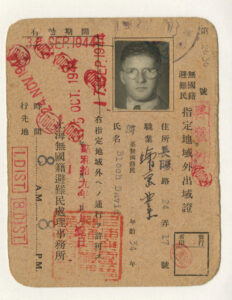
David Bloch’s Identification Card

In his memoir, Ernest Heppner wrote that “it was difficult to believe that no one asked for our papers as we passed through. . . . Hundreds of thousands of Jews in Europe were trying to find a country permitting them entry, and here  Jews  could  just  walk  ashore.” When they arrived, they were met by Jewish Shanghailanders, who brought them into an emergency shelter.4

One of the thousands entering Shanghai seeking refuge was David Ludwig Bloch. Born in 1910, David was trained at the Academy of Fine Arts in Munich. In the aftermath of the Kristallnacht and internment at the Dachau concentration camp, he immigrated to Shanghai in 1938. His detailed woodblock prints serve as perspective primary sources on the outlook of Jewish refugees in Shanghai, specifically in the Restricted Sector for Stateless Refugees5.

I will be examining two of Bloch’s woodcuts. Through the first, I aim to illustrate the internationality of the city, especially as shown by an outside viewer. The second will serve as indicative of the internal struggle felt by Bloch, as he is a person without place and subjected to limited freedom of movement by Nazi-aligned Japan. 
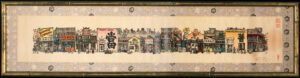
Chinese Street, David Bloch, 1945

This piece is done in the tradition of a Chinese handscroll, and appears to be mounted on silk backing. It features traditional Chinese seals in the top right. It is clear from the piece that Bloch had a strong appreciation of Chinese characters, and engaged with them significantly. Furthermore, there is an apparent appreciation for Shanghai visual aesthetics, notably in the style of trees three-quarters through the piece. Brightly colored storefronts are labeled in both English and Chinese. These stores are not only for the Chinese or foreign inhabitants, but cater to both customer bases. Other languages are notably absent. They are of various sizes and architectural styles, evoking visual interest, and creating a sense of decentralization. In the middle of the scene, above the eye doctor, buchter, and tailor, looms the Bund skyline in the distance. Above the mundane and the everyday, there are the large financial and administrative buildings, offering another side of Shanghai and creating a spatial hierarchy. The institutional buildings almost provide the image with a core, as they do the city. Further to the right, there is a “Money Exchange” above a rice shop. The scene is bustling with life. Shopkeepers clean, patrons stroll, children play, and a goose watches. From Bloch’s detailed woodcut, we are able to get a sense of vibrancy, internationality, and multi-dimensionality. It is clear that Chinese artistic styles have influenced him, and that he has gained an understanding for the city
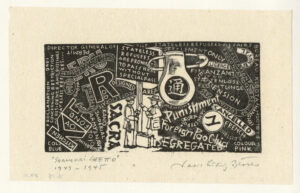
Shanghai Ghetto,  David Bloch, 1943 – 1945

With a bang, 1941 marked the occupation of Shanghai by German-aligned Japanese forces. On February 18, 1943, Jewish occupants of the city were given 3 months to relocate into the Restricted Sector for Stateless Refugees in the Hongkou area. The Shanghai Ghetto, as it was colloquially known, had poor conditions, rampant disease, and scarce food. Represented by  visual cacophony of text, the confusion and fear from this period is apparent. Out of darkness, the eye is drawn to the central figures of the woodcut. Bloch presents his pass to a guard. A t’ung, a special day pass was necessary to leave the ghetto, though they must return by 6pm6. Some words jump out of the scene – “Punishment”,  “Cancelled”,  “Foreign” and “Segregated”. They set the tone for the piece, along with the setting. “Okura” and “Ghoya” are inscribed, referring to the harsh administrators of the settlement. Ernest Heppner recounts that in encounters with them, they might be “slapped, beaten, and kicked and ran the risk of being sent to the bunker, a lice-infested jail within the police station.”7 That these figures are written by name is a testament to how involved the administrators were in the lives of the Jews in the settlement. Both Heppner and Bloch know and fear their names. “Pao Chia” refers to the civilian police force. It was a Song Dynasty Chinese institution giving municipal authorities the power to ‘draft’ able bodied men into an auxiliary police force. In the settlement, it served as a surveillance force, with the Jewish conscripts heavily monitored by Russians and Japanese, and punished if they did not report wrongdoing.8Rather than extra-territoriality, the Jewish position in Shanghai could be described as “non-territoriality”. Refugees in the settlement were “stateless” meaning they lacked the external sovereign protections attained by other foreigners. They are the inverse of the American girl who was free to come and go, and flaunt social norms ten years prior. Rather, the Jewish population under Japanese occupation is shackled.  

China Street emphasizes movement and color, while Shanghai Ghetto evokes containment and regulation. From these two pieces, we can gain insight into the perspective of Jewish refugees living in Shanghai during the Japanese occupation. The woodcuts are dense, and heavily symbolic. I have only analyzed a small fraction of the material. Further study could include a component relating the spatial aspect of the art, as well as a comparison of Jewish woodcuts with Chinese and international ones created within the same time period.

  1. Cassel, Pär. 2016. “Extraterritoriality in China.” In Treaty Ports in Modern China, edited by Robert Bickers and Isabella Jackson. Routledge. [↩]
  2. Ho, Manli. 2019. “Diplomatic Rescue: Shanghai as a Means of Escape and Refuge.” In A Century of Jewish Life in Shanghai, edited by Steve Hochstadt. Academic Studies Press. [↩]
  3. Goldstein, Jonathan. 2019. “Desperate Hopes, Shattered Dreams: The 1937 Shanghai–Manila Voyage of the ‘Gneisenau’ and the Fate of European Jewry.” In A Century of Jewish Life in Shanghai, edited by Steve Hochstadt. Academic Studies Press. [↩]
  4. Heppner, Ernest G. 1993. Shanghai Refuge : A Memoir of the World War II Jewish Ghetto. University Of Nebraska Press, 40 [↩]
  5. Rochester Institute of Technology. 2024. “InfoGuides: Deaf Art Collections: Bloch, David (Jewish American).” Rit.Edu. https://infoguides.rit.edu/deafartcollections/blotch. [↩]
  6. Rubin, Evelyn Pike. 2019. “Survival in Shanghai 1939–1947.” In A Century of Jewish Life in Shanghai, edited by Steve Hochstadt. Academic Studies Press. [↩]
  7. Heppner, Shanghai Refuge : A Memoir of the World War II Jewish Ghetto. 115 [↩]
  8. Heppner, Shanghai Refuge : A Memoir of the World War II Jewish Ghetto. 114  [↩]

Mapping Illness and Spatial Division in Hong Kong

Illness, although not the first thing that might typically come to mind when discussing spatial histories, can prove very significant in mapping patterns of settlement, social divisions, and perceptions of different public spaces. “Climate and Sanitary Condition” from The Treaty Ports of China and Japan illustrates how illness intersects with the labelling of certain spaces. “Climate and Sanitary Condition” from The Treaty Ports of China and Japan describes mid-19th-century Hong Kong from the view of the foreign inhabitants residing there. This source is fascinating for a number of reasons. At first glance, this section of the source, “Climate and Sanitary Condition,” seems to focus solely on disease, specifically detailing which illnesses befell the foreigners across their first few years of inhabitance in the British colony of Hong Kong, with the primary source citing all sorts of illnesses throughout Hong Kong, corresponding locations of said illnesses and outbreaks, and a chart denoting mortality rates among foreigners in their first eight years settling in Hong Kong. However, the meticulous mapping and logging of the specific locations of illness outbreaks serve a broader purpose. By mapping illness outbreaks to certain spots in Hong Kong, the author covertly manages to forge associations, through the use of deliberate language, characterising spaces where predominantly lower-class Hong Kong locals reside as sites of illness. These associations strengthen pre-existing racial/class divisions between foreigners and Hong Kong locals under the guise of spatial divisions. This idea is further reinforced by many other sources in mid-19th century China, like in Treaty Ports in Modern China: Law, Land and Power and The Treaty Ports of China and Japan, where foreign ideas surrounding sanitation and health oftentimes informed the spatial organisation of China’s treaty ports.

The language used to map various illnesses in “Climate and Sanitary Condition” demonstrates how perceptions of disease became paired with particular spaces, and the people who resided in those spaces. “Climate and Sanitary Condition” has a section describing the foreign-stationed soldiers who were residing amongst Hong Kong locals when there was a particularly severe outbreak of an illness, the source writes, “From all accounts, it is not easy to escape the spots of this malarious character at Hong Kong; and if it is ever to be a healthy station, our soldiers must not be housed as they have been hitherto.”1 The terminology used by the author here, describing spots in Hong Kong as possessing “malarious character”2 and later in the source describing the locality of the barracks as “unwholesome,”3 illustrates a contempt for certain spots in Hong Kong, and these certain spots are far from coincidental. The foreign soldiers of the “unwholesome” locality were stationed in the barracks of the East and West ends of town, where many lower-class Hong Kong locals resided.4 In fact, most, if not all, of the “towns” where illness is mapped throughout “Climate and Sanitary Condition” were inhabited by Hong Kong locals, usually “among the lower classes.”5

Due to the large emphasis placed on mapping illness, sanitation became a big priority in areas occupied by foreigners, as a means to combat the areas marked by illness. Specific language in source passages in “Climate and Sanitary Condition” demonstrate just how much sanitation was prioritised. In Bickers and Jackson’s Treaty Ports in Modern China: Law, Land and Power, it is explained that sanitation played a big role in the organisation of foreign spaces within China’s treaty ports. Significantly, this mention of sanitation was centred in the foreign concession, again illustrating spatial separation between foreigners and locals in the treaty ports. Bickers and Jackson write that treaty-port municipal authorities in China employed “public health officials” and attempted to construct “a suitable system for sanitation in the concession.”6 An emphasis on sanitation in the foreign concession does not mean a lack of sanitation in local areas by any means; the significance here has more to do with the emphasis and importance placed on sanitation and how significant this concept was to foreigners. This illustrates that both in the treaty ports and in cities like Hong Kong, when something was deemed sanitary or needing to be sanitised, it was reliably associated with foreigners. Associative wording is of the utmost significance here, as putting so much emphasis on sanitation in foreign spaces creates a connotation of “sanitary” and “healthy” in specific relation to the foreigners. Contrasting that with the aforementioned descriptions of local spaces as “unwholesome” and having “malarious character,” there appears to be quite a harsh divide between locals and foreigners and what attributes or associations they have been given.

A large idea in aforementioned primary source passages is how certain spaces were “marked” with certain illness. Though this is evident throughout “Climate and Sanitary Condition,” it is not exclusive to Hong Kong foreigners and their perceptions of Hong Kong locals. In Henriot’s “The Shanghai Bund in Myth and History: An Essay through Textual and Visual Sources,” Henriot wrote about the renaming of Chinese street names with French figures in Shanghai’s French Concession, demonstrating that colonial separatism from Chinese locals was produced through terminology, where language was able to “mark” spaces in a way that imbues a real association with a place.7 This is arguably the same method of separatism through terminology as seen in the “Climate and Sanitary Condition” section of The Treaty Ports of China and Japan, prompting the question: was the practice of foreigners labelling or “marking” of local spaces commonplace across China in the mid-19th century? Was the practice of “marking” through language predominantly negative in connotation? Or, is this just a small sample of foreigners describing local spaces, not indicative of the opinions of the larger foreign population that inhabited China? Nevertheless, it is interesting to see the role of associative language in both Hong Kong and treaty ports in China.

Ultimately, in The Treaty Ports of China and Japan, the sections regarding illness and sanitation were as they appeared to be. The Treaty Ports of China and Japan was not useful providing empirical evidence through the logging and mapping of illnesses in mid-19th-century Hong Kong; instead, the writing on illness revealed more about the social perspectives, class divisions between Hong Kong locals and foreigners, and how language reinforced spatial separation between them.

  1. Nicholas Belfield Dennys, ed., The Treaty Ports of China and Japan: A Complete Guide to the Open Ports of Those Countries, Together with Peking, Yedo, Hongkong and Macao (London: Trübner and Co., 1867), 32. [↩]
  2. Dennys, Treaty Ports of China and Japan, 32. [↩]
  3. Dennys, Treaty Ports of China and Japan, 33. [↩]
  4. Dennys, Treaty Ports of China and Japan, 33. [↩]
  5. Dennys, Treaty Ports of China and Japan, 34. [↩]
  6. Robert Bickers and Isabella Jackson, eds., Treaty Ports in Modern China: Law, Land and Power (London: Routledge, 2016), 3. [↩]
  7. Christian Henriot, “The Shanghai Bund in Myth and History: An Essay through Textual and Visual Sources,” Journal of Modern Chinese History 4, no. 1 (2010): 5–6. [↩]

Shanghai extraterritoriality during the Second Sino-Japanese War

I have identified two primary sources pertaining to the treaty ports and extraterritoriality. Both concern Shanghai’s International Settlement during China’s war with Japan in the 1930s and 1940s. Taken together, they open up interesting avenues of inquiry into the ways in which Western extraterritoriality in the city was disrupted and how it negotiated the threat—and, later, the reality—of occupation by the forces of Imperial Japan. Specifically, it shows how the concessions initially served as havens from the Japanese invasion, in contrast to the surrounding occupied territory, before later becoming contested spaces in which extraterritorial jurisdictions came into complex interaction with the invading Japanese authorities.

The first source—an article in the Far Eastern Review written by its editor, C. J. Laval—illustrates how Shanghai’s pseudo-colonial power dynamics were inscribed onto the urban landscape through the spatial arrangements of the foreign concessions which created this unique safe haven in the early stages of the Sino-Japanese War. Dating from November 1937, towards the end of the Battle of Shanghai, the article, entitled “How to End the War”, offered the author’s own assessment of the prospects for China’s war against the invading Japanese. Despite praising the valour of Chinese soldiers and the resolve of the nation, Laval urged China to enter into negotiations with Japan in the hope of securing a more favourable settlement, rather than relying futilely on a war of attrition or on international intervention.1 Yet the aspect of his article that I find particularly intriguing is his description of the foreign settlements in Shanghai, with which he chose to open his discussion:

“…some semblance of the former busy appearance of the streets has been restored in the French Concession and in that portion of the International Settlement south of Soochow Creek where the shops, the theaters and the dance halls have reopened, transportation services again are operating and the familiar throngs of Chinese crowd thoroughfares and narrow passages to all intent and appearance indifferent to the encirclement of Japanese bayonets around the entire area that now is under Japanese military domination”2

At the time of writing, Japan had not yet entered into war with the Western powers and had therefore not occupied the International Settlement or the French Concession following its conquest of Shanghai. Indeed, it is a well-known folkloric story in China that the numerous residents of the International Settlement, Chinese included, quite literally watched the Japanese offensive against the Chinese garrison at Sihang Warehouse from across the Suzhou Creek. Laval’s account thus offers an intriguing perspective on the coexistence of Western extraterritoriality and Japanese military presence in Shanghai before December 1941. Writing of the Bund, the emblematic space of the International Settlement, Jeremy Taylor described it as a “spatial reminder of an entire social system and lifestyle that came to East Asia”.3 In Laval’s article, the stark juxtaposition between the prosperity and tranquillity of the foreign-administered areas and the warfare ravaging the rest of Shanghai testifies to the continued existence not only of such a distinctive social system, but also of its spatial manifestation. Yet, for all the security afforded by extraterritoriality, it was now accompanied — and perhaps somewhat unsettled — by the burgeoning military presence of the hitherto formidable Japanese Empire. Laval’s text therefore provides a useful vantage point from which to ask not simply how the separate jurisdictions of Shanghai were maintained, but how they were experienced and negotiated within a devastating yet geographically confined theatre of warfare, particularly from a spatial perspective. An overarching line of inquiry consequently presents itself: to what extent were the foreign concessions truly unperturbed by the Japanese presence around them? More crucially, a series of spatial questions follows. The communication and exchange between the concessions and the world beyond them — especially at their borders — would make for an interesting subject of study. And, turning towards people’s interaction with and production of space, how might the meanings and significance attached to particular spaces within the concessions have changed amidst the Japanese incursion? Building upon Taylor’s study of the Bund, it would be interesting to examine how the waterfront’s significance, both as a stage upon which military power could be displayed and as a safe and leisurely space for civilian activity, may have been influenced and disrupted during this period.4 Similar examinations of spatial re-imaginings could be extended more broadly to the various meanings attached to the foreign settlements: as spaces of privilege, security, domination, confidence, and, indeed, home.

Naturally, this inquiry can be extended to the period after 1941, when full-scale warfare broke out between Japan and the Allies, where the existing spatiality was disrupted and complicated by Japanese takeover of the concessions. The second source I have encountered is the minute of a special meeting of the Council held on 8 December 1941. The minute clearly reveals the difficult task confronting the American and British members of the Council as they attempted to balance their duties as citizens of their respective countries with their responsibilities as officials of the Shanghai Municipal Council.5 As Japan annexed the French Concession and the International Settlement of Shanghai, it nevertheless sought to preserve and work through the existing administrative structure of the Shanghai Municipal Council. The indecision that appears to haunt the councillors thus reflects a broader administrative ambivalence in Shanghai after 1941: the city had formally come under full Japanese control, yet its existing administrative machinery was preserved and expected to cooperate with the new regime. How this spatial reconfiguration of the city unfolded within such a novel and intricate political milieu consequently begs investigation. How did the SMP administer the city under Japanese authority? Was a new urban plan envisaged by its new rulers? Now that their former sanctuary had fallen under the control of another Asian Empire, how was the spatiality of the Shanghai concessions — supposedly a place of privilege and even seclusion from the indigenous world — re-imagined by the Westerners who remained there?

All of this remains, admittedly, highly rudimentary. Taken together, however, these ideas point towards a general direction for potential research: the disruption, reinvention and perhaps also preservation of spatiality in the context of both extraterritoriality and warfare and political change. Such an inquiry would also approach spatiality with a particular human focus, examining not merely physical landscapes and urban layouts, but the ways in which different groups of people conceptualised, experienced, interacted with and manipulated them. For this purpose, the online access to a vast array of historical sources—including newspapers, reports, books, maps and photographs—made available through Virtual Shanghai and the Internet Archive could prove particularly valuable. This, I hope, might provide the starting point for something genuinely exciting.

  1. C. J. Laval, ‘How to End the War’, The Far Eastern Review, Shanghai, 11 November, pp. 375-376, [accessed 20 September 2026] [↩]
  2. Ibid. [↩]
  3. Jeremy Taylor, ‘The Bund: Littoral Space of Empire in the Treaty Ports of East Asia’, Social History, 27:2 (2002), p. 125. [↩]
  4. Ibid., pp. 132-140. [↩]
  5. “At the Special Meeting of the Council held on Monday, December 8, 1941, at 4.30 p.m” in Shanghai Municipal Council, The minutes of the Shanghai Municipal Council – 1940-1943 (Shanghai, 2001), pp. 354-355. [↩]