For an American Audience: Manchuria, Wild West of the Far East


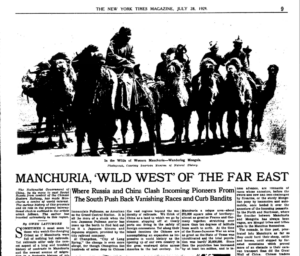
Owen Lattimore was born in 1900 to English teachers, and he grew up in American settlements in China, specifically Shanghai, Baodingfu, and Beijing.1 He would go on to be an eminent sinologist. In 1929 he wrote the New York Times article, Manchuria, Wild West of the Far East.  His lived experience is reflected in his writing, “We think of China as a land to which we go by steamer, stopping off at treaty ports and living in the safety of foreign concessions.”2 In this work, he rhetorically makes Chinese settlement legible to New York Times readers through the lens of American westward expansion. He is not only engaging with the American audience, but simultaneously legitimizes the settlement of Manchuria internationally as a vehicle for progress and modernity.  However, his lack of mention of Japanese involvement in the opium trade exposes the selectivity of this narrative, revealing pitfalls in using foreign accounts as source material.

Though 20th century Manchuria was fundamentally Chinese territory, both Russia and Japan had large foreign concessions and populations due to their construction of the Chinese Eastern Railway and Southern Manchurian Railway, respectively. So much so that Lattimore writes, “A traveler going through Manchuria by rail might well think he was passing through three countries.” To an American, this means that in Changchun, you will not be met with “Chinese coolies” but rather, a “stalwart bearded, white-aproned Russian porters”, and in Mukden, a “neat Japanese Pullman porter” will lay out “Japanese slippers”. He uses service workers as a tangible way to communicate the internationality of the region.3

He connects his reporting to issues that Americans care about. The meeting of “Russia and China” in Manchuria has the potential to affect geopolitics. Unless the two countries can “come to an agreement about limits of expansion and colonization, then Manchuria will once more be the pivot of war and invasion.” Japan is mentioned throughout the article in a commercial and modern sense, their “enterprise and efficiency” is emphasized. But ironically, they are not included in the geopolitical analysis.3

The narrative established by Lattimore of railway modernity dominating over tribalism and lawlessness is undercut by his reporting on opium. He writes that “railroads and international rivalries have turned several Manchurian “rackets” into big business”. He writes that pioneers are pressured by bandits that have “universally become known as Hunghutze, or Redbeards” to grow opium, which is then “smuggled [by bandits] in every conceivable way, even in the heating pipes of passenger trains”.3 I was not able to find a source to corroborate drug deception through heating pipes. Though he is not incorrect that bandits or natives posed a serious threat to settlement, the main vehicle in Manchuria for opium and smuggling was the Japanese empire itself. A New York Times article from Feb. 14, 1919 circulated a charge that the Japanese smuggled opium into China through their control of the South Manchurian railway. Under Japanese extraterritoriality, even prior to the Manchurian Incident 1931, “no Japanese can be arrested without informing the consulate.”4 However,  this would disrupt the narrative being painted by Lattimore of railway civilization inserting itself into uncivilized lands. The railway did not simply replace the supposedly lawless frontier with an ordered, modern society, but facilitated new forms of exploitation and illicit economic activity.

The article thus falls within a large group of literature either consciously or unconsciously perpetuating colonial civilizing justifications, while being historically flawed and incomplete. For instance, the 1900s to the 1920s Japanese “bazoku” or “bandit” literature used masculine bandit figures to intellectually transform Manchuria into a Japanese frontier for conquest5. Modern ‘Kimchi Westerns’, mostly by Korean studios, such as the Good, the Bad, and the Weird (2008), and Netflix original series Song of the Bandits (2023) portray Manchuria as a lawless territory undergoing modernisation. Both heavily feature railways as avenues for this change, and to say they lack historical precision is perhaps an understatement.


  1. https://academic.oup.com/oxford-dictionary-of-national-biography/reference/63486/reference-article-abstract/580946462?redirectedFrom=fulltext#580946462 [↩]
  2. https://www.nytimes.com/1929/07/28/archives/manchuria-wild-west-of-the-far-east-where-russia-and-china-clash.html [↩]
  3. Ibid. [↩] [↩] [↩]
  4. https://www.nytimes.com/1919/02/14/archives/charge-that-japan-aids-opium-trade-sends-morphia-into-china-and.html [↩]
  5. https://www.cambridge.org/core/journals/modern-asian-studies/article/making-manchuria-japans-frontier-the-bazoku-fantasy-and-imperial-masculinity-1900s1920s/BBF0A932AEE726AC40CA3FB07DADA2A6 [↩]
“So typical of the East”: Analysis of a Chinese Physician’s Memoir

In the 19th and 20th century, shifting sanitation responsibilities led to an extension of colonial space. As explored by Brenda Yoeh, in this sense, administrators become Foucultian “specialists of space”, as they negotiate displacement, hygiene, and co-existence between peoples.1 In the case of the Manchurian plague, preservation of health ceased to be an individual care, and moved into the sphere of international concern. Dr. Wu Lien-teh’s 1959 memoir, Plague Fighter: The Autobiography of a Modern Chinese Physician, offers an in-depth glimpse into attitudes towards sanitation during the Manchurian Plague outbreak of 1910-11. Sanitary discourse of the period was not a simple divide between Western and Chinese medical populations, but rather, strongly impacted by those carrying dual identities, being simultaneously West and the Rest. 

Dr. Wu Lien-teh’s background complicates the distinction between ‘Western’ and ‘Chinese’ medical authority. He was born in Penang, British Malaya in 1879, and became the first Chinese descendant to attend Cambridge. 2 He describes himself as “Chinese”, specifically Cantonese from Sin-ning,3 Dr. Wu was a product of the medical hierarchy of his era, and often dismissed the agency and humanity of the Chinese laborers he was meant to represent. He is not a representative for all Chinese doctors of the period, but provides an example of Western ideologies bleeding into medical procedure and verbiage of the time. 

Dr. Wu’s descriptions of Chinese laborers reproduce negative psychological stereotypes. Of the Chinese laborers who had potentially been exposed to the plague, he reported an “apathy or a fatalism, so typical of the east”4 He does not acknowledge that their agency is being stripped from them in forceful quarantine. Rather, he describes them as simply giving up. When faced by a plague that has wiped out villages, and has a “100%” casualty rate,5 fatalism appears to be a perfectly rational emotional reaction. Dr. Wu is transforming a normal psychological reaction into a negative reflection on the region as a whole. 

Dr. Wu holds Chinese medical practices to contradictory standards. In reference to simple acts of sweeping and cleansing homes, he states that “the less-educated peoples of Asia had great, if ill-founded, faith in such measures during epidemics.”6 The dismissal of Chinese attempts to maintain cleanliness and order in their homes is made ironic when paired with the contemporary medical rhetoric blaming the Chinese for the ‘filth’ of their living.7 Dr. Wu espouses that a less-than-pristine hospital resembled the “corner of old backward China.” He criticizes it for “abundance of cobwebs”, and chairs that had not been “dusted for days.”8 Though he acknowledges that such measures were ‘ineffectual’ against stopping plague, he still demonizes the Chinese hospital for its backwardness, and yet cites cleaning measures as evidence of a less ‘advanced’ cultural psyche. His account simultaneously condemns cleanliness in the face of plague as irrational, while pointing to neglected spaces as evidence of inferior medical treatment. 

Dr. Wu’s adoption of imperial attitudes towards the Chinese laborers affected by the plague was not monolithic within Western educated Chinese doctors. Western medical education did not necessarily lead to acceptance of Western medical hegemony. Dr. Ho Kai, a prominent figure in fighting the plague in Hong Kong at the end of the 19th century was educated at Aberdeen University, and yet remained a strong advocate of the Chinese community in Hong Kong. He criticized the recommended burning of Chinese neighborhoods, and the forced isolation of them in hospital ships.9 Western medical training could coexist with a commitment to Chinese interests. 

Plague Fighter: The Autobiography of a Modern Chinese Physician, complicates supposed power relations between Western medical authorities and Chinese subjects. Dr. Wu’s descriptions of laborers as fatalistic and of his country as backward reveal the extent that these attitudes permeated medical discourse. He frequently adopts frameworks used to judge the Chinese population, and their actions as ‘typical of the East’ as a whole. A brief comparison to Ho Kai reveals that this attitude was not inevitable, and that Western educated Chinese doctors occupied varying realms of Western hegemony vs. Chinese advocacy. Boundaries between Western and Chinese medical thought were not simply defined along national or racial lines, but muddled by pervasive imperial dogma. The distinction between East and West in Dr. Wu’s memoir is not simply geographical, but ideological. 

  1. Yeoh, Brenda S. A. 2003. Contesting Space in Colonial Singapore. NUS Press. 86 [↩]
  2. Elle, Ning. 2015. “Remembering ‘Plague Fighter’ Dr Wu Lien-Teh.” Saw Swee Hock School of Public Health, January 16. https://sph.nus.edu.sg/news/remembering-plague-fighter-dr-wu-lien-teh [↩]
  3. Wu, Liande. 1959. Plague Fighter: The Autobiography of a Modern Chinese Physician. Cambridge: W. Heffer & Sons Ltd. 7 )) as well as a “British subject”. (( Ibid. 15 [↩]
  4. Ibid. 18 [↩]
  5. Ibid. 27 [↩]
  6. Ibid 13 [↩]
  7. Sutphen, Mary. “Not What, but Where: Bubonic Plague and the Reception of Germ Theories in Hong Kong and Calcutta, 1894–1897.” Journal of the History of Medicine and Allied Sciences 52, no. 1 (1997): 81–113. https://www.jstor.org/stable/24624205. [↩]
  8. Wu, 1959 8 [↩]
  9. Sutphen, 1997 [↩]

Urban Planning, Space-time, and the Kowloon Clock Tower

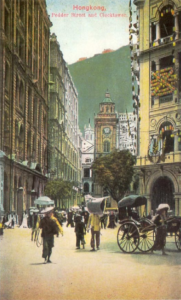
Placement and replacement of Hong Kong’s clock tower provides a case study in the changing relationship between urban space, colonial power, and standardized time.  The first clock tower in Hong Kong was built in 1862 at the junction of Peddler Street and Queen’s Road, two critical thoroughfares. As transportation needs increased, it was replaced and served as part of the Tsim Sha Tsui railway station. I will analyze these placements within the urban fabric of Hong Kong, and use them as evidence of the way that time was interpreted. 

Doreen Massey argues that space should be thought of in conjunction with time, in that space is constructed through social relations, which are inherently dynamic1.  The rapid proliferation of clock towers across the British Empire could, then, be thought of as an extreme example of space-time imperialism. Massey’s arguments help us to understand the way in which relations between colonial powers can impact the organization of a space, and associated temporal practices. Wen-hsin Yeh focuses on this, in her analysis of the Shanghai Bund, exploring the ways that a strict time-based system ultimately informed power dynamics and the economic shift towards capitalism2 . Similarly, Giordano Nanni’s monograph, The Colonization of Time, focuses on the imposition of British timekeeping onto indigenous populations in South Africa and Australia3. These studies provide a framework for my examination of the Hong Kong clocktower in space, as time. 

In 1843, Governor of Hong Kong, Henry Pottinger appointed Alexander Gordon as the Land Officer, Surveyor and Inspector of Roads of Hong Kong. He was tasked with the laying out of city infrastructure. Queen’s Road was established as the city’s main thoroughfare, acting as a belt around the city and as a boundary marker between racial residential zones. The Governor’s residence was placed at the starting point of Queen’s Road, creating a line of power into the city4. The colonial elite had a shared interest in standardized time. The tower was constructed as a public good, and time-keeping became a shared experience for those near it. It was placed directly in the junction of Peddler Street and Queen’s Road, thus making it widely visible for the foreign community, and unavoidable in daily life. The timepiece was a symbol of European establishment in the city, and its construction indicates the need for the foreign community to have a centralized and standardized time. This visible insertion should not be taken as universal acceptance, or even acknowledgement, but rather the way that time-relations within the foreign community manifested materially. 

Postcard showing Peddler Street and the Hong Kong Clock Tower, early 1900’s5

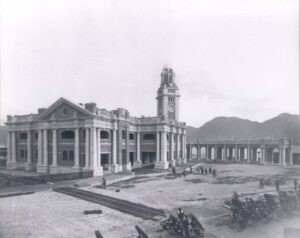
Eventually, with the proliferation of automobiles, having a massive tower in the street became cumbersome, and in 1913 it was demolished. A replacement tower was constructed at Tsim Sha Tsui as part of the new railway station.6Tsim Sha Tsui was already a transportation hub. Arthur Benison Hubback, a prominent army officer and architect in British Malaya was chosen to design the new terminus for the newly finished Kowloon–Canton Railway6. We should not overlook his history and role in empire, as they informed his architectural decisions. The significance of the placement lies in its incorporation into the wider transportation network. Rather than being a standalone, crowd funded obstruction, the clock tower becomes part of the regional infrastructure. As the tallest point on the shore, the tower physically asserted the dominance of time over the area. Incoming ships might see the clocktower, and understand that they were operating under the rule of imperial time, as well as imperial space. The stately Roman columns recall antiquity. Visually, the clocktower not only represents progress and modernity, but also refers to the distinctly European grandeur of a classical age. The Chinese living in Hong Kong are placed within a power-geometry favoring imperial time, a reminder even in the train station providing a link to the rest of China7.

Kowloon-Canton Terminus Station, Hong Kong (1916)8

Successive placements of Hong Kong’s clock tower reveal a changing relationship between standardized time, colonial space, and the wider world, as well as the spatial and temporal attitude within the foreign community of Hong Kong. On Peddler Street, time was made to be geographically at the center of the foreign community’s lives. At Tsim Sha Tsui, it became visibly part of transportation networks, and widely visible to visitors. The transformation helps to illustrate Massey’s argument that space is continually and relationally produced, and acts as a case study informing the wider literature regarding the proliferation of imperial time. 

In 1978, the train station was demolished. The clocktower was left standing, and today can be viewed as a vestige of imperial times. 

  1. Massey, Doreen. 1994. Space, Place and Gender. University of Minnesota Press. 9 [↩]
  2. Yeh, Wen-Hsin. 2007. Shanghai Splendor : Economic Sentiments and the Making of Modern China, 1843-1949. University of California Press. [↩]
  3. Nanni, Giordano. 2020. The Colonisation of Time. Manchester University Press. [↩]
  4. Ho, Pui-yin. 2018. “Duality in Planning (1841–1898).” Www.Elgaronline.Com, Edward Elgar Publishing, September 28. https://www.elgaronline.com/monochap/9781788117944/chapter01.xhtml. )). The Peddler Street Clocktower, erected in 1862, disrupted this line of power. It was funded through public subscription, as well as by a large donation from a Scottish watchmaker (( Chan, Catherine S. 2018. “Belonging to the City: Representations of a Colonial Clock Tower in British Hong Kong.” Journal of Urban History 45 (2): 321–32. https://doi.org/10.1177/0096144218769894. [↩]
  5. Valery M. Garrett, Hong Kong: Life and Times (Singapore, 1996), 120. via Chan, Catherine S. 2018. “Belonging to the City: Representations of a Colonial Clock Tower in British Hong Kong.” Journal of Urban History 45 (2): 321–32. https://doi.org/10.1177/0096144218769894. [↩]
  6. Ibid. [↩] [↩]
  7. Massey, Doreen. 2005. For Space. Sage. 183 [↩]
  8. The A B Hubback Project. 2021. “KOWLOON-CANTON TERMINUS | The A B Hubback Project.” https://www.abhubback.com/kowlooncantonterminushongkong. [↩]

Extraterritoriality or Non-territoriality: Shanghai as Seen Through the Works of David Ludwig Bloch 

In Shanghai, different populations could be subject to different legal jurisdictions within the same physical space. Following the First Opium War and the founding of the International Settlement, this resulted in extra-territorial legal and behavioral standards for foreigners in Shanghai, often to great confusion.1 Decades later, on the other side of the world, this extraterritoriality would be the saving grace for 18,000 Jewish refugees fleeing Hitler’s regime.2 Due to Shanghai’s overlapping international bureaucracies, it lacked a coherent immigration policy and system. Anyone who arrived in the city was able to enter, regardless of paperwork. Shanghai became the port of last resort.3 

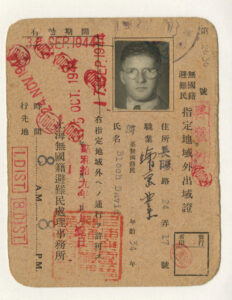
David Bloch’s Identification Card

In his memoir, Ernest Heppner wrote that “it was difficult to believe that no one asked for our papers as we passed through. . . . Hundreds of thousands of Jews in Europe were trying to find a country permitting them entry, and here  Jews  could  just  walk  ashore.” When they arrived, they were met by Jewish Shanghailanders, who brought them into an emergency shelter.4

One of the thousands entering Shanghai seeking refuge was David Ludwig Bloch. Born in 1910, David was trained at the Academy of Fine Arts in Munich. In the aftermath of the Kristallnacht and internment at the Dachau concentration camp, he immigrated to Shanghai in 1938. His detailed woodblock prints serve as perspective primary sources on the outlook of Jewish refugees in Shanghai, specifically in the Restricted Sector for Stateless Refugees5.

I will be examining two of Bloch’s woodcuts. Through the first, I aim to illustrate the internationality of the city, especially as shown by an outside viewer. The second will serve as indicative of the internal struggle felt by Bloch, as he is a person without place and subjected to limited freedom of movement by Nazi-aligned Japan. 

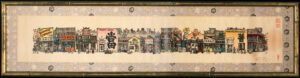
Chinese Street, David Bloch, 1945

This piece is done in the tradition of a Chinese handscroll, and appears to be mounted on silk backing. It features traditional Chinese seals in the top right. It is clear from the piece that Bloch had a strong appreciation of Chinese characters, and engaged with them significantly. Furthermore, there is an apparent appreciation for Shanghai visual aesthetics, notably in the style of trees three-quarters through the piece. Brightly colored storefronts are labeled in both English and Chinese. These stores are not only for the Chinese or foreign inhabitants, but cater to both customer bases. Other languages are notably absent. They are of various sizes and architectural styles, evoking visual interest, and creating a sense of decentralization. In the middle of the scene, above the eye doctor, buchter, and tailor, looms the Bund skyline in the distance. Above the mundane and the everyday, there are the large financial and administrative buildings, offering another side of Shanghai and creating a spatial hierarchy. The institutional buildings almost provide the image with a core, as they do the city. Further to the right, there is a “Money Exchange” above a rice shop. The scene is bustling with life. Shopkeepers clean, patrons stroll, children play, and a goose watches. From Bloch’s detailed woodcut, we are able to get a sense of vibrancy, internationality, and multi-dimensionality. It is clear that Chinese artistic styles have influenced him, and that he has gained an understanding for the city

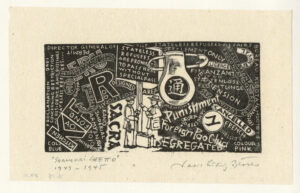
Shanghai Ghetto,  David Bloch, 1943 – 1945

With a bang, 1941 marked the occupation of Shanghai by German-aligned Japanese forces. On February 18, 1943, Jewish occupants of the city were given 3 months to relocate into the Restricted Sector for Stateless Refugees in the Hongkou area. The Shanghai Ghetto, as it was colloquially known, had poor conditions, rampant disease, and scarce food. Represented by  visual cacophony of text, the confusion and fear from this period is apparent. Out of darkness, the eye is drawn to the central figures of the woodcut. Bloch presents his pass to a guard. A t’ung, a special day pass was necessary to leave the ghetto, though they must return by 6pm6. Some words jump out of the scene – “Punishment”,  “Cancelled”,  “Foreign” and “Segregated”. They set the tone for the piece, along with the setting. “Okura” and “Ghoya” are inscribed, referring to the harsh administrators of the settlement. Ernest Heppner recounts that in encounters with them, they might be “slapped, beaten, and kicked and ran the risk of being sent to the bunker, a lice-infested jail within the police station.”7 That these figures are written by name is a testament to how involved the administrators were in the lives of the Jews in the settlement. Both Heppner and Bloch know and fear their names. “Pao Chia” refers to the civilian police force. It was a Song Dynasty Chinese institution giving municipal authorities the power to ‘draft’ able bodied men into an auxiliary police force. In the settlement, it served as a surveillance force, with the Jewish conscripts heavily monitored by Russians and Japanese, and punished if they did not report wrongdoing.8Rather than extra-territoriality, the Jewish position in Shanghai could be described as “non-territoriality”. Refugees in the settlement were “stateless” meaning they lacked the external sovereign protections attained by other foreigners. They are the inverse of the American girl who was free to come and go, and flaunt social norms ten years prior. Rather, the Jewish population under Japanese occupation is shackled.  

China Street emphasizes movement and color, while Shanghai Ghetto evokes containment and regulation. From these two pieces, we can gain insight into the perspective of Jewish refugees living in Shanghai during the Japanese occupation. The woodcuts are dense, and heavily symbolic. I have only analyzed a small fraction of the material. Further study could include a component relating the spatial aspect of the art, as well as a comparison of Jewish woodcuts with Chinese and international ones created within the same time period.

  1. Cassel, Pär. 2016. “Extraterritoriality in China.” In Treaty Ports in Modern China, edited by Robert Bickers and Isabella Jackson. Routledge. [↩]
  2. Ho, Manli. 2019. “Diplomatic Rescue: Shanghai as a Means of Escape and Refuge.” In A Century of Jewish Life in Shanghai, edited by Steve Hochstadt. Academic Studies Press. [↩]
  3. Goldstein, Jonathan. 2019. “Desperate Hopes, Shattered Dreams: The 1937 Shanghai–Manila Voyage of the ‘Gneisenau’ and the Fate of European Jewry.” In A Century of Jewish Life in Shanghai, edited by Steve Hochstadt. Academic Studies Press. [↩]
  4. Heppner, Ernest G. 1993. Shanghai Refuge : A Memoir of the World War II Jewish Ghetto. University Of Nebraska Press, 40 [↩]
  5. Rochester Institute of Technology. 2024. “InfoGuides: Deaf Art Collections: Bloch, David (Jewish American).” Rit.Edu. https://infoguides.rit.edu/deafartcollections/blotch. [↩]
  6. Rubin, Evelyn Pike. 2019. “Survival in Shanghai 1939–1947.” In A Century of Jewish Life in Shanghai, edited by Steve Hochstadt. Academic Studies Press. [↩]
  7. Heppner, Shanghai Refuge : A Memoir of the World War II Jewish Ghetto. 115 [↩]
  8. Heppner, Shanghai Refuge : A Memoir of the World War II Jewish Ghetto. 114  [↩]