Placement and replacement of Hong Kong’s clock tower provides a case study in the changing relationship between urban space, colonial power, and standardized time. The first clock tower in Hong Kong was built in 1862 at the junction of Peddler Street and Queen’s Road, two critical thoroughfares. As transportation needs increased, it was replaced and served as part of the Tsim Sha Tsui railway station. I will analyze these placements within the urban fabric of Hong Kong, and use them as evidence of the way that time was interpreted.
Doreen Massey argues that space should be thought of in conjunction with time, in that space is constructed through social relations, which are inherently dynamic1. The rapid proliferation of clock towers across the British Empire could, then, be thought of as an extreme example of space-time imperialism. Massey’s arguments help us to understand the way in which relations between colonial powers can impact the organization of a space, and associated temporal practices. Wen-hsin Yeh focuses on this, in her analysis of the Shanghai Bund, exploring the ways that a strict time-based system ultimately informed power dynamics and the economic shift towards capitalism2 . Similarly, Giordano Nanni’s monograph, The Colonization of Time, focuses on the imposition of British timekeeping onto indigenous populations in South Africa and Australia3. These studies provide a framework for my examination of the Hong Kong clocktower in space, as time.
In 1843, Governor of Hong Kong, Henry Pottinger appointed Alexander Gordon as the Land Officer, Surveyor and Inspector of Roads of Hong Kong. He was tasked with the laying out of city infrastructure. Queen’s Road was established as the city’s main thoroughfare, acting as a belt around the city and as a boundary marker between racial residential zones. The Governor’s residence was placed at the starting point of Queen’s Road, creating a line of power into the city4. The colonial elite had a shared interest in standardized time. The tower was constructed as a public good, and time-keeping became a shared experience for those near it. It was placed directly in the junction of Peddler Street and Queen’s Road, thus making it widely visible for the foreign community, and unavoidable in daily life. The timepiece was a symbol of European establishment in the city, and its construction indicates the need for the foreign community to have a centralized and standardized time. This visible insertion should not be taken as universal acceptance, or even acknowledgement, but rather the way that time-relations within the foreign community manifested materially.
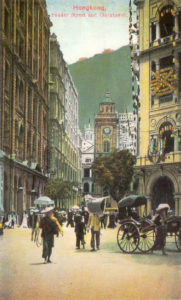
Postcard showing Peddler Street and the Hong Kong Clock Tower, early 1900’s5
Eventually, with the proliferation of automobiles, having a massive tower in the street became cumbersome, and in 1913 it was demolished. A replacement tower was constructed at Tsim Sha Tsui as part of the new railway station.6Tsim Sha Tsui was already a transportation hub. Arthur Benison Hubback, a prominent army officer and architect in British Malaya was chosen to design the new terminus for the newly finished Kowloon–Canton Railway6. We should not overlook his history and role in empire, as they informed his architectural decisions. The significance of the placement lies in its incorporation into the wider transportation network. Rather than being a standalone, crowd funded obstruction, the clock tower becomes part of the regional infrastructure. As the tallest point on the shore, the tower physically asserted the dominance of time over the area. Incoming ships might see the clocktower, and understand that they were operating under the rule of imperial time, as well as imperial space. The stately Roman columns recall antiquity. Visually, the clocktower not only represents progress and modernity, but also refers to the distinctly European grandeur of a classical age. The Chinese living in Hong Kong are placed within a power-geometry favoring imperial time, a reminder even in the train station providing a link to the rest of China7.
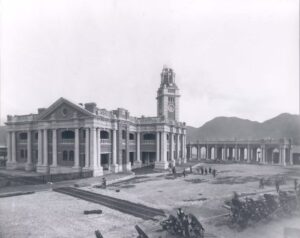
Kowloon-Canton Terminus Station, Hong Kong (1916)8
Successive placements of Hong Kong’s clock tower reveal a changing relationship between standardized time, colonial space, and the wider world, as well as the spatial and temporal attitude within the foreign community of Hong Kong. On Peddler Street, time was made to be geographically at the center of the foreign community’s lives. At Tsim Sha Tsui, it became visibly part of transportation networks, and widely visible to visitors. The transformation helps to illustrate Massey’s argument that space is continually and relationally produced, and acts as a case study informing the wider literature regarding the proliferation of imperial time.
In 1978, the train station was demolished. The clocktower was left standing, and today can be viewed as a vestige of imperial times.
- Massey, Doreen. 1994. Space, Place and Gender. University of Minnesota Press. 9 [↩]
- Yeh, Wen-Hsin. 2007. Shanghai Splendor : Economic Sentiments and the Making of Modern China, 1843-1949. University of California Press. [↩]
- Nanni, Giordano. 2020. The Colonisation of Time. Manchester University Press. [↩]
- Ho, Pui-yin. 2018. “Duality in Planning (1841–1898).” Www.Elgaronline.Com, Edward Elgar Publishing, September 28. https://www.elgaronline.com/monochap/9781788117944/chapter01.xhtml. )). The Peddler Street Clocktower, erected in 1862, disrupted this line of power. It was funded through public subscription, as well as by a large donation from a Scottish watchmaker (( Chan, Catherine S. 2018. “Belonging to the City: Representations of a Colonial Clock Tower in British Hong Kong.” Journal of Urban History 45 (2): 321–32. https://doi.org/10.1177/0096144218769894. [↩]
- Valery M. Garrett, Hong Kong: Life and Times (Singapore, 1996), 120. via Chan, Catherine S. 2018. “Belonging to the City: Representations of a Colonial Clock Tower in British Hong Kong.” Journal of Urban History 45 (2): 321–32. https://doi.org/10.1177/0096144218769894. [↩]
- Ibid. [↩] [↩]
- Massey, Doreen. 2005. For Space. Sage. 183 [↩]
- The A B Hubback Project. 2021. “KOWLOON-CANTON TERMINUS | The A B Hubback Project.” https://www.abhubback.com/kowlooncantonterminushongkong. [↩]