In Shanghai, different populations could be subject to different legal jurisdictions within the same physical space. Following the First Opium War and the founding of the International Settlement, this resulted in extra-territorial legal and behavioral standards for foreigners in Shanghai, often to great confusion.1 Decades later, on the other side of the world, this extraterritoriality would be the saving grace for 18,000 Jewish refugees fleeing Hitler’s regime.2 Due to Shanghai’s overlapping international bureaucracies, it lacked a coherent immigration policy and system. Anyone who arrived in the city was able to enter, regardless of paperwork. Shanghai became the port of last resort.3
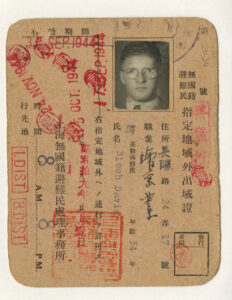
David Bloch’s Identification Card
In his memoir, Ernest Heppner wrote that “it was difficult to believe that no one asked for our papers as we passed through. . . . Hundreds of thousands of Jews in Europe were trying to find a country permitting them entry, and here Jews could just walk ashore.” When they arrived, they were met by Jewish Shanghailanders, who brought them into an emergency shelter.4
One of the thousands entering Shanghai seeking refuge was David Ludwig Bloch. Born in 1910, David was trained at the Academy of Fine Arts in Munich. In the aftermath of the Kristallnacht and internment at the Dachau concentration camp, he immigrated to Shanghai in 1938. His detailed woodblock prints serve as perspective primary sources on the outlook of Jewish refugees in Shanghai, specifically in the Restricted Sector for Stateless Refugees5.
I will be examining two of Bloch’s woodcuts. Through the first, I aim to illustrate the internationality of the city, especially as shown by an outside viewer. The second will serve as indicative of the internal struggle felt by Bloch, as he is a person without place and subjected to limited freedom of movement by Nazi-aligned Japan.
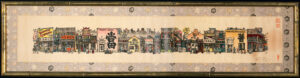
Chinese Street, David Bloch, 1945
This piece is done in the tradition of a Chinese handscroll, and appears to be mounted on silk backing. It features traditional Chinese seals in the top right. It is clear from the piece that Bloch had a strong appreciation of Chinese characters, and engaged with them significantly. Furthermore, there is an apparent appreciation for Shanghai visual aesthetics, notably in the style of trees three-quarters through the piece. Brightly colored storefronts are labeled in both English and Chinese. These stores are not only for the Chinese or foreign inhabitants, but cater to both customer bases. Other languages are notably absent. They are of various sizes and architectural styles, evoking visual interest, and creating a sense of decentralization. In the middle of the scene, above the eye doctor, buchter, and tailor, looms the Bund skyline in the distance. Above the mundane and the everyday, there are the large financial and administrative buildings, offering another side of Shanghai and creating a spatial hierarchy. The institutional buildings almost provide the image with a core, as they do the city. Further to the right, there is a “Money Exchange” above a rice shop. The scene is bustling with life. Shopkeepers clean, patrons stroll, children play, and a goose watches. From Bloch’s detailed woodcut, we are able to get a sense of vibrancy, internationality, and multi-dimensionality. It is clear that Chinese artistic styles have influenced him, and that he has gained an understanding for the city
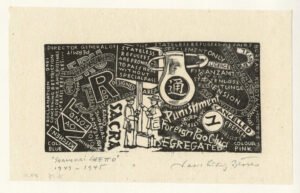
Shanghai Ghetto, David Bloch, 1943 – 1945
With a bang, 1941 marked the occupation of Shanghai by German-aligned Japanese forces. On February 18, 1943, Jewish occupants of the city were given 3 months to relocate into the Restricted Sector for Stateless Refugees in the Hongkou area. The Shanghai Ghetto, as it was colloquially known, had poor conditions, rampant disease, and scarce food. Represented by visual cacophony of text, the confusion and fear from this period is apparent. Out of darkness, the eye is drawn to the central figures of the woodcut. Bloch presents his pass to a guard. A t’ung, a special day pass was necessary to leave the ghetto, though they must return by 6pm6. Some words jump out of the scene – “Punishment”, “Cancelled”, “Foreign” and “Segregated”. They set the tone for the piece, along with the setting. “Okura” and “Ghoya” are inscribed, referring to the harsh administrators of the settlement. Ernest Heppner recounts that in encounters with them, they might be “slapped, beaten, and kicked and ran the risk of being sent to the bunker, a lice-infested jail within the police station.”7 That these figures are written by name is a testament to how involved the administrators were in the lives of the Jews in the settlement. Both Heppner and Bloch know and fear their names. “Pao Chia” refers to the civilian police force. It was a Song Dynasty Chinese institution giving municipal authorities the power to ‘draft’ able bodied men into an auxiliary police force. In the settlement, it served as a surveillance force, with the Jewish conscripts heavily monitored by Russians and Japanese, and punished if they did not report wrongdoing.8Rather than extra-territoriality, the Jewish position in Shanghai could be described as “non-territoriality”. Refugees in the settlement were “stateless” meaning they lacked the external sovereign protections attained by other foreigners. They are the inverse of the American girl who was free to come and go, and flaunt social norms ten years prior. Rather, the Jewish population under Japanese occupation is shackled.
China Street emphasizes movement and color, while Shanghai Ghetto evokes containment and regulation. From these two pieces, we can gain insight into the perspective of Jewish refugees living in Shanghai during the Japanese occupation. The woodcuts are dense, and heavily symbolic. I have only analyzed a small fraction of the material. Further study could include a component relating the spatial aspect of the art, as well as a comparison of Jewish woodcuts with Chinese and international ones created within the same time period.
- Cassel, Pär. 2016. “Extraterritoriality in China.” In Treaty Ports in Modern China, edited by Robert Bickers and Isabella Jackson. Routledge. [↩]
- Ho, Manli. 2019. “Diplomatic Rescue: Shanghai as a Means of Escape and Refuge.” In A Century of Jewish Life in Shanghai, edited by Steve Hochstadt. Academic Studies Press. [↩]
- Goldstein, Jonathan. 2019. “Desperate Hopes, Shattered Dreams: The 1937 Shanghai–Manila Voyage of the ‘Gneisenau’ and the Fate of European Jewry.” In A Century of Jewish Life in Shanghai, edited by Steve Hochstadt. Academic Studies Press. [↩]
- Heppner, Ernest G. 1993. Shanghai Refuge : A Memoir of the World War II Jewish Ghetto. University Of Nebraska Press, 40 [↩]
- Rochester Institute of Technology. 2024. “InfoGuides: Deaf Art Collections: Bloch, David (Jewish American).” Rit.Edu. https://infoguides.rit.edu/deafartcollections/blotch. [↩]
- Rubin, Evelyn Pike. 2019. “Survival in Shanghai 1939–1947.” In A Century of Jewish Life in Shanghai, edited by Steve Hochstadt. Academic Studies Press. [↩]
- Heppner, Shanghai Refuge : A Memoir of the World War II Jewish Ghetto. 115 [↩]
- Heppner, Shanghai Refuge : A Memoir of the World War II Jewish Ghetto. 114 [↩]