A False Utopia: People, Power and Space in Japanese-occupied Manchuria

I have taken to exploring various works focusing on empirical cases of Japanese urban planning in occupied Manchuria during the nineteenth and twentieth centuries. Reading how Japanese authorities and intellectuals conceptualised, planned, and justified their renovation of the Manchurian urban landscape provides a highly rewarding perspective that deepens my conceptual understanding of space and spatiality. Crucially, the study of space must consider, first, how spatial conceptions were imbued with assumptions about power relations and, second, how spatiality was shaped by the ways in which people inhabited—or were excluded from—a given space.

Spatial imaginaries often embody power relations, including domination and subjugation. As Henri Lefebvre put it, space—as a product of the social—is very often the negotiator, if not the servant, of power.1 Such an association can naturally take place in the most explicit of forms, whether in the style of architecture, the display of flags in public spaces, or the inclusion and exclusion of people from particular spaces. Yet the relationship between space and power permeates far beyond physical appearance or printed regulations, and can also be glimpsed in the ways in which people conceptualise space and approach it. As Louise Young points out, in the Pan-Asianist mission civilisatrice that characterised Japanese imperial expansion, one of the central motifs underlying this imagination of cultural superiority was Japanese prowess in urban planning.2 Hence the scheme to redevelop the cities of Manchuria. An awareness of space itself — and of the need to regulate it — therefore had a direct bearing on whether a people was considered civilised or not. In this process, space per se was appropriated as a subtle vehicle through which the Japanese Empire could establish hegemony over its subjects.

The fundamental assumption of civility also runs through the specific way in which the Japanese conceptualised the urban renovation of Manchurian cities. Seeing Manchuria as a clean slate where their work would not be hindered by “the demands of commerce, the opposition of property owners, or already existing disorderly spatial arrangements” that they faced domestically, Japanese architects and Guandong Army authorities considered the region a utopia for major architectural ventures.3 Indeed, such an impression could be traced to its geographical conditions: Manchuria boasted large swathes of fertile land that contrasted sharply with the mountainous terrain of Japan.4 Yet was Manchuria truly so utopian as to constitute a complete blank slate for the Japanese to work upon? By no means was Manchuria empty. The Japanese themselves, among others, were clearly aware of this, as their 1930s tourist guides to Manchuria made reference not only to renovated cities such as Changchun/Xinjing, but also to obscure towns characterised by “chaotic market[s] and picturesque slums.”5 The depiction of Manchuria as a pristine utopia is therefore untenable given the extensive presence of traditional Chinese settlements. Yet Japanese authorities and architects nevertheless proudly proclaimed their ability to transform the face of Manchuria, speaking of it as “an empty page on which they inscribed cities.”6 The claim of Manchuria as a utopian space, an architectural tabula rasa, therefore lay not so much in the physical and geographical reality of the region as in the grotesque imbalance of power between the incoming Japanese and the indigenous Chinese population. Geography itself did not make Manchuria an architectural utopia; the occupation did. As Young puts it eloquently, the Japanese ‘modernity utopia rested on the foundation of the absolute power of the colonial state’.7 Apart from the street names and monuments in Xinjing that proclaimed prosperity and unity under the protection of the Japanese Empire, the daunting presence of power—in this case, primarily militarist and colonial—behind space can be further revealed by examining how this architectural enterprise itself was conceptualised by the incoming conquerors. It thus speaks to the deep interlacing of power and space.

People, furthermore, are not merely part of the backdrop of a space; they are constitutive of the space itself and of its spatiality. Indeed, as Lefebvre and de Certeau would delightfully approve, people are not just in space, they also produce space — just like the pedestrians constitute and define urban space as profoundly as the streets themselves.8 It may therefore be conceptually fruitful to approach space and spatiality from an encompassing human dimension. For one, the colonial nature of Japanese spatiality in Manchuria can be revealed not merely by examining the appearance of its cities and the rationale behind their renovation, but also by analysing the inclusion and exclusion of people from those spaces. In the 1933 Agricultural Immigration Plan, for instance, Chinese residents of immigrant villages were consigned to an outbuilding of the village hamlets. The broader demographics of modernising Manchuria over the years of Japanese occupation are similarly telling. Across major cities such as Xinjing, Fengtian, and Dalian, the Japanese population grew steadily, while the rate at which the Chinese population increased was dwarfed in comparison.9 In Xinjing between 1930 and 1933, the Japanese population surged from 10,097 to 23,715, while the Chinese population virtually stagnated, rising only from 23,307 to 24,356.10 Looking at people not only illustrates the colonial balance of power embedded in Japanese spatiality in Manchuria, but also unveils the almost morbid obsession with rationalisation for the imperial cause. In the same 1933 plan for immigrant villages, the only tasks ordained for Japanese residents were domestic and agricultural labour, with little, if any, concern for the “multiplicity of urban life” or social differentiation.11 In this case, the extreme rationality of the Japanese Empire’s plans for Manchuria placed even its own subjects on the receiving end. In an almost dehumanising fashion, they were reduced to another cog in the imperial machine, whose primary duty was to produce for the greater cause. In the planning of space, therefore, it is not merely space itself but also people who are regulated. Looking at space consequently necessitates an analysis of the people who inhabit and produce it, and vice versa. People and power therefore constitute two vital conceptual passageways through which we can attain a better understanding of space and its significance.

  1. Henri Lefebvre, The Production of Space (Oxford, 1991), p. 26 [↩]
  2. Louise Young, Japan’s Total Empire: Manchuria and the Culture of Wartime Imperialism, Twentieth-Century Japan (Berkeley, 1999), p. 243. [↩]
  3. Tucker, ‘City Planning Without Cities: Order and Chaos in Utopian Manchukuo’ in Mariko Asano Tamanoi (ed.), Crossed Histories: Manchuria in the Age of Empire, (Honolulu, 2005), pp. 53-55. [↩]
  4. Ibid., pp. 53-54. [↩]
  5. Young, Japan’s Total Empire, p. 268. [↩]
  6. Tucker, ‘City Planning Without Cities’, p. 60. [↩]
  7. David Buck, ‘Railway City and National Capital: Two Faces of the Modern in Changchun’ in Joseph Esherick (ed.) Remaking the Chinese City: Modernity and National Identity, 1900-1950 (Honolulu, 1999), pp. 65-66. [↩]
  8. Lefebvre, The Production of Space, pp. 26-27; Michel de Certeau, The Practice of Everyday Life (Berkeley, 2011), pp. 92-93. [↩]
  9. Young, Japan’s Total Empire, pp. 250-253. [↩]
  10. Buck, ‘Railway City and National Capital’, p. 77 [↩]
  11. Tucker, ‘City Planning Without Cities’, pp. 62-63. [↩]
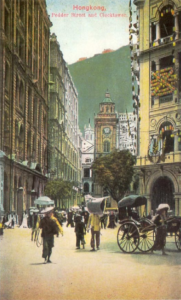
Urban Planning, Space-time, and the Kowloon Clock Tower

Placement and replacement of Hong Kong’s clock tower provides a case study in the changing relationship between urban space, colonial power, and standardized time.  The first clock tower in Hong Kong was built in 1862 at the junction of Peddler Street and Queen’s Road, two critical thoroughfares. As transportation needs increased, it was replaced and served as part of the Tsim Sha Tsui railway station. I will analyze these placements within the urban fabric of Hong Kong, and use them as evidence of the way that time was interpreted. 

Doreen Massey argues that space should be thought of in conjunction with time, in that space is constructed through social relations, which are inherently dynamic1.  The rapid proliferation of clock towers across the British Empire could, then, be thought of as an extreme example of space-time imperialism. Massey’s arguments help us to understand the way in which relations between colonial powers can impact the organization of a space, and associated temporal practices. Wen-hsin Yeh focuses on this, in her analysis of the Shanghai Bund, exploring the ways that a strict time-based system ultimately informed power dynamics and the economic shift towards capitalism2 . Similarly, Giordano Nanni’s monograph, The Colonization of Time, focuses on the imposition of British timekeeping onto indigenous populations in South Africa and Australia3. These studies provide a framework for my examination of the Hong Kong clocktower in space, as time. 

In 1843, Governor of Hong Kong, Henry Pottinger appointed Alexander Gordon as the Land Officer, Surveyor and Inspector of Roads of Hong Kong. He was tasked with the laying out of city infrastructure. Queen’s Road was established as the city’s main thoroughfare, acting as a belt around the city and as a boundary marker between racial residential zones. The Governor’s residence was placed at the starting point of Queen’s Road, creating a line of power into the city4. The colonial elite had a shared interest in standardized time. The tower was constructed as a public good, and time-keeping became a shared experience for those near it. It was placed directly in the junction of Peddler Street and Queen’s Road, thus making it widely visible for the foreign community, and unavoidable in daily life. The timepiece was a symbol of European establishment in the city, and its construction indicates the need for the foreign community to have a centralized and standardized time. This visible insertion should not be taken as universal acceptance, or even acknowledgement, but rather the way that time-relations within the foreign community manifested materially. 

Postcard showing Peddler Street and the Hong Kong Clock Tower, early 1900’s5

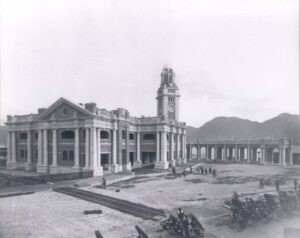
Eventually, with the proliferation of automobiles, having a massive tower in the street became cumbersome, and in 1913 it was demolished. A replacement tower was constructed at Tsim Sha Tsui as part of the new railway station.6Tsim Sha Tsui was already a transportation hub. Arthur Benison Hubback, a prominent army officer and architect in British Malaya was chosen to design the new terminus for the newly finished Kowloon–Canton Railway6. We should not overlook his history and role in empire, as they informed his architectural decisions. The significance of the placement lies in its incorporation into the wider transportation network. Rather than being a standalone, crowd funded obstruction, the clock tower becomes part of the regional infrastructure. As the tallest point on the shore, the tower physically asserted the dominance of time over the area. Incoming ships might see the clocktower, and understand that they were operating under the rule of imperial time, as well as imperial space. The stately Roman columns recall antiquity. Visually, the clocktower not only represents progress and modernity, but also refers to the distinctly European grandeur of a classical age. The Chinese living in Hong Kong are placed within a power-geometry favoring imperial time, a reminder even in the train station providing a link to the rest of China7.

Kowloon-Canton Terminus Station, Hong Kong (1916)8

Successive placements of Hong Kong’s clock tower reveal a changing relationship between standardized time, colonial space, and the wider world, as well as the spatial and temporal attitude within the foreign community of Hong Kong. On Peddler Street, time was made to be geographically at the center of the foreign community’s lives. At Tsim Sha Tsui, it became visibly part of transportation networks, and widely visible to visitors. The transformation helps to illustrate Massey’s argument that space is continually and relationally produced, and acts as a case study informing the wider literature regarding the proliferation of imperial time. 

In 1978, the train station was demolished. The clocktower was left standing, and today can be viewed as a vestige of imperial times. 

  1. Massey, Doreen. 1994. Space, Place and Gender. University of Minnesota Press. 9 [↩]
  2. Yeh, Wen-Hsin. 2007. Shanghai Splendor : Economic Sentiments and the Making of Modern China, 1843-1949. University of California Press. [↩]
  3. Nanni, Giordano. 2020. The Colonisation of Time. Manchester University Press. [↩]
  4. Ho, Pui-yin. 2018. “Duality in Planning (1841–1898).” Www.Elgaronline.Com, Edward Elgar Publishing, September 28. https://www.elgaronline.com/monochap/9781788117944/chapter01.xhtml. )). The Peddler Street Clocktower, erected in 1862, disrupted this line of power. It was funded through public subscription, as well as by a large donation from a Scottish watchmaker (( Chan, Catherine S. 2018. “Belonging to the City: Representations of a Colonial Clock Tower in British Hong Kong.” Journal of Urban History 45 (2): 321–32. https://doi.org/10.1177/0096144218769894. [↩]
  5. Valery M. Garrett, Hong Kong: Life and Times (Singapore, 1996), 120. via Chan, Catherine S. 2018. “Belonging to the City: Representations of a Colonial Clock Tower in British Hong Kong.” Journal of Urban History 45 (2): 321–32. https://doi.org/10.1177/0096144218769894. [↩]
  6. Ibid. [↩] [↩]
  7. Massey, Doreen. 2005. For Space. Sage. 183 [↩]
  8. The A B Hubback Project. 2021. “KOWLOON-CANTON TERMINUS | The A B Hubback Project.” https://www.abhubback.com/kowlooncantonterminushongkong. [↩]

Big Other is Watching You: Navigating methodological approaches to the Colonial City between Structure and Agency

Amongst scholars who have dwelt on colonial urbanisation, there is a dominant vein that agrees that the phenomenon of the ‘colonial city’ constituted a ‘heterogeneous but distinct urban type’.1 The explanations for this distinctiveness, however, have varied considerably. While Immanuel Wallerstein emphasised the colonies’ specific ‘peripheral’ place within the expanding global frame of industrialisation, Ronald Horvath and Terence McGee countered that this uniqueness was not reducible to such conventional classifications of urban development as ‘pre-industrial’, ‘transitional’ or ‘industrialised’.3 Instead, they understood the distinctiveness of the urban environment as the ‘spatial expressions of the imposition of an alien culture on an existing one’.3

Yet, as Brenda Yeoh argues, such approaches tend to treat the urban landscape as a reflection of colonial rule without attending to how the colonial city was physically ‘made’. In doing so, no matter what cultural, economic or political factors are invoked, these scholars ‘implicitly or explicitly’ assume that ‘the colonial town or city is either wholly or largely a creation of its colonial masters’.3 Although colonial administrators undeniably possessed vastly greater political and economic power than the populations they governed, to understand the colonial city simply as a product of imperial power obscures the ways that indigenous populations inhabited, negotiated and shaped these spaces. The challenge, then, is to account for the power of colonial rule without reducing those subject to it to passive, insignificant actors.

This is a familiar problem in the social sciences: how can we recognise the force of oppressive ‘structural’ power without negating the agency of individuals?  Michel de Certeau’s The Practice of Everyday Life offers one influential approach. Its central proposition, that ‘space is a practiced place’, sought to reinstate the agency of the ‘ordinary people’, who are ‘commonly presumed to be passive and guided by established rules’.4 Published in 1980, de Certeau described his work as both ‘analogous and contrary’ to Michel Foucault’s Discipline and Punish (1975), which emphasised how ‘proliferating technocratic structures’ of domination trapped the individual with an ever-intensifying ‘grid of discipline’.6

Yet, de Certeau’s account does indeed remain more ‘analogous’ to Foucault than this opposition suggests. In his example of walking in the city, de Certeau explains how authorities exercise conscious ‘strategies’, while individuals on the street must resort to ‘tactics’, that:

Lack [their] own place, lack a view of the whole, [and are] limited by the blindness resulting from combat at close quarters 7

Although walkers possess ‘agency’, they operate in the ‘absence of power’, within, or beneath, the ‘god-view’ of the authority.8 De Certeau therefore risks reproducing the binary he seeks to challenge: the omnipotence of power and the helplessness of the individual before it. As Doreen Massey argues, such a binary obscures the complex social relations through which power is produced and negotiated.9 This is particularly problematic in analyses of colonial cities, where it reinforces the image of an all-powerful empire acting on a passive population. While de Certeau’s effort to restore agency to ‘the weak’ is valiant, characterising their ‘tactics’ as unconscious and fragmented ultimately implies that they are still insignificant, incapable of driving change. Thus, the question is only intensified: how can we account simultaneously for the power of structures and the capacity of individuals to reproduce, negotiate and transform them?

Slavoj Žižek’s invocation of the ‘big Other’, elaborating on Jacques Lacan’s original conception, provides a way to approach the problem. The big Other does not refer to an individual or an institution but to the seemingly autonomous authority of the social order: the structures, rules and expectations that appear to exist independently above those that enact them.10 Yet, when Žižek claims, ‘the big Other doesn’t exist’ he does not deny the reality of power but rather challenges the idea that power exists as a natural or autonomous structure.11 The big Other has no existence independent of the people and institutions that reproduce it, yet it cannot be reduced to any one of them.

This can be illustrated through the all-too-familiar frustration of bureaucracy: after waiting two hours on hold, the customer service representative informs you that, while they sympathise with your situation, their ‘hands are tied’.12 By invoking regulations or higher-ups and referring only ‘to decisions which have always already been made’, they embody the authority of the ‘system’ they seem only to administer.13

This distinction is particularly useful for understanding colonial power. As Yeoh shows in her analysis of the Singapore Municipal Council, conflicts between government officials, councillors, ratepayers and professionals reveal how colonial power was actually practised: how legitimacy was claimed, negotiated for and given material effect.14 Colonial authority was not simply an autonomous structure imposed from the ‘god-view’ above but was produced and reproduced through individuals who embodied and enacted institutional power.

The methodological task, then, is not simply to replace the study of elites with the study of subalterns, but to examine the ‘interface’ through which power was enacted. It is through the ‘daily encounter’ that power can be studied:

in its external visage, at the point where it is in direct and immediate relationship […] it installs itself and produces its real effects 15

Following Massey, this offers a way beyond the structure-agency binary by locating power in the relations between people, institutions and spaces. As Yeoh argues, while we must recognise the ‘specific structural inequalities within colonial society’ that constrained different groups’ capacity to shape the built environment, these individuals (and groups) were also capable of intentional ‘strategies’: both those that were ‘motivated and intended’ and ‘those habitually carried out in practical consciousness.’16

Oriented in this way, de Certeau’s insight that space is practised remains valuable, provided that ‘practice’ is understood not simply as the resistance of ‘atomistic individuals’ but the way that social relations construct ‘the spatial’, ‘an ever-shifting social geometry of power and signification.’17 The colonial city should therefore be approached through the encounters in which authority became tangible: municipal meetings, planning disputes, petitions, regulations, professional networks, streets and buildings. The question is not simply who possessed power, but how actors mobilised, negotiated, subverted or reproduced its manifestations, practices enacted in space.


[1] Brenda Yeoh, Contesting Space in Colonial Singapore (Singapore, 2013), p.1.

[2] Ibid, pp.5-8.

[3] Ibid, p.5

[4] Ibid., pp.3-4.

[5] Michel de Certeau, The Practice of Everyday Life (Berkeley, 1984), p.35-6

[6] Ibid., p.xiv.

[7] De Certeau, Practice, pp.35-6, 38.

[8] Ibid., p.38.

[9] Doreen Massey, For Space (London, 2005), pp.45-6.

[10] Slavoj Žižek, How to Read Lacan (New York, 2006), p.8-10

[11] Section 3 from Slavoj Žižek, ‘The Big Other Doesn’t Exist’, Journal of European Psychoanalysis, 5, (1997)

[12] Mark Fisher, Capitalist Realism (Washington DC, 2009), p.25.

[13] Ibid.

[14] See Yeoh, Contesting Space, pp.28-59.

[15] Michel Foucault, Power/Knowledge, p.97.

[16] Yeoh, Contesting Space, p.17.

[17] Doreen Massey, Space, Place and Gender (Cambridge, 2007), p.3.

Space and spatiality – relation with the social and temporal

Reading the works and ideas of Henri Lefebvre, Michel de Certeau, and Doreen Massey have provided me with a rich dose of theoretical conceptualisations with regard to space. The texts themselves, if I were to be fully honest, are quite bemusing, even intimidating at times. Indeed, starting with Lefebvre’s own piece of writing has not been the most helpful in establishing a preliminary idea of space and spatiality for a beginner. Andy Merrifield was spot on when he wrote down how Lefebvre, in The Production of Space, “breezes through the history of Western philosophy as if it’s kids’ stuff”.1  Fortunately, the works by Merrifield himself and Elden Stuart have proven very helpful in presenting Lefebvre’s arguments with a less esoteric register, while pieces by de Certeau and Massey have provided interpretations of spatiality from various refreshing vantage points. I was able to extract two insights from the readings: first, the intertwined relation between space and the social (including modes of production, knowledge, and power); second, the need to place space alongside time, rather than approaching them in hermetic manners.

In various different ways, space is created and conditioned by the social.  With an identifiable Marxist tone, Lefebvre describes space as the direct product of modes of production (encompassing both material production and the production of society and knowledge). 2 Similarly, Doreen Massey makes sense of space and place with the rationale that they were shaped by innumerable social relations of various nature, across wildly different scales. This line of thinking does not see the dissecting the genesis of space as its intellectual endpoint, however. Beyond repudiating the conventional perception of space as a meaningless backdrop to more prominent occurrences, space is seen to have momentous importance on its own. Lefebvre’s initial fascination with space comes precisely from his study of everyday life, where he discovered how the transition from rural to urban space had a huge bearing on people’s quotidian experience.3  Thus came his later emphasis on space as the indispensable coordinates of human life. As the locus and medium of human activities, it affects the latter through a triad of spatiality — physical space is concretely perceived; mental space is abstractly conceptualised; and social space is intimately lived by people.4  Indeed, “Space has long ceased to be a passive geographic or empty geometric milieu. It has become instrumental”.5  In a way, Michel de Certeau provided a lucid illumination on how spatiality itself could have profound influence. Describing the view of New York from the Twin Towers, the elevated viewer evolved into a voyeur, as if Icarus breaking free of the labyrinthine chains crafted by Daedalus — “It allows one to read it, to be a solar Eye, looking down like a god. The exaltation of a scopic and gnostic drive: the fiction of knowledge is related to this lust to be a viewpoint and nothing more”.6  Therefore, space deserves to become a subject of inquiry on its own, not least because its formation sheds light on social relations at work, but also for the independent significance it has come to possess. By extension, the relation between space and power is also a prominent thread of inquiry by these scholars. As Lefebvre argues, the close relation between space and mode of production (especially capitalism) led to space’s existence as “a means of control, and hence of domination, of power”. 7  Massey’s works, delving into the interlacing of social relations and space, have explained the connection with greater clarity. The triumphalist Western narrative of the age of discoveries, for example, painted the indigenous civilisation as a static existence on the spatial continuum, lacking a trajectory of their own in contrast to that of the conquering Europeans. 8  Taking up the gender scope, Massey also elucidated how feminine imageries were intimately bound with the conception of the motherland as well as the home, amounting to a domestication of women who were barred from venturing beyond their own households.9  Finally, articulations of a sense of place which have gained traction in the present age of globalisation are also susceptible to being hijacked by defensive, reactionary nationalism/localism.10  Space, therefore, is neither an empty container, nor a trivial, inanimate product of social relations. As an end in itself, it has the capacity to condition and drive human activities and broader historical developments. For all the struggle I have endured working through the highly abstruse texts, I have gradually come to learn the rationale behind thinking about space and spatiality.

Furthermore, instead of treating them as conceptually sealed off, a sophisticated analysis of space should also take account of the idea of time. As Stuart has rightly pointed out, Lefebvre’s foremost contribution, rather than the elevation of space in lieu of time, was his examination of space alongside time.11  According to Lefebvre, representational spaces, closely linked to the social life of people, are very much ‘the loci of passion, of action and of lived situations, and thus immediately imply time’.12  The temporal face of space — and indeed the spatial face of time — was explored more systematically in the works of Massey who laid great emphasis on the concept of “space/time”. In her brilliant introductory chapter to For Space, Massey engagingly set out the interlacing between space and time, as spatial articulations and conceptualisations often imply a temporal dimension. Taking Clinton’s denunciation of countries like Mozambique and Nicaragua who supposedly stood against the tides of globalisation as an example, the author centred on the President’s characterisation of the said countries as “behind”. Through “a sleight of hand in terms of the conceptualisation of space and time”, the simultaneous coexistence of different countries on Earth has its spatial dimension suppressed. Instead, the problem was given a historical temporality, with Mozambique and Nicaragua cast as those among us that are in a more primitive stage. 13  Apart from this, the temporal dimension of space was underlined from another vantage point, with space described as inherently dynamic, moulded by the multiplicity of social relations that were also undergoing constant change. Against the essentialist position, therefore, space is instead “unfixed, contested and multiple”.14  Thus, it becomes the natural conclusion that any reference to space must necessarily take into consideration the temporal implications, and vice versa. Personally, I find this contention very intriguing, despite still having difficulties fully grasping its theoretical intricacies. One potential interest I have derived from reading these works is how time might be experienced variously across different spaces — in a rural village in China’s inland, on the Bund in Yokohama, or aboard an international cargo ship, etc. In these drastically different scenarios, the experience of space and time informs each other. Though as yet heavily based on quotidian impressions, they can be developed into subjects of proper investigation.

  1. Andy Merrifield, Henri Lefebvre: A Critical Introduction (New York, 2006), p. 10 [↩]
  2. Elden Stuart, Understanding Henri Lefebvre: Theory and the Possible (London, 2004), p. 184; Henri Lefebvre, The Production of Space (Oxford, 1991), pp. 31-33. [↩]
  3. Stuart, Understanding Henri Lefebvre, p. 181. [↩]
  4. Stuart, Understanding Henri Lefebvre, pp. 192-193; Lefebvre, The Production of Space, pp. 33-36 [↩]
  5. Stuart, Understanding Henri Lefebvre, p. 189. [↩]
  6. Michel de Certeau, The Practice of Everyday Life (Berkeley, 2011), p. 92. [↩]
  7. Lefebvre, The Production of Space, p. 26. [↩]
  8. Doreen Massey, For Space (London, 2005), pp. 1-4. [↩]
  9. Doreen Massey, Space, Place, and Gender (Cambridge, 1994), pp. 10-11. [↩]
  10. Ibid., pp. 151-154. [↩]
  11. Stuart, Understanding Henri Lefebvre, pp. 169-170. [↩]
  12. Lefebvre, The Production of Space, p. 42. [↩]
  13. Massey, For Space, pp. 4-5. [↩]
  14. Massey, Space, Place, and Gender, p. 5 [↩]

Extraterritoriality or Non-territoriality: Shanghai as Seen Through the Works of David Ludwig Bloch 

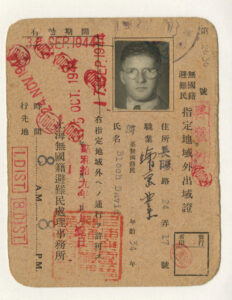
In Shanghai, different populations could be subject to different legal jurisdictions within the same physical space. Following the First Opium War and the founding of the International Settlement, this resulted in extra-territorial legal and behavioral standards for foreigners in Shanghai, often to great confusion.1 Decades later, on the other side of the world, this extraterritoriality would be the saving grace for 18,000 Jewish refugees fleeing Hitler’s regime.2 Due to Shanghai’s overlapping international bureaucracies, it lacked a coherent immigration policy and system. Anyone who arrived in the city was able to enter, regardless of paperwork. Shanghai became the port of last resort.3 

David Bloch’s Identification Card

In his memoir, Ernest Heppner wrote that “it was difficult to believe that no one asked for our papers as we passed through. . . . Hundreds of thousands of Jews in Europe were trying to find a country permitting them entry, and here  Jews  could  just  walk  ashore.” When they arrived, they were met by Jewish Shanghailanders, who brought them into an emergency shelter.4

One of the thousands entering Shanghai seeking refuge was David Ludwig Bloch. Born in 1910, David was trained at the Academy of Fine Arts in Munich. In the aftermath of the Kristallnacht and internment at the Dachau concentration camp, he immigrated to Shanghai in 1938. His detailed woodblock prints serve as perspective primary sources on the outlook of Jewish refugees in Shanghai, specifically in the Restricted Sector for Stateless Refugees5.

I will be examining two of Bloch’s woodcuts. Through the first, I aim to illustrate the internationality of the city, especially as shown by an outside viewer. The second will serve as indicative of the internal struggle felt by Bloch, as he is a person without place and subjected to limited freedom of movement by Nazi-aligned Japan. 

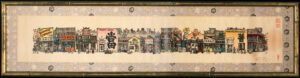
Chinese Street, David Bloch, 1945

This piece is done in the tradition of a Chinese handscroll, and appears to be mounted on silk backing. It features traditional Chinese seals in the top right. It is clear from the piece that Bloch had a strong appreciation of Chinese characters, and engaged with them significantly. Furthermore, there is an apparent appreciation for Shanghai visual aesthetics, notably in the style of trees three-quarters through the piece. Brightly colored storefronts are labeled in both English and Chinese. These stores are not only for the Chinese or foreign inhabitants, but cater to both customer bases. Other languages are notably absent. They are of various sizes and architectural styles, evoking visual interest, and creating a sense of decentralization. In the middle of the scene, above the eye doctor, buchter, and tailor, looms the Bund skyline in the distance. Above the mundane and the everyday, there are the large financial and administrative buildings, offering another side of Shanghai and creating a spatial hierarchy. The institutional buildings almost provide the image with a core, as they do the city. Further to the right, there is a “Money Exchange” above a rice shop. The scene is bustling with life. Shopkeepers clean, patrons stroll, children play, and a goose watches. From Bloch’s detailed woodcut, we are able to get a sense of vibrancy, internationality, and multi-dimensionality. It is clear that Chinese artistic styles have influenced him, and that he has gained an understanding for the city

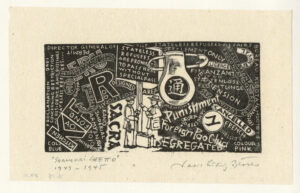
Shanghai Ghetto,  David Bloch, 1943 – 1945

With a bang, 1941 marked the occupation of Shanghai by German-aligned Japanese forces. On February 18, 1943, Jewish occupants of the city were given 3 months to relocate into the Restricted Sector for Stateless Refugees in the Hongkou area. The Shanghai Ghetto, as it was colloquially known, had poor conditions, rampant disease, and scarce food. Represented by  visual cacophony of text, the confusion and fear from this period is apparent. Out of darkness, the eye is drawn to the central figures of the woodcut. Bloch presents his pass to a guard. A t’ung, a special day pass was necessary to leave the ghetto, though they must return by 6pm6. Some words jump out of the scene – “Punishment”,  “Cancelled”,  “Foreign” and “Segregated”. They set the tone for the piece, along with the setting. “Okura” and “Ghoya” are inscribed, referring to the harsh administrators of the settlement. Ernest Heppner recounts that in encounters with them, they might be “slapped, beaten, and kicked and ran the risk of being sent to the bunker, a lice-infested jail within the police station.”7 That these figures are written by name is a testament to how involved the administrators were in the lives of the Jews in the settlement. Both Heppner and Bloch know and fear their names. “Pao Chia” refers to the civilian police force. It was a Song Dynasty Chinese institution giving municipal authorities the power to ‘draft’ able bodied men into an auxiliary police force. In the settlement, it served as a surveillance force, with the Jewish conscripts heavily monitored by Russians and Japanese, and punished if they did not report wrongdoing.8Rather than extra-territoriality, the Jewish position in Shanghai could be described as “non-territoriality”. Refugees in the settlement were “stateless” meaning they lacked the external sovereign protections attained by other foreigners. They are the inverse of the American girl who was free to come and go, and flaunt social norms ten years prior. Rather, the Jewish population under Japanese occupation is shackled.  

China Street emphasizes movement and color, while Shanghai Ghetto evokes containment and regulation. From these two pieces, we can gain insight into the perspective of Jewish refugees living in Shanghai during the Japanese occupation. The woodcuts are dense, and heavily symbolic. I have only analyzed a small fraction of the material. Further study could include a component relating the spatial aspect of the art, as well as a comparison of Jewish woodcuts with Chinese and international ones created within the same time period.

  1. Cassel, Pär. 2016. “Extraterritoriality in China.” In Treaty Ports in Modern China, edited by Robert Bickers and Isabella Jackson. Routledge. [↩]
  2. Ho, Manli. 2019. “Diplomatic Rescue: Shanghai as a Means of Escape and Refuge.” In A Century of Jewish Life in Shanghai, edited by Steve Hochstadt. Academic Studies Press. [↩]
  3. Goldstein, Jonathan. 2019. “Desperate Hopes, Shattered Dreams: The 1937 Shanghai–Manila Voyage of the ‘Gneisenau’ and the Fate of European Jewry.” In A Century of Jewish Life in Shanghai, edited by Steve Hochstadt. Academic Studies Press. [↩]
  4. Heppner, Ernest G. 1993. Shanghai Refuge : A Memoir of the World War II Jewish Ghetto. University Of Nebraska Press, 40 [↩]
  5. Rochester Institute of Technology. 2024. “InfoGuides: Deaf Art Collections: Bloch, David (Jewish American).” Rit.Edu. https://infoguides.rit.edu/deafartcollections/blotch. [↩]
  6. Rubin, Evelyn Pike. 2019. “Survival in Shanghai 1939–1947.” In A Century of Jewish Life in Shanghai, edited by Steve Hochstadt. Academic Studies Press. [↩]
  7. Heppner, Shanghai Refuge : A Memoir of the World War II Jewish Ghetto. 115 [↩]
  8. Heppner, Shanghai Refuge : A Memoir of the World War II Jewish Ghetto. 114  [↩]

Shanghai extraterritoriality during the Second Sino-Japanese War

I have identified two primary sources pertaining to the treaty ports and extraterritoriality. Both concern Shanghai’s International Settlement during China’s war with Japan in the 1930s and 1940s. Taken together, they open up interesting avenues of inquiry into the ways in which Western extraterritoriality in the city was disrupted and how it negotiated the threat—and, later, the reality—of occupation by the forces of Imperial Japan. Specifically, it shows how the concessions initially served as havens from the Japanese invasion, in contrast to the surrounding occupied territory, before later becoming contested spaces in which extraterritorial jurisdictions came into complex interaction with the invading Japanese authorities.

The first source—an article in the Far Eastern Review written by its editor, C. J. Laval—illustrates how Shanghai’s pseudo-colonial power dynamics were inscribed onto the urban landscape through the spatial arrangements of the foreign concessions which created this unique safe haven in the early stages of the Sino-Japanese War. Dating from November 1937, towards the end of the Battle of Shanghai, the article, entitled “How to End the War”, offered the author’s own assessment of the prospects for China’s war against the invading Japanese. Despite praising the valour of Chinese soldiers and the resolve of the nation, Laval urged China to enter into negotiations with Japan in the hope of securing a more favourable settlement, rather than relying futilely on a war of attrition or on international intervention.1 Yet the aspect of his article that I find particularly intriguing is his description of the foreign settlements in Shanghai, with which he chose to open his discussion:

“…some semblance of the former busy appearance of the streets has been restored in the French Concession and in that portion of the International Settlement south of Soochow Creek where the shops, the theaters and the dance halls have reopened, transportation services again are operating and the familiar throngs of Chinese crowd thoroughfares and narrow passages to all intent and appearance indifferent to the encirclement of Japanese bayonets around the entire area that now is under Japanese military domination”2

At the time of writing, Japan had not yet entered into war with the Western powers and had therefore not occupied the International Settlement or the French Concession following its conquest of Shanghai. Indeed, it is a well-known folkloric story in China that the numerous residents of the International Settlement, Chinese included, quite literally watched the Japanese offensive against the Chinese garrison at Sihang Warehouse from across the Suzhou Creek. Laval’s account thus offers an intriguing perspective on the coexistence of Western extraterritoriality and Japanese military presence in Shanghai before December 1941. Writing of the Bund, the emblematic space of the International Settlement, Jeremy Taylor described it as a “spatial reminder of an entire social system and lifestyle that came to East Asia”.3 In Laval’s article, the stark juxtaposition between the prosperity and tranquillity of the foreign-administered areas and the warfare ravaging the rest of Shanghai testifies to the continued existence not only of such a distinctive social system, but also of its spatial manifestation. Yet, for all the security afforded by extraterritoriality, it was now accompanied — and perhaps somewhat unsettled — by the burgeoning military presence of the hitherto formidable Japanese Empire. Laval’s text therefore provides a useful vantage point from which to ask not simply how the separate jurisdictions of Shanghai were maintained, but how they were experienced and negotiated within a devastating yet geographically confined theatre of warfare, particularly from a spatial perspective. An overarching line of inquiry consequently presents itself: to what extent were the foreign concessions truly unperturbed by the Japanese presence around them? More crucially, a series of spatial questions follows. The communication and exchange between the concessions and the world beyond them — especially at their borders — would make for an interesting subject of study. And, turning towards people’s interaction with and production of space, how might the meanings and significance attached to particular spaces within the concessions have changed amidst the Japanese incursion? Building upon Taylor’s study of the Bund, it would be interesting to examine how the waterfront’s significance, both as a stage upon which military power could be displayed and as a safe and leisurely space for civilian activity, may have been influenced and disrupted during this period.4 Similar examinations of spatial re-imaginings could be extended more broadly to the various meanings attached to the foreign settlements: as spaces of privilege, security, domination, confidence, and, indeed, home.

Naturally, this inquiry can be extended to the period after 1941, when full-scale warfare broke out between Japan and the Allies, where the existing spatiality was disrupted and complicated by Japanese takeover of the concessions. The second source I have encountered is the minute of a special meeting of the Council held on 8 December 1941. The minute clearly reveals the difficult task confronting the American and British members of the Council as they attempted to balance their duties as citizens of their respective countries with their responsibilities as officials of the Shanghai Municipal Council.5 As Japan annexed the French Concession and the International Settlement of Shanghai, it nevertheless sought to preserve and work through the existing administrative structure of the Shanghai Municipal Council. The indecision that appears to haunt the councillors thus reflects a broader administrative ambivalence in Shanghai after 1941: the city had formally come under full Japanese control, yet its existing administrative machinery was preserved and expected to cooperate with the new regime. How this spatial reconfiguration of the city unfolded within such a novel and intricate political milieu consequently begs investigation. How did the SMP administer the city under Japanese authority? Was a new urban plan envisaged by its new rulers? Now that their former sanctuary had fallen under the control of another Asian Empire, how was the spatiality of the Shanghai concessions — supposedly a place of privilege and even seclusion from the indigenous world — re-imagined by the Westerners who remained there?

All of this remains, admittedly, highly rudimentary. Taken together, however, these ideas point towards a general direction for potential research: the disruption, reinvention and perhaps also preservation of spatiality in the context of both extraterritoriality and warfare and political change. Such an inquiry would also approach spatiality with a particular human focus, examining not merely physical landscapes and urban layouts, but the ways in which different groups of people conceptualised, experienced, interacted with and manipulated them. For this purpose, the online access to a vast array of historical sources—including newspapers, reports, books, maps and photographs—made available through Virtual Shanghai and the Internet Archive could prove particularly valuable. This, I hope, might provide the starting point for something genuinely exciting.

  1. C. J. Laval, ‘How to End the War’, The Far Eastern Review, Shanghai, 11 November, pp. 375-376, [accessed 20 September 2026] [↩]
  2. Ibid. [↩]
  3. Jeremy Taylor, ‘The Bund: Littoral Space of Empire in the Treaty Ports of East Asia’, Social History, 27:2 (2002), p. 125. [↩]
  4. Ibid., pp. 132-140. [↩]
  5. “At the Special Meeting of the Council held on Monday, December 8, 1941, at 4.30 p.m” in Shanghai Municipal Council, The minutes of the Shanghai Municipal Council – 1940-1943 (Shanghai, 2001), pp. 354-355. [↩]

‘The Fengshui is right’: Geomancy and the ROC

Since its first encounter. Western opinion has been largely negative on the practice of Fengshui. Ernest J. Eitel in 1873 characterises it as ‘the blind gropings of the Chinese mind’, which one has ‘to overthrow’ to modernise a state.’ (1) Similarly, Edwin Dukes characterises it as a contradictory, ‘overbearing tyrant’ which will eventually be worn down and replaced by western thought and technology. (2) Beyond calling it irrational, some western scholars even characterised it as actively malevolent, posing ‘real danger and persecution’ to the missionaries. (3) By the early 20th century however, western scholarship had shifted a little, to include a few more sympathetic voices to geomancy’s case, with writers such as L.C Porter and Joseph Needham seeking to ground it in philosophy and science respectively, rather than dismissing it immediately as superstitious nonsense. (4)

This more sympathetic tone can be seen in US Congressmen Victor Murdock’s 1920 book China the Mysterious and Marvellous, which was a travel account of China and its spiritual and cultural practices. He similarly grounds Fengshui as a collected knowledge gathered over ’40 decades, ‘the science of knowing what is an auspicious place’ and an ‘ancient and revered custom’. (5)  While he argues that the new Republic should work to de-prioritise Fengshui in favour of western progressive ideas, he argues patience towards the Chinese population as asking them to change this custom is akin to asking Westerners to change something fundamental like the days of the week. (6)

What distinguishes him from both Eitel and Dukes however, is that he doesn’t just see Fengshui as a spiritual practice used by the Chinese commoners, but a wider characteristic and emblem to describe China as a whole.  In his concluding remarks  about his experience travelling through the new Republic of China he notes that ‘The Feng-shui is right…it is here, the Chinese believe in it, and it is working for the Republic.’ (7) This statement is striking for two reasons, firstly it is contradictory to the Republic’s state on the moment writing and their attitude towards Fengshui. Secondly, it highlights the conflation of two conceptions of Fengshui in Western eyes, Fengshui as something to be cultivated, and Fengshui as an omnipresent entity.

In line with Murdock’s earlier remarks in his work – that Fengshui was a longstanding, ingrained custom that the Republic’s ‘spirit of progress’ was helping to loosen its grip – the ROC policy towards geomancy was suppression. (8) The new ruling class of modern educated urban elites saw breaking popular superstition as a necessary condition to transform China and to claim the identity of a modern nation. The establishment of foreign universities and the growing interest in science led to the rise of anti-religious sentiment in the 1920s, calling for the end of rituals of popular religion. (9) Within the decade of Murdock writing this, the government produced the ‘Procedure for the Abolition of the Occupations of  Divination, Astrology, Physiognomy and Palmistry, Magic and Geomancy (1929). In this period then, the Chinese Officials and Western commentators seems to be working in tandem to undermine Fengshui. Yet despite this, Murdock still chose to characterise the Republic’s success, and future, on the existence of Fengshui.

Beyond basing their success on something that the government was actively trying to   distance themselves from, the basis he provides to evidence that Fengshui was working  in their favour seems spurious. Given that by the 1920s the Communist party was getting more of a foothold in China, and a year prior to publishing the Republic had to contend with the May Fourth movement, luck and good Fengshui are interesting qualities to characterise the new regime. He claims that the war with Japan and the Boxer uprising were fortunate events, both the workings of Fengshui which helped secure the success of the Republic. Yuan Shikai’s attempt to restore monarchy was permanently thwarted when fengshui ‘operated’ , causing his death (10). In the narrative Murdock describes, Fengshui isn’t generated or cultivated by the events, but rather it implies it cultivates the events to the fortune of the Republic. Murdock, therefore, positions this force as a spirit or omnipresent entity rather than a practice.


Both Dukes and Eitel explain, mostly disbelievingly, that Fengshui is something that can be disrupted or altered by actions, that someone can cultivate good Fengshui for themselves, or bad Fengshui for others, through distinct actions or spatial arrangements. Even beyond western interpretation, wider scholarship seems to characterise Fengshui as a more individualistic, ego-centred practice, not something working for and against a large collective such as a state. (11) Presenting it in such a way then suggests Murdock wasn’t just reviewing or critiquing Fengshui but utilising it for a distinct purpose. Murdock was working under Woodrow Wilson, whose presidency had been characterised as deploying ‘missionary diplomacy’. (12) He saw spreading Christianity and democratic ideals as his role in China, and as such worked extensively in his terms to cultivate a good relationship with the nation. As mentioned above, the educated elites were responsive to this agenda, drawing on British and American models for governance,  and in turn utilised this relationship to put pressure on Wilson to acknowledge the new regime, and securing his support in relation to their demand to have the Shandong province returned to them. (13) Murdock’s representation of the Republic, endowed with good Fengshui and somehow destined to survive, is in line with both the Republic’s and United State’s interest. By characterising a regime that had been more responsive to Western ideas and technologies as inherently lucky and auspicious, Murdock was protecting American interests. Therefore, it could be argued, in the same way that Western observers like Dukes and Eitel argued that Chinese locals used Fengshui as a way to oppose foreign influence, that Murdock saw Fengshui as a tool, and popular selling point, to bolster support and confidence around the more Western-minded Republic of China.


(1)    Ernest John Eitel, Feng Shui or the Rudiments of Natural Science in China (1873), pp.49-50

(2) Edwin Joshua Dukes. Everyday Life in China: Or, Scenes Along River and Road in Fuh-Kien. Religious Tract Society, 1885. IA Ch VIII Feng-shui: The Biggest of All Bugbears pp145-159, p.159

(3)   James E. Mills, “Western responses to feng shui.” Middle states geographer 32 (1999): 71-77, p. 72

(4) Mills, ‘Western responses’, p.73

(5) Victor Murdock, China the mysterious and marvellous. (Fleming H. Revell Company, 1920), p.134, p.137

(6) Murdock, China the mysterious, p.138

(7) Murdock, China the mysterious, p.307

(8) Murdock, China the mysterious, p.138

(9) Ole Bruun. Fengshui in China: Geomantic divination between state orthodoxy and popular religion. (University of Hawaii Press, 2003), pp.72-78

(10)  Murdock, China the mysterious, p.307

(11)   Brunn, Fengshui in Chin, p.15

(12) Eugene P. Trani, “Woodrow Wilson, China, and the Missionaries, 1913—1921.” Journal of Presbyterian History (1962-1985) 49. 4 (1971), pp. 328-351,

(13)  Trani, “Woodrow Wilson”, , p.335, pp.347-351


The Eternal Ways of Wind and Water: How Modern is Western Feng Shui?

In his article “Western Responses to Feng Shui”, James Mills argues that western representations of feng shui act as a mirror for western society, rather than informing us of authentic feng shui practice . Using this theory he claims that modern American conceptions of feng shui reveal the individualistic, commercialised, rootless nature of western society.1 However, this article ultimately falls victim to essentialising Chinese belief systems due to disillusionment with American society. “Traditional” feng shui and the feng shui of the modern west in fact bear surprising similarities, By analysing modern western feng shui, as presented in the magazine “Feng Shui for Modern Living”, we can trace continuity where Mills finds dissonance.

Figure 1: The First Issue of “Feng Shui for Modern Living”

“Feng Shui for Modern Living” was first published in 1998, and, as seen in Figure 1, it claims to be the world’s first full colour magazine on feng shui. As noted by Mills, its pages are predominantly devoted to interior design and the benefits it can have for the individual, with articles such as “12 Mood Lighting Ideas” and “Arrange Your Desk For Success” featuring in the first issue. This, he argues, represents the self-centred nature of western culture. The communal concern for street alignment and settlement layout of traditional feng shui is lost.2 However, feng shui has always been an individualistic pursuit for the common person. Whereas the elites of Chinese society tried to etch cosmic importance into the fabric of cities, common people were always concerned with their personal fortunes. Qi, the force which feng shui was designed to capture was seen as a finite resource, and as a result fostered competition between those who hoped to harness it.3 For example, in cases of parental burial, given each child’s unique cosmological relationship to a potential gravesite, siblings often struggled among themselves to select one which was most auspicious for themselves at the expense of others.4 Feng shui has thus always been an intensely and inherently individual endeavour.

Also missing from the pages of “Feng Shui for Modern Living” is any reference to the siting of tombs, which Mills argues is fundamental to “traditional” feng shui. Burial siting was undeniably an important part of early feng shui. However, Ole Brunn argues that over the course of Chinese history, divination of graves for the dead became less and less orthodox.5 By the 1880s, for the Chinese community in Singapore, burial siting was uncommon. Selecting an ideal burial site was, to a large extent, a privilege of the wealthy. Most had to make do with common graveyards run by Chinese associations, which did not totally disregard cosmological siting but were far less specifically tailored.6 Rather, grave siting took on greater meaning as a strategic discourse of resistance, used to combat British attempts to exert greater control over Chinese Singaporeans. To most of the Chinese community in colonial Singapore, burial feng shui was much more of an ideal used to justify the immunity of certain spaces from colonial interference than an essential practice. To suggest that the exclusion of burial geomancy from western feng shui is a unique omission disregards the plurality of feng shui conceptions over time.

Another of Mills’ critiques is that of over-commercialisation, with western practitioners harnessing the idea of feng shui to sell their services, magazines (such as “Feng Shui for Modern Living”), and correspondence courses.7 According to Mills, the market has been oversaturated and greedy. Yet, feng shui specialists were already omnipresent in Qing times.8 The feng shui market has always been large due to its necessity in nearly all aspects of Chinese life. These practitioners would have demanded fees for their services, and though their base salary may have been comparatively low, they were expected to be hosted lavishly with plenty of good food and drink during the period of their work, which could last for several days or more.9 In addition, Ole Brunn suggests that feng shui was used as a bargaining tool to extort money from foreigners attempting to build infrastructure into China during the 1840s and 50s.10 Overall, there is no reason to romanticise feng shui as an altruistic practice. From its origin, it has been a pragmatically deployed trade and tool.

That is not to say that modern western feng shui is the same as the ancient Chinese practice or that it tells us nothing of our current times. It is, indeed, a unique conception of feng shui born from its context. However, the same is true of feng shui in every time and place, as it is truly an umbrella term which encompasses a diversity of practices and beliefs. We should therefore be cautious of any fixed conception of feng shui at all. Attempting to contrast modern applications of feng shui with a “traditional” alternative is a baseless task, which ultimately leads to the essentialisation of eastern belief systems.

  1. James Mills, ‘Western Responses to Feng Shui’, Middle States Geographer 32:1 (1999), p. 75. [↩]
  2. Ibid, p. 74. [↩]
  3. Ole Brunn, An Introduction to Feng Shui (Cambridge, 2008), p. 63. [↩]
  4. Richard Smith, Fortune-tellers and Philosophers (New York, 1992), p. 164. [↩]
  5. Ole Brunn, An Introduction to Feng Shui (Cambridge, 2008), p. 11. [↩]
  6. Brenda Yeoh, Contesting Space in Colonial Singapore (Singapore, 2003), p. 297. [↩]
  7. James Mills, ‘Western Responses to Feng Shui’, Middle States Geographer 32:1 (1999), p. 74. [↩]
  8. Richard Smith, Fortune-tellers and Philosophers (New York, 1992), p. 132. [↩]
  9. Ibid, p. 155. [↩]
  10. Ole Brunn, An Introduction to Feng Shui (Cambridge, 2008), p. 40. [↩]

Ghosts, Festivals and Soujourner Identities

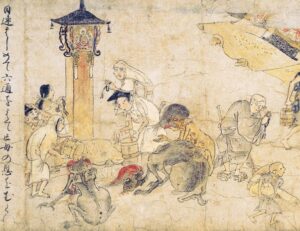
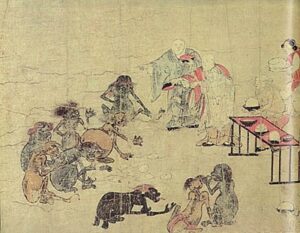
,The Yu Lan Jie (盂蘭節), or the Hungry Ghost festival provides an interesting lens to view the soujourner communities and native place associations in major Asian cities through. This can be seen in the symbolic respect of the soujourner ghost, or the community building aspect of these festivities but also the contested space itself where these festivals and rituals take place – where foreign influence and urbanisation threatened the communities’ access and claims to the land and the Yu Lan Jie celebrations.

 Playing a role in Taoism, Chinese folk religion, and Chinese Buddhism, this important festival has muiltiple reported origins, but can be traced back to an ancient Indian buddhist scripture known as Yulanpen Sutra, from which the name of the festival derives. The Sutra relays the story of Maudgalyayana, who goes on a journey to visit his deceased parents, only to find his mother in the realm of Preta, the hungry ghost. After his mother refuses his rice, Maudgalyayana is informed by Buddha that the only way he can feed and save her is by providing offerings at his monastic community during Pravarana, roughly corresponding to the 15th day of the 7th month (1). Drawing on this, the Chinese celebration falls on the 7th lunar month, considered the ghost month, where on the 15th day of that month the gates to hell and heaven open and the ghosts are believed to pass into the human realm. Rituals and offerings are given to satisfy these ghosts in both burial grounds and the house, with the intended purpose of ensuring prosperity and ward off bad luck. I bring up the origins of this festival to trace what the early depictions of this festival seem to align with, the family. In these images, celebrations seem to be more intimate and more household based rather than celebrated by guilds or communities.


This more personal setting however, applies only to one side of the festival: household celebrations were specific to ancestral ghosts, however, separate celebrations existed in the heart of the community – often in regional temples and burial grounds or marketplaces – for the ghosts with no descendants or who have been forgotten (2). Indeed, the potent image of the ‘hungry ghost’, almost animalistic in their distress, seem to align more with these forgotten, emotionally charged ghosts than the ancestral spirits. Therefore, when cities like Shanghai starting rapidly urbanising in the 19th century, the native place associations which sprang up found this festival an important event to show their regional solidarity. The ‘sojourning ghost’, as Goodman aptly puts it, and its plight as a foreign entity in the living realm, struck a cord with the lonely sojourners in the city without families (3). Indeed, a stone inscription on a Ningbo artisan association building in Shanghai seems to make this exact parallel when it says: “Living, we are guests from other parts; dead, we are ghosts from foreign territory.” (4)

The communal festivities include rituals performed by Taoist priests or Buddhist monks, – who were sometimes transported from their native regions- bonfires burning spirit money and clothes to transfer to the pauper ghosts, stage performances, costumed processions and a large collective banquet for members of the native place associations (5). These activities led to a large amount of flexibility in cultural expression, lavishness and scale, allowing a fluid framework for members to exert their regional identities through far from home. It allowed expression from across the social strata of the native place association, not just the Huiguan leaders (6). For the more )wealthy and prominent regional communities, like Guangdong and Ningbo, these processions and religious ceremonies were the perfect opportunity to exert their legitimacy and prestige as a collective.  The festivities also prompted social welfare provisions amongst the association, with cakes made for the celebration being distributed to the poorest in the group (7).  welfare did act as a point of critique of these celebrations, particularly when funds for disaster and conflict relief were being sought from those affected in their transnational communities. As a one writers chides  “The yulanpenhui is to relieve the homeless ghosts. But they are already dead. . . . Why not help the living?” (8). With the hungry ghost celebrations and public charity both important for the construction of status for the Huiguan elites and the community’s identity such a critique almost challenges an ordered hierarchy of the prestige making activities of native place associations. While public charity and mutual aid objectively seems the more worthy cause for the whole regional group, somewhat ironically it exists as the less accessible option for the lower strata to participate in than Yu Lan Jie which remained popular well into the 20th century.

The final thought I wanted to discuss about the significance of the festival was what it reflected about the ongoing struggle soujourner communities faced in regards to the burial grounds and guild halls where they would perform some of these rituals, and the very real dead they were temporarily storing before transporting them to their native regions. Rapid urbanisation of cities didn’t just lead to the rise of migrant soujourner communities in cities, but also led to the problem of relocating graveyards upon the desire to expand the boundaries of the city. In Shanghai, this problem was often characterised as a conflict between the Chinese communities and the Western powers. This could be seen generally through the western discourse of public health and plague prevention, objecting to the sojourner guilds coffin repositories in the urban areas (9). More specifically though, it is possibly most famously seen through the two conflicts between French authorities and the Ningbo people regarding the location of Siming Gongsuo and coffin repository in 1874 and 1898. While an article in the agreement between China and the international settlement specifically forbade the western powers from removing the dead from their lands without explicit permission, because said article also stated that the no new Chinese coffins should be placed within their limits, many public cemeteries quickly decided it was in their interest to agree and relocate (10). Guild graveyards proved to be more stubborn, particularly the Siming Gongsuo. Given all the discussion above, it can be understood why these locations would be more precious to the soujourner community, away from their home and family. The rise in popularity of the commercial urban graveyards in Shanghai are possibly evidence that people were feeling the distance between the city and the newly relocated, isolated graveyards. While the Ningbo riots can be characterised as examples of early popular nationalism, it’s important to contextualise these events in the broader trend of urban displacement. Thomas S. Mullaney interactive digital volume The Chinese Deathscape Grave Reform in Modern China virtually maps this phenomenon and notes that this is just as much a contemporary issue as it is historic (11). While the festivals may have spiritually marked the migration of the dead in the living realm, burial re-locations make the dead physically migrants in, what Mullaney terms, the landscape of death. This not only makes the metaphor between sojourner and ghost complete, but also indicates why such a festival has been historically so important to migrant communities, as it is not only culturally enriching but such cultural enrichment is under a continuous mounted threat from urbanisation.


(1)   Jean DeBernardi,. “The hungry ghosts festival: a convergence of religion and politics in the chinese community of Penang, Malaysia.” Asian Journal of Social Science 12, no. 2 (1984), pp.25-34, p.26

(2)  Debarnardi, “The hungry ghosts”, pp.27-29

(3)  Bryna Goodman, Native, Place, City, and Nation: regional networks and identities in Shanghai, 1853-1937, (University of California Press, 2023.), p.96

(4)  Cited in Goodman, Native, Place, City, p.96

(5)  Debarnardi, ‘The hungry ghosts’, p.27-29,

(6)  Goodman, Native, Place, City, p.100

(7)  Debarnardi, ‘The hungry ghosts’, p.28

(8)  Goodman, Native, Place, City, p.99

(9)  Ibid.p.163

(10) Christian Henriot, ‘When the Dead Go Marching in’, in Mullaney, Thomas Shawn, Christian Henriot, Jeffrey Snyder-Reinke, David William McClure, and Glen Worthey. The Chinese deathscape: Grave reform in modern china. Stanford University Press, 2019.

(11) Henriot, ‘When the Dead’.


Welcome to the Hotel der Nederlanden: Cultural Contact in Anna Forbes’ “Insulinde”

A “contact zone” refers to a space where historically and geographically separated people engage with each other and establish new relationships and identities.1 In the Dutch colonial city of Batavia, a “contact zone” of particular note was the Hotel der Nederlanden, one of the most prominent hotels in the city and often the first port of call for any visiting European. By analysing the representation of the Hotel der Nederlanden in Anna Forbes’ 1887 “Insulinde: Experiences of a Naturalist’s Wife in the Eastern Archipelago “, we can learn about Dutch colonial culture and how its unique hybridity supported discourses of colonial modernisation. By conspicuously adopting certain features of native culture, and placing them in service of western comfort and convenience, colonial Batavian society could claim to be elevating and improving native society.

Co-option of some native ways of life within the Hotel der Nederlanden is apparent in Forbes’ description of guest attire. She is shocked to learn that Dutch ladies wore the native sarong for nearly all of the day besides dinner, rather than a “respectable skirt”.2 Despite her initial reaction, she eventually sees rationality behind these clothes which are “natural in the climate”, even saying the sarong is “really becoming” once you become accustomed to it.3 Given their ready adoption of native dress by the residents of the Hotel der Nederlanden, Batavian society did not seem to outwardly harbour anxieties about “going native”. However, the sarongs worn by European ladies are seen by Forbes to be separate and improved from their native versions, being elevated by costly materials, dainty “lace or embroidery”, or a European dressing jacket.4 Thus, aspects of native culture were appropriated by Europeans who were seen to bring greater aesthetic sophistication to them, impressing the merit of Dutch colonial society upon visitors.

Beyond merely providing a backdrop for this phenomenon, the hotel perpetuated it through its dining experience. Forbes states that, after a fairly standard breakfast of eggs, coffee, and sausages, lunch at the Hotel der Nederlanden presented a fusion of Indonesian and western cuisines. The process of this meal, called the “rijsttafel” or “rice table” by the Dutch, involved guests helping themselves to rice served on an immense platter, spooning curry over it, adding various meats, fritters, vegetables, and condiments (pickles, chutneys, chili), and then mixing it all together.5 Not only did the “rice table” confront the uninitiated with new foods, it was also an unfamiliar ritual. Forbes notes how a family unused to the custom nearly missed out on all the food before her husband intervened.6 What is most clearly demonstrated here is the clear intention of the Hotel der Nederlanden to not imitate the colonial metropole. Rather than relying solely on familiar European dishes and practices, the hotel encouraged visitors to engage heavily with “native” cuisine. Yet, given a Dutch name, prepared by European chefs,7  and served alongside “beefsteaks and fried potatoes”,5 the “rijsttafel” was separated from whatever native roots it might have had. Like the sarongs of the ladies at the Hotel der Nederlanden, it was only a superficial adoption of Indonesian customs, redesigned for European consumption.

Thus, despite these visible areas of cultural hybridity, the Hotel der Nederlanden was still firmly entrenched in colonial hierarchies. One clear example of this is presented in Forbes’ description of the staff, as she notes the amount of male servants, waiters, and valets rushing about the hotel.8 All are said to be referred to as “boy”. Indeed, contemporary travel guides would often include sections on useful vocabulary for hotel life, which are predominantly addressed to the native “boy”.9 This imperious language made clear the implied hierarchy between Europeans and the Javanese. As such, though Javanese concepts, aesthetics, and culture are incorporated into the experience of the hotel, colonial prejudices were still present. Adoption of native attire or cuisine merely served to conceal this, suggesting instead that the Dutch were actively improving upon and modernising Indonesian society.

By analysing the Hotel der Nederlanden as a “contact zone”, we can learn about how Dutch colonial society constructed their identities as modernisers and cultural stewards. The aspects of culture chosen for appropriation and the methods by which they were adapted show that interest in truly accepting native culture was superficial. However, for Anna Forbes and visitors like her, the Hotel der Nederlanden and the wider Dutch East Indies came to embody the proof of the European capacity to advance native cultures.10 Thus, the Hotel der Nederlanden can be seen as a site where cultural contact was leveraged to highlight the beneficial effects Dutch rule had on Indonesian culture.

  1. Mary Louise Pratt, Imperial Eyes: Travel Writing and Transculturization (London, 1992), p. 4. [↩]
  2. Anna Forbes, Insulinde: Experiences of a Naturalist’s Wife in the Eastern Archipelago (London, 1887), p. 8. [↩]
  3. Ibid. [↩]
  4. Anna Forbes, Insulinde: Experiences of a Naturalist’s Wife in the Eastern Archipelago (London, 1887), pp. 8-9. [↩]
  5. Ibid, p. 11. [↩] [↩]
  6. Ibid, p. 12. [↩]
  7. Scott Merrillees, Greetings from Jakarta (Toledo, 2012), p. 80. [↩]
  8. Ibid, p. 7. [↩]
  9. For example: The Official Tourist Bureau, Java, The Wonderland (Batavia, 1900), pp. 4-6. [↩]
  10. Susan Morgan, Place Matters: Gendered Geography in Victorian Women’s Travel Books About Southeast Asia (New Jersey, 1996), p. 71. [↩]