‘Scotsmen the world over will be united’: The Caledonian Ball and the making of ‘Scottish’ Space in Asia

In an article present as a letter entitled ‘To Friends Across the Sea’ published in Social Shanghai, a contributor writing under the name Dulcie expressed her disappointment with the 1911 celebrations of St. George’s Day. ‘This year they decided to have a dinner,’ she complained, ‘which is considered the last resort of any patriotic Society, as it is a lazy and feeble way of displaying patriotism.’1 For the author, this event was particularly disappointing when measured against the achievements of the ‘Scotch Society’, whose Caledonian Ball, she observed, ‘never has less than a thousand guests and have had as many as fourteen hundred’. 2 Indeed, organised by the St. Andrew’s Society, Caledonian Ball was a prominent annual fixture of Shanghai’s International Settlement, and was described by a 1907 contributor to the same magazine as ‘the premier social function of the year’.3

Of course, such assessments must be read as editorial interventions. The pages of Social Shanghai were filled, if not by design, then by default, with efforts to emphasise the importance, centrality and success of whichever of the multitude of clubs, organisations and societies to which the contributor belonged. Whether or not the Scottish association occupied a particularly prominent place within Shanghai’s social hierarchy, is therefore less significant than understanding the Caledonian Ball as an example of the ways in which colonial communities constructed and maintained a sense of collective identity and belonging.

Existing scholarship has explored the particular representation and appeal of ‘Scottishness’ and Scottish national identity in the context of imperial politics, the administration of the British Empire and its aesthetic appeal within fin-de-siecle colonial society. 4 Other studies have examined the social functions of such events within colonial communities, highlighting their roles as expressions of national pride, occasions for networking among colonial elites, opportunities to fundraise for the society and its philanthropic work, and, not least, entertainment. 5 While the Caledonian Ball undoubtedly fulfilled these various functions, it also offers an opportunity to consider how such celebrations actively transformed colonial space, creating temporary environments through which participants could articulate and experience their connections to both Scotland and the wider British Empire.

Through the annual assembly of recognisable symbols, rituals and aesthetics, Shanghai’s Town Hall was temporarily transformed into a recognisably ‘Scottish’ space. Contemporary accounts of the Ball repeatedly describe a ‘familiar’ ensemble of decorations: clan shields, red and yellow drapery representing the Royal Standard, and the St Andrew’s Cross displayed alongside the Union Jack.6 A portrait of Robert Burns ‘reigned supreme’ above the central mantelpiece, while tartan and thistles featured throughout the hall. 7 Flowers and foliage were complemented by decorative weaponry, ranging from battle-axes to bayonets.8 One account even describes a display of Cairngorm rocks, Jura peat and heather shipped from Inverness, whose textures and scents evoked something of the Scottish landscape for those assembled. 9

Crucially, however, this transformation neither depended upon nor sought to produce an accurate reproduction of Scotland. As Kim Sullivan highlights, the Ball’s central imagery drew heavily upon distinctive Highland cultures, despite most Scots in Shanghai originating from the Lowlands. 10 The prominence of palm and bamboo within the hall’s decorations further underlines this distinction.11 Rather than attempting to recreate Scotland faithfully, the organisers assembled a selective and readily recognisable version of ‘Scottishness’, drawing upon symbols whose significance lay less in their geographical or cultural authenticity than in their capacity to evoke a shared identity across distance. Yet the significance of this visual language extended beyond its connection to a distant homeland: it also provided a means of connecting Shanghai’s Scottish community to a much wider network of societies across the British Empire.

The St Andrew’s Society of Shanghai was, after all, just one of many Scottish associations established throughout the Empire during the early twentieth century. The prominence accorded to its Caledonian Ball was similarly reflected elsewhere, with a 1901 article in the China Mail describing Hong Kong’s equivalent as ‘the leading event of the social calendar’.12 Indeed, accounts of these celebrations reveal striking similarities not only in the ways that colonial spaces were decorated, but also in the rituals and performances that took place within them. At Singapore’s Victoria Memorial Hall in 1910, for instance, the St Andrew’s Cross appeared alongside the Union Jack, accompanied by clan shields and displays of weaponry. Palms and bamboo framed the decorations, while ‘a few little blocks of peat’ brought ‘a whiff of Caithness bog or Hebridean marsh to the grateful Celt who brought his nose near enough’.13  A 1911 account of the Ball at Hong Kong’s City Hall similarly described the familiar combination of flags and foliage, alongside ‘correct tartan plaids’ made ‘more effective’ by displays of weaponry.14

While these were discrete local events, their shared visual vocabulary transformed different venues into iterations of the same cultural space, allowing attendees to imagine themselves as members of a community that extended beyond their immediate locality. As the China Press recognised in 1926, through such events ‘Scotsmen the world over will be united in thought and fraternal greetings will be flashed over the wires linking up those in far distant lands’.15

Indeed, contemporary newspaper accounts frequently emphasised the extent of the greetings exchanged between Scottish societies across Asia. At the 1907 Shanghai celebration, ‘telegrams of congratulation were received from the kindred Societies of Hongkong, Hankow, Foochow, Tientsin, Chefoo, Yokohama, and Kobe’, and displayed within the hall during the event.16 Similarly, a 1910 report in the Straits Times devoted considerable attention to greetings received at Singapore’s Caledonian Ball from ‘Brither Scots’ across the region. Such exchanges brought the wider network of Scottish associations into the celebrations themselves, making otherwise distant communities present within the event and reinforcing relationships that extended well beyond the city in which it was held.17

Through these shared performances of Scottish identity, those dancing in Shanghai’s Town Hall could therefore understand themselves as part of the same cultural and social world as those gathered at Singapore’s Raffles Hotel or Hong Kong’s City Hall. Indeed, these colonial venues may have offered a more immediate sense of belonging than the streets of Edinburgh itself. The Caledonian Ball was consequently more than a celebration of Scottishness overseas: through the repeated transformation of local spaces, the performance of familiar cultural practices and the cultivation of connections between societies, it helped produce and sustain the wider networks through which the British Empire was experienced.

  1.   ‘St. George’s Day Celebrations’, Social Shanghai, 11 (January-June 1911), p.134.  [↩]
  2. Ibid. [↩]
  3. ‘The Caledonian Ball’, Social Shanghai, 4 (July-December 1907), p.315. [↩]
  4. See Tanja Bueltmann, Clubbing Together: Ethnicity, Civility and Formal Sociability in the Scottish Diaspora to 1930 (Liverpool, 2015); Tanja Bueltmann, ‘Ethnic Associationalism and Networking among the Scots in Asia: A Longitudinal Comparison, c.1870 to the Present’ in T. M. Devine, Angela McCarthy  (eds.) The Scottish Experience in Asia, c.1700 to the Present (Cambridge, 2017), pp.259-282.; Isabella Jackson, ‘The Shanghai Scottish: Volunteers with Scottish, Imperial and Local Identities, 1914–41’ in T. M. Devine, Angela McCarthy  (eds.) The Scottish Experience in Asia, c.1700 to the Present (Cambridge, 2017), pp. 235-257; Kim Sullivan, ‘Scots by Association: Clubs and Societies in the Scottish Diaspora’ in Murray Stewart Leith, Duncan Sim (eds.) The Modern Scottish Diaspora: Contemporary Debates and Perspectives (Edinburgh, 2014), pp. 47-63. [↩]
  5. See Robert Bickers, Settlers and Expatriates (Oxford, 2010). [↩]
  6. ‘The Caledonian Ball’, Social Shanghai, 8 (July-December 1909), pp.281-2.; ‘The Caledonian Ball’, Social Shanghai, 10 (July-December 1910), p.248. [↩]
  7. Ibid.. [↩]
  8. Ibid .. [↩]
  9. Social Shanghai, 8 (July-December 1909), p.281. [↩]
  10. Sullivan, ‘Scots by Association: Clubs and Societies in the Scottish Diaspora’, pp.52-3. [↩]
  11. Social Shanghai, 8 (July-December 1909), p.281; Social Shanghai, 10 (July-December 1910), p.248.  [↩]
  12. ‘St. Andrew’s Day Ball’, China Mail, Hong Kong, 30th November 1901, p.4. [↩]
  13. ‘St Andrew’s Ball’, Straits Times, Singapore, 1st December 1910, p.7. [↩]
  14. ‘St. Andrew’s Ball’, China Mail, Hong Kong, 1st December 1911, p.4. [↩]
  15. ‘St. Andrew’s Day’, China Press, 30th November 1926, p.2. [↩]
  16. Social Shanghai, 4 (July-December 1907), p.315. [↩]
  17. Straits Times, Singapore, 1st December 1910, p.7. [↩]
A False Utopia: People, Power and Space in Japanese-occupied Manchuria

I have taken to exploring various works focusing on empirical cases of Japanese urban planning in occupied Manchuria during the nineteenth and twentieth centuries. Reading how Japanese authorities and intellectuals conceptualised, planned, and justified their renovation of the Manchurian urban landscape provides a highly rewarding perspective that deepens my conceptual understanding of space and spatiality. Crucially, the study of space must consider, first, how spatial conceptions were imbued with assumptions about power relations and, second, how spatiality was shaped by the ways in which people inhabited—or were excluded from—a given space.

Spatial imaginaries often embody power relations, including domination and subjugation. As Henri Lefebvre put it, space—as a product of the social—is very often the negotiator, if not the servant, of power.1 Such an association can naturally take place in the most explicit of forms, whether in the style of architecture, the display of flags in public spaces, or the inclusion and exclusion of people from particular spaces. Yet the relationship between space and power permeates far beyond physical appearance or printed regulations, and can also be glimpsed in the ways in which people conceptualise space and approach it. As Louise Young points out, in the Pan-Asianist mission civilisatrice that characterised Japanese imperial expansion, one of the central motifs underlying this imagination of cultural superiority was Japanese prowess in urban planning.2 Hence the scheme to redevelop the cities of Manchuria. An awareness of space itself — and of the need to regulate it — therefore had a direct bearing on whether a people was considered civilised or not. In this process, space per se was appropriated as a subtle vehicle through which the Japanese Empire could establish hegemony over its subjects.

The fundamental assumption of civility also runs through the specific way in which the Japanese conceptualised the urban renovation of Manchurian cities. Seeing Manchuria as a clean slate where their work would not be hindered by “the demands of commerce, the opposition of property owners, or already existing disorderly spatial arrangements” that they faced domestically, Japanese architects and Guandong Army authorities considered the region a utopia for major architectural ventures.3 Indeed, such an impression could be traced to its geographical conditions: Manchuria boasted large swathes of fertile land that contrasted sharply with the mountainous terrain of Japan.4 Yet was Manchuria truly so utopian as to constitute a complete blank slate for the Japanese to work upon? By no means was Manchuria empty. The Japanese themselves, among others, were clearly aware of this, as their 1930s tourist guides to Manchuria made reference not only to renovated cities such as Changchun/Xinjing, but also to obscure towns characterised by “chaotic market[s] and picturesque slums.”5 The depiction of Manchuria as a pristine utopia is therefore untenable given the extensive presence of traditional Chinese settlements. Yet Japanese authorities and architects nevertheless proudly proclaimed their ability to transform the face of Manchuria, speaking of it as “an empty page on which they inscribed cities.”6 The claim of Manchuria as a utopian space, an architectural tabula rasa, therefore lay not so much in the physical and geographical reality of the region as in the grotesque imbalance of power between the incoming Japanese and the indigenous Chinese population. Geography itself did not make Manchuria an architectural utopia; the occupation did. As Young puts it eloquently, the Japanese ‘modernity utopia rested on the foundation of the absolute power of the colonial state’.7 Apart from the street names and monuments in Xinjing that proclaimed prosperity and unity under the protection of the Japanese Empire, the daunting presence of power—in this case, primarily militarist and colonial—behind space can be further revealed by examining how this architectural enterprise itself was conceptualised by the incoming conquerors. It thus speaks to the deep interlacing of power and space.

People, furthermore, are not merely part of the backdrop of a space; they are constitutive of the space itself and of its spatiality. Indeed, as Lefebvre and de Certeau would delightfully approve, people are not just in space, they also produce space — just like the pedestrians constitute and define urban space as profoundly as the streets themselves.8 It may therefore be conceptually fruitful to approach space and spatiality from an encompassing human dimension. For one, the colonial nature of Japanese spatiality in Manchuria can be revealed not merely by examining the appearance of its cities and the rationale behind their renovation, but also by analysing the inclusion and exclusion of people from those spaces. In the 1933 Agricultural Immigration Plan, for instance, Chinese residents of immigrant villages were consigned to an outbuilding of the village hamlets. The broader demographics of modernising Manchuria over the years of Japanese occupation are similarly telling. Across major cities such as Xinjing, Fengtian, and Dalian, the Japanese population grew steadily, while the rate at which the Chinese population increased was dwarfed in comparison.9 In Xinjing between 1930 and 1933, the Japanese population surged from 10,097 to 23,715, while the Chinese population virtually stagnated, rising only from 23,307 to 24,356.10 Looking at people not only illustrates the colonial balance of power embedded in Japanese spatiality in Manchuria, but also unveils the almost morbid obsession with rationalisation for the imperial cause. In the same 1933 plan for immigrant villages, the only tasks ordained for Japanese residents were domestic and agricultural labour, with little, if any, concern for the “multiplicity of urban life” or social differentiation.11 In this case, the extreme rationality of the Japanese Empire’s plans for Manchuria placed even its own subjects on the receiving end. In an almost dehumanising fashion, they were reduced to another cog in the imperial machine, whose primary duty was to produce for the greater cause. In the planning of space, therefore, it is not merely space itself but also people who are regulated. Looking at space consequently necessitates an analysis of the people who inhabit and produce it, and vice versa. People and power therefore constitute two vital conceptual passageways through which we can attain a better understanding of space and its significance.

  1. Henri Lefebvre, The Production of Space (Oxford, 1991), p. 26 [↩]
  2. Louise Young, Japan’s Total Empire: Manchuria and the Culture of Wartime Imperialism, Twentieth-Century Japan (Berkeley, 1999), p. 243. [↩]
  3. Tucker, ‘City Planning Without Cities: Order and Chaos in Utopian Manchukuo’ in Mariko Asano Tamanoi (ed.), Crossed Histories: Manchuria in the Age of Empire, (Honolulu, 2005), pp. 53-55. [↩]
  4. Ibid., pp. 53-54. [↩]
  5. Young, Japan’s Total Empire, p. 268. [↩]
  6. Tucker, ‘City Planning Without Cities’, p. 60. [↩]
  7. David Buck, ‘Railway City and National Capital: Two Faces of the Modern in Changchun’ in Joseph Esherick (ed.) Remaking the Chinese City: Modernity and National Identity, 1900-1950 (Honolulu, 1999), pp. 65-66. [↩]
  8. Lefebvre, The Production of Space, pp. 26-27; Michel de Certeau, The Practice of Everyday Life (Berkeley, 2011), pp. 92-93. [↩]
  9. Young, Japan’s Total Empire, pp. 250-253. [↩]
  10. Buck, ‘Railway City and National Capital’, p. 77 [↩]
  11. Tucker, ‘City Planning Without Cities’, pp. 62-63. [↩]

Urban Planning, Space-time, and the Kowloon Clock Tower

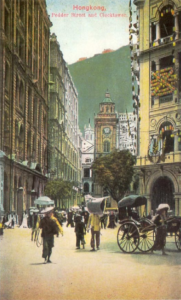
Placement and replacement of Hong Kong’s clock tower provides a case study in the changing relationship between urban space, colonial power, and standardized time.  The first clock tower in Hong Kong was built in 1862 at the junction of Peddler Street and Queen’s Road, two critical thoroughfares. As transportation needs increased, it was replaced and served as part of the Tsim Sha Tsui railway station. I will analyze these placements within the urban fabric of Hong Kong, and use them as evidence of the way that time was interpreted. 

Doreen Massey argues that space should be thought of in conjunction with time, in that space is constructed through social relations, which are inherently dynamic1.  The rapid proliferation of clock towers across the British Empire could, then, be thought of as an extreme example of space-time imperialism. Massey’s arguments help us to understand the way in which relations between colonial powers can impact the organization of a space, and associated temporal practices. Wen-hsin Yeh focuses on this, in her analysis of the Shanghai Bund, exploring the ways that a strict time-based system ultimately informed power dynamics and the economic shift towards capitalism2 . Similarly, Giordano Nanni’s monograph, The Colonization of Time, focuses on the imposition of British timekeeping onto indigenous populations in South Africa and Australia3. These studies provide a framework for my examination of the Hong Kong clocktower in space, as time. 

In 1843, Governor of Hong Kong, Henry Pottinger appointed Alexander Gordon as the Land Officer, Surveyor and Inspector of Roads of Hong Kong. He was tasked with the laying out of city infrastructure. Queen’s Road was established as the city’s main thoroughfare, acting as a belt around the city and as a boundary marker between racial residential zones. The Governor’s residence was placed at the starting point of Queen’s Road, creating a line of power into the city4. The colonial elite had a shared interest in standardized time. The tower was constructed as a public good, and time-keeping became a shared experience for those near it. It was placed directly in the junction of Peddler Street and Queen’s Road, thus making it widely visible for the foreign community, and unavoidable in daily life. The timepiece was a symbol of European establishment in the city, and its construction indicates the need for the foreign community to have a centralized and standardized time. This visible insertion should not be taken as universal acceptance, or even acknowledgement, but rather the way that time-relations within the foreign community manifested materially. 

Postcard showing Peddler Street and the Hong Kong Clock Tower, early 1900’s5

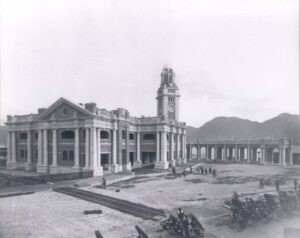
Eventually, with the proliferation of automobiles, having a massive tower in the street became cumbersome, and in 1913 it was demolished. A replacement tower was constructed at Tsim Sha Tsui as part of the new railway station.6Tsim Sha Tsui was already a transportation hub. Arthur Benison Hubback, a prominent army officer and architect in British Malaya was chosen to design the new terminus for the newly finished Kowloon–Canton Railway6. We should not overlook his history and role in empire, as they informed his architectural decisions. The significance of the placement lies in its incorporation into the wider transportation network. Rather than being a standalone, crowd funded obstruction, the clock tower becomes part of the regional infrastructure. As the tallest point on the shore, the tower physically asserted the dominance of time over the area. Incoming ships might see the clocktower, and understand that they were operating under the rule of imperial time, as well as imperial space. The stately Roman columns recall antiquity. Visually, the clocktower not only represents progress and modernity, but also refers to the distinctly European grandeur of a classical age. The Chinese living in Hong Kong are placed within a power-geometry favoring imperial time, a reminder even in the train station providing a link to the rest of China7.

Kowloon-Canton Terminus Station, Hong Kong (1916)8

Successive placements of Hong Kong’s clock tower reveal a changing relationship between standardized time, colonial space, and the wider world, as well as the spatial and temporal attitude within the foreign community of Hong Kong. On Peddler Street, time was made to be geographically at the center of the foreign community’s lives. At Tsim Sha Tsui, it became visibly part of transportation networks, and widely visible to visitors. The transformation helps to illustrate Massey’s argument that space is continually and relationally produced, and acts as a case study informing the wider literature regarding the proliferation of imperial time. 

In 1978, the train station was demolished. The clocktower was left standing, and today can be viewed as a vestige of imperial times. 

  1. Massey, Doreen. 1994. Space, Place and Gender. University of Minnesota Press. 9 [↩]
  2. Yeh, Wen-Hsin. 2007. Shanghai Splendor : Economic Sentiments and the Making of Modern China, 1843-1949. University of California Press. [↩]
  3. Nanni, Giordano. 2020. The Colonisation of Time. Manchester University Press. [↩]
  4. Ho, Pui-yin. 2018. “Duality in Planning (1841–1898).” Www.Elgaronline.Com, Edward Elgar Publishing, September 28. https://www.elgaronline.com/monochap/9781788117944/chapter01.xhtml. )). The Peddler Street Clocktower, erected in 1862, disrupted this line of power. It was funded through public subscription, as well as by a large donation from a Scottish watchmaker (( Chan, Catherine S. 2018. “Belonging to the City: Representations of a Colonial Clock Tower in British Hong Kong.” Journal of Urban History 45 (2): 321–32. https://doi.org/10.1177/0096144218769894. [↩]
  5. Valery M. Garrett, Hong Kong: Life and Times (Singapore, 1996), 120. via Chan, Catherine S. 2018. “Belonging to the City: Representations of a Colonial Clock Tower in British Hong Kong.” Journal of Urban History 45 (2): 321–32. https://doi.org/10.1177/0096144218769894. [↩]
  6. Ibid. [↩] [↩]
  7. Massey, Doreen. 2005. For Space. Sage. 183 [↩]
  8. The A B Hubback Project. 2021. “KOWLOON-CANTON TERMINUS | The A B Hubback Project.” https://www.abhubback.com/kowlooncantonterminushongkong. [↩]

Big Other is Watching You: Navigating methodological approaches to the Colonial City between Structure and Agency

Amongst scholars who have dwelt on colonial urbanisation, there is a dominant vein that agrees that the phenomenon of the ‘colonial city’ constituted a ‘heterogeneous but distinct urban type’.1 The explanations for this distinctiveness, however, have varied considerably. While Immanuel Wallerstein emphasised the colonies’ specific ‘peripheral’ place within the expanding global frame of industrialisation, Ronald Horvath and Terence McGee countered that this uniqueness was not reducible to such conventional classifications of urban development as ‘pre-industrial’, ‘transitional’ or ‘industrialised’.3 Instead, they understood the distinctiveness of the urban environment as the ‘spatial expressions of the imposition of an alien culture on an existing one’.3

Yet, as Brenda Yeoh argues, such approaches tend to treat the urban landscape as a reflection of colonial rule without attending to how the colonial city was physically ‘made’. In doing so, no matter what cultural, economic or political factors are invoked, these scholars ‘implicitly or explicitly’ assume that ‘the colonial town or city is either wholly or largely a creation of its colonial masters’.3 Although colonial administrators undeniably possessed vastly greater political and economic power than the populations they governed, to understand the colonial city simply as a product of imperial power obscures the ways that indigenous populations inhabited, negotiated and shaped these spaces. The challenge, then, is to account for the power of colonial rule without reducing those subject to it to passive, insignificant actors.

This is a familiar problem in the social sciences: how can we recognise the force of oppressive ‘structural’ power without negating the agency of individuals?  Michel de Certeau’s The Practice of Everyday Life offers one influential approach. Its central proposition, that ‘space is a practiced place’, sought to reinstate the agency of the ‘ordinary people’, who are ‘commonly presumed to be passive and guided by established rules’.4 Published in 1980, de Certeau described his work as both ‘analogous and contrary’ to Michel Foucault’s Discipline and Punish (1975), which emphasised how ‘proliferating technocratic structures’ of domination trapped the individual with an ever-intensifying ‘grid of discipline’.6

Yet, de Certeau’s account does indeed remain more ‘analogous’ to Foucault than this opposition suggests. In his example of walking in the city, de Certeau explains how authorities exercise conscious ‘strategies’, while individuals on the street must resort to ‘tactics’, that:

Lack [their] own place, lack a view of the whole, [and are] limited by the blindness resulting from combat at close quarters 7

Although walkers possess ‘agency’, they operate in the ‘absence of power’, within, or beneath, the ‘god-view’ of the authority.8 De Certeau therefore risks reproducing the binary he seeks to challenge: the omnipotence of power and the helplessness of the individual before it. As Doreen Massey argues, such a binary obscures the complex social relations through which power is produced and negotiated.9 This is particularly problematic in analyses of colonial cities, where it reinforces the image of an all-powerful empire acting on a passive population. While de Certeau’s effort to restore agency to ‘the weak’ is valiant, characterising their ‘tactics’ as unconscious and fragmented ultimately implies that they are still insignificant, incapable of driving change. Thus, the question is only intensified: how can we account simultaneously for the power of structures and the capacity of individuals to reproduce, negotiate and transform them?

Slavoj Žižek’s invocation of the ‘big Other’, elaborating on Jacques Lacan’s original conception, provides a way to approach the problem. The big Other does not refer to an individual or an institution but to the seemingly autonomous authority of the social order: the structures, rules and expectations that appear to exist independently above those that enact them.10 Yet, when Žižek claims, ‘the big Other doesn’t exist’ he does not deny the reality of power but rather challenges the idea that power exists as a natural or autonomous structure.11 The big Other has no existence independent of the people and institutions that reproduce it, yet it cannot be reduced to any one of them.

This can be illustrated through the all-too-familiar frustration of bureaucracy: after waiting two hours on hold, the customer service representative informs you that, while they sympathise with your situation, their ‘hands are tied’.12 By invoking regulations or higher-ups and referring only ‘to decisions which have always already been made’, they embody the authority of the ‘system’ they seem only to administer.13

This distinction is particularly useful for understanding colonial power. As Yeoh shows in her analysis of the Singapore Municipal Council, conflicts between government officials, councillors, ratepayers and professionals reveal how colonial power was actually practised: how legitimacy was claimed, negotiated for and given material effect.14 Colonial authority was not simply an autonomous structure imposed from the ‘god-view’ above but was produced and reproduced through individuals who embodied and enacted institutional power.

The methodological task, then, is not simply to replace the study of elites with the study of subalterns, but to examine the ‘interface’ through which power was enacted. It is through the ‘daily encounter’ that power can be studied:

in its external visage, at the point where it is in direct and immediate relationship […] it installs itself and produces its real effects 15

Following Massey, this offers a way beyond the structure-agency binary by locating power in the relations between people, institutions and spaces. As Yeoh argues, while we must recognise the ‘specific structural inequalities within colonial society’ that constrained different groups’ capacity to shape the built environment, these individuals (and groups) were also capable of intentional ‘strategies’: both those that were ‘motivated and intended’ and ‘those habitually carried out in practical consciousness.’16

Oriented in this way, de Certeau’s insight that space is practised remains valuable, provided that ‘practice’ is understood not simply as the resistance of ‘atomistic individuals’ but the way that social relations construct ‘the spatial’, ‘an ever-shifting social geometry of power and signification.’17 The colonial city should therefore be approached through the encounters in which authority became tangible: municipal meetings, planning disputes, petitions, regulations, professional networks, streets and buildings. The question is not simply who possessed power, but how actors mobilised, negotiated, subverted or reproduced its manifestations, practices enacted in space.


[1] Brenda Yeoh, Contesting Space in Colonial Singapore (Singapore, 2013), p.1.

[2] Ibid, pp.5-8.

[3] Ibid, p.5

[4] Ibid., pp.3-4.

[5] Michel de Certeau, The Practice of Everyday Life (Berkeley, 1984), p.35-6

[6] Ibid., p.xiv.

[7] De Certeau, Practice, pp.35-6, 38.

[8] Ibid., p.38.

[9] Doreen Massey, For Space (London, 2005), pp.45-6.

[10] Slavoj Žižek, How to Read Lacan (New York, 2006), p.8-10

[11] Section 3 from Slavoj Žižek, ‘The Big Other Doesn’t Exist’, Journal of European Psychoanalysis, 5, (1997)

[12] Mark Fisher, Capitalist Realism (Washington DC, 2009), p.25.

[13] Ibid.

[14] See Yeoh, Contesting Space, pp.28-59.

[15] Michel Foucault, Power/Knowledge, p.97.

[16] Yeoh, Contesting Space, p.17.

[17] Doreen Massey, Space, Place and Gender (Cambridge, 2007), p.3.

Urban Planning in Colonial Malaya & Singapore

As is the case with most urban planning, functionality was a main concern when drawing up urban plans for colonial Singapore and Malaya. Functionality, however, was not the only concern. Swettenham’s British Malaya: An Account of the Origin and Progress of British in Malaya (1907) and Pearson’s analysis of Jackson’s Plan both show the main priorities when planning how to construct and organise colonial settlements. Particularly in the cases of Singapore and Malaya, British authorities used urban planning as a means of reorganising colonial space to maximise economic productivity and/or administrative control. Even if plans were not successfully realised, the designs reveal British ambition and intentions which go further than simply functionality in urban planning.

Sir Frank Swettenham’s British Malaya: An Account of the Origin and Progress of British in Malaya (1907) is particularly revealing of the way in which the British used urban planning for the purpose of advancing economic priorities. Frank Swettenham, author of the aforementioned source, was a former Governor of the Straits Settlements, as well as the High Commissioner for the Federated Malay States. In British Malaya: An Account of the Origin and Progress of British in Malaya (1907), Swettenham writes from an insider perspective of his experiences within the colonial administration. Swettenham’s ideas surrounding economic growth being at the centre of urban planning became abundantly clear during his discussion of road construction in the Malay States. Swettenham describes roads in an interesting fashion. Instead of focusing on their practical purpose, getting people from one settlement to another, Swettenham instead describes the infrastructure as follows: “A bridle road was no sooner completed than small houses, plantations, and fruit and vegetable gardens sprang up along its whole length.”1 He writes that as the roads were improved upon, the villages were developing simultaneously. This means that roads, in the urban planning process, managed to alter the spatial organisation of the landscape by encouraging economic activities to be concentrated alongside them, a premeditated effort established by the colonial administration. This illustrates how space was seized as an opportunity to plan for the best economic outcome.

This is not the extent of economic growth as a main priority in the urban planning of Malaya. Swettenham additionally writes that, “revenue and prosperity follow the liberal but prudently-direct expenditure of public funds”2 especially when money is invested in “high-class roads, in railways, telegraphs, waterworks, and everything likely to encourage trade and private enterprise.”3 Here, Swettenham is stating that infrastructure is important because it increases land values, encourages private investment, and facilitates commerce, which ultimately benefits the government and its revenue. Swettenham is using urban planning by analysing the physical organisation of the settlement and connecting it to the networks of trade and private enterprise to best enhance productivity. The economic growth provided by the settlement, by proxy, benefits the administration that oversees it, once again proving economic growth and administrative interest are at the heart of urban planning in colonial Malaya.

Swettenham’s account, however, also reveals specific administrative efforts made within the colonial settlements whilst urban planning. Swettenham writes, “Sanitary Boards were instituted to regulate the markets, sanitation, slaughter-houses, laundries, water supply,”4 as well as various other aspects. The introduction of “Sanitary Boards” meant a new opportunity for colonial authorities to exercise power over civilians. Swettenham’s account also lays out other administrative positions that each coincide with a different location in the settlement, writing, “his main supports were the officer in charge of districts, originally styled District Magistrates.”5 This means that in urban planning, each district was assigned an officer to oversee it, showing how administrative efforts were implanted into the design of the city itself. In other words, with each district comes a specific administrative force to govern it. Swettenham’s account once again proves administrative control was at the forefront of urban planning, as the city was specifically planned for positions that coincided with certain districts.

Outside of Malaya, urban planning in colonial Singapore was orchestrated around optimisation for greater administrative gain. In H.F. Pearson’s analysis of Jackson’s Plan, the text shows British colonial powers using urban planning to implement administrative control over the settlement, though in this instance it was not exactly successful. However, the intent was always evident. The intent is especially evident in Pearson’s analysis of Jackson’s Plan, which demonstrates the ambitions of colonial planners for Singapore. Pearson cites a contemporary description of the plan: “The general plan of the town, showing the allotment of the different campongs, principal roads and streets, and the ground reserved for public purposes,”6 which shows an initial effort to make Singapore spatially ordered and, ultimately, more administratively manageable. Jackson’s Plan also included “well-regulated roads and kampongs planned according to Raffles’s instructions.”7 The language here of “well-regulated” and “planned according to Raffles’s instructions” yet again reinforces that colonial officials wanted Singapore’s physical organisation to reflect British administrative decisions.

The cases of colonial Singapore and Malaya both go to show that urban planning was not merely about creating a functional colonial settlement. Rather, urban planning was used to create a spatial organisation of a colonial settlement that was best equipped to be governable and easily regulated administratively as well as being economically efficient. The pieces of Swettenham and Pearson allow us to understand what intentions are behind the planning of a colonial city and how those intentions become realised in the actual city itself.

  1. Frank Swettenham, British Malaya: An Account of the Origin and Progress of British Influence in Malaya (London: John Lane, 1907), 238–39. [↩]
  2. Swettenham, British Malaya, 294. [↩]
  3. Swettenham, British Malaya, 295. [↩]
  4. Swettenham, British Malaya, 239. [↩]
  5. Swettenham, British Malaya, 242. [↩]
  6. H. F. Pearson, “Lt. Jackson’s Plan of Singapore,” Journal of the Malaysian Branch of Royal Asiatic Society 42. no. 1 (1969): 163, quoting Singapore Consultations, 7 February 1823. [↩]
  7. Pearson, “Lt. Jackson’s Plan of Singapore,” 164. [↩]

Space and spatiality – relation with the social and temporal

Reading the works and ideas of Henri Lefebvre, Michel de Certeau, and Doreen Massey have provided me with a rich dose of theoretical conceptualisations with regard to space. The texts themselves, if I were to be fully honest, are quite bemusing, even intimidating at times. Indeed, starting with Lefebvre’s own piece of writing has not been the most helpful in establishing a preliminary idea of space and spatiality for a beginner. Andy Merrifield was spot on when he wrote down how Lefebvre, in The Production of Space, “breezes through the history of Western philosophy as if it’s kids’ stuff”.1  Fortunately, the works by Merrifield himself and Elden Stuart have proven very helpful in presenting Lefebvre’s arguments with a less esoteric register, while pieces by de Certeau and Massey have provided interpretations of spatiality from various refreshing vantage points. I was able to extract two insights from the readings: first, the intertwined relation between space and the social (including modes of production, knowledge, and power); second, the need to place space alongside time, rather than approaching them in hermetic manners.

In various different ways, space is created and conditioned by the social.  With an identifiable Marxist tone, Lefebvre describes space as the direct product of modes of production (encompassing both material production and the production of society and knowledge). 2 Similarly, Doreen Massey makes sense of space and place with the rationale that they were shaped by innumerable social relations of various nature, across wildly different scales. This line of thinking does not see the dissecting the genesis of space as its intellectual endpoint, however. Beyond repudiating the conventional perception of space as a meaningless backdrop to more prominent occurrences, space is seen to have momentous importance on its own. Lefebvre’s initial fascination with space comes precisely from his study of everyday life, where he discovered how the transition from rural to urban space had a huge bearing on people’s quotidian experience.3  Thus came his later emphasis on space as the indispensable coordinates of human life. As the locus and medium of human activities, it affects the latter through a triad of spatiality — physical space is concretely perceived; mental space is abstractly conceptualised; and social space is intimately lived by people.4  Indeed, “Space has long ceased to be a passive geographic or empty geometric milieu. It has become instrumental”.5  In a way, Michel de Certeau provided a lucid illumination on how spatiality itself could have profound influence. Describing the view of New York from the Twin Towers, the elevated viewer evolved into a voyeur, as if Icarus breaking free of the labyrinthine chains crafted by Daedalus — “It allows one to read it, to be a solar Eye, looking down like a god. The exaltation of a scopic and gnostic drive: the fiction of knowledge is related to this lust to be a viewpoint and nothing more”.6  Therefore, space deserves to become a subject of inquiry on its own, not least because its formation sheds light on social relations at work, but also for the independent significance it has come to possess. By extension, the relation between space and power is also a prominent thread of inquiry by these scholars. As Lefebvre argues, the close relation between space and mode of production (especially capitalism) led to space’s existence as “a means of control, and hence of domination, of power”. 7  Massey’s works, delving into the interlacing of social relations and space, have explained the connection with greater clarity. The triumphalist Western narrative of the age of discoveries, for example, painted the indigenous civilisation as a static existence on the spatial continuum, lacking a trajectory of their own in contrast to that of the conquering Europeans. 8  Taking up the gender scope, Massey also elucidated how feminine imageries were intimately bound with the conception of the motherland as well as the home, amounting to a domestication of women who were barred from venturing beyond their own households.9  Finally, articulations of a sense of place which have gained traction in the present age of globalisation are also susceptible to being hijacked by defensive, reactionary nationalism/localism.10  Space, therefore, is neither an empty container, nor a trivial, inanimate product of social relations. As an end in itself, it has the capacity to condition and drive human activities and broader historical developments. For all the struggle I have endured working through the highly abstruse texts, I have gradually come to learn the rationale behind thinking about space and spatiality.

Furthermore, instead of treating them as conceptually sealed off, a sophisticated analysis of space should also take account of the idea of time. As Stuart has rightly pointed out, Lefebvre’s foremost contribution, rather than the elevation of space in lieu of time, was his examination of space alongside time.11  According to Lefebvre, representational spaces, closely linked to the social life of people, are very much ‘the loci of passion, of action and of lived situations, and thus immediately imply time’.12  The temporal face of space — and indeed the spatial face of time — was explored more systematically in the works of Massey who laid great emphasis on the concept of “space/time”. In her brilliant introductory chapter to For Space, Massey engagingly set out the interlacing between space and time, as spatial articulations and conceptualisations often imply a temporal dimension. Taking Clinton’s denunciation of countries like Mozambique and Nicaragua who supposedly stood against the tides of globalisation as an example, the author centred on the President’s characterisation of the said countries as “behind”. Through “a sleight of hand in terms of the conceptualisation of space and time”, the simultaneous coexistence of different countries on Earth has its spatial dimension suppressed. Instead, the problem was given a historical temporality, with Mozambique and Nicaragua cast as those among us that are in a more primitive stage. 13  Apart from this, the temporal dimension of space was underlined from another vantage point, with space described as inherently dynamic, moulded by the multiplicity of social relations that were also undergoing constant change. Against the essentialist position, therefore, space is instead “unfixed, contested and multiple”.14  Thus, it becomes the natural conclusion that any reference to space must necessarily take into consideration the temporal implications, and vice versa. Personally, I find this contention very intriguing, despite still having difficulties fully grasping its theoretical intricacies. One potential interest I have derived from reading these works is how time might be experienced variously across different spaces — in a rural village in China’s inland, on the Bund in Yokohama, or aboard an international cargo ship, etc. In these drastically different scenarios, the experience of space and time informs each other. Though as yet heavily based on quotidian impressions, they can be developed into subjects of proper investigation.

  1. Andy Merrifield, Henri Lefebvre: A Critical Introduction (New York, 2006), p. 10 [↩]
  2. Elden Stuart, Understanding Henri Lefebvre: Theory and the Possible (London, 2004), p. 184; Henri Lefebvre, The Production of Space (Oxford, 1991), pp. 31-33. [↩]
  3. Stuart, Understanding Henri Lefebvre, p. 181. [↩]
  4. Stuart, Understanding Henri Lefebvre, pp. 192-193; Lefebvre, The Production of Space, pp. 33-36 [↩]
  5. Stuart, Understanding Henri Lefebvre, p. 189. [↩]
  6. Michel de Certeau, The Practice of Everyday Life (Berkeley, 2011), p. 92. [↩]
  7. Lefebvre, The Production of Space, p. 26. [↩]
  8. Doreen Massey, For Space (London, 2005), pp. 1-4. [↩]
  9. Doreen Massey, Space, Place, and Gender (Cambridge, 1994), pp. 10-11. [↩]
  10. Ibid., pp. 151-154. [↩]
  11. Stuart, Understanding Henri Lefebvre, pp. 169-170. [↩]
  12. Lefebvre, The Production of Space, p. 42. [↩]
  13. Massey, For Space, pp. 4-5. [↩]
  14. Massey, Space, Place, and Gender, p. 5 [↩]