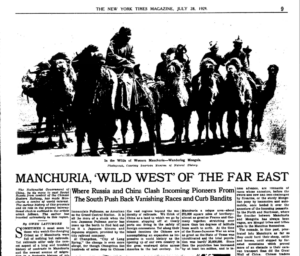
Owen Lattimore was born in 1900 to English teachers, and he grew up in American settlements in China, specifically Shanghai, Baodingfu, and Beijing.1 He would go on to be an eminent sinologist. In 1929 he wrote the New York Times article, Manchuria, Wild West of the Far East. His lived experience is reflected in his writing, “We think of China as a land to which we go by steamer, stopping off at treaty ports and living in the safety of foreign concessions.”2 In this work, he rhetorically makes Chinese settlement legible to New York Times readers through the lens of American westward expansion. He is not only engaging with the American audience, but simultaneously legitimizes the settlement of Manchuria internationally as a vehicle for progress and modernity. However, his lack of mention of Japanese involvement in the opium trade exposes the selectivity of this narrative, revealing pitfalls in using foreign accounts as source material.
Though 20th century Manchuria was fundamentally Chinese territory, both Russia and Japan had large foreign concessions and populations due to their construction of the Chinese Eastern Railway and Southern Manchurian Railway, respectively. So much so that Lattimore writes, “A traveler going through Manchuria by rail might well think he was passing through three countries.” To an American, this means that in Changchun, you will not be met with “Chinese coolies” but rather, a “stalwart bearded, white-aproned Russian porters”, and in Mukden, a “neat Japanese Pullman porter” will lay out “Japanese slippers”. He uses service workers as a tangible way to communicate the internationality of the region.3
He connects his reporting to issues that Americans care about. The meeting of “Russia and China” in Manchuria has the potential to affect geopolitics. Unless the two countries can “come to an agreement about limits of expansion and colonization, then Manchuria will once more be the pivot of war and invasion.” Japan is mentioned throughout the article in a commercial and modern sense, their “enterprise and efficiency” is emphasized. But ironically, they are not included in the geopolitical analysis.3
The narrative established by Lattimore of railway modernity dominating over tribalism and lawlessness is undercut by his reporting on opium. He writes that “railroads and international rivalries have turned several Manchurian “rackets” into big business”. He writes that pioneers are pressured by bandits that have “universally become known as Hunghutze, or Redbeards” to grow opium, which is then “smuggled [by bandits] in every conceivable way, even in the heating pipes of passenger trains”.3 I was not able to find a source to corroborate drug deception through heating pipes. Though he is not incorrect that bandits or natives posed a serious threat to settlement, the main vehicle in Manchuria for opium and smuggling was the Japanese empire itself. A New York Times article from Feb. 14, 1919 circulated a charge that the Japanese smuggled opium into China through their control of the South Manchurian railway. Under Japanese extraterritoriality, even prior to the Manchurian Incident 1931, “no Japanese can be arrested without informing the consulate.”4 However, this would disrupt the narrative being painted by Lattimore of railway civilization inserting itself into uncivilized lands. The railway did not simply replace the supposedly lawless frontier with an ordered, modern society, but facilitated new forms of exploitation and illicit economic activity.
The article thus falls within a large group of literature either consciously or unconsciously perpetuating colonial civilizing justifications, while being historically flawed and incomplete. For instance, the 1900s to the 1920s Japanese “bazoku” or “bandit” literature used masculine bandit figures to intellectually transform Manchuria into a Japanese frontier for conquest5. Modern ‘Kimchi Westerns’, mostly by Korean studios, such as the Good, the Bad, and the Weird (2008), and Netflix original series Song of the Bandits (2023) portray Manchuria as a lawless territory undergoing modernisation. Both heavily feature railways as avenues for this change, and to say they lack historical precision is perhaps an understatement.
- https://academic.oup.com/oxford-dictionary-of-national-biography/reference/63486/reference-article-abstract/580946462?redirectedFrom=fulltext#580946462 [↩]
- https://www.nytimes.com/1929/07/28/archives/manchuria-wild-west-of-the-far-east-where-russia-and-china-clash.html [↩]
- Ibid. [↩] [↩] [↩]
- https://www.nytimes.com/1919/02/14/archives/charge-that-japan-aids-opium-trade-sends-morphia-into-china-and.html [↩]
- https://www.cambridge.org/core/journals/modern-asian-studies/article/making-manchuria-japans-frontier-the-bazoku-fantasy-and-imperial-masculinity-1900s1920s/BBF0A932AEE726AC40CA3FB07DADA2A6 [↩]