Beyond Objectification: The Role of Women in the Wartime Economies of Japan and Vietnam

While stationed in Yokosuka during the American occupation of Japan, the cartoonist Bill Hume began drawing cartoons featuring a character named “Babysan,” a highly sexualized caricature of Japanese women.  Babysan: A Private Look at the Japanese Occupation was published in 1953 and in 1965, Tony Zidek published a similar collection of cartoons called Choi Oi! The Lighter Side of Vietnam, while serving in the Vietnam war.  Published as “morale-building” material for deployed soldiers as well as nostalgic accounts for those who had returned to the US, the books depict the interactions of American soldiers with Japanese and Vietnamese women.  Looking beyond their overt objectification of women, they provide insight into the roles these women played in the economic systems which developed under the American presence.

The women depicted in Babysan belong to “the greyer category of what were sometimes referred to as onrii (from ‘only’ or ‘only one’), or women who engaged in serial, ostensibly monogamous relationships with ‘only one’ uniformed lover at a time, and who received various forms of material compensation in return.”1 Although Japanese women are portrayed primarily as objects of American consumption, the cartoons suggest that women held considerable power over financial transactions.  One cartoon features Babysan remarking, “No dependent?” as she looks over her boyfriend’s tax form.2 Hume describes how the boyfriend is not only expected to support Babysan financially, but in some cases her family as well.  Women are depicted as being dependent upon the support of American soldiers, but also as financially intelligent and using their “resources” (American soldiers) as effectively as possible.  Hume states that, “Japanese women are traditionally the holders of the purse strings, so Babysan knows of many more practical ways of using his okane.”3 Not only do women control the “purse strings” of American soldiers, but Hume suggests that many women had multiple American partners and therefore multiple sources of income.

To ensure their financial security, women relied on networks of information to learn the whereabouts of their partners.  In Babysan, Hume describes how “She and her girl friends, with apparently the help of everyone else in town, have a highly efficient communication system that the Americans call the grapevine,” a system which “gives them a forecast of their economic future.”4 Although Babysan makes no direct references to black markets or prostitution, they were highly successful around American bases and likely relied on similar systems of communication.  Around 70,000 women were employed legally as prostitutes and thousands more worked on a private basis.5 Each of these ventures relied on the capital provided by Americans, combined with an internal network of information.

Like Japan, Vietnam saw the rise of black market operations following an influx of American soldiers.  “American goods dominated storefronts and street vendors’ stands in Saigon, Hue and Da Nang, putting a tight pinch on local manufacturing which could not compete. American soldiers and civilians, and the United States government, had money to spend… Vietnam realised with equal cleverness that there was money to be made.”6 As black markets flourished in Vietnam, so did currency fraud which was facilitated by informal street vending stalls or “Howard Johnsons.”  One cartoon from Choi Oi remarks, “Saigon’s ‘Howard Johnsons’ do have a flair for providing ‘extra’ services also.  Numbered among them is the illegal exchange of money.”7 Another cartoon depicts a Howard Johnson advertising the daily exchange rate of piastres to dollars and an exchange between the woman running the stall and an American soldier.8

Vietnamese, particularly women, often played the role of go-between in these schemes. For example, a soldier might get wind of an upcoming MPC conversion date… A soldier would take X piastres to the US exchange at a particular installation and purchase US dollars. He (or his Vietnamese house servant or girlfriend) would then take the dollars to the black market and purchase X + Y piastres, Y being the difference between the rate at the American exchange and the black market rate of exchange.9

Women were both “go-betweens” for Americans as well as the ones exchanging money and operating stalls.  Their role extended beyond that of wife or girlfriend, and even beyond the Vietnam War itself.  After socialist forces took and renamed Saigon, “In Ho Chi Minh city women from the middle and upper classes were involved more in socio economic activity, they were also more active in business and financial transactions, and in the black market.”10 Even after the American presence in Vietnam disappeared, women continued to play important roles in the economic systems that had taken hold as a result of the war.

While the women in Babysan and Choi Oi appear as sexualized objects of humor and entertainment, the cartoons suggest that their real role in post-war and wartime economies was varied and complex.  The American presence in Japan and Vietnam was a major contributing factor to the economic hardship faced by Japanese and Vietnamese women, but while American soldiers were present, women used soldiers both as a source of income and as a way to make the most of the financial situation caused by their presence.

  1. Kim Brandt, “Learning from Babysan,” review of Babysan, by Bill Hume, Japan Society, 3 https://aboutjapan.japansociety.org/learning-from-babysan#sthash.pt5iJI39.dpbs. [↩]
  2. Bill Hume, Babysan: A Private Look at the Japanese Occupation (Tokyo: Kasuga Bocki K.K., 1953), 56-57. [↩]
  3. Hume, Babysan, 92. [↩]
  4. Ibid., 98. [↩]
  5. Brandt, “Learning from Babysan,” 2, 9. [↩]
  6. William Allison, “War for Sale: The Black Market, Currency Manipulation and Corruption in the American War in Vietnam,” in War & Society 21 no. 2, (2003): 135. [↩]
  7. Tony Zidek, Choi Oi! The Lighter Side of Vietnam (Rutland & Tokyo: Charles E. Tuttle Co., 1965), 34. [↩]
  8. Zidek, Choi Oi!, 35. [↩]
  9. Allison, “War for Sale,” 146. [↩]
  10. Tran Phi Phuong, “Work and family roles of women in Ho Chi Minh City,” in International Education Journal 8 no. 2, (2007): 290. [↩]
Mitsukoshi and IKEA: Traveling Department Stores

In 1905, the Mitsui Dry Goods Store changed its name to Mitsukoshi and began advertising itself as Japan’s first department store.  The original store was founded in 1673, but it went through a long process of transformation to become the modern department store that exists today. In 1878, it began hosting bazaars where the public would take off their shoes before wandering through the stalls of goods, and in 1904, the addition of windows to the storefront allowed people to look in at goods from the street.1 While many of the innovations Mitsukoshi implemented were modeled on Western department stores, Mitsukoshi created its own unique “department store experience” and its branch stores in colonial Korea and Dalian enjoyed similar success when they opened in the 1930s.2

Despite Mitsukoshi’s popularity in Japan and Southeast Asia, it was less successful in the United States.  In 1979, it opened its first branch in New York in an effort to “learn more about the American market and equalize the Japanese United States balance of trade.”3 It opened its doors just as another Japanese department store, the Takashimaya company was reducing the size of its Fifth Avenue location.  The Takashimaya Company also began “shifting to primarily American products from largely Japanese because of the rising price of the Japanese merchandise.”4 Despite its goal of learning about American markets, the New York branch of Mitsukoshi closed in the 1990s.  While the failure of Mitsukoshi in New York was attributed to economic factors, it is essential to note that the products and experiences that department stores offer their customers are tailored to the place itself and its consumption culture.  In New York for instance, consumers were less interested in expensive Japanese products from a brand without widespread recognition in the United States.

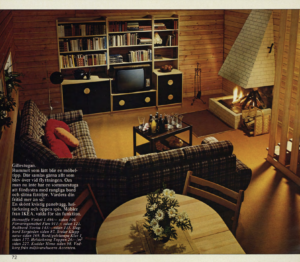
The difficulties of adapting shopping experiences to new markets went in both directions. Although certain aspects of Japanese department stores were modeled on Western department stores, this does not mean those stores were universally successful when transplanted to Japan.  Like the Mitsukoshi in New York, Ikea failed to adapt to the needs of Japanese consumers.  In 1974, Ikea entered the Japanese market but by 1986 all locations had closed.  This was attributed partly to different consumer habits, as “Japanese consumers at that time were not ready for the ‘self-service and self assembly’ concept because Japanese consumers were only accustomed to a high level of service,” but also to the spatial practices of the Japanese.  Japanese homes and living spaces tend to be smaller and “the Scandinavian style furniture from Sweden did not fit small-space living.”5

“1974 Ikea Catalogue,” Ikea Museum, 72 https://ikeamuseum.com/en/digital/ikea-catalogues-through-the-ages/1970s-ikea-catalogues/1974-ikea-catalogue/.

In 2006, Ikea relaunched in Japan with new strategies for adapting to the Japanese market.  A recent series of promotional videos on how to furnish tiny homes with Ikea products demonstrates the store’s recognition that their products must to cater to the specific spatial needs of Japanese customers.6

Like Mitsukoshi, Ikea failed to adapt to consumer habits and spatial needs.  While department store models often appear transferable, the success of a department store depends on more than management and appearances.  In a comparison of shopping malls, Lizzy van Leeuwen notes that “although the design and management strategies of shopping malls are rather standardized all over the globe, the social configurations of these centres of consumption differ remarkably at local levels.”7 The social and spatial configurations of department stores are just as unique at local levels and stores must take into account the experience of shopping as well as the specific needs and spatial practices of their customers.

  1. Brian Moeran, “The Birth of the Japanese Department Store,” in Asian Department Stores, ed. Kerrie L. MacPherson (London: Routledge, 1998). [↩]
  2. Aso, Noriko, “Mitsukoshi’s Expansion Before 1945” Bodies and Structures 2.0: Deep-Mapping Modern East Asian History. [↩]
  3. “Mitsukoshi Opens Here.” The New York Times, March 16, 1979. https://www.nytimes.com/1979/03/16/archives/mitsukoshi-opens-here.html. [↩]
  4. “Mitsukoshi Opens Here.” [↩]
  5. Thy Nguyen, Yingdan Cai, & Adrian Evans, “Organisational learning and consumer learning in foreign markets: A case study of IKEA in Japan,” Paper presented at The British Academy of Management 2018 Conference, UWE Bristol, UK (2018), 9. [↩]
  6. WK Tokyo, “IKEA |Tiny Homes Episode 2: Small Space Visions,” YouTube, December 21, 2021, https://www.youtube.com/watch?v=60KL3p-M27k. [↩]
  7. Lizzy van Leeuwen, “Celebrating Civil Society in the Shopping Malls,” in Lost in Mall: An Ethnography of Middle-Class Jakarta in the 1990s (2011), 162. [↩]

Humanizing the “Modern Girls:” Dancehalls and Social Spaces in the Photography of Hamaya Hiroshi

Hamaya Hiroshi, the renowned photojournalist, began his career documenting Tokyo in the 1930s.  In the 1940s and 50s, he traveled extensively in rural Japan, photographing the landscape, the people, and their daily lives.  In the 1960s he returned to Tokyo and captured students protesting the U.S.-Japan security treaty.1 While his work is wide-ranging, much of his photography focuses on the human experience and the social spaces which serve as a backdrop for daily interactions.

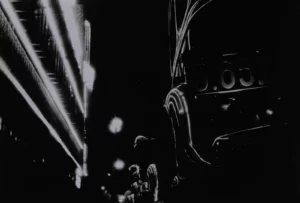
In his early photography, Hamaya captured the urban life of Tokyo in the 1930s, with a focus on dancehalls and social dancers. The Ginza district, in particular, was renowned for its vibrant nightlife, including dancehalls, jazz bands, and taxi-dancers, women who could be hired as dance partners. One of Hamaya’s 1934 photographs depicts a line of taxis at night, waiting for customers in Ginza, suggesting the similarities between hiring taxis and dance partners, both of which lined up to wait for paying customers.2 Beyond depicting life in the city, Hamaya’s photographs also document the rise of consumerism. The commercial nature of the dancehalls was a stark reality the women who worked there.  For men, they were social spaces of leisure, but for women they were often spaces of labor.3

The rise of consumerism was evident in the popularity of dancehalls as well as the emergence of a new type of woman: the “modern girl” who could be recognized by her western style, short dresses, and bobbed hair.  She was not only defined by her appearance but also the places she visited, such as “the café, the cinema, the theater, the department store, the ocean liner, and the dancehall.”4 In Japan, the modern girl was a symbol of progress, but she was also relentlessly attacked by the media.  In popular culture, she was often sexualized to represent her threat to morality and “her daring bob stood out as a graphic illustration of the rise of consumerism.”5 The modern girl demonstrated that women could be financially independent, but the self-commercialization of taxi-dancers undercut this progressive image by associating the modern girl with the negative aspects of consumerism.

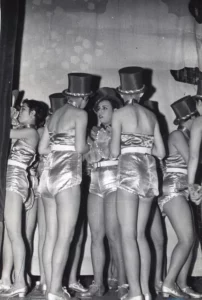
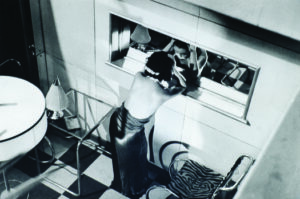
Hamaya’s dancehall photography presented alternative views of the spaces and the dancers.  While dancehalls were places of female labor, male socialization, and venues that presented the opportunity for men and women to be in close proximity, Hamaya’s photograph of revue girls at Nichigeki Theatre in 1938 shows the women at rest, socializing with each other.6 Photographing the women in between performances reveals another side of the social space of dancehalls outside their intended purpose.  Similarly, Hamaya’s photograph of a woman looking at herself in a mirror in the Florida dancehall in 1935 reveals a moment of rest and solitude in a space designed for constant activity and crowds.7 These photographs humanize their subjects and present an alternative to the highly sexualized image of the “modern girl.”

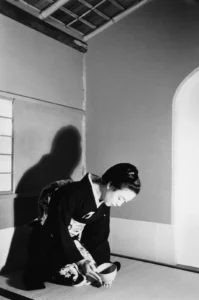
His later photographs capture social spaces that are uniquely Japanese, like bathhouses, festivals, and tea ceremonies.8 His photographs of the rural labor of rice farmers, fishermen, and folk dancers reveal a fascination with “social customs that some would consider quintessentially Japanese,” and he “pictured the Japanese folk as a way of typifying human responses to the environment their work practices for survival necessitated.”9 The social spaces, customs, and labor of rural Japanese people in these photographs were essential aspects of rural life, if not survival.  Like these rural spaces and practices, the dancehalls of the 1930s were an important aspect of Japanese life in the city and the labor of social dancers was simply one way of surviving in an urban environment.  While critics of the modern girl targeted her morality and sexualization, “Their elitism mirrored their hostility toward consumerism and their inability to see the modern girl in her role as a modern construct.”10 Hamaya humanized their labor and presented an alternative view of the modern, working woman.9

  1. John Clark, “Hamaya Hiroshi (1915–1999) and Photographic Modernism in Japan,” Self and Nation, Vol. 7, Issue 1 (Fall 2016). [↩]
  2. “Taxis Waiting for Customers, Ginza, Tokyo, 1934,” Michael Hoppen Gallery, https://michaelhoppen.viewingroom.com/content/feature/47/artworks-6748-hiroshi-hamaya-taxis-waiting-for-customers-ginza-tokyo-1934-printed-1960/. [↩]
  3. Vera Mackie, “Sweat, Perfume, and Tobacco: The Ambivalent Labor of the Dancehall Girl,” in Modern Girls on the Go: Gender, Mobility and Labor in Japan, eds. A. Freedman, L. Miller & C. Yano (Stanford: Stanford University Press, 2013), 68. [↩]
  4. Mackie, “Sweat, Perfume, and Tobacco,” 71. [↩]
  5. Barbara Sato, “The Modern Girl as a Representation of Consumer Culture,” in The New Japanese Woman: Modernity, Media, and Women in Interwar Japan, eds. Rey Chow, Harry Harootunian, & Masao Miyoshi (New York: Duke University Press, 2003), 77. [↩]
  6. Hamaya Hiroshi, “Revue girls, Nichigeki Theatre, Yurakucho, Tokyo, 1938,” Michael Hoppen Gallery, https://www.michaelhoppengallery.com/artists/125-hiroshi-hamaya/overview/#/artworks/9804. [↩]
  7. Hamaya Hiroshi, “Dancer Looking Herself in a Mirror, Ballroom Florida, Akasaka, Tokyo, 1935,” from Alexandra Lange, “‘Deco Japan’ + Designing Women,” Design Observer, March 26, 2012. [↩]
  8. Hamaya Hiroshi, “A Woman Performing the Tea Ceremony,” Michael Hoppen Gallery, https://michaelhoppen.viewingroom.com/content/feature/47/artworks-2544-hiroshi-hamaya-a-woman-performing-the-tea-ceremony/. [↩]
  9. Clark, “Hamaya Hiroshi (1915–1999) and Photographic Modernism in Japan.” [↩] [↩]
  10. Sato, “The Modern Girl as a Representation of Consumer Culture,” 68. [↩]

Protests Against Modernisation: How Japanese Authors Document Transportation Infrastructure

Trains and rail lines feature prominently in Japanese literature on modernization and growth, but writers are often critical of the ways in which new modes of transportation transform the areas around them.  In Murakami Haruki’s introduction to Sanshiro by Natsume Soseki, he describes the parallels between his life and the novel’s namesake, sixty years apart.  In 1908, Sanshiro travels for two days to reach Tokyo by steam train, while Murakami makes a similar trip in under four hours on the bullet train.1 Despite the difference in time and circumstances, their reactions to trains and descriptions of them in literature are strikingly similar.  Both Soseki and Murakami associate trains with the perils and confusion of modernity and the challenges posed by rapid technological change.  These literary depictions are not only allegorical, but reflect the reality of political protest against the consequences of modernizing transportation.

In Murakami’s 2014 novel, Colorless Tsukuru Tazaki and His Years of Pilgrimage, the train-obsessed Tsukuru sees trains and stations as spaces of possibility, beginnings, and endings, but the theme of transport is also associated with the character’s personal trauma and struggles with living in a modern world.  In the novel, trains provide snapshots of “modern” life and the struggles which come with it: “There was still some time before the train opened its doors for boarding, yet passengers were hurriedly buying boxed dinners, snacks, cans of beer, and magazines at the kiosk. Some had white iPod headphones in their ears, already off in their own little worlds. Others palmed smartphones, thumbing out texts, some talking so loudly into their phones that their voices rose above the blaring PA announcements… Everyone was boarding a night train, heading to a far-off destination. Tsukuru envied them. At least they had a place they needed to go to.”2 While trains symbolize the character Tsukuru’s internal turmoil, Murakami also uses physical proximity to trains to describes his own personal experiences of living in poverty.  He remembers that “ the National Railways’ Chūō Line ran by just below the window, which made it horribly noisy… We used to have long freight trains running by until the sun came up.”3 Not only do trains represent inner emptiness in his novel, but in his own life they are a physical manifestation of his financial circumstances in the 1970s.

Despite the separation between Murakami and Soseki, both authors associate the noise of trains with modernity, and characterize it as an unwanted inconvenience.  In contrast to Murakami’s noisy home, Sanshiro describes his University campus as being “extraordinarily quiet. Not even the noise of the streetcars penetrated this far.”4 While the expansion of transportation is often presented as a symbol of progress in historical accounts, Murakami and Soseki question whether the benefits of modernized transportation are truly positive for all.  In Sanshiro, a member of the University faculty exclaims, “They’ve built so damned many lines the past few years, the more ‘convenient’ it gets, the more confused I get.”5 His comment reveals the conflict between the convenience of modernization and the disorientation it generates.

The metaphorical associations between new modes of transportation and “confusion” in literature not only reflect the attitudes of certain communities towards government efforts of modernization, but are also effective forms of political protest.  In Nishiguchi Katsumi’s semi fictional account of the Japanese National Railway’s proposal of a new line connecting Tokyo and Kyoto, he describes the reactions of Kyoto residents who “are drawn in at first but gradually realize that they are about to lose their homes.”6 This is a process that repeats throughout history from the introduction of steam trains in 1872, street cars in 1903, and bullet trains in 1964, all of which rapidly changed the areas they connected and crossed.7 These continuous efforts to modernize transportation heavily impacted communities, but often their negative effects are overlooked in official discourse and historical narratives.8

Literary representations of transportation not only demonstrate its symbolic power, but they also document the impact on communities and the attitudes of citizens, serving as a form of protest.  In Sanshiro, “One streetcar line was to have run past the Red Gate, but the University had protested and it had gone through Koishikawa instead.”4 The University’s ability to lobby the government into redirecting the train line demonstrates the influence of powerful organizations to shape infrastructure, while also revealing the places which are powerless to avoid the disruption of their communities.  While the University remains quiet and undisturbed, other communities will be transformed and perhaps destroyed by the “noise” of modernization.  Nishiguchi’s account provides a case study of this situation fifty years later in 1958.  JNR’s plan for the proposed the line connecting Tokyo and Kyoto overlooked those “for whom the personal costs would be highest: people evicted from their homes and workplaces or condemned to life under the shadow of busy elevated tracks.”9 

While literature often seems detached from reality, the views of Soseki, Murakami, and Nishiguchi reveal that negative attitudes towards modern transportation networks existed for more than a century.  Rather than criticizing “modernisation” itself, their works address the human costs which exist in any fast-paced movement of modernisation. They provide insight into the effects of rapid technological advancement on communities with little political power and document the perspectives of those who don’t feature in historical narratives.

  1. Natsume Soseki, Introduction to Sanshiro (United Kingdom: Penguin Books Limited, 2009). [↩]
  2. Haruki Murakami, Colorless Tsukuru Tazaki and His Years of Pilgrimage (London: Random House, 2014), 285. [↩]
  3. Soseki, Introduction to Sanshiro. [↩]
  4. Soseki, Sanshiro, Chapter 2. [↩] [↩]
  5. Ibid. [↩]
  6. Jessamyn Abel, “Invisible Infrastructures of Protest in Kyoto,” in Dream Super-Express: A Cultural History of the World’s First Bullet Train (Redwood City: Stanford University Press, 2022), 20. [↩]
  7. Ailsa Freedman, “Introduction,” in Tokyo in Transit : Japanese Culture on the Rails and Road (Stanford: Stanford University Press, 2011), 5-6; Abel, “Invisible Infrastructures of Protest in Kyoto,” 34. [↩]
  8. Abel, “Invisible Infrastructures of Protest in Kyoto,” 20-21. [↩]
  9. Abel, “Invisible Infrastructures of Protest in Kyoto,” 39. [↩]

The Ideology of Architecture

“The design of urban space was no less than a project to socially engineer humanity: architects and urban planners saw the built environment as an instrument to shape the moral values and practices of the populace.”1 

The idea that architects use physical space to shape habits, values, and ideologies is a powerful claim.  In Vietnam, French colonial architecture and socialist architecture took opposing approaches to this manipulation of space.  From the earliest stages of colonial activity in Vietnam, hygiene went hand in hand with colonial authority.  More than half a century later, in the aftermath of the Vietnam war, East German architects were similarly concerned with health, but their approach to designing built environments was very different.

In colonial Indochina, health was a primary concern for the French.  Early manuals written for French settlers promoted hygiene through housing and “offered systematic rules to tropical living.”2 They not only dictated the orientation, materials, and layout of houses, but insinuated the superiority of western sanitation practices through their pseudo-scientific claims about tropical diseases.  Houses built according to these manuals were not only meant to be physically distanced from the indigenous populace for “hygienic” reasons, but to symbolize their distinctiveness through their outward appearance.  As the population of French colonialists grew, the “hill station” of Dalat was established in the mountains of central Vietnam in order to promote the health of colonial soldiers, officials, and elites.  The justification for this project relied on assumptions about the dangers of “tropicality” (which included the inhabitants of the tropics), and allowed the French to build a segregated European area designed to improve (European) health.3 Segregated facilities existed not only in the mountains, but in the infrastructure of cities as well.  The sewer system of Hanoi, a project spurred by the same prejudiced assumptions about tropical diseases, only served the “European quarter” demonstrating how “colonial sewers were part of a larger urban system in which race dictated access to the blessings of modernism.”4 Sanitation, and assumptions about the superiority of western hygiene practices, became a symbol of colonial power asserted through infrastructure and architecture.  

Paul Doumer, L’Indo-Chine Française, Souvenirs (Paris: 1905), https://catalogue.bnf.fr/ark:/12148/cb34137199k, 70.

Paul Doumer, the Governor-General of French Indochina from 1897 to 1902, published an account of his travels which contrasts the built environment of French areas with other parts of Indochina.  His description of the hospital in Hanoi (a physical monument to modern western medicine) describes its “construction mixte” (mixed construction), neither tropical nor European architecture designed to promote airflow and provide sun protection.5 He includes an image showcasing the the “Palais du Gouvernement” in Saigon which he describes as ideally constructed for “un climat ou il faut pour vivre beaucoup d’air, beaucoup d’espace” (a climate where, in order to live, one needs a lot of air and space).6 His architectural account aligns with assumptions that tropical climates were inherently dangerous to Europeans and that indigenous sanitation practices, infrastructure, and architecture were inferior to western ones.  As a result, colonial houses, hill stations, sewer systems, hospitals, and government buildings physically and symbolically separated French and indigenous forms of hygiene.  The built environment was not only a symbolic assertion of colonial sanitary superiority, but excluded the Vietnamese populace from benefiting from these allegedly superior practices.   

Christina Schwenkel, “Traveling Architecture: East German Urban Designs in Vietnam,” in International Journal for History, Culture and Modernity 2, no. 2: (2014), 164.

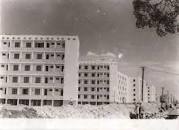
In contrast to colonial architecture, in the aftermath of the Vietnam war, “soviet block” architecture dictated hygiene in different way.  In her study of urban Vietnam and East German architecture, Christina Schwenkel compares the the destruction of the Vietnamese city of Vinh to that of Dresden during WWII, and argues that the strategies for rebuilding East Germany were later used in Vietnam.7 In response to vast housing shortages resulting from extensive bombing, complexes like the Quang Trung “Wohnkomplex” in Vinh used the concept of prefabricated housing and Soviet style uniform blocks to provide safe, clean, and modern housing for those whose homes had been destroyed.  In contrast to colonial architecture which was designed to symbolize European superiority, mass housing complexes and “socialist architecture” designed housing in collaboration with Vietnamese architects with the immediate needs of Vietnamese residents in mind.  Despite differences in historical context and approach to design, the goals of socialist German architects reflected those of colonial French architects.  Like the French, German architects saw “modernity” as buildings which “facilitated the flow of air and natural light through the apartments,” and shifted “away from communal living in cramped spaces with shared, outdoor facilities.”8 While complexes like Quang Trung were developed with Vietnamese experts and designed for Vietnamese people, they reflect the same hygiene principles as those emphasized by French colonial architects.  Schwenkel notes that while the project was a collaboration, German architects, “like their colonial predecessors, were the latest in a historical trajectory of non-indigenous architectures and foreign styles of dwelling.”9 Unlike traditional Vietnamese housing which typically separates the “service area” from the “living area,” the layout within the complex followed more Western styles which promoted a more utilitarian use of space.10 

Despite the focus on the immediate needs of Vietnamese citizens and the creation of living spaces designed to promote the health of its residents the Quang Trung “Wohnkomplex,” like French colonial architecture, reflected the agenda of socialist urban planners.  “The state’s social engineering of living space thus focused on the intimate materialities of dwelling to produce new moral and urban socialist citizens.”11 Both the Palais du Gouvernement and the “Wohnkomplex” come with ideological associations built into their very appearance.  

  1. Christina Schwenkel, “Traveling Architecture: East German Urban Designs in Vietnam,” in International Journal for History, Culture and Modernity 2, no. 2: (2014), 159. [↩]
  2. Laura Victoir, “Hygienic Colonial Residences in Hanoi,” in Harbin to Hanoi: The Colonial Built Environment in Asia, 1840-1940 (Hong Kong: Hong Kong University Press, 2014), 234. [↩]
  3. Eric T. Jennings, “Health, Altitude, and Climate,” in Imperial Heights: Dalat and the Making and Undoing of French Indochina (Berkeley: University of California Press, 2011). [↩]
  4. Michael G. Vann, “Of Rats, Rice, and Race: The Great Hanoi Rat Massacre, an Episode in French Colonial History,” in French Colonial History 4: (2003), 193. [↩]
  5. Paul Doumer, L’Indo-Chine Française, Souvenirs (Paris: 1905), https://catalogue.bnf.fr/ark:/12148/cb34137199k, 115. [↩]
  6. Doumer, L’Indo-Chine Française, 70. [↩]
  7. Schwenkel, “Traveling Architecture,” 163. [↩]
  8. Ibid., 165-168. [↩]
  9. Ibid,. 166. [↩]
  10. Ibid., 167. [↩]
  11. Ibid., 161. [↩]

Denver’s Chinatown: How Descriptions of Space Condemned a Community

In January of 1890, The Rocky Mountains News, a prominent Colorado newspaper, ran an article on the recent unrest, scheming mobs, and murder plots allegedly unfolding in Denver’s Chinatown.  The story revolved around John Taylor, a Chinese immigrant and the owner of the businesses which comprised Chinatown.  The events had apparently “attracted considerable attention all over the country,” not only for their intrigue, but because Chinatowns, and Chinese immigrants, across the U.S. were under attack by the media.1 Situated in Denver’s central business district, Chinatown covered less than a block, with one report claiming it was only 125×100 feet, and much of it was rebuilt from what had been destroyed in an anti-Chinese riot ten years earlier.2 The reporter from The Rocky Mountain News claims that readers were curious to know what the headquarters of “John Taylor and his murderous band” looked like, and the article recounts the author’s tour of the area.  It reveals how the characterization of space was used not only to reinforce intolerant attitudes towards the Chinese community, but how descriptions of space were employed to control where Chinese people were allowed to live and work.

The article is primarily concerned with criminality and a large portion of it focuses on the prevalence of opium, gambling, and prostitution in Chinatown.  The US Government’s attempts to control opium in the late 19th century — specifically an 1887 law passed by Congress which, “prohibited Chinese from importing opium and allowed only non-Chinese American citizens to manufacture smoking opium” — demonstrates the government’s intolerance of Chinese immigrants and its attempts to control Chinese populations.3 These policies increased opium smuggling, and created strong associations with Chinese immigrants and organized crime.  U.S. media also perpetuated fears of opium corrupting white women, and by extension, Chinese communities corrupting American society.  The reporter for The Rocky Mountain News drew on these fears in the article, claiming that “Many women were ruined by the Chinese in the old quarters,” and proceeds to give a description: “A celestial leads her through the dark hall. She is assigned a bunk, where she cooks her opium, smokes it while the police are outside vainly endeavoring to find them.”4 This account of the interior categorizes Chinatown as a place of corruption: impenetrable to light and the law.

Descriptions of dark hallways are prominent throughout the article and are repeatedly used to create ominous and threatening impressions.  According to the reporter, the very structure of Chinatown is designed for criminality.  He relates that smoking opium is prohibited, but “to elude the law these elevated smoking rooms have been built in such a manner that the front and rear door can be seen. It is so dark there it is impossible for a person coming in from the street to see exactly what is taking place, so that the occupants have ample time to hide their pipes in the event of a police raid on the place.”4 The rest of the buildings are described in a similar way.  False doors and narrow passageways suggest maze-like complexity with the clear objective of classifying space as criminal, dangerous, and impenetrable.  While dark hallways and false doors suggest criminal activity through the built environment, observations about the upkeep and cleanliness of the space are used to cast judgment on its inhabitants.  The reporter uses descriptors like “rickety roof,” “foul air,” “squatty buildings,” and “filth” to characterize it as uninhabitable.5 

All this precedes the reporter’s description of the businesses in West Denver owned by John Taylor’s rival and the object of his supposed murder plots, Chin Poo.  The article reads: “there are no alleys, no passages or dark hallways, the floors are kept clean, are scrubbed daily, and all the houses are well lighted and ventilated… The police permit the Chinese here to gamble and smoke opium, and will allow Taylor’s crowd the same privilege it they move over there, away from the business portion of the city, where no objection is raised against their presence.”5 The author makes no attempt to veil the true purpose of the article, and expresses no concern for Chin Poo despite his insistence that Taylor is a dangerous threat.  Instead, it’s revealed that the location of John Taylor’s businesses was the reporter’s main concern.  

The situation of Chinatown in Denver’s central business district combined with the threat of cheap labor provided by Chinese immigrants led to campaigns against the Chinese community and attempts to undermine their businesses.  The rivalry between Taylor’s “gang of cut-throats” and Chin Poo became an excuse to emphasize associations between Denver’s Chinatown and criminality through descriptions of the physical location.  While another report suggests that Chinatown was also home to three restaurants, fifty policy shops, a morgue, and a butcher shop, these legitimate businesses are conspicuously absent from the article (despite a brief reference to a restaurant which the reporter predictably describes as “filthy”).6 The Rocky Mountain News ran numerous articles arguing that Chinese businesses posed a financial threat to white businesses and warned of the social cost of the projected growth of the Chinese population in such a central part of Denver.  Chinese spaces were transformed by the media into places of corruption, criminality, and unsanitary practices which increased intolerance toward the Chinese community and ultimately led to the eradication of Denver’s Chinatown.

  1. “Three Chinatowns,” The Rocky Mountain News (Denver, Colorado), January 6, 1890, Colorado Historic Newspapers Collection. [↩]
  2. “A Home for Plague,” The Rocky Mountain News (Denver, Colorado), July 13, 1889, Colorado Historic Newspapers Collection. [↩]
  3. Jeffrey Scott McIllwain, Organizing Crime in Chinatown (Jefferson: McFarland and Company, 1969), 59. [↩]
  4. The Rocky Mountain News, “Three Chinatowns.” [↩] [↩]
  5. Ibid. [↩] [↩]
  6. The Rocky Mountain News, “A Home for Plague.” [↩]

Blank Pages: The Great Kanto Earthquake and Japanese Occupied Manchuria

The Great Kanto Earthquake which leveled much of Tokyo and Yokohama in 1923 created an opportunity for reconstruction on an enormous scale and caused a shift in the population distribution as well as the aesthetic standards of the city.  The utopian approach to rebuilding Tokyo after the earthquake mirrors Japanese attitudes towards Manchuria while also serving as a stark contrast of utopian ideals.  

The event was described in the September 1923 issue of the American publication Japan Society as “The Greatest Disaster in History.”1 The earthquake and subsequent fire left “298,000 houses burned and 336,000 more shaken down,” in the journal’s initial report.2 A final estimate of its destruction was that around 45 percent of the structures in Tokyo were leveled, transforming it “from a bustling metropolis and imperial capital to a seemingly extinct city.”3 

4 

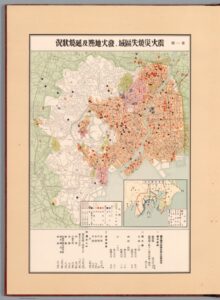
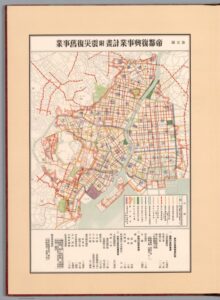
The scale of the destruction was interpreted at the time as “a moral wake-up call if not an outright act of divine punishment” but also, contrastingly, as a “golden opportunity.”5 At a time when utopianism and grand visions of urban planning were circulating in books like Ebenezer Howard’s Garden Cities of Tomorrow, the earthquake essentially rendered Tokyo a blank slate upon which to rebuild.  It literally flattened the city, creating “not only a unique, perhaps unparalleled opportunity to reconstruct Tokyo but the chance to arrest the perceived moral and ideological regress of Japan.”6 Efforts to not only reconstruct, but to renovate, beautify, and modernize Tokyo began.  By 1930 the products of these initiatives could be visibly traced on a series of maps produced by the Tokyo City Government which illustrated the results of projects dedicated to restoration and new construction of parks, schools, hospitals, roads, bridges, and electrical facilities.7 

8 

In addition to government efforts to rebuilt the city itself, the earthquake triggered a flight from the city center to the areas surrounding Tokyo, increasing the suburban population and decreasing the density of the city.  The suburb of Denenchōfu, planned and constructed in the years just before the earthquake, was modeled after the utopian vision of Howard’s garden city.  The timing of its construction (completed in 1923) and its location outside Tokyo caused its population to increase dramatically after the earthquake.9 This suburban population boom was widespread according to Japan Society’s December 1925 issue, which predicted that “Under the Greater Tokyo system, in which all of these suburban towns will be included in the City of Tokyo—and it is expected that this can be realized within the next decade or so—the City of Tokyo will have a population equalling that of London.”10

Denenchōfu serves as an example of the change in Tokyo’s population distribution as well as a new emphasis on the aesthetic qualities of the city’s spaces.  The architects of Denenchōfu placed a high value on the natural beauty of the development in accordance with Howard’s garden city ideal.11 The Tokyo government likewise invested in natural surroundings in its efforts to rebuild as evidenced by the excerpt in Japan Society’s May 1925 issue stating that “The Park Section of the Tokyo Municipality will plant 3,000 trees along streets in various sections of the city in May as part of the program to beautify the city.”12

This utopian conception of Tokyo post-earthquake as a blank slate on which to modernize infrastructure, disperse the population, and beautify the city parallels how some Japanese planners and intellectuals envisioned Manchuria.  The Japanese conquest of Manchuria after 1931, “provided a blank slate, or as city planners in Manchukuo put it, a white page, hakushi, on which ideal designs might be realized.”13 Ideal designs such as the Agricultural Immigrant Plan which envisioned utopian agricultural villages populated by Japanese farmers in northern Manchuria.14  In fact, “More than a few planners disillusioned by the resistance their plans faced in postearthquake Tokyo found planning on what they considered to be ‘blank pages’ in colonial Manchukuo more rewarding.”15 While the Agricultural Immigrant Plan was never realized, many architectural projects and modernization efforts were carried out in Manchuria.16 Like Tokyo after 1923, it served as a place in which to test utopian ideals.

Despite certain similarities in the conception of utopian plans, one of the stark contrasts between the “blank slate/page” of utopian planning in 1923 Tokyo and 1931 Manchuria was the ideology which accompanied it.  Unlike the aftermath of the Kanto earthquake in which the perceived “moral regress” included socialism, for those censored for their contrary politics in Japan, Manchuria offered a blank slate of a different kind.

  1. Japan Society, About Japan 1920-1928 (Internet Archive, 2021), https://archive.org/details/about-japan-1920-1928/page/n5/mode/2up. [↩]
  2. Ibid. [↩]
  3. Charles Schencking, “The Great Kanto Earthquake and the Culture of Catastrophe and Reconstruction in 1920s Japan”, in The Journal of Japanese Studies 34, no. 2: (Summer 2008), 296. [↩]
  4. Zenjirō Horikiri, 1. Areas afflicted by the earthquake and fire disaster, places where fire broke out and circumstances driving the spread of the fire [map], Tokyo City Government, 1930, https://www.davidrumsey.com/luna/servlet/detail/RUMSEY~8~1~334402~90102430?qvq=q%3Apub_list_no%3D%2210808.000%22%3Blc%3ARUMSEY~8~1&mi=11&trs=38. [↩]
  5. Schencking, “The Great Kanto Earthquake and the Culture of Catastrophe and Reconstruction in 1920s Japan”, 297. [↩]
  6. Ibid., 297. [↩]
  7. Zenjirō Horikiri, Teito Fukkō Jigyō Zuhyō, David Rumsey Historical Map Collection, Tokyo City Government, 1930. [↩]
  8. Zenjirō Horikiri, 5. Program for the reconstruction of the imperial capital [map], Tokyo City Government, 1930, https://www.davidrumsey.com/luna/servlet/detail/RUMSEY~8~1~334398~90102426?qvq=q%3Apub_list_no%3D%2210808.000%22%3Blc%3ARUMSEY~8~1&mi=7&trs=38. [↩]
  9. Ken Tadashi Oshima, “Denenchōfu: Building the Garden City in Japan”, in Journal of the Society of Architectural Historians 55, no. 2: (June, 1996), 146. [↩]
  10. Japan Society, About Japan 1920-1928. [↩]
  11. Oshima, “Denenchōfu: Building the Garden City in Japan”, 144. [↩]
  12. Japan Society, About Japan 1920-1928. [↩]
  13. David Tucker, “City Planning without Cities: Order and Chaos in Utopian Manchukuo”, in Crossed Histories (Honolulu, 2005), 55. [↩]
  14. Ibid., 53. [↩]
  15. Schencking, “The Great Kanto Earthquake and the Culture of Catastrophe and Reconstruction in 1920s Japan”, 323. [↩]
  16. Louise Young, “Brave New Empire: Utopian Vision and the Intelligentsia”, in Japan’s Total Empire (Berkeley, 1998), 242. [↩]

Impermanent Spaces: Japanese Gardens and their Interpretations

In 1892, Lafcadio Hearn published an article in the Atlantic Monthly on the unique characteristics of Japanese gardens.  Hearn was a writer and teacher, born in Greece and raised in Ireland, who traveled to Japan in 1890 and remained there for the rest of his life.1 His article gives a general background on the appearance, history, and symbolism of Japanese gardens for his western readers through a description of his own garden, and ends with the gloomy prediction that “…the old katchiû-yashiki and its gardens – will doubtless have vanished forever before many years… For impermanency is the nature of all, more particularly in Japan, and the changes and the changers shall also be changed until there is found no place for them, and regret is vanity.”2 Contrary to his prediction, by 2006 there would be at least 432 Japanese gardens throughout the world.3 Rather than disappearing from Japan, their global popularity seems to reflect a common fear of the very impermanence that Hearn believed would lead to their disappearance.  As spaces, Japanese gardens symbolize the preservation of natural landscapes whose value seems increasingly important as urban centers grow and natural areas diminish.  

Henri Lefebvre proposes that as natural spaces disappear, they do not vanish completely.  Natural space becomes “…the background of the picture; as decor, and more than decor, it persists everywhere, and every natural detail, every natural object is valued even more as it takes on symbolic weight (the most insignificant animal, trees, grass, and so on).”4 This symbolic weight is clearly identified by Hearn, whose account of his own garden is given primarily through descriptions of the symbolic meaning of the rocks, plants, and animals which inhabit it.  He describes objects and creatures both physically and through the myths, legends, and traditions which surround them and signify their role in the garden.  Not only do they carry individual symbolic meaning, but the garden as a whole is “…at once a picture and a poem; perhaps even more a poem than a picture. For as nature’s scenery, in its varying aspects, affects us with sensations of joy or of solemnity, of grimness or of sweetness, of force or of peace, so must the true reflection of it in the labor of the landscape gardener create not merely an impression of beauty, but a mood in the soul.”5 

This symbolism or “mood in the soul” acquires a new meaning in light of the western adoption and re-creation of Japanese gardens.  Questions arise as to whether the gardens symbolize something inherently Japanese and are therefore only authentic when they are created in Japan according to strict traditions, or whether they symbolize a broader appreciation of nature which can be replicated anywhere in the world.  Hearn argues that “In the foreigner,” the aesthetic complexities of the representation of nature in Japanese gardens, “needs to be cultivated by study. It is inborn in the Japanese; the soul of the race comprehends Nature infinitely better than we do, at least in her visible forms.”5  His suggestion that non-Japanese people cannot comprehend the full meaning and complexity of this art form is reflected by modern Japanese scholars such as Sato and Kajinishi who argue that Japanese gardens in the West are merely inauthentic reproductions (“Japanese-style gardens”), rather than the real thing.6  This idea is taken even further by the notion that Japanese gardens in the late 19th century, lost their authenticity because the Japanese government, being partially controlled by western powers through treaties, recast them embodiments of Japanese nationalism.7  

While questions of authenticity, in Western and Japanese gardens, are highly contested among historians and specialists, the spatial concept of a garden which serves to “…copy faithfully the attractions of a veritable landscape, and to convey the real impression that a real landscape communicates” is one that captured the imagination of the world.5  A place which is designed not only to reflect vanishing natural space, but also to express “moral lessons” and “abstract ideas” through its design is something which can be universally appreciated.8  While the original creator of Hearn’s garden was long gone by the time he owned it and whatever lesson or idea it was meant impart had been forgotten, Hearn believed that, “…as a poem of nature it requires no interpreter.”8 The gardens that exist today, whether ancient or modern, Japanese or Western, built on the practices of artistic tradition or ideologies of nationalism, are, as Christian Tagsold points out, “real places.”9 Their histories, symbolic meaning, and authenticity vary, but as places, they are created with intent.  They are spaces “confiscated from nature” and turned into conscious representations of a particular kind of space.10  Like the natural spaces they reflect, there is an impermanence in the meaning and understanding of Japanese gardens.  Although they are created according to certain principles and meant to represent specific ideas, (moral lessons, nationalist ideology, or western imitations of Japanese spaces) their meaning is constantly changing.

  1. Elizabeth Bisland, The Life and Letters of Lafcadio Hearn, Volume 1 (Boston and New York: Houghton Mifflin Company, 1906). [↩]
  2. Lafcadio Hearn, “In a Japanese Garden,” Atlantic Monthly, July 1892, Volume 70, Issue 417, https://www.trussel.com/hearn/jgarden.htm#Part1. [↩]
  3. Christian Tagsold, Spaces in Translation: Japanese Gardens and the West (Philadelphia: University of Pennsylvania Press, 2017), 2, ProQuest Ebook Central. [↩]
  4. Henri Lefebvre, The Production of Space, trans. Donald Nicholson-Smith (Oxford: Basil Blackwell Ltd, 1991), 30. [↩]
  5. Hearn, “In a Japanese Garden.” [↩] [↩] [↩]
  6. Tagsold, Spaces in Translation, 79. [↩]
  7. Ibid., 84. [↩]
  8. Ibid. [↩] [↩]
  9. Tagsold, Spaces in Translation, 84. [↩]
  10. Lefebvre, The Production of Space, 49. [↩]