Examining the 1933 Shanghai Power Company Strike – A Prospectus

In the autumn of 1933, some two thousand workers at the Shanghai Power Company went on strike over the dismissal of a number of employees over the previous four years. With such a large strike at a company vital for the daily life of Shanghai’s citizens, the prevailing opinion was that the company would give in to the strikers demands instead of risking power outages across the city. However, after about three months of striking, the workers returned to the company, defeated and in need of wages, which the company loaned out to them upon their arrival. Using newspaper articles, correspondence between trade unions, as well as reports from the Shanghai Municipal Police, this essay examines the reasons for the failure of the strike, as well as how the factors influencing the strike’s failure offer insight into the legal and social realities present in Shanghai in 1933.

There has been a growing list of works on Labour movements within early twentieth century Shanghai. While S.A. Smith’s work “Like Cattle and Horses: Nationalism and Labor in Shanghai, 1895-1927” focuses on the time period before this strike, the conclusions drawn by Smith are still present in 1933. While a national identity is recognised by Chinese workers, struggles for recognition are still present during industrial action, as seen by certain opinion pieces covering the SPC strike. Furthermore, a lack of unity within these disputes still hampers the effectiveness of strikes, as Chinese public opinion was split over their necessity, and other unions offered little more than respectful financial support for the strikers.

This essay found that the factor offered by most media observers as having caused the failure of the strike was the fact that the Shanghai Power Company was foreign owned, having its headquarters in America and not China. This allowed the company to listen less to the opinions of Shanghai’s Chinese citizens, who were broadly in favour of the strikers at the commencement of industrial action. In particular, “the obstinate attitude on the part of the Company” was seen as a key reason why a settlement was not quickly reached – something which would likely be different had the Company been based within Shanghai itself.

However, it should be noted that the weak national government, as well as the legal complexities within Shanghai undoubtedly made the task of the strikers much more difficult. Both the strikers and the Shanghai Power Company used legally questionable methods over the course, the former by intimidating workers wishing to return to the Company, the latter by employing thousands of strike breakers and sequestering Chinese workers within the power plant so they could avoid interacting with the strikers. Here the narratives created around the strike by newspapers played a vital role in harming the objectives of the strikers. The intimidation of workers by those on strike was emphasised, and used as proof that the Water and Electricity Union was being run by violent radical individuals, who were holding the rest of the workers hostage during the strike. As the union itself struggled to combat these characterisations, public sentiment quickly turned against the strikers, leaving them without the motivation or financial support necessary to continue their action.

Overall, this essay argues that the three broad reasons for the failure of the strikes – the international nature of the SPC, the lack of government adjudication of the strike, and media characterisations of the strikers, show how Shanghai’s political and social situation in 1933 limited the progress trade unions, particularly Chinese-based unions, could achieve. Such a confused legal space, with strong divisions surrounding ethnicity, allowed strike breakers to be employed within days of industrial action commencing, crippling the impact of such strikes. Furthermore, the fears present in Shanghai surrounding Communism made it easy for strikers to be presented as subverting the state, a characterisation which diminished their popularity. In Shanghai, a city socially and ethnically distrustful, as well as one so legally complicated, creating a labour movement that could remain united against foreign-owned companies was a difficult task, and one which the 4th District Water and Electricity Workers’ Union were unable to achieve in the latter half of 1933.
Balanced on a Modern Thread: Marketing Consumer Products in Inter-War Japan

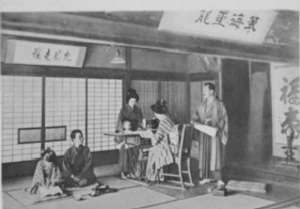
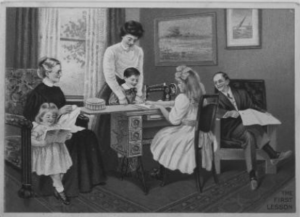
Andrew Gordon’s monograph: Fabricating Consumers: The Sewing Machine in Modern Japan covers the introduction of Western-style sewing machines into Japan, in first half of the twentieth century. Within the book, Gordon uses two figures to display how the sewing machine company Singer advertised its products towards a Japanese audience (Gordon, 2011, p. 63).


The first image shows a traditional Japanese extended family, within a traditional room, crowding round a modern sewing machine. However, the second image displays a similar size family, taking similar positions around an identical sewing machine in an American-style room. Gordon uses these two images to make two arguments. The first is that “Singer… marketed the machine in Japan, as elsewhere, as an emblem of modernity in two senses: that of rational investment on the one hand, and of freedom, style and the pursuit of Western-linked pleasure on the other” (Gordon, 2011, p. 62) . The second argument Gordon offers is that Singer used this “iconographic translation” to appeal to the same demographics as they had in America – a middle-class family, anxious to embrace modernity but still being susceptible to ideas of traditional values when shown within advertisements like this. However, the two advertisements also display a phenomenon visible in East Asian nations at this time, where culture and ideas of modernity were becoming more transnational in nature, specifically oriented to the West.

During the interwar period, debates on modernity in Japan became linked to the positives and negatives surrounding perceptions of the West. On the one hand, modernity inspired by the West often promised increased affluence and liberation, as shown through rapid economic growth and the rise of department stores, where a vast array of items could be purchased at once. However, the growth of modern spaces in Japan was also linked to fears of moral degradation, and the loss of traditional culture (Tipton, 2013). The image of the ‘modern girl’, sporting a Western-style outfit and with hair cut short, represented both the liberation and loss associated with modernity in Japan. As such, while members of the Japanese middle-classes held many aspirational feelings towards items of modernity, they also experienced fear at the rapid pace of change which items such as sewing machines – which struggled to work on Japanese clothing – represented.

This Singer ad shows a potential way to navigate a Western country through this debate, while ensuring that their products still sold well in a Japanese market. The family itself is inspired by modern ideas, as shown by the original source picture the Japanese ad was based on. However, by emphatically placing the sewing machine within a traditional background, Singer attempted to market their product as a symbol of all of modernity’s virtues, with none of the vices which had become the centre of debate. Other companies also mixed Western and traditional symbols to expand their markets. Mitsukoshi, a Japanese department store, advertised many cosmetic products using Western styles and symbols in its journals, which also promoted Japanese culture, and worked closely with the government in its coverage of the colonial developments of the 1930s. Overall, Singer’s sewing machine, like many artefacts symbolising modernity, marketed themselves to East Asian audiences as representing smaller cultural and technological steps than they perhaps did. This helped to avoid such items being tied to ideas of degeneracy or a loss of traditional values, making them more marketable in the inter-war period.

Sources

Gordon, Andrew, Fabricating Consumers: The Sewing Machine in Modern Japan (2011, Berkeley).

Mitsukoshi: Opening Up, in Ambaras, David and McDonald, Kate, Bodies and Structures 2.0: Deep-Mapping Modern East Asian History. Available at: https://bodiesandstructures.org/bodies-and-structures-2/mitsukoshi-opening-up?path=in-the-pages-of-mitsukoshi [Accessed 20/02/2023].

Tipton, Elise, ‘Moving Up and Out’ in Freedman, Alisa, et al., Modern Girls on the Go: Gender, Mobility, and Labour in Japan, (2013, Stanford), pp. 21-40.

How Guidebooks Chart Colonial Developments in Taiwan

Tourist handbooks act as useful primary sources when studying nineteenth century East Asian history. Since they were written for outsider, they are usually in Western languages, making them more accessible than most other sources. Furthermore, these guidebooks can offer insight into messages those behind the books wished to send, regarding their own country, the region in question, or the success of colonial projects. A Handbook For Travellers in Japan was written by Basil Hall Chamberlain, a British academic studying Japanese language and culture. Therefore, while not being directly influenced by the Japanese government, Chamberlain was likely tuned in to current event surrounding the nation, specifically around the island of Taiwan, which had been annexed by Japan in 1895. Between his handbook published in 1901 and a new edition published in 1907, subtle changes help show how the colonial government was consolidating control across the island, and how from a European perspective this impacted the potential for tourism in Taiwan.

In both versions, the general description of the island remains unchanged. However, in the 1907 edition a small passage had been removed. This described Taiwan as “a very unsettled state, owing to frequent risings of the Chinese”. Its removal could indicate that the Japanese government was eager to display the success of its actions in Taiwan to Western nations. Later in the 1907 guidebook, Chamberlain says that both the West and North of the island are fully accessible, “though in some parts it is advisable not to travel after dark”. This represents a significant change from just 6 years earlier, where Chamberlain noted that “practically only the capital and the larger ports are accessible”. That these are two of the most obvious edits between the guidebooks shows that the Japanese government wanted to make it clear that their operations on “civilising” Taiwan had been successful, and that more of the island was safe for travellers to visit.

The greatest difference between the two editions is an entirely new section on rail travel in Taiwan. While completely absent from the 1901 edition of the guidebook, the 1907 edition mentions that rail travel now connects Taipei in the North with other cities in the South of the island. The addition signifies the rapid construction of land routes across the island, likely constructed to provide additional security for Japanese administrators. Nevertheless, this method of travel had now become open to the public, and represented a new way to experience the island compared to travel by steamer, frequently complained about in both editions for missing the most scenic parts of the island.

Aline Demay argued that “tourism is a major and indispensable player in colonial policies”. Chamberlain’s guidebooks seem to indicate that the opposite is also true. Upon annexing Taiwan, the Japanese government’s aims were to open up the island to travel by colonial authorities, and to remove the threat of attack from both Chinese rebellions and from the indigenous people living in the highlands. By doing both of these, Taiwan also became an achievable destination for European travellers, though some intrepid spirit would still be necessary to visit much of the island. The creation of rails, vital for colonial policy, would turn out to be equally vital for enabling European tourism across the island.

Sources

Chamberlain, Basil Hall, A Handbook For Travellers in Japan, (1901, London).

Chamberlain, Basil Hall, A Handbook For Travellers in Japan, (1907, London).

Demay, Aline, Tourism and Colonization in Indochina (1898-1939(, (2014, Cambridge).

Emulating Imperialism: Japan at the 1904 World’s Fair

In the late nineteenth and early twentieth centuries World’s Fairs were opportunities for nations across the globe to display and showcase their achievements and project their power. They became spaces where East Asian nations began pushing to represent themselves on their own terms, taking control of narratives which had largely been created by Western countries. A Handbook of Japanese exhibits at the 1904 St. Louis World’s Fair offers insight into how the nation sought to use the Exposition to project a specific image of itself, as a country both steeped in history, and as aggressively modernising as any of the Western powers.

The last section of the handbook is dedicated to describing the Japanese exhibits at the World’s Fair. In it, Hajime emphasises the natural beauty of the garden that had been created for the Japanese exhibition, saying that placements of trees and other features “add beauty to the garden and make the views from within superior to any in the Fair Grounds” (Hajime, p. 114). Within this description of the exhibition, Hajime highlights the age of the features within it, from the Bonsai trees, “many centuries old”, to the buildings, each designed after aristocratic buildings at least two hundred years old. Hajime’s words make it clear that the exhibit was trying to equate Japan’s history with those found in Europe, displaying the beauty and rich culture that could be seen within the nation’s past.

Within the exhibit however, displays were described to show how modern, and similar to the West Japan had become. Within the education tent were photographs of gymnastic exercises, explicitly described as “similar to those practiced in Europe and America” (Hajime,  p. 116). The exhibition also took care not to give visitors unintended impressions from its exhibits. While the electricity exhibit was small, Hajime asked that “this must not be taken to mean that electricity for all purposes is not in general use throughout the Empire” (Hajime,     p. 121). The intended impression of the overall exhibit was of a nation with a background as culturally rich as any European nation, but one which had been able to keep up with the rapid pace of modernisation, putting it on equal footing with any Western power.

Despite Japan’s clear interest to use the exposition to represent themselves on their own terms, Hajime’s handbook presents a clear contradiction here. He mentions a Formosa exhibit, focused on Taiwan, describing the island as “ceded by China to Japan” (Hajime,               p. 120). By 1904 the island had become a Japanese colony, and as such was unable to represent itself at a World’s Fair such as this. Therefore, while Japan was struggling to display itself to the West, the nation ultimately took control over how its colony presented itself on the same stage. In addition, within Korea exhibitions would later be used to display the importance and success of assimilation (Henry, 2014). These contrasted a weak past with a more powerful present courtesy of Japan – the same stereotype Japan had been trying to overcome when presenting itself to the West. Overall, the imperial nature of such exhibitions meant that, as Japan emulated Western powers with its displays, contradictions such as this arose.

Raizman and Robey argued that, despite being designed to promote international unity, World’s Fairs were spaces where nations could present themselves to the international community (Raizman and Robey, 2017). Japan, like other East Asian nations chose to use these expositions to reject stereotypes of the nation as being underdeveloped compared to the West. Hajime’s handbook of the exhibition emphasises the impressiveness of both Japan’s past and present. The exhibition placed Japan on equal footing to the West following national humiliation in the 1895 Triple Intervention, where Western powers stopped Japanese expansion into China. While future events like the Russo-Japanese War would showcase Japan’s military strength, expositions were a softer way of expressing the nation’s newfound power.


Sources

Hajime, Hoshi, Handbook of Japan and Japanese Exhibits: at World’s Fair, St. Louis, 1904.

Henry, Todd, Assimilating Seoul, (2014, Berkeley).

Raizman, David and Robey, Ethan, ‘Introduction’ in, Raizman, David and Robey, Ethan, Expanding Nationalism at World’s Fairs, (2017, London), pp. 1-14.

The Impacts of Montesquieu’s Deterministic Arguments on Colonialism

Montesquieu’s book ‘The Spirit of the Laws’, published in 1750, focused on political theory and comparative law. However, within the book Montesquieu used the theory of environmental determinism (the belief that a region’s climate could affect the behaviour of the cultures living in it), to describe Asian history. The use of this debunked method shows how determinism was used by Europeans to project their power and modernity, and later to justify colonialism in the 19th century. This blog post will give an overview of how Montesquieu used environmental determinism to analyse Asia, and how this reflects European views on determinism.

Montesquieu argues that Asia’s geography is directly consequential for the hegemony and instability of major civilisations on the continent. This claim is ‘evidenced’ by the lack of a mountain range separating the north of the continent from the south, a function Montesquieu argues is served by the mountains of Scandinavia. To Montesquieu, the lack of a dividing range allows ‘hot’ and ‘cool’ regions to directly clash, contrasting with the more even gradient of European climates. The former was proposed to cause strong civilisations to border weak ones, which created unhealthy hegemony on the continent. Montesquieu concludes that ‘this is why liberty never increases in Asia, whereas in Europe it increases or decreases according to the circumstances’.

Montesquieu’s reasoning on this subject has been heavily debunked, but his writing opens a window into how central ideas of environmental determinism were to geographic thought in 18th century Europe. To Montesquieu, the entirety of Asian history could be explained by the dissonance present in the region’s climates – a dissonance which glosses over regional variation and other features present in the region like higher mountains and larger floodplains – both of which would have a greater impact on the mixing of cultures across the continent. Despite this, it was climate that was considered fundamental to the nature of societies, and as a result other factors are non-existent within his characterisation of Asia.

Montesquieu’s argument offers insight into how Europeans would use these ideas to justify colonialism taking place in the two centuries after the book was published. His conclusion that climate made Asia inherently unstable and illiberal would be used to justify colonialism, where a European power would take advantage of regional instability to set up a regime and crush dissent. As a result, the idea that climate meant that these regions would be governed no differently or worse without a European power in control, was central to justifying colonialism. Because of this, it is important to understand how environmental determinism began to be applied on a global scale, and was used to create a hierarchy of civilisations, to ensure that such discourse doesn’t become the norm in the future.

Source: Anne M. Cohler et al. (eds.) Montesquieu The Spirit of the Laws, Book 17 Ch3 – 8, pp. 279-284.

What’s in a Roof? Architectural decision-making behind the Manchukuo Hall of State

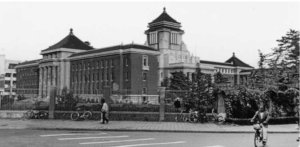
This blog post focuses on a picture included in Bill Sewell’s book “Constructing Empire: The Japanese in Changchun, 1905-45”. Sewell focuses on the roof of the Changchun Hall of State to illustrate the “Asian Revival” architectural style which inspired many of the administrative buildings built in Japanese controlled Manchukuo in the 1930s. The view of the building presented shows how architecture during this period sought to promote Asian stylistic choices over European ones, most clearly seen in the style of roof. However, the choice to incorporate Chinese as well as Japanese styles reflects the shift of the Japanese government to the idea of Pan-Asianism.

Sewell notes that the roof of the Hall of State is built in a Japanese style, called “Imperial Crown” style. This was characterised by a tented roof, adding an Asian finish to an otherwise European-inspired building. This is evident in the picture of the Hall, where the building without the roof is indistinguishable from a Western administrative building. However, Sewell argues that the use of towers and a gentle slope for the remaining rooftop resembled Chinese instead of Japanese architecture. This is initially at odds with the idea of a colonial government constructing buildings for administration, but signifies the specific style of Japanese colonialism which was employed in Manchukuo.

Since the building was meant ‘to represent the entire country as chief government offices’ it is significant that the building incorporates elements of Chinese architecture, instead of being simply a melding of Japanese and Western styles. Sewell cites Ryue Nishizawa as suggesting that the choice of a Chinese style was in an attempt to project symbolism of harmony and sedateness, both represented in the long roof architecture chosen. This in turn would imply that the Japanese colonial government was seeking some form of legitimacy in the eyes of the Chinese population, as opposed to the colonial governments led by European nations.

The decision to seek legitimacy from the Chinese population of Manchukuo fits with the idea of Pan-Asianism, a driving ideology of Japanese expansion during the 1930s. The movement sought to unite Asian ethnic communities politically and economically to combat European imperialism. As such, the end goal of Japanese colonies was assimilation into the wider state, as opposed to the Western model of colonial governance. This ideology was already present within the colony of Korea, which was becoming assimilated as a province of Japan at the time the Hall of State was being constructed. It should also be noted that this style of roof was present in architecture designed in Korea during the 1920s, suggesting that the Japanese government was in favour of rolling out this style of roof across its new colonies, to combat European design while promoting a unified Asian idea of architecture.

Overall, the roof of the Hall of State offers an insight into how architecture could reflect government ideology, and seek to project both power and legitimacy. In this case, the Hall of State’s roof was designed to oppose European building styles, while attempting to win approval from the Chinese population of the province, as an early step in the creation of a Pan-Asian utopian entity.


Sources

Kornegay, Nate, ‘Traces of the Imperial Crown Style in Colonial Korea’, Transactions 92 (2017), pp. 21-30.

Sewell, Bill, Constructing Empire: The Japanese in Changchun, 1905-1945, (Vancouver, 2019), pp. 64-106.

Picture in Sewell, Constructing Empire, p. 82.


The Tidyness of Theory: Ebenezer Howard’s Garden City

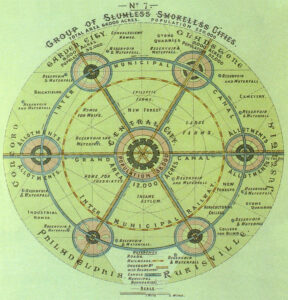
This blog post focuses on a diagram from Ebenezer Howard’s book, ‘To-morrow: A Peaceful Path to Real Reform’. In this book Howard set out his vision for the Garden City, a form of settlement designed to combat the overcrowding, disease, and squalor in cities, but also to provide job opportunities and social life not seen in rural England.


This particular diagram shows Howard’s wider vision, where a central garden city was surrounded by smaller satellite cities, connected by a system of roads, railways, and canals. In addition, the two developments set aside for allotments would help provide for the overall city, in combination with farms situated between municipalities. The overall effect of the diagram was to set out a planned community which could sustain its population with both food and employment, while also remaining self-sufficient with its welfare programs. This differentiated it from later projects like the 1950s New Towns, which were orchestrated by centralised government.
The diagram also helps shed light on contemporary views surrounding urban social problems and providing care for people with illnesses considered uncurable. The diagram clearly shows that homes for orphans and alcoholics would be situated outside the city proper, alongside an insane asylum. This highlights the arms-length approach people held towards these issues at the turn of the century: even when sympathetic to reducing these social problems, the first impulse was to remove them from the more populated cities. However, this could also fit with ideas of rural air being beneficial to health. In this way, Howard’s plan would seek to utilise the benefits of the countryside while keeping able-bodied orphans and recovering alcoholics close to job opportunities and places of education.
Above all, this diagram is clearly only theoretical. The actual layout of the city is not shown, and the locations of the surrounding services are approximate at best. There is also no mention of the landscape the perfectly straight roads and perfectly flat canals would have to contend with. This was because of two reasons: the diagram is solely conceptual, but also there were no examples of such a city to work with at the time Howard published his book. In reality, the Garden City would struggle to grow due to a lack of funds, while existing roads and railways would limit the symmetry and cohesiveness of the eventual settlements that grew using this plan.
Overall, the diagram is a useful tool to visualise Howard’s broader idea of a self-sufficient settlement combining the town and country. The model of the Garden City would utilise the space and health benefits of the countryside, while retaining a large variety of job opportunities which had caused the mass migration into cities during the nineteenth century. This fulfilled one of Howard’s most important ideas, the town-city: a combination of the best of both living environments. While no full Garden City was ever made, Howard’s design shows how urban planners at the start of the twentieth century were increasingly focused on solving social and economic problems through planned city design.

Sources
Hall, P. 1990. Cities of Tomorrow. Oxford: Blackwell. pp. 86-136.
Diagram – Hall, P. Cities of Tomorrow, p. 92.

More than Maps: How Culture is a Space within History

Spatial history is usually thought of as being focused around a geographic space, such as a city, country or household. However, concepts such as cultures can also constitute spaces within history. Like cities or countries, they are characterised by their diversity, the inter-relations between many different groups, and the ability for these relationships to change over time. This post uses an interview on the communities of Singapore to highlight this point, with regards to culture in Malaysia. The interviewee is Kenneth Kim Ban Cheo, a teacher and expert on Baba culture, an ethnic group comprised of the first Chinese immigrants to South East Asia. In the interview, he discusses Baba ethnicity, the ways it differs from the multitude of ethnicities in Singapore and Malaysia, and how this ethnic diversity has varied in recognition between 1940 and 1995, the year of the interview.


In the interview, Mr Cheo describes the Baba culture less in terms of its own characteristics, and more as the ways it relates to other communities in the region. For example, he notes how the Baba culture speak a specific dialect of Malay, which enables them to recognise different ethnic groups who do not use the same words, phrases or pronunciation when speaking. In addition, he argues that the attitude of the Baba to the region they live in separates them from other groups, like later Chinese immigrants. He says of national attitudes that, “to the Babas this is where their roots are, and this is where they belong’”. Overall, his choice on defining culture in this way highlights how many in the region viewed ethnicity in relation to others, a hallmark of a cultural space.


Important to the idea of Baba culture being defined in relation to other ethnicities, is the fact that Mr. Cheo characterises Malaysia in his interview as being very diverse. Within Chinese immigrant communities alone he differentiates between the Baba ethnic group, the wider group of Peranakan and those he describes as Straits born. However, this is a small number of ethnicities present in the region, painting a picture of a diverse space of interaction and relations, a hallmark of a distinct cultural space.


The interview suggests that the ways in which the Baba distinguish themselves has changed over the 20th century. Cheo says that the current differences he identifies only became identified following the Second World War. Before this, he argues that the multiple types of Chinese immigrants would all be referred to as a single ethnic group, Peranakans. However, after the war the Baba began to separate themselves from the wider Peranakan ethnicity, which Cheo described as being “too wide a term” to use precisely. Similarly, Cheo also mentions how the younger generation of Baba are reducing the emphasis on a separate Baba culture, wearing clothing more associated with Indonesia, as opposed to the more specifically Baba clothes described earlier by Cheo. An important characteristic of any space is the ability for relations within it to change over time. It is clear that Cheo’s descriptions of the Baba show a culture which has shifted in terms of its definition since the beginning of the 20th century, and show little signs of stabilising.


Overall, Cheo’s description of the Baba ethnic group shows how culture in Malaysia can be given its own space. Like other spaces, it is defined by its relations with others in the same space – in this case the Baba define themselves in relation to other ethnic groups in South East Asia. Furthermore, culture in South East Asia is extraordinarily diverse, with numerous ethnicities being mentioned by Cheo as interacting with each other in the same region. Finally, the relations within this cultural space interact with each other over time, with the Baba ethnic group in particular becoming more and less distinguished over generations. Therefore, while not often being viewed as such, culture in South East Asia is clearly a space in itself, and the interactions between ethnic groups over the 20th century can be described as part of spatial history.


Source

Cheo, K., 1987. Interview with D. Chew.  [Online]. Available from: https://www.nas.gov.sg/archivesonline/oral_history_interviews/interview/000770 [Accessed 26 September 2022] pp. 1-10.