“Memory is constantly on our lips because it no longer exists.”

“Memory is constantly on our lips because it no longer exists.”

Written by Pierre Nora in the first paragraph of his general introduction, ‘Between Memory and History’, the phrase argues that memory has been lost due to the acceleration of history, which has overtaken the “the equilibrium between the present and the past”. [1] An incorrect conclusion when we examine the demolition of the Japanese Government-General Building in Seoul in 1995. A building which was at the forefront of the debate over Japan’s legacy and visual memory in Korea, for its construction resulted in the partial destruction of Kyŏngbok Palace, a Chosŏn dynasty palace which was constructed in 1395. From GCB’s completion in 1927 it’s memory was contested on multiple levels; Korean architects, for example, saw it as an embodiment of early cosmopolitan architectural ideas, originating from Europe at the turn of the 20th century. [2] For many Koreans, however, it was a painful colonial legacy which was affecting the national spirit of the country and so needed to be demolished to allow for the restoration of the Kyŏngbok Palace. [3] A demand which is interesting to note as it demonstrates memory emerging victorious over history, for the historical significance of the Palace within Korean national identity before the construction of the GCB was minimal, having been abandoned for large parts of its history.

Nora had attempted to counter this, when he addressed the use of his work in understanding memory in Franco’s Spain. His criticism centred on the fact that the investigation was too contemporary and so did not fit the definition of the concepts he had provided for places as memory, a term he called ‘les lieux de mémoire’. [4] A defence which Eugenia Allier Montaño states, ignores the historiographical debates of the late sixties and seventies which affirmed the validity of studying history of the present. [5] This is important as the ‘les Lieux de mémoire’ provides a developed framework for spatial historians to explore sites of collective memory. For example, Nora requires places to be material, symbolical and functional, to allow memory to crystallise and secrete itself and so should not be limited by periodisation of the term. [6]

The Chiang Kai-Shek Memorial Hall in Taipei stands testament to this argument; it is still a contested place of memory for many Taiwanese today. The site encompasses much of modern Taiwan’s collective memory, reminding many, through its design, the connection the nation has to the Chinese mainland, as well as serving for some as a painful legacy of occupation and oppression. [7]

Pierre Nora is right, history and memory can and do conflict, however, they are not binary opposites. Memory as I have shown has not lost out to history. Instead, often, the two work in tandem, allowing ‘les lieux de mémoire’ to offer unique insights into the collective past of social groups.

[1] Michael Rothberg, ‘Between Memory and Memory: From Lieux de mémoire to Noeuds de mémoire’, Yale French Studies 118/119 (2010), p. 4.

[2] Jung-sun Han, ‘Japan in the public culture of South Korea, 1945–2000s: The making and remaking of colonial sites and memories 1945-2000’, Asia-Pacific Journal 12:15:2, <https://apjjf.org/2014/12/15/Jung-Sun-Han/4107/article.html>[25 April 2020].

[3]Ibid.

[4] Eugenia Allier Montaño, ‘Places of memory. Is the concept applicable to the analysis of memorial struggles? The case of Uruguay and its recent past’, Cuadernos del Claeh 2:31:96-97 (2008) pp. 87-109, <http://socialsciences.scielo.org/scielo.php?script=sci_arttext&pid=S0797-60622008000100001#_ftn25>[25 April 2020].

[5] Ibid.

[6] Ibid.

[7] Marc Andre Matten, “The Chiang Kai-Shek Memorial Hall in Taipei: A Contested Place of Memory” in Axel Schneider and Susanne Weigelin-Schwiedrzik (ed.), Places of Memory in Modern China: History, Politics, and Identity (Leiden, 2011), pp. 51-86.

Bibliography:

Han, Jung-sun, ‘Japan in the public culture of South Korea, 1945–2000s: The making and remaking of colonial sites and memories 1945-2000’, Asia-Pacific Journal 12:15:2, <https://apjjf.org/2014/12/15/Jung-Sun-Han/4107/article.html>[25 April 2020].

Matten, Marc Andre, “The Chiang Kai-Shek Memorial Hall in Taipei: A Contested Place of Memory” in Axel Schneider and Susanne Weigelin-Schwiedrzik (ed.), Places of Memory in Modern China: History, Politics, and Identity (Leiden, 2011), pp. 51-86.

Montaño, Eugenia Allier, ‘Places of memory. Is the concept applicable to the analysis of memorial struggles? The case of Uruguay and its recent past’, Cuadernos del Claeh 2:31:96-97 (2008) pp. 87-109, <http://socialsciences.scielo.org/scielo.php?script=sci_arttext&pid=S0797-60622008000100001#_ftn25>[25 April 2020].

Rothberg, Michael, ‘Between Memory and Memory: From Lieux de mémoire to Noeuds de mémoire’, Yale French Studies 118/119 (2010), p. 3-12.
Space, an everchanging landscape.

Gonda Yasunosuke’s approach to understanding Asakusa, an entertainment district in Tokyo, sought to portray it as an urban space under constant motion, an interpretation which he concluded would result in an inability to separate its individual parts as they represented Asakusa itself. [1] This brief summary implies a fluidity and flexibility to the understanding of this urban setting, an idea which is synonymous across multiple levels of space. For example, Sanam Luang, otherswise known as ‘The Royal Field’, a large open park in the centre of Bangkok, has served multiple meanings since its inception in 1782. The field was at first used as a cremation ground and a ceremonial rice field, before becoming a symbol of Westernisation and protest. [2]

It can, therefore, be seen that these two examples of urban space each possess a range of meanings and understandings. A diversity which raises questions over the definition of space itself, such as if it is a multi-layered concept, as the two examples suggest, or if it could be simply interpreted as having just one meaning or understanding. For example, could it not be argued that, if we examine space in one moment, a snapshot, it could be interpreted in just one way. Yet, in arguing this you ignore the complexities of space itself, historians themselves are yet to find an adequate universal definition for this concept. Instead, much like Yasunosuke’s description of Asakusa, it represents an idea of constant motion, where academics grapple to place socially constructed boundaries around spatial entities which are both mental and physical.

The Star Ferry Terminal in Hong Kong offers an interesting case study. From one perspective the ferry can be understood as a transport hub and a tourist attraction due to its colonial era design, and yet mentally as a space it represents much more. Following protests in the 1960’s the terminal became a symbol of anti-government protests, a meaning which the Chinese Communist Party (CCP) tried to diminish by demolishing the building in 2006. This in turn tied the building into a growing local identity within Hong Kong, which was developing as a reaction to the increasing influence of the CCP in the city, as well as helping to popularize the desire for the conservation of the city’s colonial legacies. [3]The Star Ferry Terminal, therefore, throughout out its life and beyond inhabited multiple levels of space, more often than not at the same time.

As urban historians we must acknowledge that space can be investigated beyond the traditional sense of the urban sphere, requiring the exploration of the local psyche as well as material aspects. Even then, it is not straight forward, for conflict arises in interpretation. Both the CCP and local Hong Kong residents differed on the importance of the Star Ferry Terminal, one side seeing the space as problematic, whilst the other saw it as a source of local pride. An answer to this difference can be found in the fact that space is defined by the eyes of its beholder, a statement which is seemingly confirmed when we explore Miriam Silverberg’s book, ‘Erotic Grotesque Nonsense: The Mass Culture of Japanese Modern Times’. Her chapter entitled ‘Asakusa Eroticism’, highlights the multiple understandings and approaches undertaken by writers who were attempting to convey the meaning of this urban space. For example, whilst Gonda Yasunosuke focused on the importance of class division, Kawabata Yasunari used the colour palette of Soviet Constructivism to demonstrate his noir tale of Asakusa, tinged with eroticism. [4]

The difference of these two understandings represents a beauty which urban historians should delight in. Space it seems does not have just one meaning, a conclusion which is not problematic as this diversity is a gift in which historians can attempt to untangle the urban maze, unravelling ideas which may have implications beyond the topic under investigation. Post-colonial narratives particularly revel in this, as it offers them an avenue to dismantle traditionally European dominated discourses on colonial history, allowing agency to be placed within the hands of the colonised.

[1] Miriam Silverberg, Erotic Grotesque Nonsense: The Mass Culture of Japanese Modern Times (California, 2012), p. 179.

[2] Koompong Noobanjong, ‘The Royal Field (Sanam Luang): Bangkok’s Polysemic Urban Palimpsest’ in Manish Chalana (ed.), Messy Urbanism: Understanding the “Other” Cities of Asia (Hong Kong, 2017), pp. 81-98.

[3] Carolyn Cartier, ‘Culture and the City: Hong Kong, 1997—2007’, China Review 8:1 (2008), p. 76.

[4] Silverberg, Grotesque Nonsense, p. 191.

Bibliography:

Cartier, Carolyn, ‘Culture and the City: Hong Kong, 1997—2007’, China Review 8:1 (2008), pp. 59-83.

Noobanjong, Koompong, ‘The Royal Field (Sanam Luang): Bangkok’s Polysemic Urban Palimpsest’ in Manish Chalana (ed.), Messy Urbanism: Understanding the “Other” Cities of Asia (Hong Kong, 2017), pp. 81-98.

Silverberg, Miriam, Erotic Grotesque Nonsense: The Mass Culture of Japanese Modern Times (California, 2012).

Enframent and Resistance, Hong Kong in the 21st Century

Having recently read ‘Colonising Egypt’ by Timothy Mitchell, I couldn’t help but be drawn into his theory of enframent, which he used to address the place of colonialism within the critique of modernity. The idea of enframent is simple enough, it describes the process in which a container is placed upon a society, enframing the society’s inhabitants within new structures of power and order. The simplicity of this definition makes the theory incredibly versatile, enabling us to apply it beyond the colonial sphere. To prove this, I have chosen to explore the relationship between China and Hong Kong within the 21st century, a case study which details the complexities of enframent within the modern world.

     In recent times, when we think of Hong Kong and China, the first thing that tends to come to mind is civil unrest. Before the outbreak of Covid-19, news reports to do with these two entities were primarily dominated by ongoing protests which were caused by attempts to introduce a new extradition law to Hong Kong. Yet, between 2003 and 2009 more residents of Hong Kong identified themselves as Chinese citizens, than as citizens of a localized identity, begging the questions ‘How did this happen?’ and ‘Why did this change?’. [1]

     The answer to these questions I believe, rests in the importance of disciplinary power, an idea that Mitchell takes from Michel Foucault. [2] After the handover of Hong Kong in 1997, Hong Kong’s first Chief Executive, Tung Chee-hwa, spoke of the need to make the city more Chinese. For example, advocating the need for civic education amongst the youth, stressing that it was important that they, ‘‘would have national pride as Chinese.’’ [3] This is important as patriotic education represents a soft policy, which could subtly regulate the power of thought and behaviour. Furthermore, the Hong Kong Special Administrative Region (HKSAR) government targeted the youth of the city through organising activities such as inviting mainland nationalist’s heroes to tour and perform in Hong Kong. [4] It is, therefore, clear that Chinese Communist Party (CCP) attempted in the early 2000’s to enframe the youth of Hong Kong through the introduction of disciplinary policies, which disseminated nationalist rhetoric.

     So where did this all go wrong? Marilynn Brewer suggests that Chinese integration policies failed to garner widespread support for the Chinese government. [5] Instead, within the transition period an ‘identity conflict’ arose, as Beijing was unable to strike a balance between differentiating Hong Kong identity and their desire to assimilate the city. For example, the demolition of the Star Ferry terminal in 2006 was seen by many as an attempt by the CCP to remove a symbol of protest from Hong Kong’s collective memory. [6] A decision which led to widespread protests and the development of a heritage conservation movement, which was clearly tied to concerns about the erasure of Hong Kong identity. These concerns can be found to date back as early as 2004 when 300 professionals, concerned that Hong Kong’s identity was being eroded, issued a declaration in the press to uphold values such as human rights and democracy. [7] It would, therefore, seem that disciplinary measures employed by the Chinese where not subtle enough, gradually pushing many Hong Kong residents towards a localised identity to combat the ‘mainlandisation’ (enframent) of the city. This is comparable to Mitchell’s descriptions of enframent policies in Egypt in the 1830’s, where disciplinary reforms, such as the reorganisation of the military and agriculture were met with large scale resistance as they were too overt. [8] Furthermore, Brewer believes that perceived threats towards Hong Kong were amplified by the depth of pre-existing regional identity within the city, leading inhabitants to become more inclined to respond to these threats with political resistance and conflict. [9]

     It, therefore, seems that although mainland China was initially able to begin enframing Hong Kong within the ideals of the CCP, these soon unravelled as the pace and intensity of disciplinary action became too overt. This in turn led to the development of a stronger local identity, setting the stage for the protest movements of 2014 and 2019.

[1] Yew Chiew Ping, Kwong Kin-ming, ‘Hong Kong Identity on the Rise’, Asian Survey 54:6 (2014), p. 1089.

[2] Disciplinary power is a mechanism of power that regulates the thought and behaviour of social actors through subtle means such as surveillance and through institutions (i.e. schools and the military).

[3] Ping, Kin-ming, ‘on the Rise’, p. 1089.

[4] Examples of these heroes are Yang Liwei, the first Chinese astronaut and medallists from 2004 and 2008 Olympic games. Ibid.

[5] Marilynn B. Brewer, ‘Multiple Identities and Identity Transition: Implications for Hong Kong’, International Journal of Intercultural Relations 23:2 (1999), p. 195.

[6] Carolyn Cartier, ‘Culture and the City: Hong Kong, 1997—2007’, China Review 8:1 (2008), p. 76.

[7] Ping, Kin-ming, ‘on the Rise’, pp. 1102-1103.

[8] Timothy Mitchell, Colonising Egypt (Berkley, 1988), pp. 41-42.

[9] Brewer, ‘Identity Transition’, p. 196.

Bibliography:

Brewer, Marilynn B., ‘Multiple Identities and Identity Transition: Implications for Hong Kong’, International Journal of Intercultural Relations 23:2 (1999), pp. 187-197.

Cartier, Carolyn, ‘Culture and the City: Hong Kong, 1997—2007’, China Review 8:1 (2008), pp. 59-83.

Mitchell, Timothy, Colonising Egypt (Berkley, 1988).

Ping, Yew Chiew, Kin-ming, Kwong, ‘Hong Kong Identity on the Rise’, Asian Survey 54:6 (2014), pp. 1088-1112.

The Guildhall and its levels of space

The Craft guilds of the 19th century played an important role within Shanghai’s urban space, combining a multitude economic, social, and religious functions. The centre of these urban networks was the guildhall, a building which would come to symbolism the power and prestige of Shanghai’s guilds. Unlike in Europe, the guilds of Shanghai were based off of native place as well as occupation, operating as the focal point for migrant communities. The social makeup of the city was altered, perpetuating a sense of separation within the city due to the discriminatory nature of the guilds’ geographic outlook. This sense of separation was not just limited to the mental sphere of collective identity, manifesting itself within the physical parameters of the city, as seen in the preference of guild members to only frequent tea houses within the vicinity of their guildhall.[1] It can, therefore, be seen that socially the guildhall influenced the habits and perceptions of Shanghai’s urban craftsmen.

Yet, the guildhall didn’t just operate as a social nexus, it also possessed a spiritual role. Temples could be found within most guildhall complexes, dedicated to a patron saint or deity, with active worship still being recorded within guildhalls in the 1920’s.[2] John S. Burgess and Niida Noboru have challenged the religious role of Chinese guild. However, Timothy Bradstock states that this is because they misunderstood certain sources, leading them to believe that a lack of religious practice within certain guilds indicated an unconformity when it came to possessing a spiritual purpose.[3]  Instead, Bradstock explains that a lack of religious practice was often associated with a lack of funds. A problem which does not seem to apply to Shanghai when the supposed architectural splendour of the guildhalls are considered.[4]

The architectural design of these buildings was important, as it was a testament to the power and influence of a guild, becoming a rallying post for the community that the guild had created. The importance of the guildhall as a rallying post is reflected in the decisions made within it, such as to protest or to strike, decisions which would shape Shanghai as the guilds were often surprisingly effective when they chose to mobilise around a cause. For example, the Siming gongsuo guild was able to resist attempts by the French concession to seize its land in 1874 and again twenty years later.[5] Guildhalls acted as the nerve centre within a web of influence, not only acting as rallying points but also as a bastion of protectionism. Economic activity within craft industries was controlled through the guilds. Price and wages were regulated as well as materials, labour and training. Guilds, for instances, often fixed apprenticeships to a three year period, limiting workshops to just one apprentice at a time.[6]

Guildhalls impacted Shanghai on multiple levels, defining the lives of the urban craftsman as well as the city itself. Guildhalls were not just symbols of guild power but also a vital apparatus in their system of control. The conclusions of the revisionist historian, S. Oilgive, seem to be, therefore, entirely invalid as these guilds were neither ineffective nor inflexible.[7] In fact, guildhalls were so significant to the guild members themselves, that when painters in 1914 got locked out of their guild by the Chinese government, a city wide strike was organised by other guilds in support.[8]

[1] Elizabeth J. Perry, Shanghai On Strike: the Politics of Chinese Labor (Stanford,1993), p. 37.

[2] J. S. Burgess, ‘The Guilds and Trade Associations of China’, The Annals of the American Academy of Political and Social Science 152 (1930), pp. 75-76.

[3] Christine Moll-Murata, State and Crafts in the Qing Dynasty (1644-1911) (Amsterdam, 2018), p. 330.

[4] Ibid.

[5] Perry, On Strike, pp. 45-46.

[6] Moll-Murata, State and Crafts, p. 329.

[7] S. R. Epstein, ‘Craft Guilds in the Pre-Modern Economy: A Discussion’, The Economic History Review 61:1 (2008), p. 159.

[8] Perry, On Strike, p. 23.

Bibliography:

Burgess, J. S., ‘The Guilds and Trade Associations of China’, The Annals of the American Academy of Political and Social Science 152 (1930), pp. 72-80.

Epstein, S. R., ‘Craft Guilds in the Pre-Modern Economy: A Discussion’, The Economic History Review 61:1 (2008), pp. 155-174.

Moll-Murata, Christine, State and Crafts in the Qing Dynasty (1644-1911) (Amsterdam, 2018).

Perry, Elizabeth J., Shanghai On Strike: the Politics of Chinese Labor (Stanford,1993).

Book pirating in Shanghai, an infringement of copyright

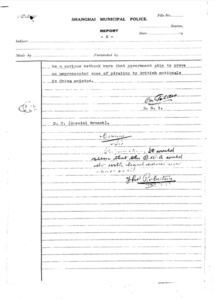
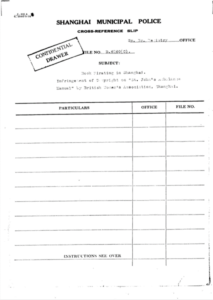
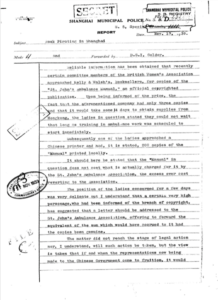
‘Book pirating in Shanghai, an infringement of copyright’, not the most gripping title in the world. However, the task for this week’s tutorial was set, we had to find source material on law and order in Shanghai, and I thought this may offer an interesting alternative to the other material my classmates would be producing. As soon as I opened up the document I was rewarded, on its first page the word ‘confidential’ was stamped across the report, on the next page more stamped lettering, this time spelling out ‘secret’. At this point my interest was piqued and so I delved further into the document, the report revealed a conspiracy in which an anonymous member within the higher echelons of the international settlement had stepped in to cover up the actions of the British Women’s Association. The Association had pirated a first aid manual from the St. John’s Ambulance, printing 240 copies.

The source could be easily explained as a powerful man exercising his authority to protect a wife, friend or relative who was part of the association. However, this fails to explain the concern of the writer of the report, who states that if the Chinese were to find out there would be an international incident. Instead the source underscores the conflict between the racial views of the British, the state of the international settlement and the Chinese opinions of it. Firstly, the actions of these women contradict the prevailing ideas of racial superiority held by the British. The Chinese were considered to be ‘racially unequal’ when compared to Europeans and so required European overlordship so as to civilise them.[1] The actions of the Women’s Association undermined this, offering evidence of immoral activity among the British, a double standard to do with the implementation of law, as well as presenting men of status within the colony as being unable to control their women (within the confides of the patriarchal society they were operating in).  These thoughts would have trouble the British authorities who were trying to navigate an increasingly politically complicated Shanghai, with Chinese nationalist, Chinese communists and Japanese nationalists all fighting for control.

This concern mirrors constant attempts by the Chinese to undermine the International Settlement. Chiang Kai-shek had made it clear in 1927 that the purpose of new Shanghai municipal government was to bring law and order to one of the most crime ridden cities in the world.[2] A city which had been failed by the International community. These opinions by the 1930’s had spread throughout Chinese society, with literary scholars in Beijing accusing writers from Shanghai of interlacing their stories with sex and decadence.[3] It can, therefore, be seen that the British establishment saw it as prudent to suppress this incident so as to not provide the Chinese with evidence of perceived inequalities and inefficiencies within the government of the International Settlement.

[1] Robert Bickers, ‘Shanghailanders: The Formation and Identity of the British Settler Community in Shanghai 1843-1937’, Past & Present 159 (1998), p. 184.

[2] Frederic Wakeman, Jr., ‘Policing Modern Shanghai’, The China Quarterly 115 (1988), pp. 419.

[3] David Koren, ‘Shanghai: The Biography of a City’ in Jan Kolen, Johannes Renes, Rita Hermans (ed.), Landscape Biographies (Amsterdam, 2015), p. 267.

Bibliography:

Bickers, Robert, ‘Shanghailanders: The Formation and Identity of the British Settler Community in Shanghai 1843-1937’, Past & Present 159 (1998), p. 161-211.

Koren, David, ‘Shanghai: The Biography of a City’ in Jan Kolen, Johannes Renes, Rita Hermans (ed.), Landscape Biographies (Amsterdam, 2015), pp. 253 – 282.

Wakeman,Frederic, Jr., ‘Policing Modern Shanghai’, The China Quarterly 115 (1988), pp. 408 – 440.

Source:

Heterotopias – Historical Evidence.

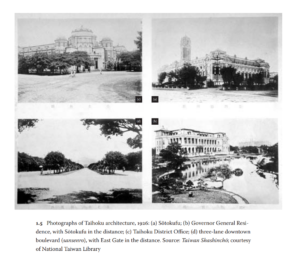
Figure A: Colonial buildings of Taipei.

At first I struggled to understand Michel Foucalt’s theory on Heterotopia, a theory which states that spaces have multiple meanings or relationships that do not immediately meet the eye. Yet, upon completing the prescribed chapter within ‘Taipei: city of displacements’ the idea of Heterotopias all fell into place. As Foucalt states, these spaces are found in all communities and in the case of Taipei this can be seen in the colonial administrative buildings built by the Japanese. These grand buildings as seen in Figure A are based upon European architectural design, announcing to the inhabitants of Taipei the colonial power of the Japanese. These spaces are designed to imply a colonial utopia, demonstrating the superiority of the Japanese as well as their efforts to modernise. It is interesting to note that following World War II, these buildings were adopted by the Chinese national government and took on another meaning. The buildings’ Japanese colonial history was expunged and instead the buildings became symbols of power for the national government. The reason I highlight this is that it offers an excellent example of Foucalt’s second principle within his theory on Heterotopia, demonstrating the impact of the passing of history on society.[1] What is important to understand here is that Heterotopia’s function can change over time as society develops.

              My curiosity was piqued from having made the connection between Taipei’s colonial buildings and Heterotopias and so, I decided I wanted to find some more examples to be able to explore Foucalt’s theory. Focusing upon colonial buildings still, I stumbled upon an article by Maggi Leung titled the ‘Fates of European Heritage in Post-Colonial Contexts: Political Economy of Memory and Forgetting in Hong Kong’ and found an excellent case study in Star Ferry pier and the Queens pier. As Foucalt states in his third principle, Heterotopias can juggle multiple spaces, sites which are incompatible with one and other.[2] These piers proved to be exactly that, offering spaces for the people of Hong Kong to ‘express their sense of local, national and global citizenship.’[3] The Chinese, on the other hand, saw them as symbols of British colonialism.[4] I can be seen that as mirrors of society, heterotopias can represent many different mental spaces, where the eye of the beholder plays an important part in unlocking certain spaces. This is demonstrated by the difference in meaning of the piers from a Chinese and Hong Kong perspective.

The power of heterotopias as imagined spaces is represented in the picture below, highlighting not only the variety of mental space, as seen by the plethora of buildings, but also the potential for change and decay as society evolves.

Figure B: Heterotopia in summary.

[1]Michel Foucault, Of Other Spaces: Utopias and Heterotopias (1984), p. 5.

[2]Ibid, p. 6.

[3]Maggi W. H. Leung, ‘Fates of European Heritage in Post-Colonial Contexts: Political Economy of Memory and Forgetting in Hong Kong’, Geographische Zeitschrift 97:1 (2009), p. 34.

[4]Ibid.

Bibliography:

Secondary Sources:
Leung, Maggi W. H., ‘Fates of European Heritage in Post-Colonial Contexts: Political Economy of Memory and Forgetting in Hong Kong’, Geographische Zeitschrift 97:1 (2009), pp. 24-42.
Figures:
Adkin, Paul, Heterotopias, 6 April 2013, <https://pauladkin.wordpress.com/2013/06/21/heterotopia/>[03 November 2019].
Allen, Joseph Roe, Taipei: city of displacements (Seattle, 2012), p. 34.