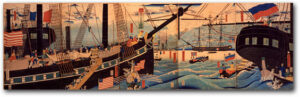
Spring Prospectus: Boating and the Bund: The Shanghai Yacht Society and the masculinity of leisure, c.1890-1930.

This blog is a short introduction to my Spring essay followed by a short analysis of a few primary sources intend to use as part of the final analysis.

The relationship between sport and empire initiated the homogenization of societies, cultures and institutions whilst introducing western sports globally.1 This essay will explore the relationship between the Shanghai Yacht Club and its use as a font of colonial masculinity.  Through the club’s role as a site of leisure, its function consolidated the British settler community in Shanghai as an economically, politically and racially separate and exclusive social unit from its establishment in 1868. The first recorded yacht race along the Shanghai River was in 1869 and soon after in 1871 the private Shanghai yacht club Boat house and Slipway Company was established in the bund; a ‘‘spatial form’’ that was already was backed up by a full set of strong and largely autonomous Western dominated institutions such as Shanghai Municipal Council, Mixed Court, Volunteer Corps, and Maritime Customs.2 The racially exclusive nature of these events distinguished British Settlers from the rest of the International Settlement. Resultantly, the club became a source of institutionalized identity for the settlers who controlled access to the bund and therefore, activities such as rowing or yachting which took place on the waters parallel were a physical manifestation of their ethnic and economic elitism.  

Boating and the Bund is an essay of three parts, it firstly asks, how did the leisure activities of rowing and sailing buttress the social lives and status of British male colonial identity in the Shanghai International Settlement from c.1890s-1930? The Shanghailanders, a nickname for the British settlers in Shanghai, were a social and ethnic group causing significant issues for the British State because if the legalities of their informal prescience in Shanghai.  With their financial successes tied inextricably to the treaty port system and their extraterritorial privileges, British settlers used social activities to create a unity and a sense of community identity.3 Articles in the Social Shanghai, a tabloid style magazine that as published by the North-China daily New and Herald Limited performed as a public newsletter focused on elevating the prestige associated with the British Settler’s leisure activities and the reputation of prominent men within these groups. A section of the Social Shanghai entitles ‘Well-Known Shanghai Residents’  in the 1908 January- June edition includes a section on MR G. W. Noel ‘a native of Surrey, came to Shanghai in 1895’, a reputable local man who became a partner at the auctioneering firm Makenzie and Co to form ‘one of the best known  and most highly esteemed auctioneers in the Far East’.4 Dubbed a great success, Mr. Noel is immediately named as an ‘active member’ of over 12 clubs in Shanghai (fig. 1) including the yacht club. tis clear that prestige and charisma, qualities of foremost importance within Shanghai’s British elite, were expressed primarily through visibly participating in community building leisure activities in order to highlight that your wealth and social standing was substantial enough to afford such pastimes. 5 On one level, participation was an illustration of a mans wealth and on another it was a sign of commitment to the Shanghailander community by investing in their shared value system, operated through leisurely clubs. Consequently, this essay asks; Why did the North China Herald and China Daily newspapers build such substantial excitement around the British clubs (as in rowing/sailing etc. rather than dancing clubs) of Shanghai and make their events into a source of tabloid media?  
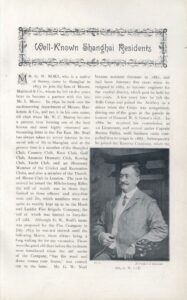
Figure 1: Social Shanghai,  January-June 1908.6

Secondly, executing the Yachting races along the bund illustrates how British settlers used the site to reinforce their identity spatially. As figure 2 illustrates, it is clear that the Bund is a site of exerting British culture and national identity through architecture and leisure. Sailing and rowing were primary opportunities to display agility and skill whilst asserting spatial control over the bund. These club also used their institutions and infrastructures to generate British imperialism within Shanghai’s international settlement during the decline of the Shanghailander political authority. By racing with British settlers from the Hong Kong yacht club to provide a vector through which the British settlers of Shanghai could associate themselves with the colonial authority of Hong Kong. The Hong Kong Telegraph and the China Herald report extensively on the relations and competitions between the two British yachting clubs.7 This essay argues that this relationship was co-constitutional. Whilst the Shanghailanders need to outsource their authority as British Settlers form their more stable Hong Kong associates, equally British colonial masculinity was supported significantly by the use of sport to illustrate their capacities and therefore the Hong Kong club also boosted their colonial identities from the racing tournaments.
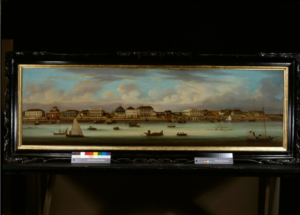
 

Figure 2: The Bund, Shanghai by Sunqua (1830-1870).8

Thirdly, as the Nationalist Revolution took hole in 1923-1928, dependence on Leisure as a source of strength established competing masculinities. with the boom of Chinese clubs were challenged by Chinese alternatives in the leisure and club scene, no evolution occurred within British circles. Therefore, using articles from North-China Herald, China Mail and the Hong Kong Telegraph to track the growth of their Chinese counterpart clubs,  the this essay aims to analyze how this decline impacted the relationship between the British and other ethnic groups within the international settlement as they were no longer able to rely on this source of colonial masculinity which was fundamental to asserting their control in treaty port Shanghai. 

This essay will argue that the creation of social anticipation and a group mentality through clubs like the Yacht Society were established to separate the British Shanghailander from other international settlers and local Chinese residents. Consistent records of races between Shanghai and Hong Kong Yacht and Rowing Clubs further illustrate that this was an inter-treaty port social system through which British treaty port settlers were able to justify each other’s permanency.  

  1. Ning Jennifer Chang, ‘Women in the Chase: sports Empire, and Gender in Shanghai, 1860-1945’, Chinese studies in History 54, no. 2 (2021), pp.130-148. [↩]
  2. Christian Henriot, ‘The Shanghai Bund in Myth and History: An Essay through Textual and Visual Sources,’ Journal of Modern Chinese History 4, no. 1 (2010), pp.1–27 [↩]
  3. Robert Bickers, ‘Shanghailanders: The Formation and Identity of the British Settler Community in Shanghai 1843-1937’, Past and Present (1998), pp.161-211. [↩]
  4. North China Daily News and Herald Ltd., ‘Social Shanghai: A Magazine for men and women’ Vol V (January-June 1908), p.31. Accessed at: Social Shanghai Vol V January-June 1908 : Shorrock, Mina : Free Download, Borrow, and Streaming : Internet Archive (accessed 20/03/2024) [↩]
  5. ‘Social Shanghai: A Magazine for men and women’ Vol V (January-June 1908), p.31. Accessed at: Social Shanghai Vol V January-June 1908 : Shorrock, Mina : Free Download, Borrow, and Streaming : Internet Archive (accessed 20/03/2024) [↩]
  6. North China Naily News and Herald Ltd., ‘Social Shanghai: A Magazine for men and women’ Vol V (January-June 1908), p.31. Accessed at: Social Shanghai Vol V January-June 1908 : Shorrock, Mina : Free Download, Borrow, and Streaming : Internet Archive (accessed 20/03/2024) [↩]
  7. Anonymous 1925, Feb 09. HONG KONG YACHT RACERS WINNERS FROM SHANGHA, The China Press (1925-1938), p.1. (Accessed at: HONGKONG YACHT RACERS WINNERS FROM SHANGHAI: Full Account Of Interport Regatta; Some Very Good Sailing – ProQuest) Accessed on 20/03/2024 [↩]
  8. The Bund, Shanghai by Sunqua (1830-1870) in the Ashmolean Library collection, Accessed at: https://collections.ashmolean.org/object/359962  (Accessed 20/03/2024) [↩]
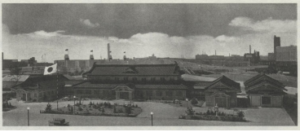
Exporting imaginaries of Empire: Navigating soft diplomacy surrounding Japanese depictions of Manchuria at the Chicago World’s fair, 1933-34.

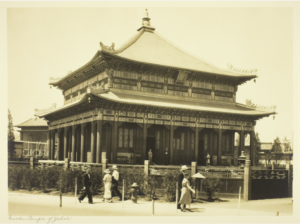
The puppet state of Manchukuo, created in 1932, was advertised by the Japanese Empire as a state “autonomous from Western influence”.1 This narrative was consistently reinforced through exhibitions, pamphlets and films produced by the Japanese government. To reinforce this narrative on a global stage, the Japanese invested a small portion of their exhibit at the World’s Chicago Fair in 1933 through a Manchuria exhibit in partnership with the Southern Manchuria Railway Company (fig.1). Concurrently, an American exhibit of the Golden Temple of Jehol (fig. 2), a province invaded by the Japanese Kwantung army and also an annexe of Manchuria at the time, was an expensively replicated and highly popular exhibit at the fair.2 This article uses Shepherdson-Scott’s work on the World’s Chicago fair supported by pamphlets and images of the event to illustrate that political diplomatic pursuits were consolidated through visual displays of authority.2 These imaginaries of Manchurian and Chinese territories served to assert specific narratives about contested legitimacy of Japanese authority in Manchuria at this time.

Defined by Young as the ‘Jewel in Japan’s Imperial Crown’, Manchukuo developed into a significant and profitable portion of the Japanese empire, however, public knowledge in the US about of the role of Japan in Manchukuo was controlled, Manchukuo was not recognised as a state by the US government and Japanese involvement in this territory was considered aggressive.3 Soft power, this is co-opting rather than coercion, in the form of elements of Japanese culture such as Japanese gardens or the exportation of travel guidebooks and pamphlets to private tour companies across Europe and the United States was widely accepted and proliferated in public discourses on Japan. In contrast, the acclimatisation of western audiences to imaginaries of Japanese Imperial power was confronted and countered by the US. Images of Japan were only accepted in the form that they were presented to a western audience when they were a exotic or visually appealing, thus, the trustees of the A Century for Progress fair capitalised on this reality by exoticising the Temple of Jehol and reinforced its Chinese heritage and the sovereignty of China. By challenging Japanese associations with the Manchurian Railway company and its assimilation of ‘Manchukuo’ into Japanese notions of modernisation and mobility, the temple of Jehol publicly rebuffed the relevance of the Japanese occupation of Manchuria and intertwined national politics corporate public relations within the context of the fairground.2

Figure 1: Illustration of the Japan Exhibition complex, Manchurian pavilion is visible on the far right (1933-34).4

Figure 2: The golden Temple of Jehol at the Century of Progress World’s fair 1933-34.5


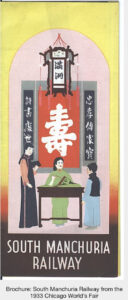
Figure 3: Cover of the Brochure for the Southern Manchuria Railway exhibit at the Chicago World’s Fair in 1933.6

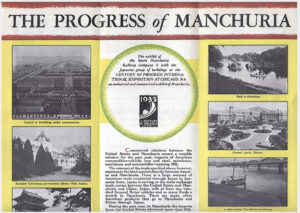
In this period following the 1931 ‘Manchuria Incident’ when the legitimacy of Manchukuo and the role of Japanese occupation and the Kwantang army still proved to be an elephant in the room, these displays of consolidation and reputation by the Japanese and the US governments respectively reflected the sumbilinal power play between the two nations over the legitimacy of Japanese dominance in Manchukuo.2 In the official Southern Manchurian Railway brochure (fig.4), relations between the US and Manchuria regarding trade is phrase neutrally, ”Japan is serving as the major trade exchanger between the United States, and Manchuria and China” and yet it still alludes to Japanese hegemony in the region.7 Moreover, images in the brochure include, the capital city under construction by the Japanese, the Japanese Kwantung Army Government offices, and the central circle of government buildings in the capital, Changchun.8 In contrast to the cultural statement in the form of the temple of Jehol which gained significant praise for its dazzling quality and drew attention from visitors because of its beauty, the presentation of the Manchuria exhibit focused on acclimatising the American audience with Japan as an intermediary between the US and China/Manchuria. Whilst the temple challenged the political borders of Manchukuo and the authority of the Japanese exhibition, the production of knowledge that associated Japan with significant political and economic stakes in Manchuria’s capital and infrastructure and the physical positioning of the Manchurian exhibit within the Japanese exhibition proved to be a spatially powerful illustration of their authority in the region and their goals for the future.

Figure 4: Brochure for the Southern Manchuria Railway exhibit at the Chicago World’s Fair in 1933.6

In conclusion, the overt retaliation against Japanese constructions of Manchukuo at the Chicago World’s fair by the American embassy illustrate the limits applied to Japanese overseas diplomatic pursuits. The competing narratives created by the US to challenge Japanese assertions of Imperial power highlight that beyond military and policy based rebuttals of Japanese occupation of Manchuria in the early 1930’s, alternative and creative challenges to Japanese power were established within the public eye designed both to covertly manipulate public opinions of the power of the Japanese government but also to intimidate Japanese authority on foreign soil.

  1. Louise Young,  Japan’s Total Empire: Manchuria and the Culture of Wartime Imperialism (London, 1998), p.1, p.22. [↩]
  2. Kari Shepherdson-Scott, ‘Conflicting Politics and Contesting Borders: Exhibiting Japanese Manchuria at the Chicago World’s Fair, 1933-34’, The Journal of Asian Studies 74:3, (2015), pp.539-564. [↩] [↩] [↩] [↩]
  3. Young,  Japan’s Total Empire, p.22. [↩]
  4. Illustration of the Japan Exhibition complex, Manchurian pavilion is visible on the far right (1933-34), A century of Progress exposition in Chicago, 1933-34.  Accessed at: Yale University Library. [↩]
  5. Image of The golden Temple of Jehol at the Century of Progress World’s fair 1933-34, Accessed at the Art Institute of Chicago, https://www.artic.edu/artworks/235402/golden-temple-of-jehol (Accessed 5/02/2024). [↩]
  6. Cover of the Brochure for the Southern Manchuria Railway exhibit at the Chicago World’s Fair in 1933, Available at: http://travelbrochuregraphics.com/blog/2014/01/09/brochure-south-manchuria-railway-from-the-1933-chicago-worlds-fair/ (Accessed: 05/02/2024). [↩] [↩]
  7. Brochure: Southern Manchurian Railway form the 1933 Chicago World’s Fair, Available at: http://travelbrochuregraphics.com/blog/2014/01/09/brochure-south-manchuria-railway-from-the-1933-chicago-worlds-fair/. (Accessed: 05/02/2024). [↩]
  8. Brochure for the Southern Manchuria Railway exhibit at the Chicago World’s Fair in 1933, Available at: http://travelbrochuregraphics.com/blog/2014/01/09/brochure-south-manchuria-railway-from-the-1933-chicago-worlds-fair/ (Accessed: 05/02/2024). [↩]

Accessing the ‘Other’: Brooklyn’s Botanical Gardens as an access point to the ‘Land of the rising sun’

By examining the constriction of access to and behavior within the Japanese garden, situated in the Brooklyn Botanic gardens, I argue that the Garden’s commissioners aimed to maintain Japanese ‘otherness’.  By using an additional behavioral standard’s and enforcing a code of conduct deemed unnecessary across the rest of Brooklyn Botanic Gardens. By controlling how the Japanese garden was perceived and restricting how it was used by the public, the gardens’ commissioners established their authority over writing Japanese culture in an American context. 1 This article uses images, maps, manuals and entrance signs of Japanese parks in western foreign countries to illustrate that despite the absence of an enclosure garden as a consistent tradition in Japanese culture, in the west, Japanese gardens are enclosed and purposefully detached from the larger garden. The separation and containment of Japanese gardens in the West highlights the containment and fetishization of these spaces and also the use of isolation as a form of exerting power over the the translation of Japanese culture in Western public discourse.2

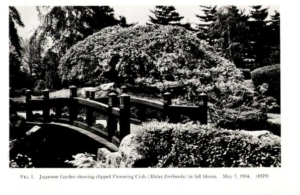
Figure 1: Image of the Flowing Crab in Japanese Garden from the Brooklyn Botanic Garden Record, 19343

Rather than being immersed in the surrounding context of a public park, the Japanese garden is frequently isolated and this practice is justified by marketing the Japanese garden as a superior garden and yet it perpetuates a hierarchical binary between ‘the west and the rest’.4 For the Japanese garden in Brooklyn Botanic Gardens, established in 1915 and designed by Takeo Shiota, restrictions over behavior and use of space have constrained it to become a disciplinarian space.  the Boston Botanic Gardens enclose the Japanese garden with a wooden fence which is justified as an element of tradition, however, there a plethora of cases in Japan where this does not apply, and this wall was erected fifteen years after the Japanese garden was officially opened.5 The physicality of the separation between conceptions of Japanese horticulture in the eyes of American observers comparatively to its ‘authentic’ purpose within Japanese culture. Frequent financial support provided by  the Japanese government to support the establishment of Japanese gardens in western cities highlights that whilst the Japanese government intended to enforce soft power through diplomatic advances like financial support to establish Japan within the vision of the American Garden-observer, commissioners who controlled public parks made significant spatial choices which limited the assimilation of Japanese tastes into American gardens by consistently organizing Japanese gardens as a traditional, formalized novelty.

Specific, traditional behavioral codes were enforced on entrance to the Brooklyn’s Japanese Garden which operated to restrict creativity and freedom of movement in the space.  Signs around the garden advised visitors to ‘stroll’, there are no benches and it is stipulated that walking on the grass is prohibited.6 Similarly, children were to be accompanied at all times in fear that they would disrupt the tranquil atmosphere and case noise and disrupt the reflective atmosphere.7 The active performance of enjoyment due to the limited interaction allowed with the garden restricts it from becoming a “lived space” where people are able to create memorable interactions and explore freely. By exoticizing the Japanese Garden the gardens commissioners removed its capacity to integrate into Brooklyn’s spatial politics and local culture because it was associated with the foreign and unfamiliar behaviors and sensations enforced by the park itself.

The mystification of the components of the Japanese Garden and their contribution to its cultural significance in turn establish the authority of curating the general knowledge accessible to the American public regarding these spaces to the commissioner of the Botanic gardens. In the Brooklyn Botanic Garden Handbook on Japanese gardens from 1968, the Japanese garden sis described as illustrating, “the peculiar attitude of the Japanese towards life, in which they join nature with everyday living’.8 By presenting the Japanese ‘mentality’ as separate and therefore distant, foreign, exoticized and ultimately for consumption the language used in this handbook highlights how a powerful construction of knowledge through the containment of the Japanese garden as a phenomenon purposefully separated from the holistic botanic garden structure served to establish a binary in the American mind between western, familiar conceptions of the use and behavior within a park or garden and the ‘otherness’ of the Japanese garden.  Indeed, the language used also served to describe ‘western’ and ‘eastern’ understandings of garden composition in opposition to each other, ‘the symmetry, uniformity and rectilinearity of Western gardens is disregarded in the Japanese garden’ .9 Resultantly, the western authorities prevailed in establishing control over the ‘otherness’ of the Japanese garden within the context of the public park. By dispensing mystified, vague and shifting details on the significance of the stones, lanterns and bridges present in the Japanese garden, the casual romantic exoticism of the ‘orient’ in American spatial politics prevailed.

To conclude, information and behaviors inscribed onto the Japanese garden by commissioners and local councils in an American context have served to fundamentally alter the conception of the Japanese garden and thus the curated image of Japan ‘mentality’ within the American observer. The interests of local authorities to present the Japanese garden as a concentrated impression of the ‘core qualities’ of an exoticized Japan conflicted with the assimilation of Japanese culture into the American observer that was desired by the Japanese government.

  1. Christian Tagsold, Spaces in Translation: Japanese Gardens and the West (Philadelphia, 2017), p.137. [↩]
  2. Tagsold, Spaces in Translation, p.138. [↩]
  3. Brooklyn Botanic Garden Record, (Brooklyn, 1934), p. 10 [↩]
  4. Tagsold, Spaces in Translation, p.137. [↩]
  5. Tagsold, Spaces in Translation, p.127. [↩]
  6. Brooklyn Botanic Garden and Kan Yashiroda,  Handbook on Japanese Gardens and miniature Landscapes (Brooklyn, 1968), p.6. [↩]
  7. Tagsold, Spaces in Translation, p.130. [↩]
  8. Brooklyn Botanic Garden and Kan Yashiroda,  Handbook on Japanese Gardens and miniature Landscapes (Brooklyn, 1968), p.6. [↩]
  9. Brooklyn Botanic Garden and Kan Yashiroda,  Handbook on Japanese Gardens, p.9. [↩]

Keen to be clean: Sanitation reforms in the “diseased city” of Colonial Keijō

Hygiene rituals in the city of Seoul – known as Keijō during the Japanese occupation – were formally institutionalised and led by police forces bi-annually during the Japanese occupation of the peninsula in 1910 until the end of Japanese occupation in 1945.  The power over sanitation and welfare policy was transferred from the Home Ministry of Sanitation Bureau to the Police Supervisory Board in 1912.1 This article will analyse the sanitation chapter of the Annual Report on Reforms and Progress in Korea by the Government-General in 1913-14 to outline the structural failings of colonial policy and the contradictory nature of government rhetoric which promised the assimilation of Seoul’s Korean citizens into a hygienic Japanese city and simultaneously implemented a Japanese-settler-centric programme of sanitation reform.2 The Governor-General of Seoul aimed to produce clean streets and active citizens who they wanted to condition into a habit of self-regulated cleaning. This article maps the enforcement of policed hygiene standards in Seoul’s densely populated residential areas and their racially charged origins.3 Although reports by the Police Supervisory Board imply that enforcing cleaning was introduced to encourage residents to associate cleanliness with their health, this assertion assumes prior knowledge that would enable the unification of cleanliness with health.4 In contrast, Korean newspapers make it clear that the monetary cost of non-compliance and the avoidance of aggravating the police force were the factors motivating residents, not a consciousness surrounding sanitation5

Government reports consistently reflect the Japanese officials’ prioritisation of the Japanese expatriate population, who were more susceptible to illness,  despite their relatively higher wealth level and capacity to install household waste disposal and hygienic food disposal, were at the forefront of policy and the construction of service to support sanitation improvements6 The Annual Report on the Reforms and Progress in Korea in 1913-14 highlights that a series of epidemic diseases broke out on the Korean Peninsula in 1913 like cholera, typhoid fever, dysentery, diphtheria and smallpox.  Whilst the report highlights that there was a 160-person decrease in the number of deaths compared to 1912, the report is clear that there is a significantly higher number of Japanese settlers who reported epidemic cases than Koreans. For example, 1,250 Japanese caught typhoid fever and 284 died, comparatively, 700 Koreans caught typhoid fever and only 86 died of the disease.7 The report’s data emphasises that colonial policy, which enforced police-imposed standards of hygiene,  aimed to protect Japanese settlers by mobilising the Korean population, rather than establishing constructive sanitation systems that would tangibly benefit Korean citizen and align with the government’s assimilation rhetoric.8

Chart from the Annual Report on Reforms and Progress in Korea 1913-14, Epidemic diseases in Choson

Figure 1: Chart explains the number of Japanese, Korean, and foreign people with epidemic diseases and the number of people who died from those diseases. Chart from the Annual report on reforms and Progress in Korea 1913-14.9

Furthermore, the report states that to tackle these epidemic diseases “qualified Japanese physicians [will be] attached to police stations to attend to public sanitation”. The draconian method of police enforcing semi-annual cleanups was an intrusive manner through which the government restructured Korean notions of cleanliness and government reports suggest that this was done with little resistance.10 However, evasion of government officials regularly occurred due to the implementation of hospital quarantine and the enforcement of a treatment plan for Koreans once they had informed officials of their symptoms. From a cultural perspective, Koreans also deeply feared dying outside of their homes because this was a space where they believed spirits could come to venerate them after death.11  An overarching insensitivity to the social and cultural consciousness of Korean citizens curbed the efficiency of colonial policy and directly contradicted the government’s assimilation project. This can be illustrated further in the measures taken to sanitise the streets and sewage systems of Korean populated areas of Seoul.

The reports served the government by reconstructing national understandings of city management by delegitimised Korean notions of health and sanitation. In section 122, the report states that “numerous natives who only know old-fashioned Chinese methods and nothing of modern medical science”. In contrast to the government’s proliferation of Korean incompetence, the Seoul Sanitation Association (SSA), directed by the Residency-General, imposed a fee for excrement collection on the city’s Korean population when Korean fertiliser merchants were completing their task more effectively and free of charge.12 Resultantly, newspaper interviews reflect that waste was collected much less frequently, exacerbating hygiene issues whilst rural farmers suffered a resource deficit in manure.13 The SSA enforced using a top-down approach to managing sanitation which ignored the knowledge of seasoned local professionals and citizens, resultantly, many Koreans failed to pay their share due to poverty in the region and fears it was a financial fraud due to this service already being provided by local fertiliser collectors. Henry highlights that either a heavy fine or labour instead of a wage would be requested if the two sen fee was not paid.14 These policy’s did not focus on the integration of Koreans through education suited to their understandings of sanitation or the use of methods which respected the privacy of Korean people, instead, these policies ritualised cleaning and fee paying which the government felt would help to curb the infection rate of the expatriate population. Although sanitisation cooperatives and talks surrounding education on sanitation were set up partly to educate the population, their association with police enforcement significantly impacted engagement with these groups and ultimately decreased the effectiveness of lectures and other communication techniques imposed on the Korean population.

In conclusion, Henry argues that the evident subordination of Seoul’s Korean population during Japanese colonial governance is illustrative of the continual privileging of the Japanese settlers and the hegemony of the pervasion of the euro-asian power-knowledge concept into their style of colonial policy.15 Despite the Governor-Generals insistence that the aim was to assimilate the Korean peninsula into Japanese society, medical reports and municipal government data highlight that the production of knowledge regarding the causal relationship between the city’s sanitation infrastructure and the knowledge Seoul’s colonised residents had regarding sanitation was constructed to present the Japanese as superior in their understanding of health.16 Using partial knowledge of pre-established sanitation efforts used by Korean’s to ‘solve’ the city’s sanitation issues, the colonial government diagnosed the so-called “diseased city” of Keijō with issues that were only exacerbated by their presence.

  1. Todd A. Henry, Assimilating Seoul: Japanese Rule and the Politics of Public Space in Colonial Korea, (Berkley, 1972), p.137. [↩]
  2. Governor-General of Chosen, Annual Report on Reforms and Progress in Korea by the Government-General in 1913-14, (Seoul, 1915), pp. 123 -131, Accessed at: https://archive.org/details/annualreportonreformsandprogressinchosenkorea191314/page/n171/mode/2up (Accessed on: 6/11/2023). [↩]
  3. Henry, Assimilating Seoul, p.136. [↩]
  4. Ibid, p.139. [↩]
  5. Ibid.  [↩]
  6. Ibid, p.155 [↩]
  7. “Report on Reforms and Progress in Korea 1913-14”, Accessed at: https://archive.org/details/annualreportonreformsandprogressinchosenkorea191314/page/n171/mode/2up, (Accessed 6/10/2023), pp.125 [↩]
  8. Henry, Assimilating Seoul, p.131. [↩]
  9. Annual Report on Reforms and Progress in Korea 1913-14, pp.123-131. [↩]
  10. Henry, Assimilating Seoul, p.139. [↩]
  11. Ibid, p.142. [↩]
  12. Ibid.p.135. [↩]
  13. Ibid, p.136. [↩]
  14. Ibid. p.135. [↩]
  15. Ibid. p.139. [↩]
  16. Ibid. [↩]

Building on Tradition: From Kampong to High-Rise, the ‘tropical city’ and its manifestation in Singapore

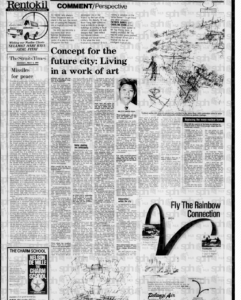
The elusive topic of tropicality has pervaded conversations surrounding the design and function of Singaporean architecture since the imposition of Western architectural styles and layouts following the ratification of the Treaty of Singapore in 1819. This article will argue that the categorisation of Singapore as a ‘tropical city’ comprised of ‘tropical architecture’ is the product of colonial power that was integrated into the production of knowledge about the built environment and is therefore inherently responsible for the continuation of discourses that associate Southeast East cities as the ‘other’ to those in Western, temperate climates.1 However, as architects like Mr Tay Kheng Soon illustrate the term ‘tropical city’ has also served as a reclamation of Singaporean independence and the celebration of the city’s culture and agency through a selective incorporation of European modernity.2 This article analyses a Straits Times interview conducted in 1989 by Patrick Daniel and Caroline Chan of the Singaporean architect Mr Tay Kheng Soon who applied his vision of the tropical city to Singapore to detach the independent city-state from the epistemic conquest of British hegemony.3

Figure 1: Article in The Straits Times, “Concept for future city: Living in a work of art”.4

Tay envisioned an “intelligent tropical city” and argued that a tropical city could emancipate Singaporeans from the economic dominance of Britain in the region.5 He aimed to re-politicise urban planning by separating the city from the “mono-cultural compactness” of colonial offices and housing by designing Singapore to be a “work of art” and a compact city capable of “increasing business opportunities” and “providing a medium for intense, social, cultural and economic exchange.6 By using the tropical city concept, Tay identifies that the architectural aesthetics of tropicality were attached to colonial and post-colonial power relations and seeks to separate Singapore from these streams of power. By designing a city which prioritises “poly-cultural compactness”  to form a  “support structure for their [people’s] activities… and yet contribute to the cooling of the city as a whole” he illustrated that colonial power was ingrained in the construction of Tropicality. Equally, he highlights that Signporean architects had the necessary tools to begin deconstructing this discourse.7

The introduction of ‘tropical architecture’ established a sphere of knowledge which ran through Imperial networks during the colonisation of Singapore and was utilised by the Colonial Office to ‘other’ Southeast Asian architecture in opposition to temperate architecture.8 The term tropical architecture prioritises the climate in its terminology whereas temperate architecture is categorised by regional geographic zones or nations, imposing a homogenous staticity onto Singaporean urban development.9 Tropicalisation involved the surface-level modification of Western governmentalities to tropical conditions rather than the necessary transformation.10 Tay emphasises that in the 1980s tropicality was not considered “another symbol of modernity” and he asserted that the “big bland blocks” of highrises that covered the city were “still a sign of the captive mind”.11 Indeed, the “captive mind” he refers to in the Straits Times interview illustrates the power-knowledge concept and the overt control colonial powers had over conceptions of tropical architecture and their subsequent limitation of the built environment to benefit colonial wealth and power.12  The perpetuation of this reductive understanding of the city’s needs justified the colonial administration’s choice to prioritise Singapore’s sanitation and fears of reassuring contamination issues, rather than holistically solving civic issues through the optimisation of the built environment.13

Tay’s Straits Times interview and his successive proposals for tropical urbanism began to combat the circulation of British colonial networks and their epistemic conquest over the focal point of Singapore’s housing strategies by proposing socio-economic structural problems were addressed which would in turn resolve sanitation issues.14 By proposing that the tropical city is defined by its interconnectedness, Tay defined the tropical city by its, “combination of tropical rain forest with the city by increasing transpiration”.15 To establish Singaporean independence from colonial power relations Tay designed a climate-responsive built environment, working in favour of its citizens.16 His holistic approach to the city and its economy assimilated tropical architecture into the tropical climate rather than adopting temperate architectural models that exacerbate the urban heat island effect.17 As Chang explains, the architectural aesthetics of tropicality are inseparably bound to colonial and postcolonial power relations and the implementation of Western hegemony through ideals of social order and the application of policy.18 These concepts are closely linked to the sanitisation movement and the colonial government’s preoccupation with contamination, these fears greatly influenced the structure and organisation of Singapore’s housing and the developments that occurred beyond the European socio-spatial enclaves of the city.19

Tay’s reclamation of the term ‘tropical city’ reflects the complex relationship between language and the built environment in Singapore’s postcolonial legacy. Alongside other regional architects, Tay produced a deviating discourse on tropical architecture that challenged the cultural and economic supremacy of the West by proposing a multi-tiered city. By prioritising the city’s functionality, his urban planning methods and vision were ahead of their time and later were used to distinguish Singaporean identity as heterogonous and separate from Western notions of tropicality.

  1. Chang Jiat-Hwee, A Geneology of Tropical Architecture: Colonial Networks, Nature and Technoscience (New York, 2016), p.7. [↩]
  2. Chang, A Geneology of Tropical Architecture, p.1. [↩]
  3. Chang Jiat-Hwee, “Deviating Discourse: Tay Keng Soon and the Architecture of Postcolonial Development in Tropical Asia”, The Journal of Architectural Education, 63:2 (2010): 153. [↩]
  4.  Kheng Soon Tay, “Concept for the future city: Living in a work of art”, The Straits Times, Singapore, 8th May 1989, p.16 Accessed at: https://eresources.nlb.gov.sg/newspapers/digitised/article/straitstimes19890508-1.2.49.2 (Accessed 24/10/2023) [↩]
  5.  Kheng Soon, “Concept for the future city: Living in a work of art”. [↩]
  6. Ibid. [↩]
  7. Ibid. [↩]
  8. Chang, A Geneology of Tropical Architecture, p.5 [↩]
  9. Ibid, p.6 [↩]
  10. Chang Jiat-Kwee, “Tropicalizing Planning, Sanitation, Housing and Technologies of Improvement in Colonial Singapore, 1907-1942”, in Robert Pecham and David Pomfret (eds.) Imperial Contagions: Medicine, Hygiene and Cultures of Planning in Asia, ( Hong Kong, 2013), p.41. [↩]
  11. Kheng Soon, “Concept for the future city: living in a work of art”.  [↩]
  12. Chang, A Geneology of Tropical Architecture, p.6. [↩]
  13. Chang, “Tropicalizing Planning, Sanitation, Housing and Technologies”, p.37. [↩]
  14. Chang, “Deviating Discourse”: 154. [↩]
  15. Kheng Soon, “Concept for the future city: living in a work of art”. [↩]
  16. Ibid. [↩]
  17. Chang, “Deviating Discourse”: 157. [↩]
  18. Chang, A Geneology of Tropical Architecture, p.2. [↩]
  19. Chang, “Tropicalizing Planning, Sanitation, Housing and Technologies”, p.38. [↩]

A Utopian Facade?: Japanese statecraft in Manchukuo and the development of ‘Asian Revivalism’

In this short visual analysis, I will argue that the distinctive phases of architectural style visible in the architecture of Changchun and Xinjing illustrate the Japanese state’s search for an international modern style to characterise Manchukuo as a ‘utopian’ state. Space within the cities was used to portray the technical capability of the Imperial government whilst also appealing to Asian sentimentally.1 Young emphasises the speed and proficiency with which the Japanese puppet state introduced railway lines. Indeed, over 5,030km of new track was built between 1932 and 1938 and the resultant rapid formation of railway towns and cities.2 Similarly, running water, underground sewage systems, gas and electricity were efficiently introduced during the construction of Manchukuo’s cities.3

Whilst these elements of city planning were clearly defined necessities within Japanese conceptions of ‘utopia’, the style, organisation and decoration of state and public buildings was a more complex process of evolution, trial and error. The utopian vision following the Manchurian incident in 1931 sought to establish the state of Manchukuo as a source of mutual benefit and liberation for the Japanese colonisers and the Chinese colonised.4 Whilst Japanese commercial enterprise was prioritised, the Architecture of Changchun and Xinjing reflected Chinese revivalism and the emergence of Manchurian style in the search for the ideal ‘utopian’ structure and facade. The design and implementation of these structures are used to implement order. They demonstrate the manipulation of European styles as a means to connect with Western merchants and the inclusion of Chinese and Manchurian styles to encourage cultural mixing to align with the ideals of a modern, cohesive society.5

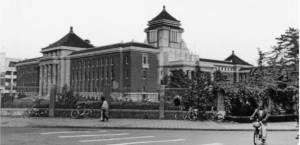
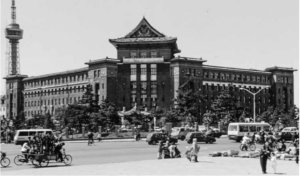
Figure 1: Manchukuo’s Hall of State6

Figure 2: Manchukuo’s Ministry of Public Security.7

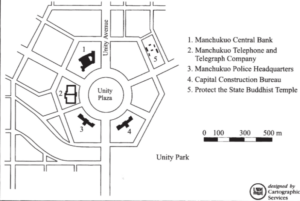
Figure 3: Unity Plaza8

The construction of a ‘utopian’ vision for the puppet state of Manchukuo was realised through assimilating Chinese architecture with a modern Japanese style.9 The scale of the state buildings constructed in the Manchurian style used symmetry to reflect a desire for a utopian balance and harmony between the Chinese and Japanese inhabitants of the city.10 The conflation of Japanese and Chinese building practices alongside the sheer size of these state buildings functioned as Japanese propaganda by emphasising the capabilities, power and legal monopoly of Japan over Manchukuo. Significantly, this blend of European columns and stonework with Asian roofs instilled notions of Asian superiority over the European style to create Xinjang’s bureaucratic expressions of Manchukuo as a ‘utopia’.

Asian Revivalism was an architectural style that aimed to mask Xinjing’s initial period of architectural chaos, these buildings were often characterised by a Japanese-styled roof.11 This building style was referred to as the “Manchukuo bureaucratic building style”.12 The Hall of State, built between 1934 and 1936 was designed by Ishii Tatsure and contained a pagoda-style roof flanked by two similar roofs at the end of the central section of the buildings.13 Freestanding columnar entryways positioned beneath the capped roofs also separated also distinguished the Hall of State from previous styles14 Columns appear in fours throughout the wings and central structure of the building, enhancing the European-inspired element of verticality.6. Similarly, the Ministry of Public Security also sported capped sloping tiled roofs. Built between 1935 and 1945, it is of note for housing the Manchukuo military headquarters.15 These buildings began the initiation of a “rising Manchurian style” notable for its implementation of verticality and the adoption of Japanese-style roofs with exposed roof gable.7

These buildings surrounded the ‘Unity Plaza’ (depicted in figure 3), a 36-metre wide extension to the SMR settlement that conformed to the grid pattern of the SMR settlement and was designed to reinforce elements of national architectural heritage and was named to imply the unity of the various groups, Manchu, Chinese, Korean, and Japanese which formed Manchukuo.16 Unity Avenue, a 36-metre wide road extending from Unity Plaza, was a site of consistent ceremonial celebration where thousands gathered for mass meetings throughout the 1940s in support of Japan’s wars in Asia.17 The construction of these broad plazas and large authoritative Bureaucratic administration buildings reflect the significant role of urban planning and constriction to the state regulation of Manchukuo and the role of “Asian Revivalism” in attempting to create a modern harmonious city. As Buck asserts, Chinese residents of Xinjing continued to experience subordination throughout the puppet states’ influence over Manchukuo18 Indeed, these works of architecture reflect the tensions between the ideological harmony desired by the intelligentsia and their understanding as ‘utopia’ as the consideration and inclusion of ethnic groups that lived in Manchukuo and the harsh imperial reality of the motivations of the Japanese government.

  1. Bill Sewell, Constructing Empire: The Japanese in Changchun, (Toronto, 2009),  p.76 [↩]
  2. Louise Young, Japan’s Total Empire: Manchuria and the Culture of Wartime Imperialism, Twentieth-Century Japan, (Berkeley, 1999), p.244. [↩]
  3. Young, Japan’s Total Empire, p.245. [↩]
  4. Ibid, p.242 [↩]
  5. Sewell, Constructing Empire, p.79 [↩]
  6. Ibid, p.84 [↩] [↩]
  7. Ibid, p.85 [↩] [↩]
  8. David Buck, “Railway City and National Capital: Two faces of the Modern in Changchun” in Joseph Eshwick (ed), Remaking the Chinese city: Modernity and National Identity, 1900-1950 (Hawaii, 2000), p.83. [↩]
  9. Young, Japan’s Total Empire, p.241 [↩]
  10. Sewell, Constructing Empire, p.87 [↩]
  11. Ibid, p.81 [↩]
  12. Ibid, p.81 [↩]
  13. Ibid, p.82 [↩]
  14. Ibid, p.83 [↩]
  15. Ibid, p.85 [↩]
  16. Buck, “Railway City and National Capital”, p.84 [↩]
  17. Ibid, p.86 [↩]
  18. Ibid, p.88 [↩]

Curating First Impressions: Exploring the Seascapes of Sadahide’s Yokohama prints and their presentation of the Early Treaty Port Era

Sadahide’s Yokohama Prints or Yokohama-e are the product of a significant shift in the spatial context within a plethora of Japanese ports during the 1850s. These artworks illustrate the spatial dynamism within the Treaty Port’s commercial and social areas. In spite of the dangers of being a foreign merchant and complex spatial barriers incurred by the legal segregation of land and access to littoral space in Yokohama, Sadahide’s exoticised portrayals of the Treaty Port reflect the process in which people’s sense of place is curated and altered. The Harris Treaty signed aboard the U.S. warship Powhatan, came into effect in 1859 and catapulted Yokohama into the international economy.1

The pressured opening of Japanese trading ports induced the restoration of the social issues of human trafficking, and the violation of Japan’s domestic security.2 Foreign traders and officials hastily constructed entertainment venues and brothels to cater to their sailors’ needs.3 They were also known to venture deeper into the inlets of Edo Bay beyond the boundaries of the Treaty Ports and these outings often ended in violence against the foreigners.4 These acts began to break down Japan’s status society and, combined with the continued commercial concessions enforced on the imperial court, sparked acts of violence by the Bakufu against foreigners.5 The realities of Treaty Port life are largely excluded from Sadahide’s exploration of Treaty Port life and focus on the economic vitality, cultural sophistication, and social cohesion of the Treaty Port.

The artwork “Pictures of Western Traders at Yokohama Transporting Merchandise”, produced in 1861, consists of five weed blocks attached that capture Sadahide’s portrayal of the age of commerce in Yokohama’s Treaty Port. This print depicts five ships, each flying a flag that distinguishes them as one of the five Western members of the Ansei Treaties. Traditional Japanese woodblock printing emerged a century prior to the signing of The Ansei Treaties in 1858, which opened access to Japan’s trading ports after two centuries of seclusion.6 The national flags on each ship in Sadahide’s print are those of the United States, Britain, France, the Netherlands, and Russia. These countries established trading rights, port access, and the application of extraterritoriality between Japan themselves.7 This arrangement was arguably forced upon Japan by the United States by intimidating the shōgunate by periodically sending warships into Edo Bay.8

Despite Japan’s coercion into the treaty, its re-introduction into the global market and the high value of imported goods transiting through the Treaty Ports is illustrated thoroughly in “Pictures of Western Traders at Yokohama Transporting Merchandise”.  A mixture of steam and sailboats are visible. Inside the port holes, small sightings of the internal luxury are discernable. Many foreign women accompanying their husbands are visible, despite their scarcity in this period.9 A diversity within the staff is also depicted, on the American boat, an Indian male, distinguished by his turban, is pulling in the rigging. Goods are overflowing on the decks of each ship and in the small rowing boats on the water. Overall, the seascape is overwhelmingly a Westernised image. Sadahide celebrates a bustling yet peaceful image devoid of the local xenophobia that was rife towards the inhabitants of the Treaty Ports.10 This image is also thought to be inspired by a print published in the Illustrated London News half a year before this print release.11 Sadahide’s potential imitation of the British artist illustrates that Sadahide is able to manipulate Western artistic fashions to appeal to foreign consumers and curate a specific and positive sense of place within the viewer. 

Figure 1: “Pictures of Western Traders at Yokohama Transporting Merchandise”,  by Sadahide (1861).

Figure 2: Harbour Scene at Naples, from Illustrated News London.

The print entitled “A Picture of Sunday in Yokohama”, released in 1860 illustrates the spatial exclusivity of the Treaty Port.12 The image depicts a procession of the foreign inhabitants of Yokohama’s Treat Port including a brass band, the wives of merchants and again the flags of the five nations involved in The Ansei treaty. In the background, the merchant ships and one of the jetties can be seen, reinforcing the semi-colonial assertion of power the five nations have enforced on Yokohama. In Neo-Confucian conceptions of moral behaviour and within Tokugawa society, the role of merchants and handling money is associated with improper ethical practice and is a lowly occupation.13 Sadahide is perhaps mocking the Western ritualised celebration of the merchant class and contesting their perceptions of how they assert power over Yokohama’s littoral space by implying they are morally unrefined. This is a significant example of how perceptions of space and who holds power in these places may be interpreted by foreigners and Japanese people may interpret Sadahide’s representations in his prints differently.

Figure 3: “A Picture of Sunday in Yokohama”, by Sadahide (1860).

To conclude, Sadahide’s artworks exude a sense of calmness and present a highly sterilized image of Yokohama to engender Japan with the prestige and financial prosperity it aimed to embody in the eyes of Western visitors.14 In contrast with the dangerous and male-dominated reality of Yokohama’s Treaty Porty at this time, Sadahide provides an enchanting, stylised depiction of semi-colonialism. During the messy, infancy of the Treaty Port system, foreign merchants began to test the pliability of the spatial boundaries that they had assigned. Resultantly, markets for prostitution, and “coolie” labour were drawn to Yokohama’s shores to facilitate the growing market.15 As tensions rose between the British and Japanese in their quests for legal hegemony over legalities that transgressed the port’s limits, Sadahide continued to print visuals that appealed to Western foreigners residing and travelling through. There is a constant exoticism and beautification of the Treaty Port, the harbour, and the merchants.

  1. John Dower, “Yokohama Boomtown: Foreigners in Treaty Port Japan (1859-1972), Available at: yb_essay04.html (Accessed: 18/09/23) [↩]
  2. Daniel Botsman, ‘Freedom without Slavery? “Coolies,” Prostitutes, and Outcastes in Meiji Japan’s “Emancipation Moment”’, The American Historical Review 116, no. 5 (2011): 1323–47. [↩]
  3. Marius Jansen, The Making of Modern Japan, (Harvard, 2022), p.317. [↩]
  4. Jansen, The Making of Modern Japan, pp.317-319. [↩]
  5. Jansen, The Making of Modern Japan, pp.314-317. [↩]
  6. Dower, “Yokohama Boomtown”, available at: yb_essay04.html (accessed: 18/09/23) [↩]
  7. Jeremy Taylor, “The Bund: Littoral Space of Empire in the Treaty Ports of East Asia,” Social History 27, no. 2 (2002): 125–42 [↩]
  8. Todd Munson, “Imperialism and Indomedia in Bakumatsu Japan: The View from Treaty Port Yokohama”, PhD Thesis, (University of Indiana, 2004) pp.50-53 [↩]
  9. Dower, “Yokohama Boomtown”, available at: yb_essay04.html (accessed: 18/09/23) [↩]
  10. Jansen, The Making of Modern Japan, p.317 [↩]
  11. MIT Visualising Cultures, “Boomtown”, Available at: https://visualizingcultures.mit.edu/yokohama/yb_essay04.html, (Accessed 18/09/23) [↩]
  12. MIT Visualising Cultures, “Boomtown”, Available at: https://visualizingcultures.mit.edu/yokohama/yb_essay04.html (accessed:18/09/23) [↩]
  13. Munson, “Imperialism and Indomedia in Bakumatsu Japan: The View from Treaty Port Yokohama”, p.156 [↩]
  14. Munson, “Imperialism and Indomedia in Bakumatsu Japan: The View from Treaty Port Yokohama”, p.147. [↩]
  15.  Botsman, ‘Freedom without Slavery?”: 1323–47. [↩]