Human rights, a symbol for a new Taiwan

Taiwan, officially known as the Republic of China (ROC) is a semi-recognised sovereign state with an independent government but limited recognition state in East Asia with only 11 UN member states recognising it by the time of writing.1 Even though the name China appears on the name of Taiwan, the Taiwanese residents today, especially the younger generation see themselves as ‘Taiwanese’ rather than ‘Chinese’ despite the ROC being a remnant of the Chinese Civil War from 1945 to 1949 where the ruling Nationalist party (KMT) lost and established a rival government to the Communists (CCP).2 To understand this phenomenon of Taiwanese identity shift, this blog will explore the two sites managed by the National Human Rights Museum established in 2018. This blog argues that the construction of human rights-themed museums builds onto the Taiwanese identity to showcase to the outside world that they are different from authoritarian Mainland China as an indirect form of protest against the ‘Chinese’ identity being forced upon Taiwanese residents. The blog will start by contextualising the argument through a brief account of the recent history of Taiwan. Next, the Green Island Memorial managed by the National Human Rights Museum will be analysed. Finally,  a concise comparison of the museum with the Japan-British exhibition will be used as a discussion of the theme of museums and exhibits.

Taiwan or Formosa is an island located off the coast of Fujian, China separated by the Taiwan Strait. From 1895 to 1945, as a result of the Qing defeat in the First Sino-Japanese War, Taiwan became a colony of the Japanese Empire, seeing industrialisation and exploitation of Taiwanese resources for the Japanese war effort.3 In 1945 at the onset of the surrender of the Japanese, Taiwan was to become under the administration of the ROC, which at the time controlled Mainland China as well. However, with the onslaught of the Chinese Civil War and the defeat of the KMT under Chaing Kai-shek at the hands of the CCP led by Mao Zedong, the KMT established their government in Taipei, with the goal of eventually reconquering the Mainland.4 Under KMT rule until 1989, forms of opposition or suspicion of being communist spies were a target for arrests and execution, and any form of Taiwanese separatism, speaking Taiwanese Hokkien or praising the Japanese were seen as treason and a breach of national security reinforced by Martial Law.5 This policy was in line with the KMT policy to instil a sense of Chinese identity in the Taiwanese population to eventually retake the Mainland, and to promote itself as the ‘true China’. Fast forward to 1987, Taiwan lifted Martial Law and free elections were held, causing Taiwan to flourish as a young democracy.6 This has allowed for a broader room of discussion for topics that used to be banned such as Taiwanese identity, democracy, human rights, and free speech. This democratising environment eventually culminated in the 2000 presidential election of Chen-Shui-bian of the Democratic Progressive Party (DPP), which promote a Taiwanese identity distinct from the Chinese-centric KMT, hence marking a shift in Taiwan’s history.7 Since 2000, Taiwan has become an established democracy with the KMT and DPP constantly vying for power with some notable cases of brawling in the Legislative Yuan (Taiwan’s parliament). 

Under DPP administrations, the government has pushed for the introduction of liberal values that distanced itself from China. The promotion of human rights is a major policy for the Taiwanese government. The DPP administrations under Chen-Shui-bian (2000-2008) and Tsai Ing-wen (2016-2023) have pushed for a Taiwanese-centered identity which aimed to promote a Taiwan-centered society and de-Sinicise the education system.8 The establishment of the National Human Rights Museum in 2017 was a milestone in Taiwan’s quest to distance itself from an ever-aggressive China. According to the museum’s official website, it took over 15 years of donations from organisations and countless legislative obstacles to establish the museum managing two former sites used to imprison KMT political opponents to educate the public about the importance of freedom and reflecting on past mistakes. ( (https://www.nhrm.gov.tw/w/nhrm/Introduction )) This demonstrates how the Taiwanese government under the DPP tried to establish former spaces of oppression to promote new Taiwanese values. I believe this was done to counter the growing assertiveness of the Chinese government in claiming Taiwan for itself.

The Green Island Human Rights Park was a former prison used to imprison political opponents during the Martial Law era and is now a museum site under the administration of the National Human Rights Museum. Located in Taitung prefecture on the east coast of the island, this 32 acre site used to be a former prison that housed activists who challenged the government.9 By turning the site into a museum that commemorated the victims of the KMT regime, it demonstrates a power shift. Under the DPP administration, the KMT past, especially the era under Martial Law was seen as a period where innocent Taiwanese were imprisoned because of promoting free speech created a new discourse that the KMT and China were foreign invaders of Taiwan and were not native to the land. This shows how the DPP is attempting to construct a discourse of Taiwanese identity that aims to distance itself from China in light of the heightened tensions across the Taiwan Strait. As China is increasing its crackdown on human rights and individual freedoms, Taiwan sees itself as the bastion of freedom against the communist regime across the Straits. By coming to terms with the past human rights abuses and promoting a sense of Taiwanese identity, this museum exhibit aims to educate the public that human rights is an important aspect of post-Martial Law Taiwan. By directly turning a former site of political oppression into a site that educates the public on values of democracy, it demonstrates that the government under the DPP is attempting to create a discourse that the past KMT-centered government is responsible for numerous atrocities and that the Taiwanese identity is central to a new discourse. This showcases how the DPP aims to construct that the new Taiwan was born under the abandonment of the China-centric approach by the KMT, solidifying the political narrative. With museums, it is an effective measure to promote to the public as it uses summarised and condensed narratives on how particular political progress is achieved.

In comparison to the Japan-British Exhibition of 1910, the transformation of the Green Island Museum draws parallels. The Japan-British Exhibition of 1910 aimed to promote Japan’s imperialism and justify having an empire over territories like Taiwan and Korea whereas the Taiwan one aimed to promote human rights as part of national identity construction.10 Similar to how the Japanese wanted to project their empire to the West, the Taiwanese aimed to use the human rights museums to promote that they are in line with the West in democracy against the authoritarian China much like how the Japanese did 100 years ago. In short, although there is a 100 year gap between my elective reading and the example used in this elective reading, fitting in with Western values often signify a sign of civilisation, in which colonised populations hope to achieve and become a part of it.


  1. https://www.bbc.co.uk/news/world-asia-67978185 [↩]
  2. https://tw.news.yahoo.com/%E6%B0%91%E8%AA%BF-76-7-%E8%87%AA%E8%AA%8D%E6%98%AF%E5%8F%B0%E7%81%A3%E4%BA%BA-%E4%B8%AD%E5%9C%8B%E8%AA%8D%E5%90%8C%E5%B7%B2%E7%B6%93%E5%80%8B%E4%BD%8D%E6%95%B8-044006112.html?guce_referrer=aHR0cHM6Ly93d3cuZ29vZ2xlLmNvbS8&guce_referrer_sig=AQAAAMa3tYOVvzOCVYWYQfcdY3JVR-V-tDwjxGpcmLNCusfFh3acFRPJnKI5hcA0YdS4FewkhElwHzleI0hXC2-GpoAqhJot16047_x8OV8yv60InDnCCx9klHRCio-zR7lo2ARrRFLe1ectntl9KfRXnPIDxrR2mlNEwNAhxYR8jAVQ [↩]
  3. Dawley, Evan Becoming Taiwanese: Ethnogenesis in a Colonial City 1880s-1950s  [↩]
  4. Manthorpe, Jonathan, Taiwan: Forbidden nation  [↩]
  5. TIEN, HUNG-MAO, and CHYUAN-JENG SHIAU. “Taiwan’s Democratization: A Summary.” World Affairs, vol. 155, no. 2, 1992, pp. 58–61. JSTOR, http://www.jstor.org/stable/20672340. Accessed 4 Feb. 2024. [↩]
  6. TIEN, H.-M., & SHIAU, C.-J. (1992). Taiwan’s Democratization: A Summary. World Affairs, 155(2), 58–61. http://www.jstor.org/stable/20672340 [↩]
  7. CHANG, BI-YU. “From Taiwanisation to De-Sinification: Culture Construction in Taiwan since the 1990s.” China Perspectives, no. 56, 2004, pp. 34–44. JSTOR, http://www.jstor.org/stable/24051939. Accessed 4 Feb. 2024. [↩]
  8. https://www.lemonde.fr/en/international/article/2023/12/29/taiwan-questions-the-role-of-chinese-literature-and-history-in-education_6384023_4.html [↩]
  9. https://www.nhrm.gov.tw/w/nhrm/GI_History [↩]
  10. Hotta-Lister, A. The Japan-British Exhibition of 1910: Gateway to the Island Empire of the East. 1 edition. Richmond: Routledge, 1999. [↩]
Victoria Park: A caricature of Hong Kong’s difficult history and conflicting values

Hong Kong has been known to many as the financial hub and gateway to the East with its vibrant culture and food scene earning the nickname ‘Pearl of the Orient’. Under this guise, however, few in the West are unaware of the complex history of this place which Western values come into play with traditional Chinese family values and how 156 years of British rule created a sense of identity that comes into conflict with that of its behemoth sovereign China.1 Instead of focusing on the political aspect of Hong Kong which newspapers and scholars do a much better job at, I will take a look at Victoria Park, the second largest public park and green space in Hong Kong by land area and how its existence captures the conflicting values of Hong Kong discretely. I argue that the statue and this large space is representative of how Hong Kong’s complex interactions with China and the West created and destroyed certain values like free speech and it also acts as a ground of cultural representation for its secondary function. The park will be compared to the Sanam Luang (Royal Field) in Bangkok at the end.

The park was built on reclaimed land from the Causeway Bay typhoon shelter and was so named Victoria Park because of a statue of Queen Victoria. The bronze statue of Queen Victoria was originally built to commemorate her Diamond Jubilee in 1897 and was located in Statue Square in Central, a 7-minute metro ride away. During the Second World War, the statue was stolen by the Japanese to make way for arms production. It was not until the 50s that the statue was recovered and coincidentally, the area around the old Causeway Bay typhoon shelter has been reclaimed and it was decided that a park was to be built on the reclaimed land measuring 19 acres. The park was to be named Victoria Park because of the statue.2


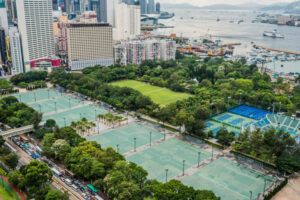
Figure 1: Aerial overview of Victoria Park

The statue of Queen Victoria, symbolising British control over Hong Kong was smeared with red paint and the nose was broken one year prior to Hong Kong’s handover in 1996 by an artist who criticised Hong Kong’s colonial art culture.3 The colour red is significant because in colonial Hong Kong discourse, the colour red is associated with communism or the mainland’s government in general, with it being especially sensitive in the aftermath of the 1989 Tiananmen Square Massacre. Coincidentally, since 1989 until the enactment of the National Security Law in 2020, every year on June 4th, hundreds of thousands of individuals will gather to commemorate the victims slaughtered by the Chinese government through candlelight vigils as in China it is a banned topic.4 The gathering of the masses in a park with the name of the British monarch showcases an act of resistance by local Hong Kong activists to demonstrate that they cherish the values of democracy and freedom which does not sit well with the Chinese government.

With the Chinese government wanting to increase its grip on Hong Kong, it chose to assault what Hong Kongers cherished the most, open expression of a sense of identity. The park signified resistance in the form of an annual tradition, being featured on international outlets like the BBC and CNN. By using the pandemic as a pretext, the six football pitches where individuals used to gather have been cordoned off by the police in 2021 and 2022 showcasing how the Chinese authorities have been increasingly clamping down on Hong Kong in recent years.5 In June 2023, a patriotic fair that sold Chinese goods and promoted Chinese peace and values was set up in the place of the vigil according to a report from Radio Free Asia.6 This clearly shows a power shift and an overarching power of the Chinese authorities over the former established institutions as the Queen’s statue has faded into the background. In other words, the value of spaces changes over time and is synonymous with power dynamics and in the case of Victoria Park, it signifies the value of authoritarianism crushing civil liberties. It further aligns with the Chinese government’s vision of making Hong Kong ‘Chinese’.

For its secondary function, the park is a place for recreation and symbolises the livelihood of Hong Kong, an escape from the hustle and bustle of the city. Having six football pitches, six basketball courts, an Olympic-standard indoor swimming pool, a tennis stadium, a jogging track and a picnic ground, it has abundant space for individuals to stay healthy and enjoy socialising.2 I remember going to swimming classes with my secondary school during the summer term for Physical Education (PE) classes and the park seems so tranquil whenever I go there, a great escape from the city.

Sanam Luang in Bangkok plays a symbolic role like Victoria Park. As Sanam Luang is a large open field located near the Royal Palace and a major Buddhist temple, the use of the space by groups like monarchists and protesters signifies the vibrant nature of different voices in Thailand.7 By hosting royal funerals and being near the palace, it demonstrates a power line that the monarch remains the most important figure within Thai society and the lese majeste laws that forbid slandering the monarch compliments the ‘peace’ of Sanam Luang. This draws parallels to how the Security Law creates a sense of ‘peace’ as opposed to the protests towards the Chinese government prior to the law.

In conclusion, the use of parks and open spaces alongside legislation showcases how certain authorities try to use space as an expression of power or enforce new values upon the population.

  1. https://www.nationalgeographic.com/culture/article/hong-kong-history-explain-relationship-china [↩]
  2. https://www.discoverhongkong.com/tc/explore/great-outdoor/urban-retreat-at-city-parks.html [↩] [↩]
  3. https://web.archive.org/web/20150924101554/http://www.scmp.com/article/180291/queen-victoria-has-successful-nose-job [↩]
  4. https://www.bbc.com/zhongwen/trad/chinese-news-48511746 [↩]
  5. https://edition.cnn.com/2022/06/03/asia/hong-kong-june-4-tiananmen-nsl-intl-mic-hnk/index.htmlOutside of its political functions, the park captures the livelihood of Hong Kong. [↩]
  6. https://www.rfa.org/cantonese/news/htm/hk-fair-06042023104236.html [↩]
  7. Chalana, Manish, ed. Messy Urbanism: Understanding the “Other” Cities of Asia. Hong Kong: Hong Kong University Press, 2017. Ch 5 The Royal Field (Sanam Luang): Bangkok’s Polysemic Urban Palimpsest [↩]

Cambodia, a land of gentleness? A comparison between an old and modern tourist perceptions

Cambodia, a country located on the Indochinese peninsula in Southeast Asia is often referred to as a hidden gem for international tourists. With bordering countries Thailand to its west, Vietnam to the east and Laos to the north, Cambodia is constantly overshadowed by both its western and eastern neighbours as Thailand has been known to international tourists for decades and Vietnam has been known for its long war with America and a rapidly growing economy in recent times.1 As democracy is restored to Cambodia, its rich history, especially the globally renowned UNESCO world heritage site of Angkor Wat has attracted millions of tourists every year and has even featured on the current national flag of Cambodia despite the fact that it was discovered when Cambodia was under French rule.2 This blog post will compare how an old foreign travel account from The Geographical Journal written by Lord Curzon in the 19th century and a 2023 Chinese travel agency’s article views Cambodia and what sites they feature prominently. After doing a brief comparison with Bali, the article will conclude that the images of tourism in Cambodia are shaped by power dominance given how it remains a poor state and that the nationality of the individual writing about it plays a key role in shaping narratives about the country.

The first account from The Hon. Lord Curzon, a prominent British politician published in The Geographical Journal published in 1893, it details his travels across French Indochina in what is now Vietnam, Laos and Cambodia. In his account, he generalises the lives of Cambodians as native and exotic as he notes how swift they are at building wooden huts on top of the Tonle Sap Lake. First, following the French colonial administration, he reinforces the account of the ‘Indochinese’ people by dividing them into categories. He describes the ‘natives’ as more effeminate and shorter in stature the deeper south you go and that the landscape is abundant with crops and crops.3 Subsequently, he describes their eating habits as ‘barbaric’. This demonstrates that at that time when not much technology was around, tourism was limited to the upper class and that generalised accounts, especially by the privileged like Lord Curzon were seen as authoritative and acceptable to be published in magazines like The Geographical Journal. Next, he offers a description of a travel itinerary from Phnom Penh to Angkor Wat. The journey he undertook involved riding on a French steamship and then embarking by land on oxen carts and sampans operated by native Cambodians. Following up, he offers a brief description of the ruins on how they illustrate a once-glorious empire now being controlled by the French and under constant threat from invasion by the Siamese (present-day Thailand).4 This indirectly justifies imperialism and showcases the weakness of Cambodian culture as by showing the ruins of an extinct great empire, it shows how the power is now rested in the French, that is controlling Indochina and the Siamese, who resisted colonialism and constantly putting pressure on French interests in the region. As a result, it can be seen that in the heyday of imperialism, travel was limited to the colonial elite and native cultures of the people under European control were subject to exoticisation and generalisation. 

Fast forward to the 2020s, Cambodia, although managing to free itself from colonialism and the horrors of the Khmer Rogue with its strong economic growth, its development standards lagged behind global standards. In place of the French, the Chinese now have a strong presence in the region as part of its Belt and Road Initiative to provide infrastructure aid to developing nations across the world to achieve its status as a great power.5 Although it was claimed that the investments were to benefit Cambodia’s growing economy, it has raised concerns among experts that Cambodia is becoming too dependent on China and that China is attempting to use its economic might to chip away at Cambodia’s sovereignty.6 By looking at tourist numbers by nationality, China ranks third after Vietnam and Thailand as the largest source of tourists outside of Southeast Asia.7 In the travel guide published by China International Travel Service Guilin Co. Ltd, it lists out the top sites for travel in Cambodia, which not suprisingly Angkor Wat appearing on the top, then it advertises certain Buddhist temples, the royal palace in Phnom Penh and numerous beaches along the southern coast with a short paragraph stating Cambodians as pure and nice.8 Unlike Lord Curzon’s account which describes Angkor Wat and the people of Cambodia in detail, the Chinese account simply just lists out sites that are culturally ‘Cambodian’ in nature and a complete guide to Cambodian cuisine. Furthermore, the account states that the friendliness of Cambodians and the affordability nature of the country is definitely a reason to visit the country. This demonstrates how with changing geopolitics and modes of travel, the nature of tourism also changes, and in the case of the Chinese, they are the main power influencing Cambodia.

What is interesting to me is that the Chinese site leaves out the Tuol Sleng Genocide Museum in Phnom Penh. I believe that the reason is because in order to court Chinese investments, the current Cambodian government, filled with members from the brutal Khmer Rogue regime (1977-1979) is making an effort to downplay anything that will contribute to angering China hence showcasing how bilateral relations often shape the style of tourism.

Linking to the compulsory readings, I see parallels with the case of Cambodia with Bali not too far away. Similar to Cambodia, Bali was under Dutch colonial rule and subject to international accounts exoticising its culture.9 Bali was also subject to having its narratives controlled by external forces as while the Dutch conquered it, it was seen as savage, but after pacifying it, the Dutch played a key part in creating images of ‘Peaceful Bali’ by demonstrating its unique mystical characteristics and ornate temples. Even after independence, the multi-cultural state of Indonesia actively promoted Bali as a peaceful paradise for foreigners to attract economic activity while the natives barely got a voice in the construction of their identity. This elucidates how the Dutch colonial government and the Indonesian government all played a part in exoticising Balinese culture similar to what the European travellers and Chinese government did to Cambodia. In short, power plays a part in shaping tourist narratives.

  1. https://www.theguardian.com/travel/2014/oct/28/-sp-cambodia-tour-two-weeks-holiday-itinerary [↩]
  2. https://whc.unesco.org/en/list/668/ [↩]
  3. Curzon, George N. “Journeys in French Indo-China (Tongking, Annam, Cochin China, Cambodia) (Conclusion).” The Geographical Journal 2, no. 3 (1893): 193–210. https://doi.org/10.2307/1773660. [↩]
  4. Curzon, George N. “Journeys in French Indo-China (Tongking, Annam, Cochin China, Cambodia) (Conclusion).” The Geographical Journal, vol. 2, no. 3, 1893, pp. 193–210. JSTOR, https://doi.org/10.2307/1773660. Accessed 26 Jan. 2024. [↩]
  5. https://china.usc.edu/what-chinas-belt-and-road-initiative-means-cambodia [↩]
  6. https://www.rfa.org/english/news/cambodia/substitute-07232020153513.html [↩]
  7. https://www.thestar.com.my/aseanplus/aseanplus-news/2023/11/30/foreign-tourist-numbers-skyrocket-in-cambodia#:~:text=This%20marked%20an%20increase%20of,%25)%2C%20expanding%20by%20497.5%25. [↩]
  8. https://www.citsguilin.com/article/gonglue/jianpuzhailvyougonglue.htm [↩]
  9. Vickers, Adrian Bali: A Paradise Created (2012 [1996]) [↩]

The Mass Transit Railway (MTR) and its revolutionisation of Hong Kong

Hong Kong is a sprawling metropolis with over 7.3 million individuals situated in a combined area of less than London and where land is scarce with 90% of its territory covered by mountains. Despite the challenges it faced with the population explosion after the Second World War, today Hong Kong is regarded as a city with one of the best transport systems in the world due to its punctuality and affordability, even gaining the title of having the best transport in the world.1 For this article, I will be focusing on the Mass Transit Railway or MTR which is arguably the backbone of Hong Kong’s efficient transport system. I will first analyse its beginnings, then followed by its association with the Hong Kong identity, and then analyse the negative association with higher living costs and being complicit with the Hong Kong government’s crackdown on civil liberties during the 2019 Anti-Extradition protests.

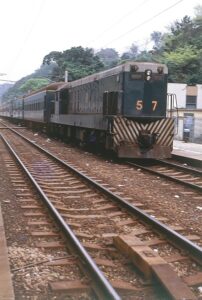
Prior to the construction of the MTR, there was only the Kowloon-Canton Railway (KCR) that opened in 1910, running a single-track line from Kowloon station in today’s Tsim Sha Tsui, through the then-rural areas of the New Territories and eventually crossing the border into mainland China through the Shum Chun river (today’s Shenzhen.2 Therefore, not many trains were needed and a single-line track to China sufficed as many individuals looking to flee the mainland from Communist persecution made use of the railway to reach the haven of Hong Kong.

However, the influx of population to nearly 4 million in 1970 and the overcrowding of urban areas and buses in Hong Kong and Kowloon proved to be unmanageable for the Hong Kong government and a new approach was needed. To complement the development of New Towns in the New Territories spearheaded by then-Governor General Barron Murray MacLehose, not only will the existing KCR line be double-tracked and electrified, a brand-new underground system initially running from the densely-populated housing districts of East Kowloon to the economic hub of Tsim Sha Tsui and eventually crossing the harbour into Central was constructed from 1975 and completed in 1979, completely transforming the way Hong Kong residents commuted.3 In particular, my family benefitted from the MTR construction as their daily commuting lives shortened from over an hour on buses to a mere half an hour by train from Kowloon to Hong Kong Island.


Figure 1: A diesel hauled train of the Kowloon-Canton Railway pre-electrification (circa 1960s colourised)

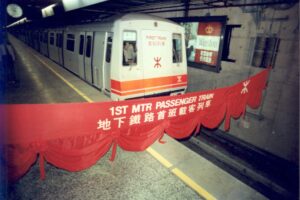
Figure 2: The first MTR train to ever run (Source: South China Morning Post)

The MTR has completely revolutionised people’s lives. According to a 2005 article by Man Hui Po a Hong Kong newspaper, it has become a pillar of the majority of Hong Kongers’ lives no matter which district they live in as since 1979 to the present day, the MTR has expanded to cover every district and its dominance over Hong Kong cannot be underestimated.4 The affordability and timeliness of the MTR is what makes it attractive. Even in non-peak hours, people can expect a train to arrive every 5 minutes unless it is the train lines for the less crowded districts. I have taken the MTR for granted as I have relied on it for my everyday commute to school since primary school all the way until my matriculation at St Andrews. I miss the jingle of trains, station announcements and people going on their daily lives for myself these sounds characterise the identity of Hong Kong. Although there are always people misbehaving on trains like playing music loudly, shouting obscene words or not covering your mouth when coughing, it is the MTR that makes Hong Kong function as without it, the idea of ‘Hong Kong efficiency’ will not be born as Hong Kong is known for being a city that never sleeps with individuals always rushing about to complete as much tasks as possible.5

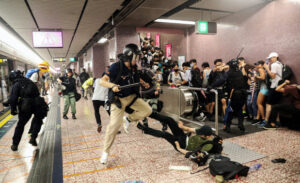
Despite all the positive associations of the MTR, it has not been without its problems. For instance, after the merger of the MTR and KCR in 2007 in which the KCR systems have become under the operation of the MTR, it has become the sole monopoly of rail service provider of Hong Kong, hence limiting competition.6 The merger has also become a source of frustration among the local populace as it was rumoured that the MTR cooperation has been neglecting maintenance due to the increasing number of accidents that partially paralysed commuters, generating inconveniences among the commuters. Besides this, the MTR cooperation has also been portrayed as being complicit in the ‘Sinicisation’ of Hong Kong culture as not only does it have control over vast swaths of property and malls located close to stations with land prices being one of the most unaffordable on the planet. The discontent with the system came to a boiling point in the 2019 anti-extradition bill protests in which protesters initially calling for a controversial law allowing fugitives to be extradited to Mainland China for trail became a protest for free speech and democracy as the Hong Kong leader did not make concessions.7) The MTR has been criticised by the pro-democracy camp for assisting police officers by allowing them access to paid areas of stations to make arbitrary arrests and close stations where demonstrators gathered, as the police have been under fire for using excessive brute force against demonstrators.8

As a result, what was once Hong Kong’s pride can lose its prestige among its citizens within a short time as even places of mobility can become very politicised in the era of the digital world. Therefore, the MTR, although an inseperable part of Hong Kong’s identity and life can also be subject to criticism especially in recent years which society has become politicised.

Figure 3: Police cracking down on demonstraters at Prince Edward station on 31st July 2019. Source: Mainichi Shinbun


  1. https://www.weforum.org/agenda/2023/01/davos23-how-to-keep-cities-moving-sustainably/ [↩]
  2. John M. Carroll, A Concise History of Hong Kong (2006), p. 171). Up until the late 1960s, the northern areas of Hong Kong Island and most of Kowloon remained the core areas of Hong Kong with most of the business activities and industrial production centered around these two parts. In contrast, the New Territories remained a world of its own mainly focusing on agricultural production and village life. ((Frank Welsh, A History of Hong Kong (1997) [↩]
  3. Frank Welsh, A History of Hong kong (1997) [↩]
  4. http://paper.wenweipo.com/2005/03/12/NS0503120002.htm [↩]
  5. https://doi.org/10.1016/j.retrec.2021.101133 [↩]
  6. 港鐵,邁進新紀元,2007版 [↩]
  7. Michael C. Davis, Making Hong Kong China (2019 [↩]
  8. https://apnews.com/article/d4b799db57e54f42962b92dbebc57333 [↩]

Hong Kong’s early public housing: Changing attitudes under a colonial context

Hong Kong’s housing today is known for its unaffordability and sky-high rents due to limited space. Hong Kong has a population greater than Scotland but its total available land area is less than half of Greater London which explains why housing remains a constant problem in one of the world’s most densely populated metropolises.1 In spite of this, Hong Kong actually has a rather unique history of housing, especially the public housing realm that has permeated throughout society as a result of British policy measures to combat poverty and discontent as the bulk of the Hong Kong population initially saw them as Chinese and Hong Kong to them was a temporary place to do business before returning to their homeland, thus breeding the phrase coined by Richard Hughes, “Borrowed place, borrowed time.”. (Richard Hughes, Hong Kong: Borrowed Place, Borrowed Time, 1966)

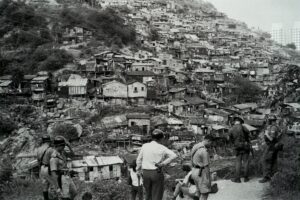
In order to cope with the increasing population, demand for housing and the realisation that Mao Zedong’s Communist Party’s hold on China will be permanent, the British colonial government decided that housing the population and housing reform would need to be undertaken. Contrary to popular belief that the 1967 riots marked the start of public housing provision in Hong Kong, it was actually the 1953 Shek Kip Mei fire that made the government start building flats to accommodate people as it was poor conditions of squattered areas consisting of wooden houses and corrugated iron sheets.2. Interestingly enough, my maternal grandmother and grandfather, both of whom were poor immigrants from neighbouring Guangdong province arrived in Hong Kong during the 1950s and initially settled in a poor, squattered housing, but was then resettled in a public housing complex under the Hong Kong government’s colonial scheme. In order to pay my tribute to them, I will focus this article on analysing how Hong Kong’s public housing estates contributed to a new sense of identity and gave individuals hope to abandon the sojourner mentality as described by Hughes above. For this, I will focus on a newspaper report from Wah Kiu Yat Po from December 1963, when Choi Hung Estate, where my mother and her brothers and sisters grew up was completed.

Figure 1: A typical squattered area or slum in Hong Kong during the 1950s – 60s, Source: South China Morning Post

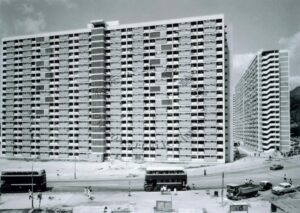
Figure 2: View of Choi Hung Estate from Kwun Tong Road (1963) Source: flickr

The news report, published on December 19th 1963 presented the inauguration of Choi Hung Estate by then British governor Robert Black as an important ceremony for the city as the newspaper quoted in the headlines stating it is the ‘largest project of the city’ and the contents mentioning officials from the housing department, civilian affairs attending it.3 The public housing scheme was seen as a watershed moment for the city for both the British and local Chinese residents. That is because for the British, the Hong Kong housing plan is the most vigorous and dynamic project ever undertaken that was not seen in other places in the world besides Singapore and that housing a large population with limited resources is certainly no easy feat. As for the local residents, it built a sense of community spirit amongst residents that started to envision that Hong Kong is their home and that they will be there to stay, thus planting the seeds of a unique ‘Hong Konger’ identity, which was seen in the next decade under the governorship of Murray Maclehose.4 Although I did not personally grow up in a public housing estate myself, but I had to say that this undoubtedly changed Hong Kong permanently and affected who I am today as my parents, who were sons and daughters of poor individuals from China who benefitted from the resettlement scheme was able to enjoy better living conditions and more access to secondary and tertiary education opportunities, hence showcasing how housing plays a key role in raising population approval in terms of governance and that increasing opportunities can change societal fabrics. As a result, it is evident that housing policy can directly alter the course of history on a certain place’s development.

Furthermore, this example ties to the wider theme in the compulsory reading. That is because as seen in the Tianjin reading, during the time when multiple foreign powers had their own zones, each attempted to use their own styles of housing to instill in the minds of the Chinese people on what it means to be ‘modern’.5 Additionally, the Meiji government in Japan attempted to construct Western methods of sanitations and dwellings in order to turn the Japanese into a ‘civilised’ race.6 Therefore, it is evident that there is a continuum that demonstrates the effective and central role housing plays in governance and constructing modernity.


  1. Tim Summers, China’s Hong Kong, Politics of a Global City, 2019, pp. 127-135 [↩]
  2. Steve Tsang, A Modern History of Hong Kong, 2003, p. 204 [↩]
  3. Wah Kiu Yat Po, December 19th 1963: https://mmis.hkpl.gov.hk/coverpage/-/coverpage/view?_coverpage_WAR_mmisportalportlet_hsf=%E5%BD%A9%E8%99%B9%E9%82%A8&_coverpage_WAR_mmisportalportlet_actual_q=%28%20verbatim_dc.collection%3A%28%22Old%5C%20HK%5C%20Newspapers%22%29%20%29%20AND+%28%20%28%20allTermsMandatory%3A%28true%29%20OR+all_dc.title%3A%28%E5%BD%A9%E8%99%B9%E9%82%A8%29%20OR+all_dc.creator%3A%28%E5%BD%A9%E8%99%B9%E9%82%A8%29%20OR+all_dc.contributor%3A%28%E5%BD%A9%E8%99%B9%E9%82%A8%29%20OR+all_dc.subject%3A%28%E5%BD%A9%E8%99%B9%E9%82%A8%29%20OR+fulltext%3A%28%E5%BD%A9%E8%99%B9%E9%82%A8%29%20OR+all_dc.description%3A%28%E5%BD%A9%E8%99%B9%E9%82%A8%29%20%29%20%29&_coverpage_WAR_mmisportalportlet_sort_field=score&p_r_p_-1078056564_c=QF757YsWv5%2FH7zGe%2FKF%2BFApeJWgOkWwE&_coverpage_WAR_mmisportalportlet_o=2&_coverpage_WAR_mmisportalportlet_sort_order=desc&_coverpage_WAR_mmisportalportlet_filter=dc.publicationdate_dt%3A%5B1960-01-01T00%3A00%3A00Z+TO+1969-12-31T15%3A59%3A59Z%5D) By putting resources into public housing, it implies that the British colonial government is trying to introduce measures that aims to solve the most pressing problem in Hong Kong at the time, which is affordable housing and having a roof.  As mentioned in the article, each apartment does not have its own bathroom or kitchen and each apartment has an average space of 300 sq ft.  It can be seen as a massive milestone for the colony, as prior to the beginning of the scheme, the government constantly faced budget constraints and lack of policy direction in order to implement this plan, but within the timespan of a decade, the government managed to co-ordinate and build over seven public housing estate, each being able to house over a total of 100,000 residents of a population of nearly 3.4 million. (( Steve Tsang, A Modern History of Hong Kong, 2003, pp. 204-205 [↩]
  4. Steve Tsang, A Modern History of Hong Kong, 2003, pp. 204-205 [↩]
  5. Elizabeth LaCouture, Dwelling in the House, Family, House and Home in Tianjin, China, 1860 – 1960, 2021 [↩]
  6. Jordan Sand, House and Home in Modern Japan: Reforming Everyday Life 1880 – 1930, 2005 [↩]

Lap Sap Chung and the cleanup of Hong Kong in the 1970s

Hong Kong today is seen as a modern metropolis with an efficient transport system, high-quality healthcare and high awareness of personal hygiene. Growing up in Hong Kong, I was taught as early as kindergarten to wash my hands with soap after taking a dump, recycle certain items in specific bins and most importantly not litter as it would attract bugs and rats. Additionally, in various public spaces like metro stations, wet markets and railings, there are ubiquitous colourful signs informing the population to not litter or spit on the streets, threatening them with a high fine.1 From a young age, I asked my parents why Hong Kong is so obsessed with hygiene and cleanliness, and my parents told me without hygiene education, Hong Kong would not be Hong Kong today. They told me that during their childhood they had to undergo hygiene education at school and constantly saw hygiene commercials and leaflets that warned them against unsanitary habits like spitting, blowing their nose in public, not washing vegetables, eating raw meat, and urinating in public. This signifies that hygiene in modern Hong Kong, unlike the notions of hygiene used to weaponise or justify imperialism like the case of the Japanese blaming Koreans in Keijo2, the British Hong Kong government starting in the late 60s devolved powers to locally-educated individuals to educate the lower classes through indirect means which is the main focus of this blog. To illustrate my point, I will be focusing on a newspaper report regarding hygiene from the Wah Kiu Yat Po published in 1972.

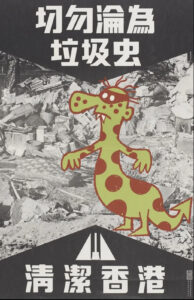
Figure 1: Lap Sap Chung poster in the Clean Up Hong Kong campaign, extracted from: https://zolimacitymag.com/lap-sap-chung-monster-kept-hong-kong-clean-ah-tak/

Above is the illustration of Lap Sap Chung which translates to rubbish bug which is a fictional character created by cartoonist Arthur Hacker.3 Lap Sap Chung was created as a method to appeal to Hong Kong residents because its unsanitary behaviour included littering and dirtying the streets, which was a massive problem in Hong Kong that led to diseases and deaths. By having a figure to ostracise those bad behaviour, it gives the incentive for Hong Kong people to work hard to clean up their city and foster a sense of identity to showcase what being ‘civilised’ and ‘modern’ is like. Unlike the colonial mentality of sanitation as per the readings, the campaign does not directly imply that the local Hong Kongers are dirty compared to their British overlords but rather it is everybody’s collective effort to maintain a clean Hong Kong. It is in reflection of the changing attitude towards governance as after the 1967 riots, the British colonial government realised that in order to prevent the spread of communism’s appeal and discontent among Hong Kong residents, improving livelihoods through education and concerted efforts are crucial to ensuring it.4

Drawing from the Wah Kiu Yat Po’s newspaper report on 9th September 1972, it showcases a headline in which residents caught violating the laws of public hygiene will be fined HKD$1000 and the second offence increasing to HKD$2000, somewhere around the sum of nearly a thousand pounds in today’s money.5 Although hefty fines were proven to be ineffective as in the case of Korea under Japanese rule and Singapore under the British colonial government, the main difference that differs Hong Kong’s case than the other two cases is the use of the Lap Sap Chung. As the article says, the board director of the ‘Clean Hong Kong Campaign’ was headed by a local, Wong Mong Fa, who quotes that the first step of advertising the campaign is declared a success and that the second step involves education. In order to succeed, the use of inspection teams to inspect every apartment block and verbally educate the residents about the laws regarding sanitation. In addition to the teams, leaflets, radio broadcasts, commercials, and newspapers will also be utilised to complement the efforts of the inspection teams. This showcases that the British colonial government was different from their attitudes towards Singapore in6 where the locals and British colonial officials were pitted against one another in the late 1930s, the 1970s in Hong Kong showcased how getting the locals to cooperate through increasing local involvement is actually a much better solution as educating the lower classes and ensuring citizens understood the laws thoroughly. This demonstrates how the involvement of different factors is needed in order to increase education and awareness about a hygienic society.

In conclusion, the example of Lap Sap Chung is widely regarded as a success as Hong Kong’s previously dirty streets have witnessed a massive improvement, and kids of individuals who grew up under the ‘Clean Hong Kong’ campaign like myself have seen the long-term effects of effective hygiene education not through just school but through digital and print media. Local involvement and the absence of racial ostracisation is what drive public health campaigns forward.


  1. Steve Tsang, A Modern History of Hong Kong, 2003 [↩]
  2. Todd. A Henry, Assimilating Seoul: Japanese Rule and the Politics of Public Space in Colonial Korea, 1910-1945 Ch 4 Civic Assimilation: Sanitary Life in Neighbourhood Keijo [↩]
  3. https://zolimacitymag.com/lap-sap-chung-monster-kept-hong-kong-clean-ah-tak/ [↩]
  4. Steve Tsang, A Modern History of Hong Kong 2003 [↩]
  5.  https://mmis.hkpl.gov.hk/search-result?p_p_id=search_WAR_mmisportalportlet&p_p_lifecycle=0&p_p_state=normal&_search_WAR_mmisportalportlet_keywords=%E8%A1%9B%E7%94%9F&_search_WAR_mmisportalportlet_hsf=%E8%A1%9B%E7%94%9F&_search_WAR_mmisportalportlet__cnsc1002_WAR_mmisportalportlet_formDate=1698495896489&p_r_p_-1078056564_actual_q=%28%20verbatim_dc.collection%3A%28%22Old%5C%20HK%5C%20Newspapers%22%29%20%29%20AND+%28%20%28%20allTermsMandatory%3A%28true%29%20OR+all_dc.title%3A%28%E8%A1%9B%E7%94%9F%29%20OR+all_dc.creator%3A%28%E8%A1%9B%E7%94%9F%29%20OR+all_dc.contributor%3A%28%E8%A1%9B%E7%94%9F%29%20OR+all_dc.subject%3A%28%E8%A1%9B%E7%94%9F%29%20OR+fulltext%3A%28%E8%A1%9B%E7%94%9F%29%20OR+all_dc.description%3A%28%E8%A1%9B%E7%94%9F%29%20%29%20%29&p_r_p_-1078056564_new_search=true&p_r_p_-1078056564_q=%E8%A1%9B%E7%94%9F&p_r_p_-1078056564_freetext_filter=%E6%88%BF%E5%B1%8B&p_r_p_-1078056564_freetext_filter=%E7%97%85%E6%AF%92&p_r_p_-1078056564_curr_page=1&_search_WAR_mmisportalportlet_jspPage=%2Fjsp%2Fsearch%2Fcnsc05.jsp [↩]
  6. Yeoh, Brenda, Contesting Space in Colonial Singapore Ch 3 Municipal Sanitary Surveillance, Asian Resistance [↩]

Prince of Wales Island: A British ‘tropical paradise’

As the Europeans expanded their imperial domains across the globe in order to secure lucrative commodities, they colonised lands that were vastly different to their home countries, with the climate being the most pressing difference as it affected how people lived, the gastronomy and the animals that inhabited there.1 In this context, the primary account written in 1804 by George Leith, the first Governor General of Prince of Wales Island, known as Penang Island in the present day will be used as a centrepiece to illustrate the biased and flawed attitude the Europeans had towards the tropics and how this source ties into the wider theme of tropicality.

Given that the account was published during the time the British were seeking to expand their hold overseas to dominate trade under the Napoleonic Wars, cutting French supplies and establishing a foothold in the Malacca Straits was a top British priority as stated in the source.2 In order to make the colony functional, the British had to build infrastructure and provide amenities for the both the coloniser population, new immigrants and the locals. In the source, Leith explicitly states that the island is abundant with water and soil, the harbour is well shielded by the Malay peninsula, overlooks the Straits of Malacca, has reasonable high altitude hill retreats to escape the dry season, and the biggest settlement, George Town has brick buildings, hospitals, roads and houses which implies a sign of modernity. By stating all those factors, it can be assumed that Leith is attempting to encourage settlement on the island as all those factors make it attractive for colonists looking to maximise their profits in an expanding empire. Secondly, he notes how the island has a reasonable climate as compared to India. This point strikes me because, in the secondary readings, it was often assumed that the Indian subcontinent was the epitome of ‘tropical romanticisation’ due to its abundant natural resources and relative similarities to how the British or other Europeans envisioned a ‘tropical society’ where there are abundant resources and good weather.1 By shining the island’s potential in a positive light, it allows the Europeans to see that its climate is favourable and suitable for economic investment. This is in stark contrast to my elective secondary source reading on French Indochina, in which the French saw their colony as a deathbed with a 2% death rate and that the average life expectancy of a Frenchman is only around the 40s as the colony was filled with diseases.3 As a result, the ‘tropical climate’ or European colonies with hot weather can vary from being romanticised as a paradise or described as a place filled with disease and ‘bad air’ like how the French saw Indochina. As a result, the tropics are often ‘imagined’ in the European mindset.

Leith explicitly classifies occupations and characteristics of certain races in a sub-section called Inhabitants. He describes the Chinese, Parsees and Chooliahs as the races doing most of the hard work and are well-behaved which makes them useful as coolies and labourers to successfully run a colony. Conversely, he describes the Malays as indolent, vindictive and treacherous because they are an uncivilised race and are useless for labour. This signifies that inhabitants in the tropics are often seen by the Europeans are more lazy which is based on ancient Greek ideas of how the hotter the climate, the lazier and less warlike an individual becomes as illustrated by Hippocrates.4 This signifies that ‘tropicality’ is not based on science but rather supported by pseudo-philosophy by ancient philosophers like Hippocrates which do are not grounded in scientific methods and create a racial division line that separates races according to their ‘usefulness’ and perceived ‘nature’.  Therefore, it is evident why ‘tropicality’ is a flawed and biased concept. In the case of the British Strait Settlements, the British like Leith perceived that the Malays are lazy and uncivilised, Chinese and Indian labour had to be bought in from other colonial possessions in order to maximise profits, thus altering the settlement pattern and demography of present-day Malaysia and Singapore.

To sum it up, the concept of ‘tropicality’ is biased in the sense that it was based on pseudo-science, assumptions and, imaginations hence making it flawed.

  1. Arnold, David John. The Tropics and the Travelling Gaze: India, Landscape, and Science, 1800-1856 Introduction + Ch 4 From the Orient to the Tropics [↩] [↩]
  2. Leith, George, Sir, A short account of the settlement, produce, and commerce, of Prince of Wales Island, in the Strait of Malacca  [↩]
  3. Jennings, Eric Thomas. Imperial Heights: Dalat and the Making and Undoing of French Indochina Ch 1 Escaping Death in the Tropics [↩]
  4. Hippocrates v. 1 ‘Airs Waters Places’ XII-XVI pp. 105-117 [↩]

Manchukuo: A Japanese utopia

Manchukuo, a puppet state that existed from 1931-1945 is often misrepresented or misunderstood by mainstream media as being a state of repression and a showcase of Japanese imperialism to repress Chinese nationalism and Japanise it.1 However, in reality, Manchukuo is unique in the field of spatial history as it showcases Japanese ambitions to combine multiple cultural styles and modern techniques to turn it into a ‘utopia’, making it even more advanced than the Japanese home islands itself and what it managed to achieve during wartime makes it even more remarkable. This blog will analyse a primary source of a tourist pamphlet then tie it to the wider theme of the Japanese vision of a multicultural utopia and how it aims to achieve it.

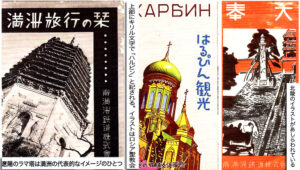
Figure 1: Japanese tourist pamphlet showcasing attractions of Liaoyang, Harbin and Fengtian (present-day Shenyang) extracted from: http://kousin242.sakura.ne.jp/wordpress014/%E6%88%A6%E4%BA%89%E3%83%BB%E8%B2%A0%E3%81%AE%E9%81%BA%E7%94%A3/%E6%98%A0%E5%83%8F%E8%B3%87%E6%96%99%E3%81%AE%E8%AA%AD%E3%81%BF%E6%96%B9/3785-2/

Description/rough translation: 

This source is a tourist pamphlet produced in the 1930s by the Japanese-owned South Manchurian Railway Company with added annotations from the blog’s author. From the far left the large captions it translates to a starter guide of travels to Manchuria and it showcases an ancient pagoda in Liaoyang, a city not far from Shenyang. In the middle, we can see the Cyrillic script of Harbin and the Japanese hiragana which translates to: Tourism in Harbin. The interesting thing to note is that usually, foreign locations excluding China and Korea are usually written in the Katakana script but Harbin, a city with a Chinese name is written out in Hiragana, which implies the multicultural nature of the city. On the right, the pamphlet shows the old city gate of Fengtian, the name of Shenyang at the time, which showcases the rich Chinese cultural heritage of the city.

Inferences/Analysis:

In relation to the source above, the Japanese prioritised the needs of the Japanese citizens and realised the necessity of making Manchukuo as Japanese as possible to ensure permanent settlement to create a settler colony to alleviate the Japanese overpopulation of the home islands.2 However, given Manchuria’s already-present diverse population, the need for labour and the threat of possible Chinese and Soviet attacks from Manchukuo’s borders, and the international isolation Japan faced after its invasion of Manchuria, it aims to cultivate an image of racial harmony through its use of space.3 In order to make Manchukuo ‘Japanese’, the Japanese embarked on ambitious plans to create walled villages populated with men acting as both farmers and part-time soldiers, incorporating modern techniques such as wide streets and rows of housing organised in a hexagonal structures. This proved to be overly-ambitious as the Japanese did not have enough Japanese immigrants that moved to Manchukuo and that not all parts of Manchukuo were fertile as some parts were mountainous and not suitable for Japanese settlement due to climate differences. The cities that were populated by Japanese were mainly the cities close to the South Manchurian Railway like Dalian and Fengtian.

In relation to the picture however, the Japanese are using the cultures of Manchuria to promote tourism to justify its own expansionism and that former sites of cultural importance to those ethnic groups are reduced to mere tourist sites for Japanese to see how ‘exotic’ life in Manchuria is.  By producing it for Japanese residents, the Japanese imperialists or the army aimed to draw support from the local Japanese populace to attract them to eventually settle into Manchukuo. In addition, the Japanese is also trying to use Manchukuo as a testing ground to test out their new city-planning techniques such as the incorporation of Chinese roofing techniques and Russian equipment like pechkas (Russian ovens) into Japanese-styled houses as Manchukuo is relatively undeveloped and much larger compared to the already-established colonies of Taiwan and Korea.4 Manchukuo attracted the attention of many famous Japanese architects and even world-renowned foreign architects like Le Corbusier that aimed to construct modern cities with public transport, hotel, amenities, religious spaces and green spaces while making sure residents have access to proper housing. This demonstrates how this often-overlooked aspect of empire building is multifaceted and that imperial urban constructions and utopia is an important pillar of empire building.

  1. Louise Young, Japan’s Total Empire: Manchuria and the Culture of Wartime Imperialism, Twentieth Century Japan (Berkeley, Calif: University of California Press, 1999), “Brave New Empire: Utopian Vision and the Intelligentsia” 241-268. [↩]
  2. Tucker, David, “City Planning without Cities: Order and Chaos in Utopian Manchukuo” [↩]
  3. Buck, David D., Railway City and National capital: Two faces of the modern capital in Changchun [↩]
  4. Sewell, Bill, Constructing Empire: Japanese in Changchun, 1905-45 [↩]

Japanese city-planning of Keijo (modern-day Seoul)

Korea is a milestone for a rapidly growing Japanese empire, as Japan took control of the peninsula after defeating Qing China and Imperial Russia, consolidating its status as a great power. In order to showcase their progress and power in relation to other imperial powers like Britain, France and Germany, the Japanese colonial government in Korea embarked on a plan to ‘modernise’ and ‘re-create’ Keijo, or modern-day Seoul. I argue that the Japanese had succeeded in laying out plans for a modern city not for the sake of the majority of its residents, but rather to benefit Japanese interests. I would focus on a primary source and support it with the reading: Assimilating Seoul by Todd Henry.

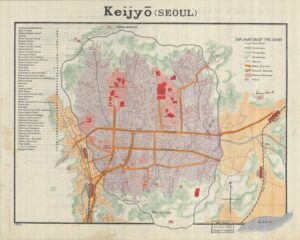
https://blogs.loc.gov/maps/2018/05/maps-of-seoul-south-korea-under-japanese-occupation/

The primary source I have chosen is a map of Keijo published by the Japanese Tourist Bureau in 1913, three years after the Japanese took full control of Korea and produced in English for foreign tourists. As we can see from the map, the orange signifies the main thoroughfares of the city and red represents what the Japanese colonial government deems as important sites. The important sites are well connected by the roads and supported by a tramway system, which implies that the colonial government puts the interest of the coloniser above the colonised, as evident in urban planning. Subsequently, given that the source is produced for a Western tourist, it aims to showcase Japan’s modernity which is showcased in the map that the areas labelled in red are all structures built for Japanese interests like railway stations besides a few Korean palaces and mausoleums. Anything related to Korean culture or promoting Korean distinctiveness is blurred out in the purple background or branch streets as labelled on the map.

One thing that caught my interest was the labelling of green spaces on the map. The garden-city movement became a cornerstone for the development of colonial cities to produce green spaces for the colonising power to relax. {{ Peter Hall Cities of Tomorrow: An Intellectual History of Urban Planning and Design since 1880 (2014 4th ed.), Ch 4 “The City in the Garden }} Within the city boundaries of Keijo, green spaces surround the neighbourhoods and all the government-associated buildings have an abundance of green space near them. This is to showcase the absence of chaos to imply power and dominance. {{ Henry, Todd A. Assimilating Seoul: Japanese Rule and the Politics of Public Space in Colonial Korea, 1910–1945 (2014) }} This is a practice inherited from the British in their colonial city planning as showcased in Robert Home’s book Of Planting and Planning. [[ Home, Robert K. Of Planting and Planning: The Making of British Colonial Cities (1996) ]]. 

The findings of the map are backed up by Henry’s argument that although the city-planning of Keijo was intended to integrate the Koreans as loyal Japanese subjects through Japanification, numerous factors, including the lack of funding, war and the failure of Japanese economic policy ensured the gap between Koreans and Japanese settlers persisted and that little was done in improving the housing conditions of over 50% of Koreans living in poverty. [[ Henry, Todd A. Assimilating Seoul: Japanese Rule and the Politics of Public Space in Colonial Korea, 1910–1945 (2014) ]]. Subsequently, the town planning committees were overwhelmingly dominated by Japanese settlers and the lack of organisation of the funding system implies that Keijo was hard to become a reality for the Japanese city planners in achieving their ultimate plan in promoting their own imperial urbanism.