Between Bayonets and Paper Money: The Failure to Police Rice Shortages

In “Policing Modern Shanghai” Frederic Wakeman argues that murky relationships between different police forces, criminal organisations, and corrupt political relationships were vital for “police work.”1 Even as a top-down effort for police professionalisation, the Chinese Special Municipality’s Public Safety Bureau (PSB) nonetheless needed to negotiate these treacherous, pre-existing networks of political relationships, for as long as the opium trade was central to Chiang Kai-shek’s as a source of revenue. Set in this historiography, scholars have used rice and food supplies to effectively historicise the spatial politics of empire-making in Occupied Shanghai. Along these lines, I use contemporary press reports of a late 1939 rice shortage to argue that the refraction of political blame was dominated by reactions to a depleting social order and questions of Chinese loyalist affiliations.

Late 1939 Shanghai was characterised by a city grappling with acute commodity shortages,2 homelessness and refugee movement.3 In the immediate aftermath of full-scale war, Henriot has argued, even basic statistical data failed to record information such as “sex” or “age” – they counted “only as ‘mouths’.”4 Shanghai as 孤岛 gudao (lonely island) exemplified the way in which Japanese control of commodities had brought the Chinese to their knees. In fact, the imperial hierarchy meant that immediate sources of rice went to Japanese citizens in the imperial metropole and the Japanese army in China.5

For the case of Shanghai, rice became a commodity with several levels of obstacles. Beyond the wider Japanese naval blockade manifested in a second level of political control: via “certifications.” Rice, on the physical verges of the seaports of Shanghai, was often held up, as it was at Soochow Creek because the Japanese had “withheld all permits for the entry of rice from the hinterland via the important shipping centres of Quinsan, Wuhu and Sungkiang.” Even by land, rice “arriving here by trains were prohibited from being transported into the Foreign Settlements.” To that effect, a second level of bureaucratic control meant that rice supplies were merely sitting in boats, obstructed from redistribution. To combat this, the Shanghai Municipal Council, Rice Guilds and the French Municipal Administration instituted a price ceiling and declared prices above $20 per zah to be illegal.6 Under this system of control, the press excoriated high rice prices as the result of “unscrupulous” rice merchants, hoarding supplies and raising prices opportunistically. Each criticism, however, was directed at different culprits. On the other hand, a Chinese evening paper reported Chiang Kai-shek’s reaction to focus on traitor elimination: he had ordered “Chungking forces in Zhejiang to investigate the price increase “racket” in Shanghai” and to “shoot those merchants who co-operate with the Japanese in manipulating markets.”7

The different truths of different newspapers was also reflected in reports that much of the rice shortage owed to “the Nipponese army” descending upon “the huge rice producing area from Wuhu to the Tai Hu lake” with “bayonets and paper “money”.”8 For Chiang Kai-shek’s imagination of the police “as an instrument of vertical integration,” moreover, his attack on opportunists ironically appears to encapsulate the opportunism of his modernisation project as a guise to implement “instruments of autocracy.”9 Thus, even within these different types of supplies blockades amidst the Japanese Occupation, the apportioning of culpability and collaboration became ever closely examined under the lens of the press in relation to the politics of retribution and loyalism.

  1. Frederic Wakeman, “Policing Modern Shanghai”, The China Quarterly no. 115 (1988): 409. [↩]
  2. See footnote 50 in: Christian Henriot, “Shanghai Industries in the Civil War (1945-1947)”, Journal of Urban History 43, no. 5 (2017), 744-766. [↩]
  3. Christian Henriot, ‘Shanghai Industries Under Japanese Occupation’ in In the Shadow of the Rising Sun: Shanghai Under Japanese Occupation, edited by Christian Henriot and Wen-Hsin Yeh (Cambridge: Cambridge University Press, 2004): 20-25. [↩]
  4. Christian Henriot, “Shanghai And The Experience Of War: The Fate Of Refugees” European Journal of East Asian Studies 5, no. 2 (2006): 231. [↩]
  5. Frederick Wakeman, The Shanghai Badlands (Berkeley: University of California Press, 1996), 55. [↩]
  6. “New Record Price Quoted for Rice”, North China Daily News, 9 Dec 1939 [↩]
  7. Ibid.  [↩]
  8. “Japan Buying Causes Rice Price Increase”, Shanghai Evening Post & Mercury, 30 Nov 1939 [↩]
  9. Wakeman, “Policing”, 439. [↩]
(Moral) Panic! at the 歌台

In his chapter “Important Attractions” Andrew Field relied mostly on the mosquito newspaper 晶報 Jing Bao (Crystal) to discuss the evolution of the ‘dance hostess’ as a vocation. In the social imagination of 1930s Shanghai, a dance hostess – previously looked down upon by a café waitress in courtesan-era Shanghai – was now a position that a film star aspired to. One inherent limitation of this source reliance is Field’s tacit, diligent acknowledgement that he could not overextend his argument when claiming dance hostesses’ self-identification in newspapers.1 Furthermore, Field was unable to confidently historicise the way gang activity ‘infiltrated’ dancehalls as spaces.2 Inspired nonetheless by this discussion, I explore in this post a parallel moral panic in the 1950s Chinese-language mosquito press within Singapore about the 歌台 getai (literally singing stage, but in effect a dancehall). Where Shanghai discourse examined the dancehall’s main figure of attraction – the hostess – in Singapore the mosquito press’ moral panic descended upon the peripheral figure (in performance terms) of the striptease performer. While both moral discourses had the same function of dislocating the controversial performer from their space, the parameters of each controversy was governed by specific expressions of nationalism.

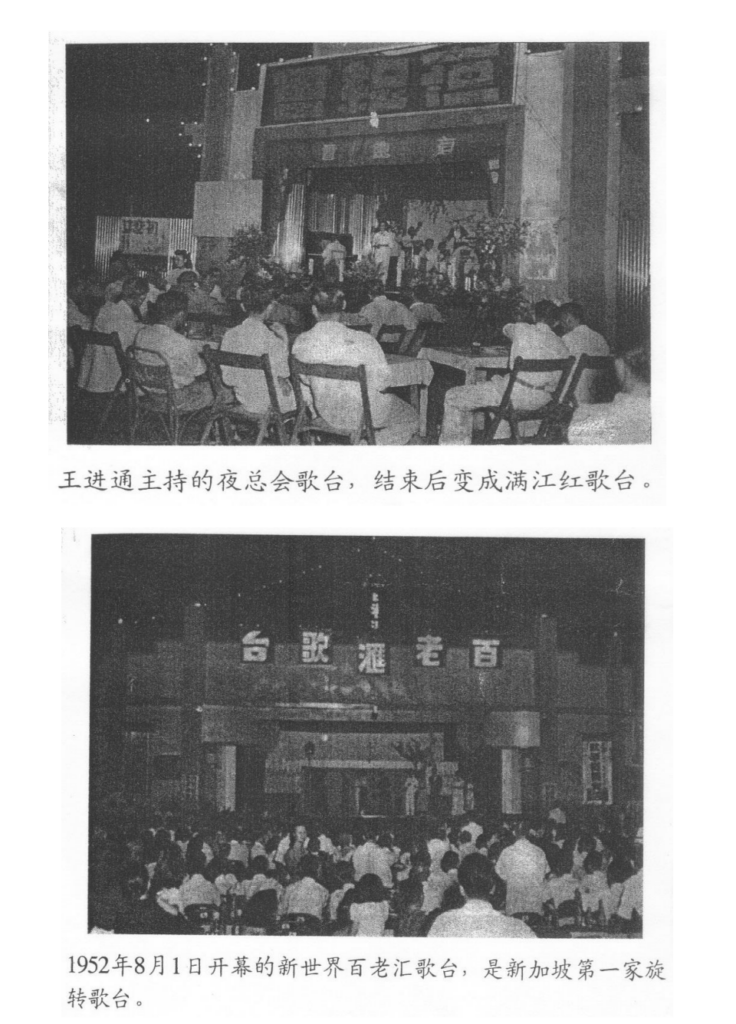
Unlike contemporary imaginings, the getai in 1950s Singapore was a remnant of the Japanese Occupation when the Japanese administration used the Beauty World, Gay World, and Happy World amusement parks to host cinemas, stalls and gambling farms for fiscal revenue.3 While there were similar styles of variety shows that had originated from Shanghai in the 1930s, the three “Worlds” were the locus for getai activity in post-war Singapore.4 In an industry with low barriers to entry and exit, poaching of talent was common, and a getai was driven by a desire for immediate revenue. Thus, when taken in isolation, the striptease was but one of a repertoire of acts in this profit-driven enterprise.

Photographs of getai from Wang’s 新加坡歌台史话 in Ho’s M.A. Thesis

However, the peripheral getai striptease performer was invariably brought to the front within the distinct discursive spaces that were the English- and Chinese-language presses. In showing this, I first highlight the need to lend weight to 1950s Chinese-language ‘mosquito newspapers’ because of their broad-based popularity.5 Secondly, the Chinese-language press notably had direct traces of cultural discourse from the 1930s Shanghai press. One adaptation6 of the Chinese intellectual 劉吶鷗 (Liu Na Ou)’s words was his charge that art should be pursued to entertain the masses and present the “sensual pleasures of the urban city.”7 Where Liu was writing of 1930s soft-core films in Shanghai, a 1953 Saturday Review article appropriated Liu to lyricise the effect of watching a striptease: 心灵坐沙发椅 and 眼睛吃冰淇淋.8

The spotlight on striptease overshadowed the wider post-colonial moral panic in the 1950s surrounding “yellow” culture. Both English and Chinese language discourse excoriated moral depravity, known as “yellow” culture, within the epoch’s Overton window of “anti-colonial sentiments, burgeoning Malayan consciousness, anxieties over rapid urbanisation, and fears of rampant moral debauchery.”9 Yet, as Ho has shown, the 1950s discourse was destabilised precisely because the Chinese-language press (mosquito or otherwise) had no “homogeneously puritanical or left-inclined” moral position.10 Mosquito newspapers were often hypocritical and more concerned with performative condemnations of rival newspapers that endorsed striptease, slapping rivals with labels such as “yellow, influential publication”.11 On the other hand, mainstream Chinese intellectuals were divided, portraying strippers anywhere between 色情販子 (vendors of sex) and purveyors of art.12 Finally, strippers themselves were far less inclined to wax lyrical over the artistic value of their own profession.

Thus, the 1950s moral panic surrounding striptease in Singapore was largely framed by the specificity of social anxieties surrounding nationalism and urbanisation. When put in conversation with the 1930s Shanghai discourse, it becomes clear that these intellectually tenuous moral panics simultaneously engendered and were caused by despatialisations of popular entertainment. Regardless of their performative gravity, both the Shanghai dance hostess and the getai stripper were dislocated from their social spaces and their underlying power structures, only to be reconstructed within the vacuum of printed columns as lightning rods for moral significance.

  1. Andrew Field, Shanghai’s Dancing World: Cabaret Culture and Urban Politics, 1919–1954 (Hong Kong: Chinese University Press, 2010), pp. 137-140. [↩]
  2. Ibid., pp. 134-136 [↩]
  3. CM Turnbull, A History of Modern Singapore, 1819-2005 (Singapore: NUS Press, 2009), p. 207. [↩]
  4. Zhen Chun, Wang, 新加坡歌台史话 (Singapore: 新加坡青年书局, 2006), pp. 67-70. [↩]
  5. This is especially relevant in the historiography of nationalism in Singapore because it rarely engages with the Chinese masses beyond the activities of student activists or intellectuals. Hui Lin, Ho, “The 1950s Striptease Debate in Singapore: Getai and the Politics of Culture” (M.A. Thesis, National University of Singapore), p. 11 [↩]
  6. Saturday Review, Nov 21, 1953, pp. 15-17. [↩]
  7. Leo Ou-fan Lee, Shanghai Modern: The Flowering of a New Urban Culture in China, 1930-1945 (Cambridge: Harvard University Press, 1999), p. 92. [↩]
  8. Taken literally, Liu writes that the soul was “resting on the sofa” and the eyes were “eating ice-cream”; Ho translates this as “repose for the soul” and “feast for the eyes.” Ho, “The 1950s Striptease Debate in Singapore”, p. 51. [↩]
  9. Ibid., p. 54. [↩]
  10. Ibid., p. 58. [↩]
  11. 夜燈包 Ye Deng Bao, Mar 19, 1953, p. 2. [↩]
  12. 生活報 Sheng Huo Bao, May 8, 1956, p. 7. [↩]

Finding Empire in the 1922 Malaya Borneo Exhibition and British Malaya in the 1924 British Empire Exhibition

The Western exhibition of the Cairene, according to Mitchell, was defined by an “objectness of the Orient, as a picture-reality containing no sign of the increasingly pervasive European presence required that the presence itself.”1 While a key plank to Mitchell’s heuristic for explaining the particularity of the Western “exhibition” was the reflexive nature of Arabic sources, I ask if an exhibition’s location matters at all. By comparing the 1922 Malaya Borneo Exhibition in Singapore and the 1924 British Empire Exhibition at Wembley, I argue the importance of colonial power relations that undergirded both exhibitions about “British Malaya”. Indeed, both led to ironic results: the former in terms of Singapore’s spatial realities and the latter in terms of the attempt to artificially engender the “kampung.” I conclude by demonstrating the lasting consequences of spatial representation in post-colonial societies.

The 1922 Exhibition was the brainchild of colonial administrators’ attempt to stimulate local trade. Held in Singapore from 31 March to 17 April 1922, it did so by portraying a singular, Malayan unity, especially under the eyes of the visiting Prince of Wales.2 Unlike previous exhibitions where Malay states were represented individually,3 the plurality of groups on display necessitated coordination with a gamut of organisers for the sprawl of “Sulu and Dyak dances, mak yong and menora dance forms from Kelantan, boria theatre from Penang, mek mulung theatre and wayang kulit shadow play from Kedah, regimental band music and even a Tamil fire dance.”2 Furthermore, the fair contained a “small model village” full of “real” Dayak and Murat representations “dressed in leopard-skin and full headdress.” Ironically, while undermining a “single Malaya”, the Exhibition was a success for private commerce built on the essentialisation of the “reality” of tribes from the Malay Archipelago. That the sight surprised visitors (urban Singaporeans) offered the most ironic demonstration of the simultaneous premises of “authenticity” and “distinctiveness” of the Dayak vis-a-vis urban Singaporean. Yet, under a colonial structure, they were hierarchically the same under the imperial gaze toward “Malaya Borneo.”

Two years later, the British Empire Exhibition in 1924-5 at Wembley articulated this vision more clearly by parading British Malaya (comprising Malaya Borneo, but decidedly not named as such) along other “trophies of empire.”4 Curiously, this naming discrepancy was rendered even more ironic since the British Rajah of Sarawak declined a collective showing under the Malayan banner to the chagrin of Andrew Caldecott.5 Of course, the actuality of “British Malaya” was a collection of Brunei, the Federated Malay States, the Unfederated Malay States and the Straits Settlements – each of which constituted a plethora of political and ethnic entities. Almost as a refraction of the metropole’s view of Malaya, The Times’ supplement on 23 April 1924 celebrated its “wonderful natural resources of a rich tropical country,” as spatialised by “adapted Musulman architecture.” The Times’ details of the Malayan Pavilion at Wembley were reproduced in Singapore via The Straits Times, emphasising to its readers the recreation of Malaya’s “tropical locale.”6 For the British visitor, “twenty Malayan artisans and attendants” that comprised “weavers, silversmiths, geological assistants… and carpenter to attend to the different sections” were housed in a “fenced kampong” at the rear of the building. The Pavilion eminently contained characteristics of the textbook “Exhibition” insofar as onlookers consumed “picture-as-reality,” unaware of its artificiality. Finally, it was morbidly replete with the irony of an alleged death of Halimah bte Abdullah due to the “kampung” conditions she was subject to.7

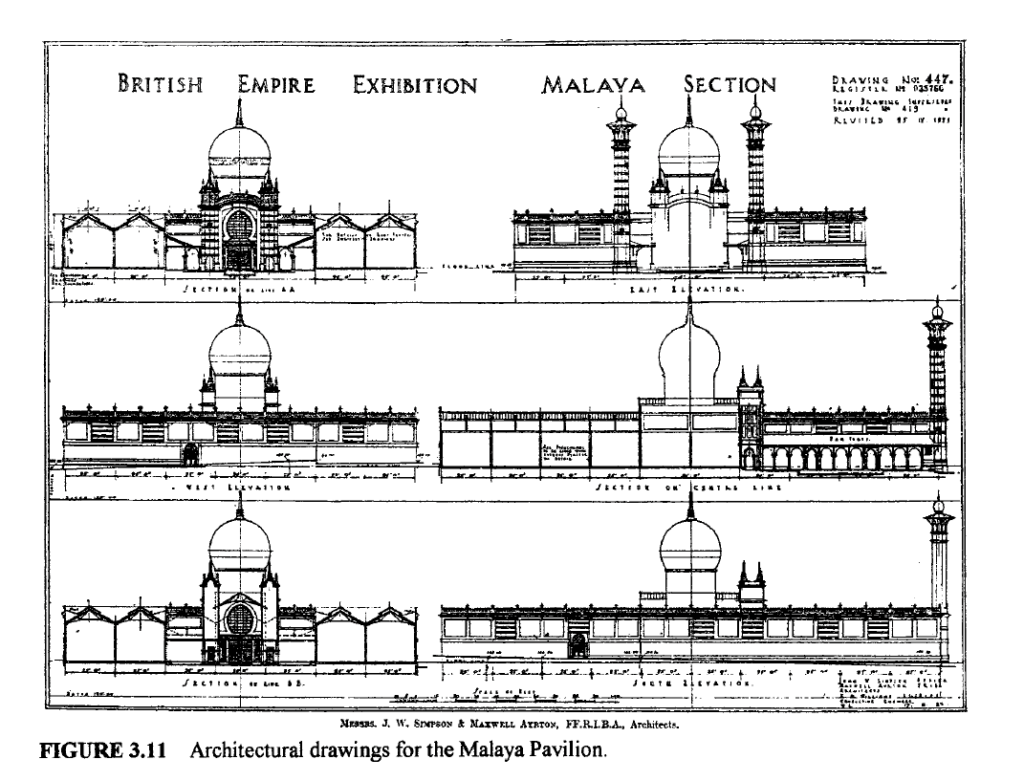
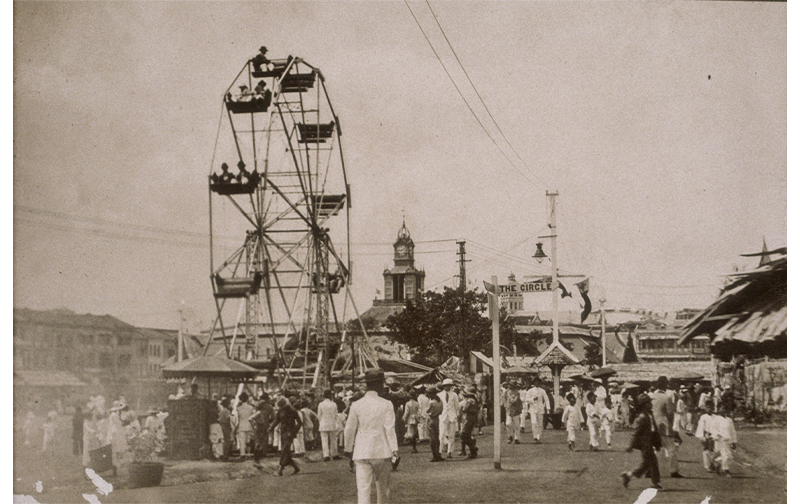
Both exhibitions, characterised by different ironies, yielded appalling evidence of Malaya’s imperial worth: its tin and its islands. Yet, both exhibitions were spatialised in radically different ways. In 1924, British visitors at Wembley went away with an identification of British Malaya in terms of “Moorish-Arabesque” (Figure 1) architecture. Yet, one surviving picture of the 1922 Singapore exhibition (Figure 2) shows no such instance of such architecture in precisely a constituent location of British Malaya, rendering the irony of exhibition as “reality” even more jarring. The second irony for this is the historical transmission of Indo-Islamic architecture. Indo-Islamic, or Indo-Saracenic, was a style brought out of British India and across empire by British architects after they had worked in or visited India.8

Figure 1 – the Indo-Islamic Style, associated with Malaysia, was brought out of British India by colonial architects

Figure 2 – https://biblioasia.nlb.gov.sg/vol-17/issue-3/oct-dec-2021/prewarphotography/

The historical, spatial irony of the Indo-Islamic remain spatially poignant today. On one level, tourist-facing resources slap this designation of “modern Arab” or “Moorish” architecture onto Masjid Sultan in Singapore. While the Mosque was originally built by Sultan Hussein Shah himself in 1823 like early mosques in the Malay Archipelago, the colonial architect Denis Santry in 1924 spearheaded an Indo-Islamic rejuvenation of the Mosque, in spite of the “presence of Arab, Indian, Tamil, Bugis, local Malay and Javanese representatives in the mosque committee.”9 Beyond the visitor’s gaze, the Mosque’s iconic architecture10 today has been cast as a foremost symbol of ethnic and racial pluralism in Singapore by the state and by Singaporeans. Near the Mosque is the Sultan’s previous residence, which had been acquired by the government in 1999 for the construction of the Malay Heritage Centre.11 Finally, this symbolism has been refracted outward into foreign relations. The street on which the mosque is situated – Muscat Street – hosts 8 metre-high granite arches displaying ornate Omani carvings, murals that were painted by Omani artists and tiles that were specially selected and imported from Oman.12 Plaques underneath the arches memorialise, in Arabic and English, the street’s redevelopment as a collaborative project between Singapore’s Urban Redevelopment Authority and Oman’s Muscat Municipality in 2012.

Having first demonstrated the ease with which one can problematise two colonial representations of reality, this post has then focused on the far-reaching implications of spatial representation. As the history of Indo-Islamic architecture indicates, what is far more deserving of academic attention is the ease with which memory and spatial representations travel. Embedded within these transmissions is the often ironic role of colonialist and imperialist power structures.

  1. Timothy Mitchell, “The World as Exhibition”. Comparative Studies in Society and History 31, no. 2 (1989): p. 228. [↩]
  2. https://biblioasia.nlb.gov.sg/vol-17/issue-3/oct-dec-2021/prewarphotography/ [↩] [↩]
  3. Jesse O’Neill. ‘Reorienting Identities at the Imperial Fairground: British Malaya and North Borneo’, Design History Society Conference 2019: The Cost of Design, 5–7 September 2019, Northumbria University, Newcastle-upon-Tyne, UK. [↩]
  4. Chee Kien Lai, “Concrete/Concentric Nationalism: The Architecture of Independence in Malaysia, 1945-1969” (PhD Thesis, University of California, Berkeley, 2005), pp. 124, 129-145 [↩]
  5. Assisting Secretary to the Federation government, and chief of the Malayan and Bornean exhibits. O’Neill, ‘Reorienting Identities at the Imperial Fairground’, p. 5 [↩]
  6. Lai, pp. 143-45. [↩]
  7. Ibid. [↩]
  8. Lai, p. 109. [↩]
  9. Lai, p. 110. [↩]
  10. https://www.sg101.gov.sg/resources/connexionsg/sultanmosque/ [↩]
  11. https://www.straitstimes.com/singapore/politics/budget-debate-istana-to-be-restored-malay-heritage-centre-redeveloped [↩]
  12. See: https://www.mfa.gov.sg/Newsroom/Announcements-and-Highlights/2017/12/Muscat-Street [↩]

Korea through Terry’s (through the Imperial Japanese) Looking Glass

To borrow from Edward Said, whose writings occupy an almost exhaustive historiography on his own, “contrapuntal reading” in literature invites the reader to ponder writing actively says and does not say about one’s disposition and blind spots. Insofar as scholars agree that tourism both reflected and reinforced efforts to build and maintain overseas empires,1 officially-affiliated travel guidebooks are clear opportunities for discursive analysis of the “self” and “other.” The historiography of Japanese colonialism in Korea is no different.2 The concerted Japanese attempt to market the Korean peninsula for foreign revenue, I argue, is best evinced by Terry’s Japanese Empire.3 However, by examining the presentation of Korea within a Western-facing guidebook of Imperial Japan, I argue that the tenuousness of “Othering” in an “Occidental”-facing book evinces Hom’s clarification of imperialism as “textured by uneven gradations of sovereignty and sliding scales of differentiation that bind colonial past and imperial presence.”4

Firstly, Terry argues that Japan is as geographically and culturally specific as it is “typical” for an Oriental entity. This discourse is presented both in terms of climate and geography. On page lxi (of a 283-page long preliminary information section) Terry argues that it is ‘quite those of our dreams’ to see Japan and ‘learn its charm is equivalent to drinking the waters of Guadalupe.’ Contemporaneously, the Korean landscape is both littered with ‘limp and enervated Europeans from the torrid south’ while devoid of a ‘good gov’t to make it one of the most opulent countries of the gorgeous East.’ (698-99) In terms of culture, the text assumes fixed profiles of the tourist and those viewed by tourists. For Terry, there is a single, tourist profile of a traveller who has embarked on a long journey from Western Europe, Australia, or America, and the essentialism of the other even does not spare countries from the Mediterranean. Conversely, the object of the rigidly defined “Korean” man is impenetrable and physiognomically fixed. “[Like] the Chinaman, he has, in his fathomless conceit and besotted ignorance, a sturdy and unshakable faith in his own impeccability,” among other pejorative judgements. (719) This essentialist discourse appears indistinguishable from the liberal comparisons drawn to men from Spain and specifically South Italy insofar as poor cultural traits are concerned. In contrast, the Japanese man is “non-controversial and dignified” and Japan is made of ten different “native races [that] dwell within the Japanese Empire.” (clv-clvi)

Yet, what Terry says about Korean history becomes problematised beyond the level of the “Occidental” perspective. On one hand, the hierarchy of civilisations is clear when Terry presents an entity characterised by corruption and ineptitude. Terry particularly describes the Three Kingdoms period as replete with each kingdom having (apparently) ‘episodes of national triumph and reverse,’ (bold is mine) and that the source of civilisation in Korea eventually derived from Japan. Yet, even this hierarchy was ‘only replaced in the latter half of the 19th cent. By the higher civilisation of Europe.’ (709) Finally, the Japanese ‘introduction of civilisation and enlightenment’ is a tangible process that can be tracked if one requests the Government General of Chosen’s ‘Annual Report on Reforms and Progress in Korea’.

On another level, Terry’s unabashed, liberal reference to Joseph H. Longford’s The Story of Korea reflects the ways in which imperial tourism refracts Japanese imperial knowledge about Korea. According to a publicly available copy of Longford’s 1911 text, Longford relied on the goodwill of the Japanese Ambassador, the Consul-General in London, as well as the Secretaries of the Embassy and Consulate-General “in elucidating obscure points in ancient history.”5 Longford’s preface sums up the confluence of two imperial interests: Japan converted “potentialities into realities of industrial and commercial wealth” as Britain invests in “the future status of our ally and in the political balance of the Far East.” The section on Korean history as a Japanese Protectorate reiterated the narrative of imperial salvation and modernity amidst Korean corruption and dysfunction.6

This analysis of a simple and almost uncritical presentation of the history of Korea in Terry’s guidebook shows how imperial texts have aligned to reinforce the Japanese imperial image of Korea, even as Japan was still subject to Terry’s Orientalist writing. Even in a colonial model of “Occidental” tourist-centric writing, this confluence of editorialising and knowledge transmission reinforces how Japan moderated and negotiated Orientalist treatment, leaving Korea twice removed from the mental hierarchy of Terry’s archetypal Western tourist.

  1. Shelley Baranowski et al., “Tourism and Empire,” Journal of Tourism History 7, no. 1–2 (May 4, 2015): 100–130. [↩]
  2. Hyung Pai, “Travel Guides to the Empire. The Production of Tourist Images in Colonial Korea” in Laurel Kendall (ed.) Consuming Korean Tradition in Early and Late Modernity: Commodification, Tourism, and Performance (Honolulu: University of Hawaii Press, 2010), 65-87. [↩]
  3. Philip Terry, Terry’s Japanese Empire: A Guidebook for Travellers (Boston and New York: Houghton Mifflin, 1914). [↩]
  4. Shelley Baranowski et al., “Tourism and Empire,” 126. [↩]
  5. Joseph H. Longford, The Story of Korea (London: T. Fisher Unwin, 1911), v-vii). [↩]
  6. Longford, The Story of Korea, 351-365. [↩]

“Kampung House” Experiments

Chua’s chapter “Modernism and the Vernacular” explains how the different spatial configurations of the kampung and of Chinese squatters’ housing led to different socialisations of “public space” in the modernist Housing Development Board (HDB) housing estate. The HDB’s vision was one of “overwhelming conformity” with some form of abstract designs of which their purpose is to “serve as ‘place markers’ in what would otherwise be placeless continuum of similarity.”1 While Chua’s chapter elucidates a theme central to the historiography of housing in post-colonial Singapore, Chua’s unilateral presentation of HDB’s housing vision can be nuanced by investigating the Singapore Institute of Architects (SIA) journal Rumah2 during the first phases of HDB’s development. The “modern” and the “vernacular” were envisioned as a possibility and spelt a vision of “public space” completely different to that of the HDB.

The SIA in its September 1961 issue presented the HDB’s raison d’être as one of continuity and change. The HDB’s initial work was launched off the final of the Singapore Improvement Trust (SIT)’s reports on housing.3 Yet, this Report entailed the post-colonial government’s “basic reassessment of aims and policies” in terms of “rental of housing units, densities of development, standard of accommodation, scale of building programme and many others.” Geographically, the HDB would begin by renewing “obsolete properties in the central areas” before a gradual, radial process of undoing marginal, slum properties.4 This was in concert with the HDB chief architect Teh Cheang Wan, who agreed with the remit of the HDB in relation to SIT. His words were confirmed by Lim, who argued that this strategy was needed as a “lasting solution to the urban housing problem prior to major economic development, industrialisation and a basic solution to employment,” indeed emphasising that this would also be the terms the HDB would be judged on.5

Thus the SIA, while accommodating the aforementioned writings from both HDB officials, was also very deliberate with student development. The Student Section, while bearing the stamp of the Singapore Polytechnic Architectural Society (SPAS), was open to any letters from the public. The SPAS also seemed aligned with how Chua characterises the HDB – “modern architects’ socialist sentiments” infused with the early twentieth century British “Garden City” movement.6 The page bore the SPAS’ “manifesto” – in which students emphasised the primacy of “public spaces”, “parking facilities” and the relationships buildings held within the unit of a formalised “Town Plan.”7

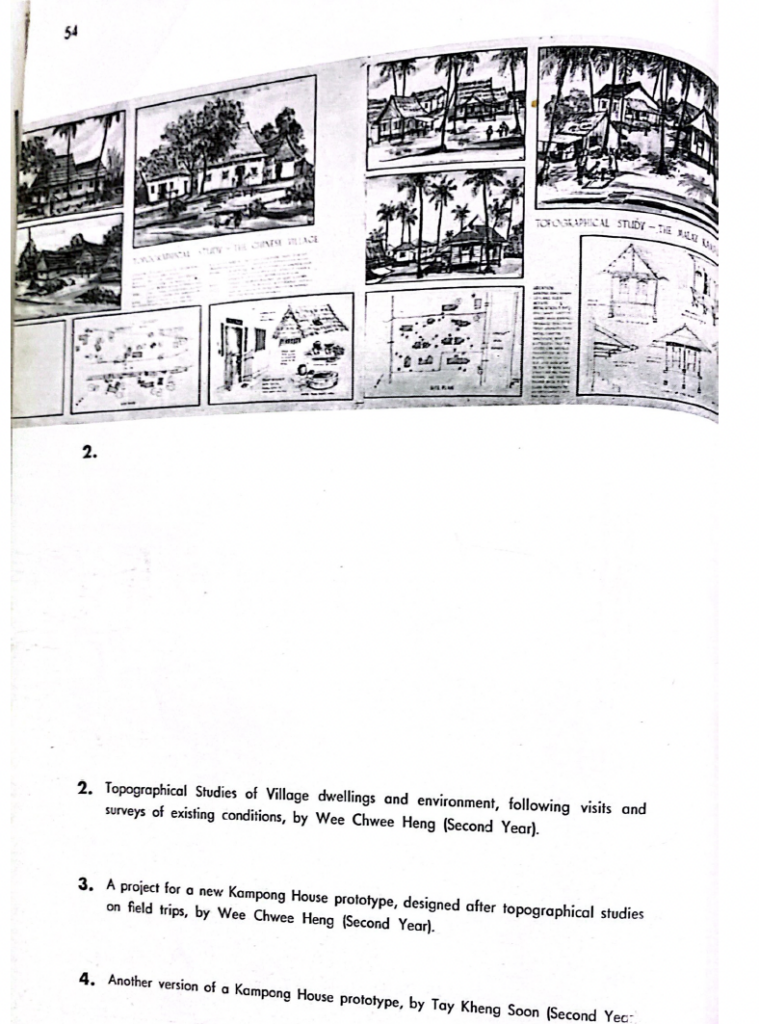
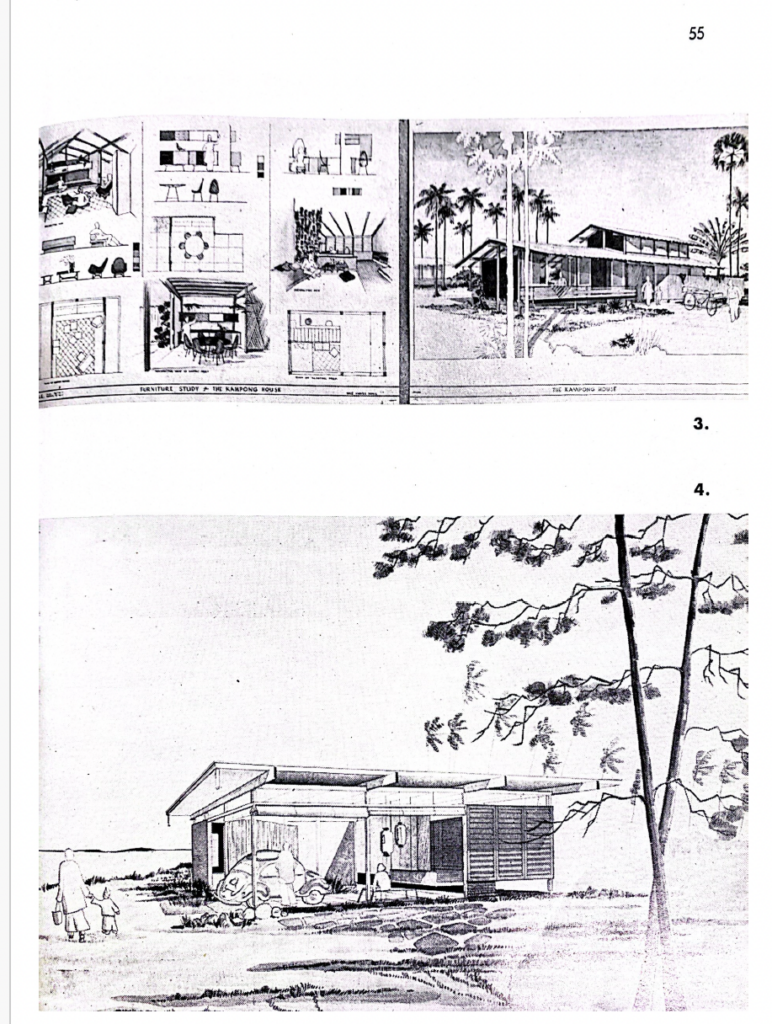
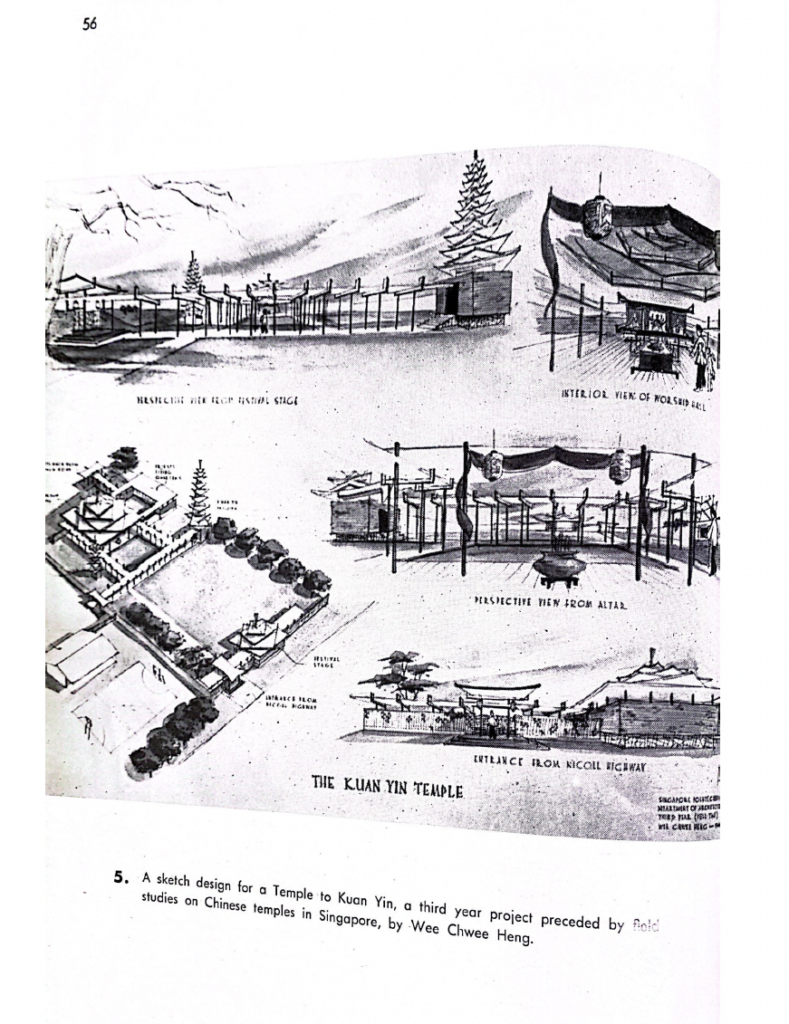
Pages 54-56 of the “Student Section” of Rumah, Sep 1961

However, the entries in this issue were just as concerned with the “vernacular”. All the entries were concerned with “Village dwellings”, with Second Year student Wee Chwee Heng’s entry detailing a topographical study following fieldwork Wee conducted. Wee was also the only student to submit a design for a “Temple to Kuan Yin” which he submitted as a “third year project preceded by field studies on Chinese temples in Singapore.” In contrast with schematics that Chua uses in his chapter, Wee focused his drawings on wide-angled views rather than bird’s eye projections of his studies. Wee’s drawings place the “vernacular” firmly within the “modern” – his temple is designed with an “entrance from Nicoll Highway.”8

The bulk of the other drawings responsed to a call for a “Kampong House prototype”, including an entry by Tay Kheng Soon when he was still a Second Year student. Tay’s envisioning of a kampung on stilts visualises the elements that Chua describes in the kampung – the clear features of the stilts and the serambi (verandah) are immediately obvious. Yet, just like Wee, Tay’s conception of the “vernacular” kampung house imagined both “modern” and “vernacular”. Tay pictures a car pulling into the paved flooring, leaving still a bench in the serambi for a resident to use, even if the car’s intrusion into this “public space” is not clear. In fact, Wee’s last submission bears a similar imagination in “prototyping” a “Kampong House” focused on envisioning the “modern” and the “vernacular”. Yet, both students did not identify “public” space necessarily as an area of discontinuity, and instead found ways of picturing them both inside and outside the kampung.4 For these architectural students, therefore, Rumah columns became a platform for experimentation – just as public housing would eventually become for the HDB.

  1. Beng Huat Chua, Political Legitimacy and Housing: Singapore’s Stakeholder Society (London: Routledge, 2002), 74-75. [↩]
  2. Bahasa Melayu for “Home” [↩]
  3. The Report is not available in the issue but is discussed by William Lim. Lim later gained prominence for his architectural achievements and social activism. William SW Lim, “The Singapore Improvement Trust 1959,” in Rumah (Sep 1961): 58-59. [↩]
  4. Ibid. [↩] [↩]
  5. All quotes are from Teh’s article is at the front of the issue. Teh, “Public Housing in Singapore,” in Rumah (Sep 1961): 5-9. [↩]
  6. Chua, Political Legitimacy and Housing, 75. [↩]
  7. “Student Section,” in Rumah (Sep 1961): 49. [↩]
  8. “Student Section,” in Rumah (Sep 1961): 54-56. [↩]

Between Client and State: Lee Fatt Dreams of a Three-Room Flat

Jordan Sand in House and Home argues that Meiji Era social reformers redefined the meaning of “home” and the roles of the persons physically present in the “home” for the sake of the nation-state. In selectively maintaining continuity with agreeable tenets of hitherto home life while simultaneously co-opting Taylorist practices pertaining to “home” in the West, Sand argued that Meiji Era journals, school curricula and newspapers reproduced this new praxis of the “home”. In line with Sand’s approach to studying the reproduction of “home”, I have examined the Lee Fatt Furniture & Electrical Company’s 1968 product brochure and its advertising in Singapore newspapers between 1964 and 1973 just as the nascent Housing Development Board (HDB) began to widen its public housing. Its brochure and advertising strategy, I argue, refracted both a shift in a rent-based to a leasehold-ownership-based form of housing ownership and characterised the new homeowner as the individual seeking upward socio-economic mobility on behalf of one’s family.
At the time of the People Action Party (PAP)’s attainment of internal self-government from the British, the PAP had inherited a growing population that had either been “living in over-congested shophouses in the city area” or in “wood-panel and thatched-roof houses in urban-fringe kampong”.1 Within a decade, the HDB had resettled much of the population into public housing flats; and by the turn of the twenty-first century 90% of Singaporeans lived in public housing. Most owners of these state-subsidised flats hold their flats under leasehold “homeownership” for a period of 99 years. The HDB’s work in public housing was and remains “the PAP government’s signal achievement, as a testament to its social democratic impulse, and as a foundation of its legitimacy and longevity in parliamentary power.”2
In recency, socio-economic studies3 of public housing have served as an avenue of texturing the unevenness of the physical safety and low-cost, multi-cultural harmony that housing ministries and statutory boards argue Singaporean public housing has helped to engender. Historically, however, this apparently linear trajectory only took place after 1964. Between 1960 and 1964, its first batches of flats required tenants to share toilets, bathrooms and laundry spaces; representing not much of an improvement over the hitherto predominant housing conditions available for the masses. In 1964, however, two important schemes changed the nature of public housing and home ownership. The HDB upgraded its provisions by starting production of “three-room flats, which referred to two bedrooms and one sitting room in HDB nomenclature” not including a kitchen and a bathroom-cum-toilet.4 Furthermore, the introduction of the Home Ownership Scheme alleviated financial difficulties for prospective homeowners and eased the financing of HDB flats that had hitherto been meant as rental flats. Further changes after 1964 allowed individuals to use their social security savings to offset the costs of purchasing flats. This newfound model of ownership, and widened accessibility, can be gleaned through a host of newspaper advertisements and brochures distributed by furnishing and electrical companies in the 1960s and 1970s.
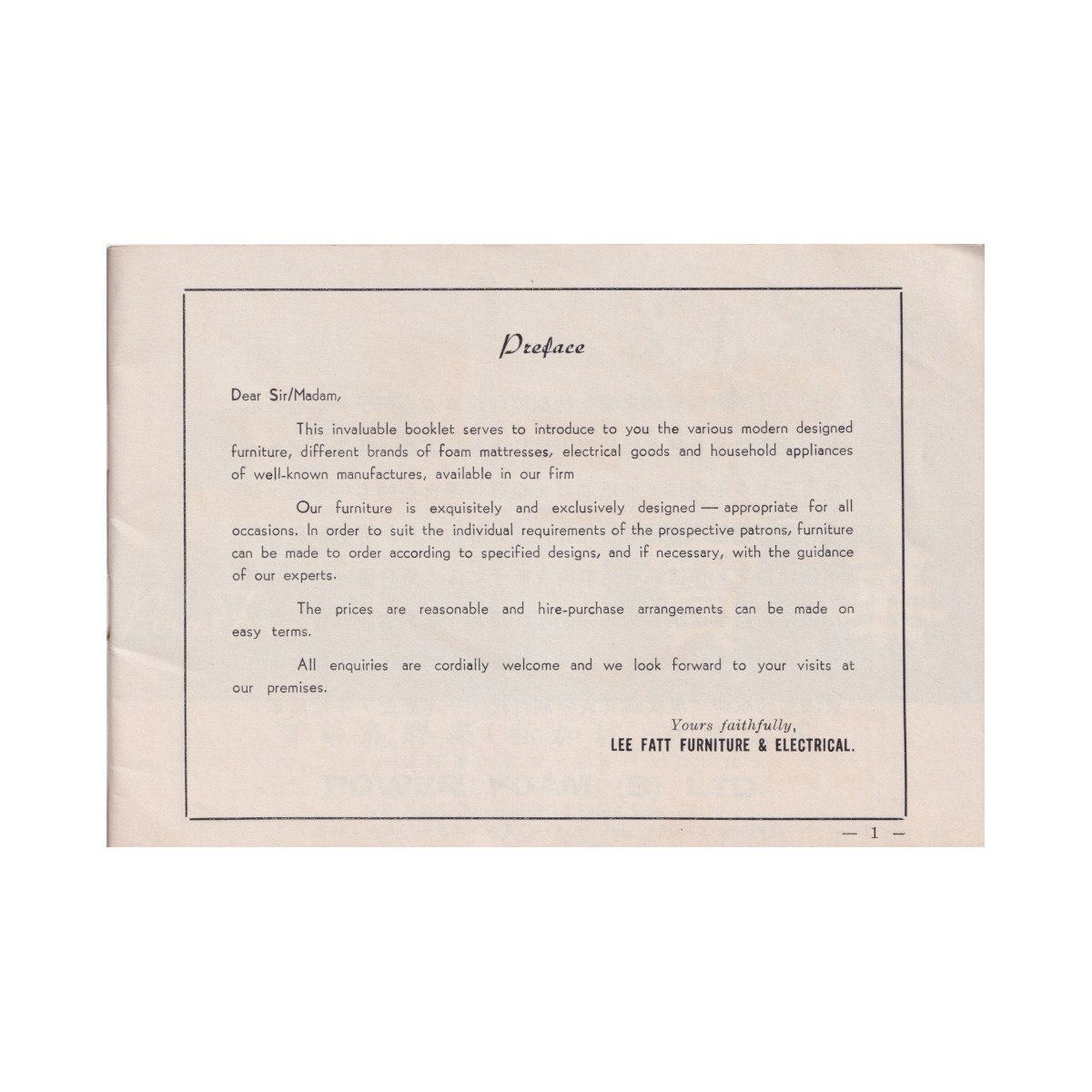
Page 1 of Lee Fatt's 1968 brochure
Lee Fatt Furniture & Electrical (利發木器傢俬) belonged in this category as a furniture and electrical supplier that took root in the 1960s. It placed its first furniture advertisement ion 26 November 1964.5 In 1966, it opened a new branch at 14 Jalan Tiong, in addition to its existing headquarters at the former Nelson Road, and in 1968 it published a 40-page brochure that was targeted at the growing number of new home owners in Singapore. The brochure a variety of household furniture items such as desk chairs and mattresses, advertisements from associated retailers and a range of household appliances. On page 1 its preface emphasised its “various modern designed” goods that were “exquisitely and exclusively designed” for the new prospective homeowner, while offering furniture that could be “made to order according to specific designs, and if necessary, with the guidance of our experts.”6
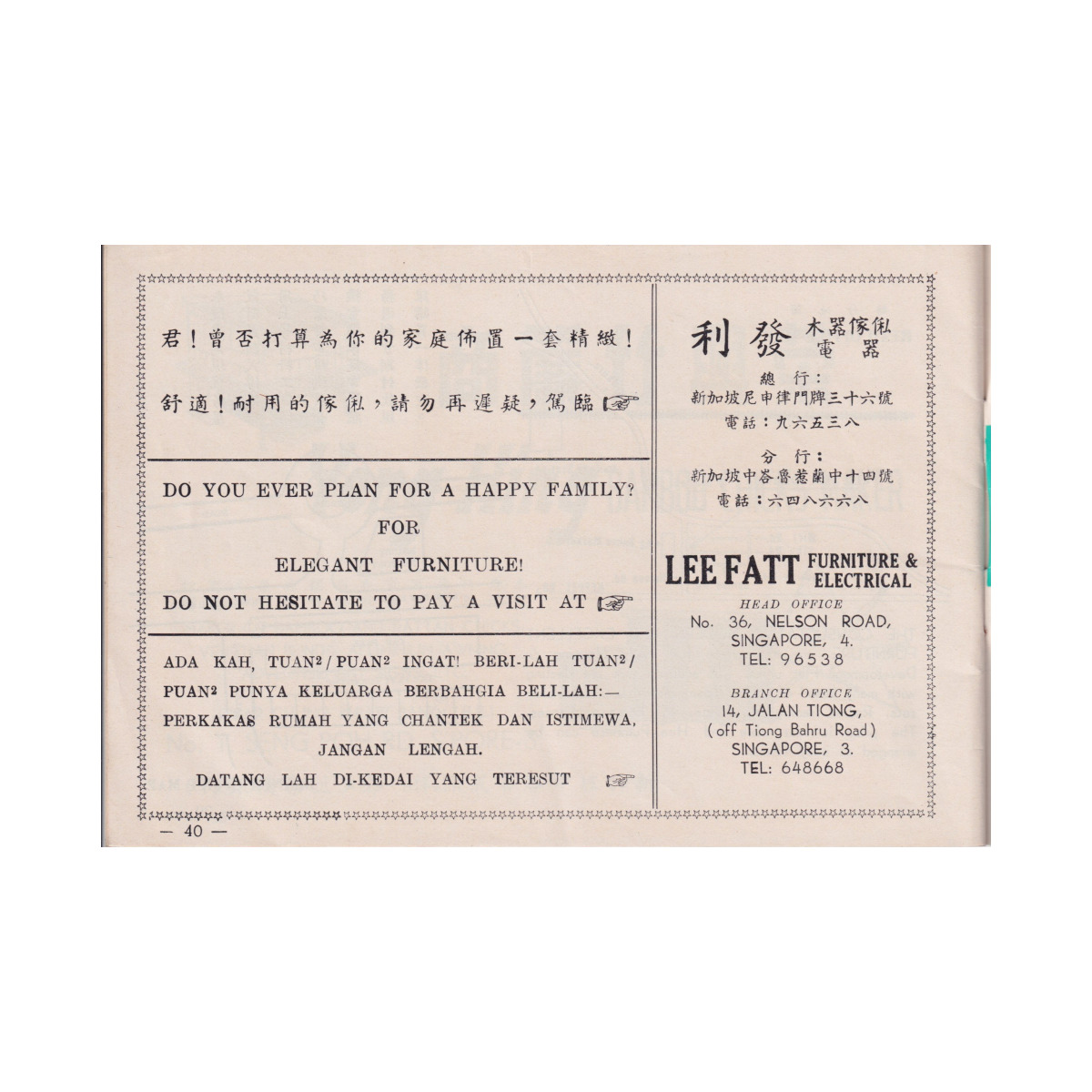
Page 40 of Lee Fatt's 1968 brochure
Beyond the front of the brochure, Lee Fatt wrote on the last page of the brochure its personalised messages to prospective patrons in Bahasa Melayu, Mandarin and English. One reason for this may have been the abundance of available Mandarin-language books in Singapore in this period which had its first pages at what we would consider the “end” of the book. Its messaging, subconsciously or otherwise, envisioned its customer base as new homeowners who were on the cusp of a new phase beyond just “modernity” but the uplift of a “happy family”. The messaging in Bahasa was gender neutral, appealing to both men and women (“tuan2/puan2”) while the messaging in Mandarin phrased purchases as “for the sake of one’s family” (“曾否打算為你的家庭佈置一套精緻!舒適!耐用的傢俬”).7
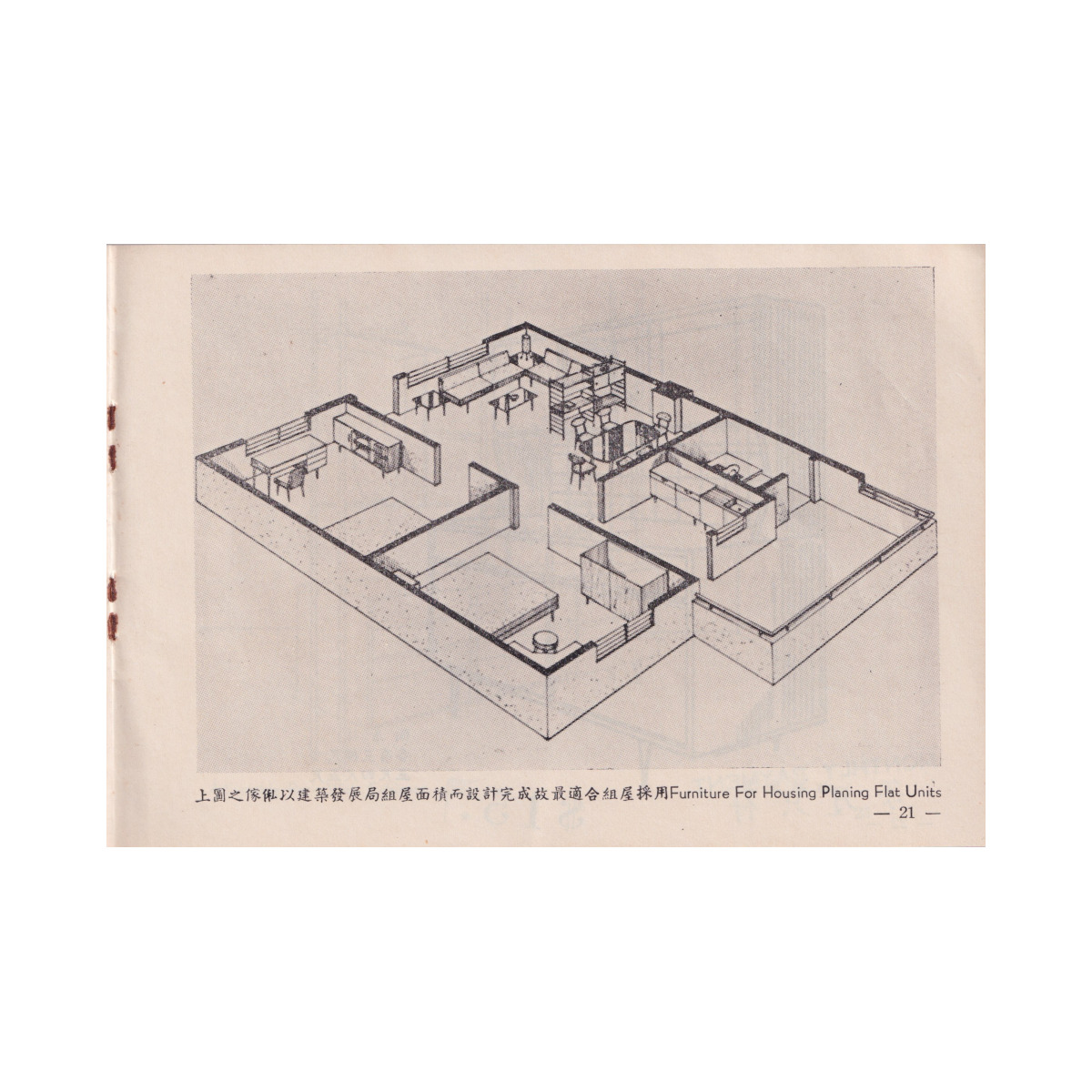
Page 21 of Lee Fatt's 1968 brochure
Lee Fatt’s brochure even alluded directly to the new model of a HDB flat. Page 21 of its brochure idealised how furniture would fill space in a blueprint of a three-room flat. The image showed a three-room flat with cabinets, beds, lamps, desks and sofas in a configuration that was idealised as befitting a new family. The caption made explicit mention, writing in English that this image was an ideal of “Furniture For Housing Planning [sic.] Flat Units”. In Mandarin, the link was more explicit, writing that this envisioning pertained specifically to the regulations and parameters of a new HDB flat (“以建築發展局組屋面積而設計完成故最適合組屋採用”).(( Ibid., 21 ))
Therefore, when situated in relation to the HDB’s burgeoning capabilities, the Lee Fatt brochure is an exciting source that suggests the particularities of advertising and consumer culture in the 1960s. This cursory exploration of the brochure encourages further research possibilities across different media, languages and economies of consumption in post-colonial Singapore.

  1. Beng Huat Chua, Liberalism Disavowed (New York: Cornell, 2017), 73-76. [↩]
  2. Ibid., 75. [↩]
  3. For an example see: Annas Bin Mahmud, ‘“There You Eat, There You Sleep, There You Study”: Housing Concerns and Needs of Low-Income Malay HDB Tenants in Singapore’. M.A. Thesis, National University of Singapore (Singapore), 2020. [↩]
  4. Chua, Liberalism Disavowed, 75-76. [↩]
  5. Advertisements Column 5, The Straits Times, 26 November 1964, 19. https://eresources.nlb.gov.sg/newspapers/digitised/article/straitstimes19641126-1.2.116.5 NewspaperSG (accessed November 14, 2023) [↩]
  6. “Lee Fatt Furniture & Electrical (利發木器傢俬),” Singapore Graphic Archives, 1. [↩]
  7. Ibid., 40 [↩]

Pu Yi and the Importance of Grandeur, Even in Utopia

The planning of Manchukuo (滿洲國) was an articulation of “utopia” for Japanese urban planners and architects, an empty canvas upon which Japanese architecture and construction could project a “Japanese” technical superiority. Historians have shown how planners manifested this in “modern” technologies relating to water supply, heating, sanitation, residential infrastructure.1 Yet, planners increasingly needed to accommodate the Japanese vision of a Greater East Asia Co-Prosperity Sphere. Within the spatial logic of Manchukuo, however, this latter vision was constricted by the planners’ own implementation of space in Manchukuo. The 16-17 September 1937 commemoration of the completion of capital construction that was meant to legitimise Japanese imperialism, I argue, demonstrates how the former unwittingly undermined the latter.


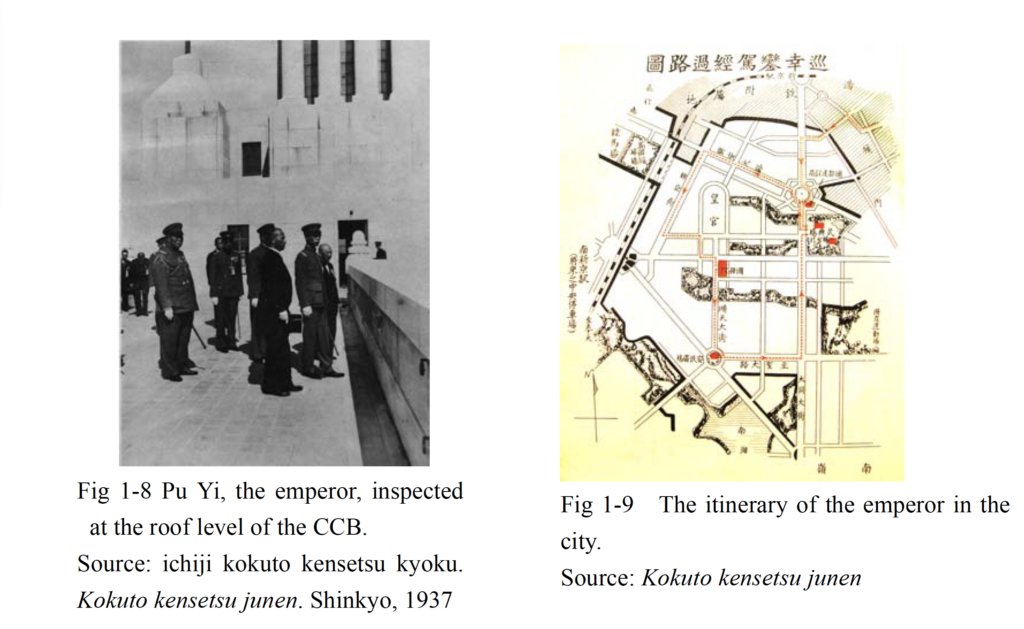
Images are from Yishi Liu’s Competing Visions of the Modern: Urban Transformation and Social Change of Changchun, 1932-19572

Firstly, the September commemoration was a deviation from the original, central concern of the colonial authority of planning Changchun. The founding of Manchukuo had been 1 March 1932, but authorities reflected that an anniversary celebration in March 1937 was too early for uncompleted infrastructure. Hence, a modest, barely publicised celebration was first held in the capital Changchun to commemorate the fifth anniversary of the establishment of Manchukuo. Correspondingly, the September commemoration of the construction of Changchun encompassed a working group and preparations including “siting, constructing temporary buildings, deciding the agenda and participants, security, propaganda, and above all, the tour of the emperor. The total cost for the ceremony reached 149,565 Yen.”3

Critically, we should see the remit of the emperor Pu Yi as a fascinating tale of exclusion. The puppet emperor’s significance had been spatially obvious from the get-go – Pu Yi had been housed in what was ‘far from being the grandest house in the city’.4 Yet, even as Pu Yi still retained a ceremonial role, the government-organised tour focused on the legitimising of physical infrastructure over other aspects of governance. Pu Yi’s itinerary consisted of the Capital Construction Bureau (CCB), Datong Plaza, State Council and exhibits of State Council construction achievements among others. At the end of the day, Pu Yi then returned to the palace while officials had a dinner banquet together.5

Liu further demonstrates that the September celebrations were augmented by copies of the emperor’s itinerary, a parade procession that was popularly attended, and the selling out of commemorative memorabilia. Finally, on the 17th, the bonfire tower at Datong Plaza championed “co-existence and co-prosperity” in an imposing manner where it had been flashing the words 一心一德 (”heart and virtue in unity”). While Liu omits further detail on the mass congregation that followed in the days after, possibly due to source limitations, Liu’s exposition of the pomp of the world fair and the “exhibitionary edifice” critical to the Japanese imperialist project demonstrates clearly the primacy of urban construction to Japanese colonialism in Manchukuo.

By privileging the tenets of utopia that underlined the Japanese construction of Manchukuo, I have argued that even the “fair” or “celebration” in a utopic spatial plan can undermine the original structures of rule undergirding such a spatial arrangement. Here, the utopic priorities of the urban planner took precedence over the symbolism of Japanese control in the first place – the September celebrations demonstrate the primacy of space as a way of asserting Japanese imperialism under the disguise of modernity and material progress under a purportedly Asiatic banner.

  1. See: David Tucker, “City Planning Without Cities: Order and Chaos in Utopian Manchukuo” in Mariko Asano Tamanoi (ed.), Crossed Histories: Manchuria in the Age of Empire, pp. 53-81. [↩]
  2. Yishi Liu, Competing Visions of the Modern: Urban Transformation and Social Change of Changchun, 1932-1957, PhD Thesis, University of California, 2011, p. 13. [↩]
  3. Yishi Liu, Competing Visions of the Modern: Urban Transformation and Social Change of Changchun, 1932-1957, PhD Thesis, University of California, 2011, p. 12. [↩]
  4. Bill Sewell, Constructing Empire: The Japanese in Changchun, 1905–45 (Vancouver: UBC Press, 2019), p. 106. [↩]
  5. Yishi Liu, Competing Visions of the Modern, p. 12. [↩]

Tracks and Fields – Oral Histories of Punggol

How much do urban planners know about the historical contexts of the spaces they organise? In this post, I engage in a rudimentary exploration of oral histories of the Punggol area in north-east Singapore and find that there existed no single historical context to speak of. Indeed, while histories of Punggol were similar to other planned areas in that they were richly variegated along lines of religious identification, dialect and surname association for the Chinese, Punggol inhabitants’ genealogies suggest a different orientation in the first place – that within the wider Malay Archipelago.

Two accounts of urban planning suggested to me the need to seek the perspectives of the proverbial walker. Firstly, Wooldridge’s nuanced and holistic chapter on Zeng Guofan’s image of Nanjing reconstruction demonstrated how literal reconstruction was state building.1 To be sure, Wooldridge’s grasp over the funding and bureaucratic machineries specific to Zeng worked well to evince different power systems when read with Yeoh’s chapter on the municipal government in Contesting Space.2 Here, Wooldridge was well aware of the limits of understanding the urban planner’s logic of reconstruction, noting the complex regional identities for the Nanjing intellectual elite who returned to Nanjing after 1865, even if the chapter eventually contained little in-depth exposition of these nuances.

While that served his point of top-down “reconstruction”, I instead considered Punggol, recently in Singapore the centre of a history exhibition at the opening of its new library. Contemporarily, it is known today as a housing neighbourhood town designed to court young families attempting to purchase public housing flats. Yet, what was this image reconstructed from?

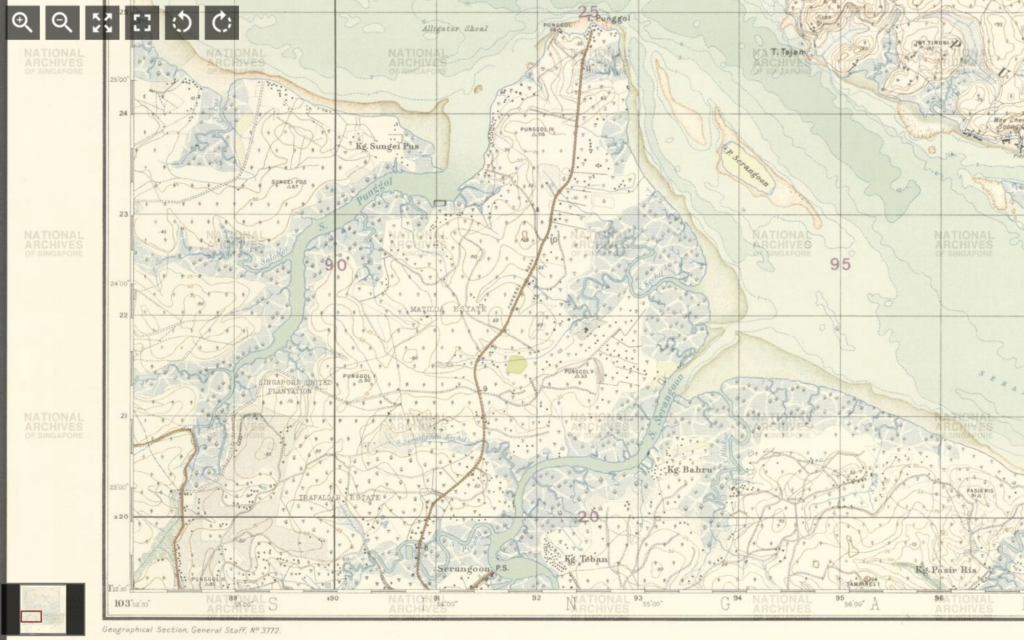
In Singaporean heritage projects, the spatialisation of Punggol has been the particularity of its “Track” system.3 However, when we examine maps from the National Archives of Singapore, the “Track” system first appears only on maps after 1959 – the year Singapore attained full internal self-government.4 Before that, topographical maps of Punggol were produced by the colonial-era Singapore Survey Department. These surveys were fixated on features such as railway widening lines and municipal boundaries. These maps also used the ‘mukim’ system; and between the first maps in the nineteenth century and 1959, little new information was added for each new addition for the focus was on land titles and land use.5

Correspondingly, this gulf is echoed in oral history interviews. On the other hand, oral history interviewees who were born before the 1950s used the Punggol ‘milestone’ markers as their way of spatialising Punggol.6 What remains similar in pre-1959 and post-1959 accounts, beyond the use of property and the association of land with ownership, is the exacting of demographic association down to specific streets for different dialect groups and surnames – a phenomenon Yeoh has elaborated on clearly in Contesting Space.

Yet, another primary source in 1957 presents a completely new dimension to Punggol history. In 1957, Muhammad Ariff Ahmad, a teacher based in Sekolah Melayu Ponggol (Ponggol Malay School), published Tok Sumang, the tale of his great-grandfather. In the English translation7 we learn that Tok Sumang had originated from Pahang and that his family had never been ‘fixed at one place’ – it was in the aftermath of war training on Tekong that he decided to move to ‘neighbouring Singapore, which was covered with dense forests and home to crocodiles and snakes.’ By 1891, Tok Sumang (‘always accompanied by his shovel and violin’) and his followers had agreed with the British that the land would never be taxed in exchange for the British construction of a road – the road that was built leading to the shore of Tanjong Punggol was named “Jalan Wak Sumang”. This was a different location of Punggol, not as an administrative unit in Singapore, and far from the contemporary understanding of the sovereign Singaporean nation-state as the center.

My comparison of Survey Department maps and different recollections of Punggol over time merely scratches the surface. In this case, the Surveyors’ maps did not merely lack markers of local knowledge. Between the Survey Department and internal self-government, topographical indicators said more of each administration’s goals than of Punggol’s historical particularity. The former emphasised land value, while the latter identified features of ‘community’ according to its own understanding, including landmarks such as ‘community centres’ and ‘police stations’. Secondly, the proliferation of a range of historical memories demonstrates one way in which the Lefebvrian idea of the “lived” can be actualised. Methodologically, I argue that there are far-reaching implications in using oral history to challenge the urban planner’s primacy. Oral histories and heritage culture, however state-directed either might potentially be, still spatialise a multiplicity of histories in ways that an urban planner’s map cannot.

  1. Chuck Wooldridge, City of Virtues: Nanjing in an Age of Utopian Visions, Seattle: University of Washington Press, 2015, pp. 117-149. [↩]
  2. Brenda Yeoh, Contesting Space in Colonial Singapore: Power Relations and the Urban Built Environment, Singapore: NUS Press, 2003, pp. 28–78. [↩]
  3. https://remembersingapore.org/2018/09/30/old-punggol-road-26-tracks/ [↩]
  4. Singapore Survey Department, Singapore 1961 – Tampines Accession Number TM000054_3. The use of “Track” is further replicated not just on topographical but electoral maps following this, with the post-1959 maps also taking care to mention vital community fixtures such as community centres and police centres – itself a change that deserves a discussion beyond the scope of this post. [↩]
  5. The Singapore Land Authority uses the system today, explaining that “Every land parcel in Singapore is uniquely identified by a lot number. This identifier has two components, namely the survey districts Mukim (MK) or Town Subdivision (TS) number and the lot number.” Mukim is a Malay word meaning ‘district’ with its roots from the Arabic مقيم (resident). [↩]
  6. Lee Chor Eck, Oral History Interview with Chai Yong Hwa Accession Number 000172. https://www.nas.gov.sg/archivesonline/oral_history_interviews/record-details/e0d5e6eb-115d-11e3-83d5-0050568939ad?keywords=Punggol&keywords-type=all. See especially reel 3 and reel 7. Maria Boon Kheng Ng, Oral History Interview with Hong Siew Ling, National Archives of Singapore . https://www.nas.gov.sg/archivesonline/oral_history_interviews/record-details/f09a160a-115d-11e3-83d5-0050568939ad?keywords=Punggol&keywords-type=all. See reel 3. [↩]
  7. Muhammad Ariff Ahmad (trans. Ahmad Ubaidillah), Tok Sumang, (Singapore: Geliga Limited, 1957). https://biblioasia.nlb.gov.sg/vol-19/issue-2/jul-sep-2023/tok-sumang-english/ [↩]