The Politics and Economics of Gandhi Hats in 1930 Bombay

At the onset of the 1930s, anti-Gandhi hysteria amongst the British in India was close to boiling point. This was largely thanks to the now iconic Salt March, where over 24 days, he led a non-violent protest to the Arabian Sea in protest at salt taxes. The British clamped down on this movement, arresting tens of thousands, including Gandhi himself on the 5th May.[1]

This event sparked civil disobedience throughout India. The response of the British was one of righteous indignation, with one paper reporting that, ‘consciously or unconsciously, Mr. Gandhi is playing a dangerous game. In the name of Ahimsa he is actually promoting violence, not only in feeling but in act. Within the week just ending all the Presidency towns and every city has witnessed scenes of wilful rioting and excesses by mobs’.[2]

I was surprised therefore, when in the very same newspaper I read the following, terse report from Bombay dated a couple of weeks previously:

‘The bullion, cotton share and cloth markets in the city have posted special notifications forbidding admission of all Indians wearing foreign head-gear to their respective places of business. Gandhi caps are being freely distributed’.[4]

These hats had long been associated with the home-rule movement, first being worn by Gandhi in 1919, and soon entering into mainstream popularity, being sold at pro-independence meetings in the early 1920s.[5] The British response had been swift, with cap-wearers suspended from Government jobs, fined or even beaten.[6] Such hats have therefore maintained political significance up to the present day, with the anti-corruption Aam Aadmi (common man) Party dishing out tens of thousands of these cheaply made caps emblazoned with party slogans at rallies from 2012 onwards.[7]
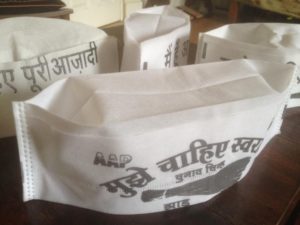
AAP Gandhi Hat (Andrew Whitehead)

Against this backdrop therefore, this report seems somewhat paradoxical. Having previously banned it, and at a time when Gandhi was coming to be considered pariah-in-chief in India, the British authorities seem to have tolerated the open distribution of one of his most iconic symbols.

What conclusions can we draw therefore from this anecdotal news article? The fact that three of the most important markets in the city had banned ‘foreign’ head-gear seems significant, as it suggests that domestic cloth manufacturers were feeling the strain of competing with foreign imports (coupled with the ongoing economic fallout from the Great Depression). The fact that Gandhi caps were being freely distributed as well points to the open support of independence by some of the leading merchant’s associations of the city. In this context then, the British tolerance of the manufacture and distribution of Gandhi hats, even to the detriment of imports, can also be seen in light of needing to prop up Indian industries. It also potentially demonstrates how Indian cloth merchants could use this rising nationalist tide to spur and stimulate their own industries, using it as an excuse to prevent competition. This isolated case therefore demonstrates the often grey area between political and economic nationalism, with the latter frequently fuelling the former across South East Asia in the 1930s.

[1] ‘Salt March’, History.com, 16th Jan 2020

[2] Rangoon Gazette and Weekly Budget, 5th May 1930, p7

[3] Ibid., p24

[4] Rangoon Gazette, ‘Free Distribution of Gandhi Caps in Bombay: Bullion and Other Markets object to foreign headgear’, 14th April, p2

[5] Andrew Whitehead, ‘Radical Objects: The Common Man’s Gandhi Cap’, History Workshop, 17th April 2014

[6] Lata Singh, Popular Translations of Nationalism: Bihar, 1920-1922, (Delhi 2012)

[7] Andrew Whitehead, ‘How India’s iconic Gandhi cap has changed sides’, BBC, 28th April 2014
‘Cautionary Tales’, The State of Burmese Cinema in the 1930s

Of all art forms, film has often found itself most susceptible to government censorship. This became clear when I was conducting research for a project on Indo-Burmese relations in 1930s Rangoon. Whilst in the British Library, poring over a very large and exceedingly dry copy of the Burma Gazette (filled for the most part with regional judicial and forestry commission reports), I randomly came across a bi-annual report from the Police Commissioner’s office, showing the activities of the Burma Board of Censors. This provided not only an intriguing insight into the early Burmese film industry, but also the colonial government’s attempt to police the thoughts of its captive audience.

Firstly, the Burmese film industry appeared to be very healthy despite its relative newness, with the first Burmese film having only been released a decade earlier, in 1920.[1] From 1st January to 28th April 1930, fifty-three new films were submitted for certification.[2] Nor was this industry seemingly dominated by a couple of major companies, with over sixteen different studios submitting applications over this period. The vast majority of these films (thirty-six), are classified as ‘Burmese’, presumably indicating their language and the origin of their producers. Certain major Burmese companies included the British Burma Film Company, as well as the Burmese Favourite Company, headquartered in Rangoon at No. 276, 39th Street and Sule Pagoda Road respectively. Together they produced a range of Burmese language films designed for a purely domestic audience, with titles ranging from ‘Thidagu’ to ‘Khemathee’.[3]

What is especially interesting however is the prevalence of Chinese films, comprising 15 in total. Despite being produced by a range of different studios, the most important company appears to have been the so-called Star Motion Picture Company, headquartered in Shanghai. Here the films appear to have been more along the lines of so-called ‘blockbusters’, featuring English language titles such as ‘Three Knights in the Army’, ‘The Young Heroine’, and ‘Knight of Burning Temple’. Importantly however, Chinese English-language films were also permitted even if they were explicitly political, as is clear from the title of one approved film, the ‘Northern Expedition of Nationalists’, produced in 9 parts by the San Bim Film Company.[4]

In light of this, censorship of this cinematic mix appears to have been very light. Every film on the list is approved, with some Burmese films even referenced as having passed the censorship test ‘Without Examination’. Indeed, only one film appears to have been subjected to censorship; a regional Burmese news report where the censors appear to have noted certain particularly graphic scenes, for example ‘The holding up of the bloodstained clothes which are presumably exhibits’.[5]

The evidence from this report therefore suggests that Burma enjoyed an unexpectedly vibrant cinema culture under British occupation, with healthy levels of competition between local and international studios, presided over by a seemingly light censorship hand. It also provides a cautionary tale about how the development of the arts can easily be reversed. With the onset of military rule, all cinemas were nationalised in the 1960s, with the industry instructed to broadcast the ‘march to Burmese socialism’. From a peak of 244 cinemas, Burma in 2011 was therefore reduced to 71 as popularity dwindled, with the ruling National League for Democracy (NLD) continuing much of the censorship apparatus of the military junta which preceded it.[6] Documents like this can therefore help to throw the problems of Burmese cinema today into sharp relief.


[1] Mark Magnier, ‘Myanmar’s once-proud film industry a flicker of its former self’, LA Times (1st April 2013)

[2] ‘Register of Cinematograph Films examined by the Burma Board of Censors, Dated Rangoon, the 15th May 1930’, in the Burma Gazette, Part IV, pp. 945-947

[3] Ibid.

[4] Ibid.

[5] Ibid., p. 947

[6] Aung Kaung Myat, ‘Military Rule May Be Over, But Myanmar’s Film Industry Remains in a Tawdry Time Warp’, Time (22nd August 2018)

‘Everything old is new again’: Contrasting discourses on modernity in Western and Japanese Colonial Enterprises

Much has been written on the benevolent, patriarchal language and discourses of empire that surrounded the Western colonial projects of SE Asia. These models sought to justify European imperial expansion on the grounds of restoring the material, artistic and myriad other cultural glories of SE Asian states and kingdoms. In doing so, colonial powers became guardians, or stewards, of subject peoples waylaid and fallen into depravity and decadence, who required educating on their own historical achievements to attain a higher level of civilisation.[1]

Evidence of this is abundant within both the French and British contexts. Within the former, French colonisation of Cambodia included initiatives to promote traditional arts, the restoration of a national museum, as well as crucially the restoration of monuments from the Angkorean period, including the site at Angkor Wat. As Andaya notes, ‘by resurrecting the glories of Angkor, the French provided the Khmer people with a permanent reminder of their former greatness and a powerful symbol of Cambodia as a nation’.[2] This both allowed the French to frame themselves as a benevolent force undertaking a mission civilatrice, as well as cementing the symbolic connection between the Khmer and the French.

This framework is also shown in Sir Stamford Raffles plan for a college of Native Learning in Singapore. As justification, he points for example to Great Britain’s long history in ‘promoting the truth and diffusion of knowledge’, and ‘to the improvement of the condition of her new subjects’.[3] On the grounds therefore of ‘exciting the intellectual energies and increasing the individual happiness of the people’, he therefore proposed the establishment of an Institution of Higher Learning in Singapore, ‘having for its object the cultivation of the languages of China, Siam and the Malayan Archipelago; and the improvement of the moral and intellectual condition of the inhabitants of those countries’.[4] This moreover had the additional advantage of training a new class of bureaucrats, skilled in local languages, to cement Imperial control.

These cases form a marked contrast however to the Japanese form of Imperialism, which eschewed the improvement of indigenous peoples. Instead, upon the annexation of Manchuria in the 1930s, the seemingly open, barren landscape was perceived as an opportunity to liberate the colonising Japanese themselves, through new infrastructures of urban modernity. The civilising mission in this case hence was directed inwards, with Meiji conceptions of Korean and Chinese cultural and economic backwardness providing the justification for Imperial expansion.[5]

This ideal was illustrated by large-scale and ground-breaking urban projects. The trading town of Changchun was transformed into the new Imperial capital of Xinjing, with wide open green spaces, and axial formations of boulevards radiating outwards from key monuments to Japanese modernity (for example a War Memorial , the Puppet Emperor’s Palace, a train station etc). Under the urban planner Sano Toshikata, it moreover became the first Asian city where all buildings were equipped with water closets. This hence paved the way for large scale immigration, with the civilian population of Manchuria being swelled by 800,000 mainly middle-class Japanese immigrants from 1930-41. .[6] Japanese colonial discourse therefore helped to disseminate of a new, urban utopia, with the idea that this would inform and inspire similar improvement schemes back in Japan, though such grand schemes were ultimately abandoned due to financial constraints.[7] Nevertheless, such a case study is instructive in illustrating the marked ideological contrast between European and Japanese discourses on colonisation and modernity. Whilst the former purportedly looked to the past to find inspiration for modernising its indigenous subjects, the latter kept its gaze firmly fixed on the future, for the supposed betterment of its own population.

[1] Edward Said, Orientalism (Penguin, 2003), Introduction

[2] Leonard Andaya, ‘Ethnicity in Pre-colonial and Colonial South East Asia’, in Norman Owen (ed.), Handbook of Southeast Asian History, (Routledge, 2014), p.273

[3] Sir Stamford Raffles, Formation of the Singapore Institution: A.D. 1823, (Mission Press, 1823), p.5

[4] Ibid, pp.3-6

[5] Louise Young, Japan’s Total Empire: Manchuria and the Culture of Wartime Imperialism, (University of California, 1999), pp.255-258

[6] Ibid., pp.262-263

[7] Ibid., p.281

Luddites of the Far East? The Hidden Dimension of the 1905 Hibiya Riot

The Hibiya Riot is famous for being the first major social upheaval in modern Japanese history. Angry at what was perceived to be the disappointingly minor concessions gained following the end of the Russo-Japanese war in 1905, a heterogenous group of lower and middle class rioters brought Tokyo to a standstill for three days, at the end of which 311 people had been arrested, and 17 people were killed.

Japanese propaganda had obscured a Pyrrhic ending to the conflict. Japan had suffered 80,000 fatalities in a drawn-out, attritional war, with total costs incurred coming to 1.7 billion yen; eight times the cost of the Sino Japanese War of 1894-1895. Andrew Gordon’s account hence demonstrates clearly how public fury was directed at visible signs of Government authority. For example, nearly three quarters of all the neighbourhood police boxes were destroyed in the city, whilst clashes resulted in injuries to 450 policemen and 50 firemen.

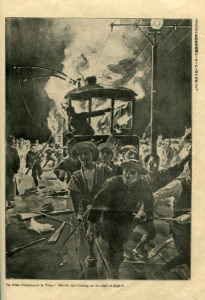
However, the roots of this riot can be found in more than just anger over tainted national pride. There is also evidence for a more subtle, economic dimension to this groundswell of popular protest. Besides the police boxes, the other public institution to be specifically targeted was the recently opened streetcar system. Tokyo had invested heavily in its tram system as a potent symbol of the new Imperial and democratic Japan. However, they were expensive, and beyond the means of many of the city’s lower classes. They were also a disruptive presence, threatening the livelihoods of thousands of rickshaw drivers in the city. Nor indeed was this a one-off occurrence. Upon the anniversary of the riots, a rise in streetcar fares spurred a new rally in Hibiya Park, which again ended with the smashing of dozens of streetcars, as well as an attempt to storm the streetcar offices. [1]


Image from The Tokyo Riot Graphic, No. 66, Sept. 18, 1905, (Kinji Gahō Company, Tokyo)

Such a case therefore illustrates the simmering tensions between the ‘old’ city of Edo and the ‘new’ metropolis of Tokyo. The transition between the two is discussed by Henry Smith in the ‘Edo-Tokyo Transition’. He refers to the distinction in Japanese intellectual thought between the shitamachi and the yamanote. Whilst they began as geographical designations (shitamachi referred to the lower class Eastern downtown of the city, whilst yamanote was associated with the elite Western upland areas), Smith argues that by the early 20th century, they had come to embody two competing ideological frameworks, with the former representing the old, traditional ‘plebeian’ ethos of Edo, whilst the latter instead heralded the new, modern and Imperial Tokyo.[2]  

What conclusions can be drawn from this? In terms of the destruction of modern technology, there are obvious parallels between the Hibiya Riot and the 19th century Luddite movement in Britain, where textile workers attempted to destroy textile machinery that threatened their employment.[3] What is interesting about the Japanese case though, is how this struggle against streetcars formed part of a deeper, ideological battle for the very soul of the city; with competing notions of modernity versus tradition helping to shape urban social protest in early 20th century Japan.

[1] Andrew Gordon, ‘Social Protest in Imperial Japan: The Hibiya Riot of 1905’, MIT Visualising Cultures, < https://visualizingcultures.mit.edu/social_protest_japan/trg_essay01.html> (accessed 9/12/2019)

[2] Henry Smith, ‘The Edo-Tokyo Transition: In search of Common Ground’, in Marius Jansen and Gilbert Rozman (eds.), Japan in Transition: From Tokugawa to Meiji, (Princeton, 1986), pp. 370-374

[3] Evan Andrews, ‘Who Were the Luddites’, in History Today, (26.6.2019), <https://www.history.com/news/who-were-the-luddites> (accessed 9/12/2019)

The Raj Abroad: Comparing Indians in British Service in Rangoon and Shanghai

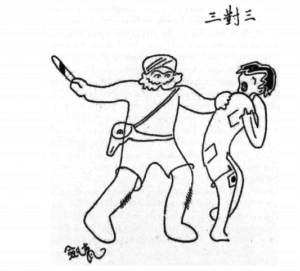
In her article ‘The Raj on Nanjing Road’, Isabella Jackson illustrates the crucial role played by Sikh policemen in the Shanghai International Settlement during the late 19th and early 20th centuries.[1] This reflects the wider importance of Indians to the Imperial project, fulfilling myriad roles across British territories in East and South East Asia. I was therefore interested to read James Warren’s article ‘The Rangoon Jail Riot of 1930’, which details the unique role played by Indians in the prison administration of British Burma.[2] Whilst significant similarities exist between these groups of Indians abroad, it becomes clear that their experiences could vary hugely, according to the prestige of their respective occupations, as well as the local context of their employment.

At first glance, Indians serving abroad seem to have been united by their subjection to racist, derogatory attitudes from indigenous peoples. Certainly, this seems true of Shanghai Sikh policemen, who even today are vilified in much Chinese history as ‘hongtou asan’ (Red-headed monkeys), perceived as vicious stooges of oppressive colonial rule.[3] Sikh policemen were for example blamed by the Chinese for opening fire on Chinese protesters in 1925, in the now infamous May 30th Incident.[4]

Fig. 1. Cartoon of a Sikh Policeman hitting a Chinese rickshaw puller. (Jackson, ‘The Raj on Nanjing Road’, p.1686

This is mirrored in the case of Burma, where, by the early 20th century, the entire population of prison wardens was Indian. In 1930, a huge riot broke out in the Rangoon Central Jail, with the ostensible aim of killing the superintendent, Major Bharucha. This reflected a long history of Burmese racially aggravated attacks against Indian prison staff.[5] Nor was racism confined to native Burmese, with the British enquiry into the riot laying the blame squarely at the feet of major Bharucha. He was described as both a bully and a coward, unsubstantiated accusations were made of his brutality, and he was summarily dismissed from his position.[6]

Whilst superficially similar however, it would be wrong to homogenise the experience of Indians in British service abroad. Working conditions appear to have been relatively good for Sikh policemen in Shanghai, attracting mainly ex-sepoys with the promise of pay five times greater than the Indian army, as well as the offer of nine months leave upon completion of five years service.[7] In the Burmese case by contrast, becoming a prison warden remained an unappealing prospect, with very low pay and long working hours. Indeed, according to a report by the Indian Jails Committee, an Indian jail warden was ‘but little less of a prisoner than the inmates whom it is his duty to guard’.[8] It would be wrong therefore to claim that Indians had a single, universal reason for seeking British employment abroad, with different opportunities instead being marketed at different subcategories within Indian society.

Moreover, the racism directed at Indians could spring from very different roots. In the Shanghai case for example, Sikh police became a ‘surrogate target for Chinese resentment of Euro-American Imperialism’.[9] Whilst this was also surely true in Burma, attitudes towards Indians in Rangoon likely had an economic dimension as well. The early 20th century had seen mass Indian immigration into Rangoon to work as unskilled labour. This led to growing competition with local Burmese, resulting in a huge race-riot in 1930 directed against Indian dock workers, resulting in over 500 deaths.[10] Seen in this context, anti-Indian sentiment could therefore spring from a number of locally derived sources, rather than exclusively from their association with the British.

Robert Bickers has concluded that Indians were employed by the British Empire for the three interlinked processes of ‘economy, defence, and display’.[11] Whilst this fundamentally seems to hold true, we should not let this obscure the very real differences in both how the British empire used its Indian subjects, as well as how such Indians were received by the local population. Whilst I have considered only two cases in this post, a more comprehensive study comparing the different experiences of Indian communities abroad would therefore be valuable.


[1] Isabella Jackson, ‘The Raj on Nanjing Road: Sikh Policemen in Treaty-Port Shanghai’, in Modern Asian Studies, Vol. 46, No. 6 (2012), pp.1672-1704

[2] James Warren, ‘The Rangoon Jail Riot of 1930 and the Prison Administration of British Burma’ in South East Asia Research, Vol. 10, No. 1 (2002), pp.5-29

[3] Jackson, ‘The Raj on Nanjing Road’, p.1675

[4] Ibid.

[5] Warren, ‘The Rangoon Jail Riot of 1930’, p.21

[6] Ibid., pp.13-14

[7] Jackson, ‘The Raj on Nanjing Road’, p.1680

[8] Warren, ‘The Rangoon Jail Riot of 1930’, p.22-23

[9] Jackson, ‘The Raj on Nanjing Road’, p.1691

[10] Warren, ‘The Rangoon Jail Riot of 1930’, p.11

[11] Jackson, ‘The Raj on Nanjing Road’, p.1676

Polynucleation and Houseboat Communities in 19th Century Bangkok

     ‘There it was, spread out largely on both banks, the Oriental capital which had yet suffered no white conqueror; an expanse of brown houses of bamboo, of mats, of leaves, of a vegetable-matter style of architecture, sprung out of the brown soil on the banks of the muddy river (…) Some of these houses of sticks and grass, like the nests of an aquatic race, clung to the shores, others seemed to grow out of the water; others again floated in long anchored rows in the very middle of the stream.’[1]

Such was the view that greeted Joseph Conrad as he ascended the central prang of the Temple of Dawn in Thonburi, the royal district of 19th century Bangkok. Located on the Chao Phraya river, 35 km north of the Gulf of Siam, this city, apocryphally dubbed the ‘Venice of the East’, captured Western imaginations with its unique spatial hierarchy between the land and the water. For the first 50 years of its existence, beginning with the movement of the capital to Thonburi under Rama II in 1782, the right to reside on land was almost exclusively granted to nobles or to Buddhist institutions. Accordingly, by the mid-19th century, 350,000 members of the rapidly growing city lived in semi-permanent rows of houseboats, anchored several layers deep on the Chao Phraya’s riverbanks.[2]

This arrangement, unlike any other in SE Asia, allowed a fluid, impermanent version of urban life to dominate. Houseboats were multipurpose dwellings, incorporating verandas which functioned both as commercial shopfronts during the day, as well as social spaces during the evening, when wooden frontages could be put up. Houses hence formed ‘streets’ and communities roughly corresponding to trade and/or ethnicity, albeit with the added advantage of mobility. George Earl, writing in the 1820s and 30s, wryly noted indeed the advantages that such an arrangement had for avoiding the flooding caused by seasonal monsoon rains, as well as the added benefit of being able to eject troublesome neighbours or move away from commercial competitors.[3]

Such a fluid, decentralised urban layout, bears a striking resemblance to the utopian vision of cities famously articulated by Lewis Mumford. Rather than focusing on urban spaces as purely physical, essentially static entities, Mumford’s view of the city was primarily as a social institution; an organic, fluctuating entity that functioned as ‘a theatre for social action’.[4] He moreover argued that in order to counter the social disconnections caused by modern cities becoming ever more massive and chaotic, it would soon be necessary to build ‘polynucleated’ cities, with multiple social and commercial focal points enabling all to participate in the drama of local social networks.[5] This vision of cities as encompassing multiple independent systems of social, economic and cultural exchange, with opportunities for fluidity created by an ever changing urban layout, is illustrated well by the dynamism of early Bangkok. This is both due to the strength of local associations found in the many polynucleated ethnic and commercial communities, as well as the ever-changing spatial layout of the city permitted by movement of living and commercial spaces.

The Bangkok witnessed by Conrad was gone in a fleeting instant. The Bowring treaty, and the onset of large scale commercial shipping, largely sounded the death knell for mass floating communities, with almost all houseboats cleared by municipal authorities by the 1920s. One observer indeed remarked that by the 1890s, the so called ‘Venice of the East’ had become merely an ‘Eastern Rotterdam’, of factories and wharves.[6] Traces of the old ethos still survive in Bangkok’s layout however. Even today, the lack of any single commercial or historical centre demonstrates the cities postmodern characteristics, with skyscrapers haphazardly scattered randomly across the city. In the brief history of Bangkok’s houseboat communities therefore, it is possible to see an accidental forerunner in many ways of Mumford’s influential ideas on polynucleation, with streets of boats forming urban communities in microcosm, characterised by fluid social dynamics and ephemerality.


[1] Joseph Conrad, ‘The Shadow Line’ (1917), in Maryvelma O’Neil, Bangkok: A Cultural History, (Oxford University Press, 2008), p.78

[2] Ibid., p.8

[3] George Windsor Earl, ‘The Eastern Seas of Voyages and Adventures in the Indian Archipelago in 1823, 1833 and 1834, in Ibid., p.79

[4] Lewis Mumford, ‘What is a city?’, in Richard LeGates and Frederic Stout (Eds.), The City Reader, (Routledge, 2003), p.94

[5] Ibid., p.96

[6] O’Neil, Bangkok, p.26