Following World War II, Japan was fertile ground for new, reinvigorated urban planning to relieve housing shortages and rebuild bombed cities. Nishiyama Uzô (1911-1994), a leading urban planner at the time, imagined city designs centering the relationship between everyday life and the built environment to promote accessibility in urban spaces. In the 1940s, Japanese communities were oriented at the local level of neighborhoods and towns – machi – rather than at the national level.1 Nishiyama engaged with German urban planning principles, adapting them to Japan’s urban organization needs as well as cultural backgrounds. Nishiyama’s selective adoption of foreign urban planning ideas reflects a broader theme of cultural syncretism in Japan following the end of Tokugawa-ear sakoku (seclusion) in 1854. The nation was not a passive recipient of cultural content and political ideologies; as has been suggested, Japan and its citizens played an intentional and active role in their engagement with foreign concepts.
The opening of Japan to the wider world was not necessarily forced upon the Japanese; rather, the Japanese were able to exercise political authority in the transition. The signing of the Kanagawa Treaty by the United States and the Tokugawa Shogunate open Japanese ports to foreign vessels and stimulated a wave of similar treaties between Japan and other Western powers. It’s been rightfully characterized as a watershed moment in the conclusion of sakoku but deserves more recognition for its display of Japan’s agency. The English language version of the treaty lacks a signature by the Japanese (fig. 1) since “their laws forbade the subjects of the empire from putting their names to any document written in a foreign language”.2 By only signing the document in the Japanese language, Japanese political authorities acted on their own terms, not on those of the United States. Thus, the Kanagawa Treaty is also a watershed moment in Japan’s approach to imported ideas.
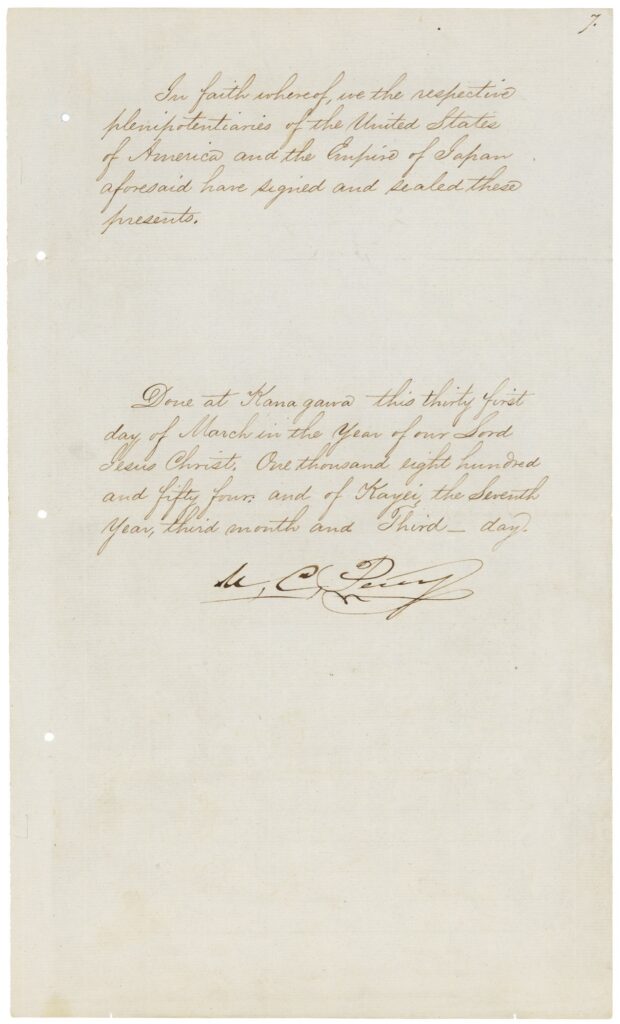
Figure 1. Attestation of the Kanagawa Treaty, with Japanese signatures absent. ‘Treaty of Kanagawa’, March 31, 1854. Courtesy of the U.S. National Archives and Records Administration, 299806.
Nishiyama Uzô culturally syncretized European urban planning theory, applying it within the context of Japan’s machi. Nishiyama took inspiration from the work of Nazi German civil engineer Gottfried Feder, who proposed for overgrown metropolises to be reorganized as “satellite towns” orbiting a city center.3 Similarly, Nishiyama’s plans sorted the city into a conglomerate of decentralized, self-governed neighborhood units he called “life spheres” (figs. 2 and 3).4 He disagreed with the German National-Socialist political context that engendered this urban planning concept, instead focusing on its potential to make a city more livable for its inhabitants while accounting for the communal identity of machi.5 Instead of prioritizing nationalist monumental architecture or centralization, Nishiyama’s plans organized space around the routines and practical needs of everyday lives of families. Rather than trying to encourage a specific type of movement through space, it supports the movements that are already likely to be made in that space. Ultimately, Nishiyama’s selective adaptation of German urban planning principles demonstrates not only Japan’s active agency in its engagement with foreign ideas, but also how cultural syncretism negotiated an approach to urban space which distinctly served the social and spatial priorities of postwar Japan.
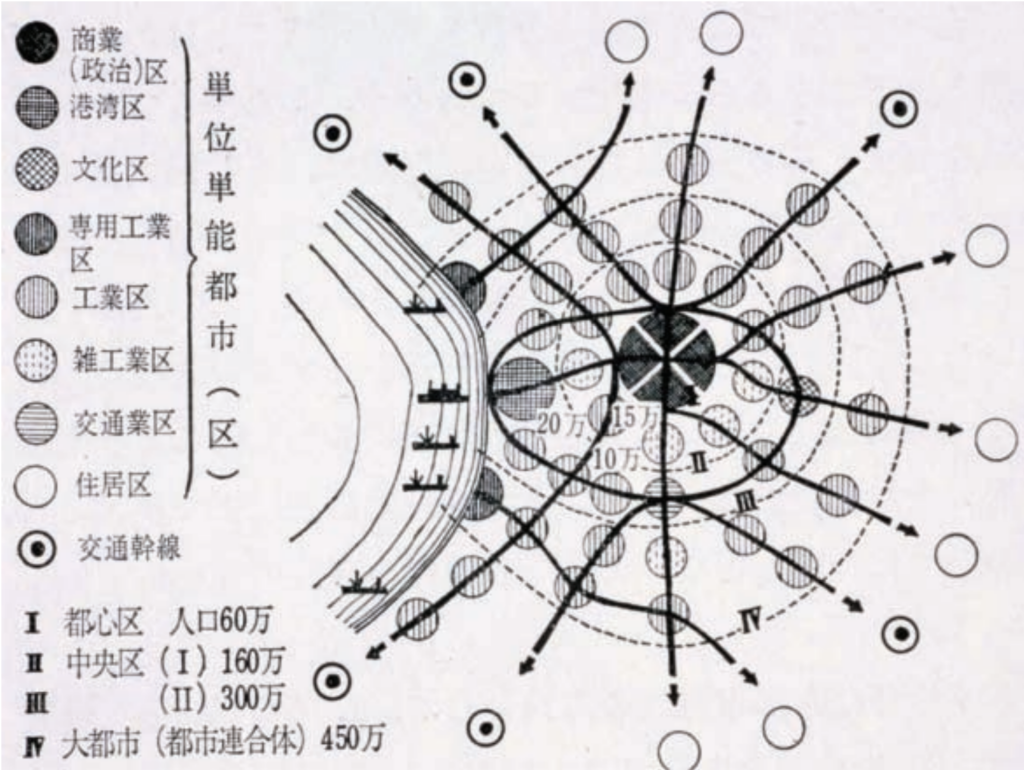
Figure 2. Nishiyama’s proposal for the zoning of a metropolis. Nishiyama Uzô, ‘Kokudo kôsei no ichi shiron’ in Chiiki kûkan ron (Reflections on urban, regiona and national space), ed. Nishiyama Uzô (Tokyo, 1968). First published as ‘Atarashiki Kokudô kensetsu’, Shinkenchiku 6 (1946).
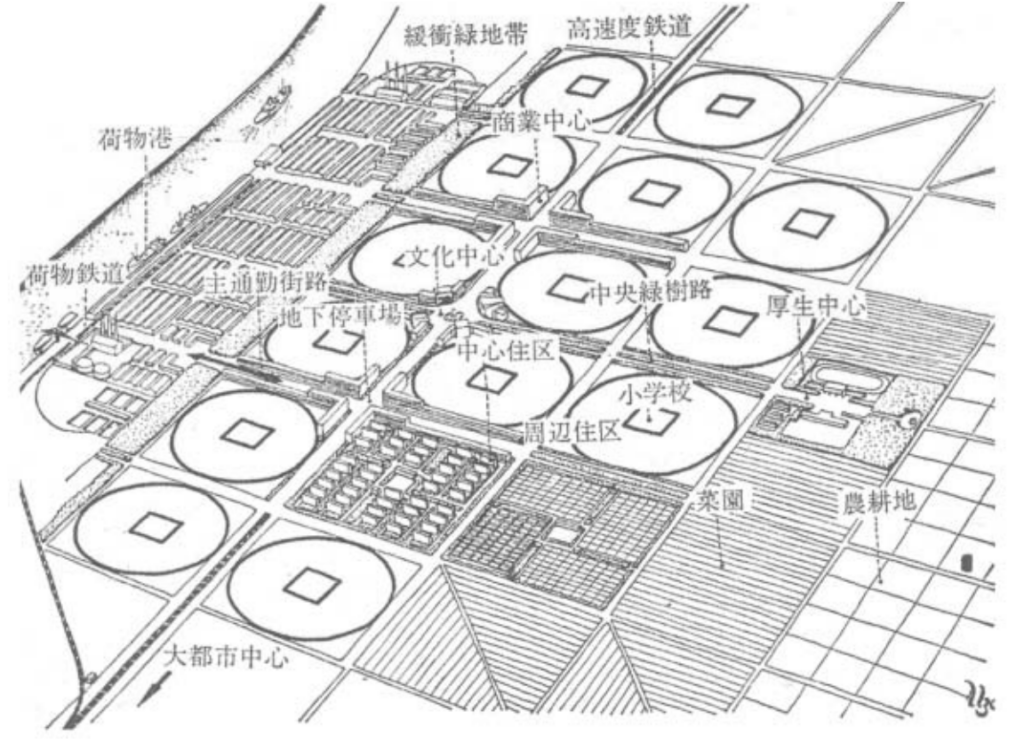
Figure 3. Nishiyama’s proposal for the interior structuring and urban units. Nishiyama Uzô, ‘Kokudo kôsei no ichi shiron’ in Chiiki kûkan ron (Reflections on urban, regiona and national space), ed. Nishiyama Uzô (Tokyo, 1968). First published as ‘Atarashiki Kokudô kensetsu’, Shinkenchiku 6 (1946).
- Carola Hein, ‘Machi: Neighborhood and Small Town – The Foundation for Urban Transformation in Japan’, Journal of Urban History 35: 1 (2008), p. 75. [↩]
- ‘Commodore Perry to Secretary of the Navy’, April 1, 1854, in Matthew C. Perry and Franklin Pierce (eds), Message of the President of the United States, Transmitting A Report of the Secretary of the Navy, in Compliance With a Resolution of the Senate of December 6, 1854, Calling for Correspondence, &c., Relative to the Naval Expedition to Japan (Washington, D.C., 1855), p. 147. [↩]
- Joshua Hagen, ‘Social Engineering, National Demography, and Political Economy in Nazi Germany: Gottfried Feder and His New Town Concept’, Claudio Minca and Paolo Giaccaria (eds), Hitler’s Geographies: The Spatialities of the Third Reich (Chicago, 2016), p. 143. [↩]
- Hein, ‘Machi’, p. 99. [↩]
- Ibid., p. 93. [↩]