Policing Indian Nationalism in Shanghai

The rise of transnational revolutionary anti-colonialism also oversaw the diversification of the duties of policing. Shanghai provides a case study of how urban policing transformed the rising pressures to survey, monitor and police rising anti-colonialism. Section 4 of the Shanghai Municipal Police Force (the Indian branch) is an interesting focus of study as its formation signalled the diversification of the duties of the Indian police force in Shanghai. Their position became more than just an economic method of asserting British colonial authority. The Indian police force became involved in the wider movement to suppress anti-colonialism across the British empire, demonstrating how urban policing became connected to the wider network of anti-colonialism. 

Reports from Section 4 division highlight the worry of anti-colonialism amongst the Indian population, influenced by the rise of Chinese nationalist groups during the 1920s and the narrative of pan-Asianism supported by the growing Japanese empire in China.1 A notable fear comes from members of the Ghadar movement who were arriving from the United States and Canada to expand their influence to Indian populations across the empire.2 The Sikh and Indian population formed a core of the British military forces globally, and the influence of anti-colonial sentiment could fracture the British military structure.3 These fears become evident with reports in the Shanghai Municipal Police Archives demonstrating a need to increase surveillance of ‘seditious Indians’ across Shanghai.4 Surveillance includes that, ‘In all cases, however trivial, involving Indians it is essential that the names of the paternal parents and villages of births to be obtained’ with all information forwarded to the detective constable.5 The reports highlight a developing insecurity of the wider Indian population and their connections to anti-colonialism, warranting the need to increase population surveillance. 

These insecurities highlight the diversifying role of Indian police officers in Shanghai. The 1927 construction of the Section 4 branch occurred out of awareness of rising Indian revolutionary movements in Shanghai and the need to suppress those movements. Indian police officers are viewed as valuable due to their ability to speak the local languages of Indian nationalists, their existing experience in police and detective work and their’ most comprehensive knowledge of local Indian affairs’.6 The new branch and the officers’ new position highlight the transitioning role of Indian police officers as agents of anti-colonial suppression. 

New duties of the special branch included collecting intelligence and border security. Their increased responsibilities in policing unravel surprising insights on the extent of surveillance collected on the Indian population in Shanghai. By 1936, the Special Branch held 2000 photographs and 1000 biographies of Indian ‘seditionaries and sympathisers’ residing in Shanghai.7 This included a comprehensive collection of individual names, photographs, family histories, ancestral homes in India, passport numbers and registration numbers. 8 The nature of the information collection demonstrates a need to easily identify suspects, establish connections of individuals to other revolutionary groups and track their travel history. This is starkly different from policing trends of 1930 that detailed the need only to survey newly arrived Indians from North America residing within International Settlement Districts.9 By 1936, surveillance methods expanded beyond the geographic jurisdiction of the Shanghai Municipal Police and towards any member of the Indian population, including students, professionals and travellers.4 It demonstrates how the insecurities held by governmental forces altered the role of Indian officers to become intelligence officers for the British. 

An additional role of the Special Branch included the enforcement of border security. Movement was an important aspect of surveillance as the 1937 report from the special branch detailing new procedures for the emigration of Indian nationals back to India. The processes included an arduous procedure of consultation with both the consulate and the special branch. To travel, the national would be required to fill out documents and submit them to the special police branch and once approved, the branch (under instruction from the consulate general) would allow the individual to purchase a ticket.10 Finally, the consulate would issue a certificate authorising the national to travel.7 The procedure highlights two factors. Firstly, the need to have police surveillance over the movement of Indians demonstrates the insecurities held by the British government of the increasing rise of transnational anti-colonialism and the need to prevent its spread to other corners of its empire. Secondly, the diversified role of Indian police officers in monitoring and controlling Indian movements in and out of the city.

Intelligence and border control are only two elements of urban policing connected to suppressing anticolonialism. However, the blog post is attempting to highlight how the transformatory role of the Indian constable demonstrates the wider relationship between urban policing and colonial security. British insecurities of rising anticolonialism transformed a municipal police force into a transnational intelligence agency.

  1. Shanghai Municipal Police, Section 4, Indian Section, Special Branch, February 11 1936, Special Branch Sections: Organisation and Work 1929-1941, File No. D.8/8, p. 22. [↩]
  2. Ibid., p. 24 [↩]
  3. Isabella Jackson, ‘The Raj on Nanjing Road: Sikh Policemen in Treaty-Port Shanghai’, Modern Asian Studies 46: 6 (November 2012), pp. 1697-1700. [↩]
  4. Shanghai Municipal Police, Indian Section, p. 24. [↩] [↩]
  5. Shanghai Municipal Police, Police Order No. D. 6679, Indians Arrested at Stations, December 24 1936, Special Branch Sections: Organisation and Work 1929-1941, File No. D.8/8, p. 8. [↩]
  6. Shanghai Municipal Police, June 21 1929, Special Branch Sections: Organisation and Work 1929-1941, File No. D.8/8, p. 49. [↩]
  7. Ibid. [↩] [↩]
  8. Shanghai Municipal Police, Indian Section, pp. 24-27. [↩]
  9. Shanghai Municipal Police, April 29 1930, Special Branch Sections: Organisation and Work 1929-1941, File No. D.8/8, p. 41. [↩]
  10. Shanghai Municipal Police, Indians: Emergency Certificates to India, May 10 1937, Special Branch Sections: Organisation and Work 1929-1941, File No. D.8/8, p. 12. [↩]
Modernity Through the Unmodern: Establishing a ‘Modern’ Architectural Style in Kuala Lumpur

One of the most prominent themes when encountering colonial literature is the notion of ‘modernity’. Whether it is a self-congratulatory remark on western-derived actions or the assertion of native ‘barbarism’, the language of modernity is a consistent tool utilised within primary source text. Elizabeth LaCouture, in her talk with the School of Transnational and Spatial History about her book, At Home in the World: Family, House and Home in Tianjin, China, 1860-1960, stated how modernity was constructed only in relation to the traditional1 In the examples of Tianjin domestic space, the western object was assumed as modern because of the ‘unmodern’ status applied to the Chinese object. LaCouture emphasises this concept in her description of the sofa in Chinese homes that distinguished Chinese living space from a traditional Chinese home from a ‘modern’ sitting room.2 By buying and placing a modern western object in a Chinese domestic space, the space had itself become ‘modern’. This definition of modernity is constructed in contrast to existing Chinese sitting furniture, where the sofa was established as modern in comparison to the unmodern Chinese alternatives, including the upholstered armchair or rattan chair.3 In her example, LaCouture emphasises that modernity in style is only constructed in contrast to traditional or unmodern other. I would argue that this understanding of modernity is also applicable to architecture in colonised spaces where the modernity of design was imposed by primarily establishing an unmodern traditional ‘other’ to contrast. This idea is exemplary in the British introduction of Indo-Saracenic architectural styles in Kuala Lumpur, where the style’s modernity was constructed by asserting the ‘simplicity’ of Malay-style domestic spaces. 

The establishment of an ‘unmodern’ other was the first step in establishing the modernity of British architectural styles. Common amongst officers in the Malayan Federated States were descriptions of the everyday life of the Malay people, especially their domestic space. A common term frequently used within the primary sources is ‘simple’. Malay dwellings are commonly described as primitive domestic spaces, simple in functionality, architectural style, and material usage. In its material composition, Richard Winstedt, a colonial administrator of British Malaya in the 1920s, heightens the modernity of European and Chinese dwellings based on the material composition of Malay houses.4 He emphasises their simplicity because the floors are constructed from split coconut trees fastened by rattan, or roofs made of palm leaves or wood could be imagined as ‘tents’.3 Under the pretence of the consistent urban fire outbreaks in wooden housing districts, wood as a material for housing construction is deemed an unmodern feature.5 In contrast, Winstedt highlights the modernity of Chinese and European housing due to their materiality, as both style housings used brick, tiles and glass, fireproof and sturdier materials.6 In addition, the multifunctionality of the Malay dwelling further emphasises the ‘simplicity’ of the Malay space as Winstedt asserts how one room is used for eating, sleeping and working, which contrasts to European domestic spaces, which were much larger and held separate spaces for each purpose. The limited size and multifunctionality constructed a less grandiose and unimposing structure within the urban environment, unlike Western-designed buildings. These descriptions highlight attempts to construct a narrative of ‘simplicity’ that emphasises the unmodern standard of Malay spaces, which is later used to support British architectural styles. 

It is evident that the modernity of the Indo-Saracenic architectural style was established by contrasting it with the Malay architectural styles under the pretence of functionality and material composition. In their article on the completion of the newly constructed Government Offices built in the Indo-Saracenic style, the Selangor Journal attributed the modernity of the building to the consistent use of brick, cement and steel as the primary material of construction.7 The materials are proudly described as fireproof that prevents the potential hazard of a fire breaking out in the complex like in Malay districts built entirely from wood.8 The emphasis on the fireproof nature of the building not only supports the style’s modernity but also contrasts it to Malay style dwellings, which have consistently been prone to fire outbreaks. In addition, the style’s modernity is also attributed to the functionality of the Offices as a grandiose space that appropriately supports the functions of the British colonial administration.9 Its functionality is defined not in terms of practicality, but its ability to represent British colonial power. As described above, the ‘functionality’ of the Malay dwelling was limited due to its small size ‘primitive’ use of space. Thus, the Malay dwelling is viewed as unmodern based on the parameters to support and represent colonial authority, which establishes the modernity of the British style.

It becomes clear that ‘modernity’ is not only the representation of what the object is, but it is also a representation of what the object is not. In relation to architectural styles, the British constructed Indo-Saracenic architectural style was deemed ‘modern’ by primarily establishing an unmodern ‘other’. LaCouture’s application of modernity raises interesting questions of how it speaks to wider discussions of how colonial power and authority is represented in colonised spaces. 


  1. Elizabeth LaCouture, At Home in the World: Family, House and Home in Tianjin, China, 1860-1960.(New York: Columbia University Press, 2021), p. 174. [↩]
  2. Ibid. [↩]
  3. Ibid. [↩] [↩]
  4. Richard O. Winstedt, Malaya: The Straits Settlements and the Federated and Unfederated Malay States (London: Constable & Co. Ltd, 1923), pp. 91-92. [↩]
  5. Shapiza Sharif and Arba’iyah Mohd Noor, ‘The Brick-making Industry in Kuala Lumpur in the Late Nineteenth Century.’ Journal of the Malaysian Branch of the Royal Asiatic Society 90, Part 1, No. 312 (June 2017), p. 62. [↩]
  6. Winstedt, Federated and Unfederated Malay States, p. 92. [↩]
  7. Selangor Journal: Jottings Past and Present, Volume V (Kuala Lumpur: Selangor Government Printing Office, 1897), pp. 219-222. [↩]
  8. Ibid., p. 222. [↩]
  9. Ibid., p. 222-234. [↩]

Constructing ‘Asia’: Despotism as a rhetoric tool of Civilisational Othering in 19th century Siam

Within colonial-era travel writing and orientalist discourse, ‘despotism’ is a common term used to describe Asia. Montesquieu applies the term ‘despot’ as a reflection of a civilisation’s ‘enslaved’ status.1 However, writers that utilise this term through orientalist language fail to expand on their application of despotism. Its definition, application and usage are vague and contradictory. Thus, I argue that in most historical discourse, engaging with the notion of despotism utilises it as a literary device as a form of othering, constructing barriers between a civilisational ‘us’ and a despotic ‘other’. Unsurprising that orientalist discourse is utilised to construct boundaries of ‘civilised’ and ‘uncivilised’, my argument highlights the importance of distinguishing between rhetoric and concept within historical writings. Despotism and enslavement are not used as conceptual terms to describe a governmental system or nation state, rather, they are used as rhetoric tools to establish boundaries of civilisation.

‘Despotism’, within Montesquieu’s texts, is used to construct an idea of a ‘despotic Asia’, in contrast to the free and liberated Europe.2 Asia exists in a state of enslavement, either enslaved by other Asian empires or enslaved by their own people.3 Despite the existence of vast empires similar to those in Europe, those empires differ in that they are not truly free. Montesquieu provides the example of the ‘Tartars’ as ‘Asia’s natural conquerors’, describing how despite their military prowess in expanding their empires, the ‘Tartar’ people will eventually become enslaved.4 This characteristic is attributed to their eventual demise into ‘despotism’ as a desire to emulate the original conquerors of their newly acquired land.4 Thus, the ‘Tartar’ colonies become enslaved from arbitrary powers imposed on the colonised subjects. The example provided here describes despotism not as an intricate governmental system but rather as a rhetorical tool to invoke an idea of Asia and Asians as disenchanted, enslaved people. Despotism constructs Asia into both a geographic and ideational space in the minds of European readers.

This ideational spatiality is also applied in travel literature as travellers were important in constructing ‘Asia’ into the minds of their readers. The language of despotism is also applied within the writings of Howard Malcolm, an American missionary who wrote accounts of his travels to British India, Burma, Siam and Malaya during the mid 19th century. Notable mentions of despotism come in his description of Siam, where he constructs a dystopian image of Siam as opposed to Burma as a ‘civilised’ society.5 His descriptions of the Bangkok population fall upon orientalist discourse’s rhetoric as he views them as ‘crafty, mean, ignorant, conceited, slothful, servile, rapacious, and cruel.6 This assessment of Siamese character reflects on their ‘civilisational value’ as Malcolm attributes these characteristics to Siam’s ‘despotic’ state. Slavery is emphasised to support Malcolm’s despotic reflection of Siam as he argues that ‘men may sell their wives, parents and children, at pleasure; and often sell themselves’.7 By highlighting the arbitrary nature of the Siamese slave trade and how people ‘sell themselves’, Malcolm emphasises Siam’s despotic nature through its ‘enslaved’ population. Much like Montesquieu, Malcolm constructs an idea of Asia and the ‘Asian’ as a disenchanted and enslaved individual. This is not to challenge Malcolm’s observations of slavery, rather, I provide this example since Malcolm uses slavery to support notions of ‘despotism’ while also utilising slavery as a means of highlighting Burma’s civilisational prowess. As mentioned previously, despotism is ill-defined and vague, used in contradictory manners. While constructing a disenchanted image of Siam through its extensive slave trade, Malcolm argues how Burma’s well-structured regulations regarding slave maintenance and usage show Bruma’s civilisational prowess in relation to its neighbours.8 Additionally, Malcolm’s contradictory discourse on slavery disregards his national context as an American whose country still practised slavery during the time of his travels and publications.

Although it is unsurprising that colonial discourse is contradictory, it is important to unravel those contradictions to highlight the writer’s underlying messages and intended image. It becomes clear that Malcolm utilises dystopian rhetoric to construct an idea of a ‘civilised’ and ‘uncivilised’ Asia in the reader’s mind. Siam, through the rhetoric of enslavement, is othered as ‘uncivilised’, while Burma, through the same rhetoric of enslavement, is accepted as ‘civilised’. The contradictory application of despotism and enslavement highlight the weaknesses in his argument but also uncover the role of these terms as rhetoric tools rather than conceptual terminology. As a result, the imposition of an idea of Asia becomes the primary effect of Malcolm’s text as Asia becomes more than a geographic space, but it is an ideational space within the mind of the reader.

  1. Anne M. Cohler, Basia C. Miller and Harold S. Stone (eds.), Montesquieu: The Spirit of the Laws (Cambridge, 1989), p. 282. [↩]
  2. Ibid. [↩]
  3. Ibid., pp. 282-283. [↩]
  4. Ibid [↩] [↩]
  5. Howard Malcolm, Travels in South-Eastern Asia: Embracing Hindustan, Malaya, Siam and China; with Notices of Burmese Missionary Stations and full account of the Burman Empire (Philadelphia, 1850), p. 161; pp. 320-322. [↩]
  6. Ibid., pp. 320. [↩]
  7. Ibid., pp. 321-322. [↩]
  8. Ibid., p. 169. [↩]

The Transnationality of Prisons: A Comparative study of Japanese and British penal institutions

The study of labour as an integral element of empire is frequently underrepresented in academic literature. Labour is an integral element in fueling colonial capitalist enterprise and oftentimes enlightens the reader on the fabrics of how an imperial power was supported. The third chapter of Shu-Mei Huang and Hyun Kyung Lee’s work, Heritage, Memory and Punishment: Remembering Colonial Prisons in East Asia, engages with the experiences of Korean, Chinese and Taiwanese penal labourers under Japanese colonial rule between 1895 and 1945.1 It highlights the gruelling experiences of Korean and Taiwanese penal labourers, the conditions they endured, the work they were forced to conduct and the Japanese structures and rhetoric that supported the system. An enlightening aspect of Lee and Huang’s chapter is their argument regarding Japan’s desire to demonstrate its modernity to western powers by mimicking western practices of punishment. The intense study of western penal systems led Japanese penal institutions to emulate those practices in their penal settlements to expand their imperial holdings and demonstrate their modernity.2 I argue that efforts to mimic the west are most visible when comparing the rhetoric and conditions of penal labour usage of Korean penal labourers in Japanese colonies and South Asian penal labourers in British Southeast Asian colonies. Both structures, which were prevalent less than a century apart, hold distinct similarities that demonstrate the origins behind Japanese structures of correction.

Lee and Huang highlight how justifications for the use of Korean penal labour was to reform the prisoner through labour. The Japanese were endeavouring on a moral mission to change the attitudes of the prisoner and convert them to become ‘dutiful subjects of the Japanese emperor’.3 The rhetoric demonstrates how Japanese officials self-identified as their subjects’ moral educators and reformers. These justifications are quite similar to Indian experiences in Penang, Malacca and Singapore as John McNair, a former superintendent of convicts highlights how the use of convict labourers was so they ‘become useful members of society, and free themselves from the disabilities under which they labour’.4 From McNair’s account, he viewed himself as integral to the moralising mission of ‘reforming’ the convicts he supervised and making them into ‘useful members of society.5 Written in 1899, McNair’s accounts were logged not long after the colonisation of Taiwan and Korea. Although not displayed directly, the two accounts display the transnationality of penal ideology as both states utilised paternalistic rhetoric to uplift their own international image.

In addition to the justifications, the practices of penal labour usage beyond the rhetoric also falls upon similar lines. Structures under both imperial regimes expanded, assimilated, and maintained empires in their colonised territories. Both examples demonstrate the mobile nature of penal life as labourers were juggled between the military, engineering department, private enterprise and their labour was not restricted to any particular prison or space.6 However, one of the unique links I believe both examples hold is their use of their prisoners as skilled labourers. Lee and Huang highlight the profitability of Taipei prison by utilising convicts as skilled labourers that would construct furniture, consumer and military goods for department stores, railway hotels, railway museums, the military and even the royal family.7 This correlates strongly to accounts of South Asian convicts being used as skilled labourers for government and private usage. McNair accounts for convicts in Singapore being particularly skilled in brickmaking whose production capacity and quality surpassed any private business and heavily supported the construction of infrastructure for the engineering department.8 Statistical accounts of the Strait Settlements detail the revenue generated by ‘selling’ penal labourers to private institutions and other government departments, highlighting the commercialised nature of penal labour usage.9 South Asian penal labourers were primarily viewed in the context of their profitability, and as the account details, the eventual abandonment of the practice came primarily from their lack of profitability that provided no incentive to employ them.10 From these examples, the South Asian and Korean examples show strong similarities as both structures were enforced due to the highly commercialised nature of skilled labour supported by the rhetoric of reform.

Insights into the rhetoric and practices of penal labour usage across both empires speak to the profit-making nature of penal institutions that exist even to this day. As mentioned by Dr Huang in her discussion with the MO4971 class, the privatisation of the US penal system in the use of prisoners as a cheap skilled labour force holds legacies from previous systems of imprisonment, which guise their practices under the rhetoric of reform.

In addition to the above connection, the comparative analysis speaks to the transnational nature of penal history. Although spatial in nature, penal institutions are not isolated to a single compound or building. Rather, the institutions also uphold an ideological foundation that can be inspired, affected and influenced by foreign penal practices and institutions. Penal history also connects to the wider historical narratives of modernity and empire. As reflected in the Japanese example, the operation of Japanese penal institutions resonated with imperial desires to appear modern in the face of western powers, both by upholding a reformist image while sustaining an ever-growing empire. The examples above spoke to the contradictory nature of penal institutions, necessary as a signal of reform and necessary to expand private and imperial interests.

  1. Shu-Mei Huang and Hyun Kyung Lee, Heritage, Memory and Punishment: Remembering Colonial Prisons in East Asia (New York, 2020), pp. 31-52. [↩]
  2. Ibid., pp. 35-37. [↩]
  3. Ibid., p. 49. [↩]
  4. John McNair, Prisoners their own Warders (London, 1899), p. 5. [↩]
  5. Ibid., p. 159. [↩]
  6. Lee and Huang, Heritage, p. 44-45; McNair, Prisoners, p. 66. [↩]
  7. Lee and Huang, Heritage, p. 44. [↩]
  8. McNair, Prisoners, p. 29; Ibid., p. 58. [↩]
  9. Department of Statistics, Government of the Straits Settlements, Straits Settlements Blue Book for the Year 1873, 1874, pp. 38-46. [↩]
  10. Ibid., pp. 60-76. [↩]

A Spatial Construction of Dual Identities: South Asian Convicts Labourers in the Strait Settlements

For the long essay, I aim to discuss the use of South Asian convict workers in the construction and maintenance of Strait Settlement colonies by the British in the late 18th and early 19th centuries. I will provide a particular focus on Penang and Singapore, presenting how these colonies were both spaces of imprisonment and spaces of individual freedoms.

On a theoretical level, I have drawn influence from Lefebvre’s conception of space as socially constructed, constituted of multiple layers, each with its unique set of meanings.[1] Strait Settlements were spaces of life imprisonment where the agency of individual labour was requisitioned and used for colonial expansion and maintenance. However, Strait Settlements were spaces where convicts could construct heterotopic identities, one of perpetual imprisonment and one of individual agency and value.

Additionally, I have drawn heavily upon Anand Yang’s recent publication, Empire of Convicts and his argument of a duality of identity experienced by convict workers. He highlights how the necessity for labour in distant colonies created an environment for which convicts could express a degree of agency in their own lives, calling themselves Company ke Naukar (workers of the company) rather than Bandwars (prisoners).[2] I plan to present the spatial construction of Strait Settlements as conduits for convicts to express this duality of identity.

In terms of primary sources, the National Archives of Singapore provides an excellent base to acquire Strait Settlement government reports (A08-A24 Penang Consultations), maps (Singapore Survey Department), and newspaper articles (Straits Times, Malaya Tribune, Singapore Free Press) on the use of convict workers in Strait Settlement colonies.[3] Blue Books and Consultation notes provide statistical data and activities on the movement, use and disposal of south Asian convict workers.[4] These sources provide knowledge on the scale of convict worker usage and the nature of how they were used in settlement construction and maintenance. Letters and correspondence from governors such as Francis Light, George Leith, Robert Farquhar and Stamford Raffles highlight direct correspondence with the East India company on discussions related to the usage of convict workers. Finally, I aim to look at Calcutta criminal and judicial records to provide information on individual convicts who arrived in the colonies.

However, one of the main limitations of the project are the limited voices of the actual convict workers who laboured in the colonies. Most of the literature focuses on the perspective of the colonial government, which makes it challenging to ascertain viewpoints of convict imprisonment from the perspective of the convict. To alleviate this issue, I plan to look at how spatial conditions and policies were created for the convicts to express the duality of identity. An example of which being the construction of Convict Lines, residences for the labourers. The space was created to hold convicts and was designed to prevent escape, displaying a space of imprisonment.[5] However, the Lines were constructed in the centre of the city, separate from the local jail and correctional centre, which was placed away from the city centre – displaying a distinct sense of identity from being just a convict.[6] Their spatial location and distinct separateness present the creation of identity above the status of a convict.


Bibliography:

Primary Sources:

Internet Archive, Blue Book for the year 1873, 1873 <https://archive.org/details/dli.granth.73418> [accessed 28th October 2021].

McNair, John, F.A., Prisoners: Their own Wardens (Westminster, 1899).

National Archives of Singapore, A25: Penang Consultations, 1826, <https://www.nas.gov.sg/archivesonline/> [accessed 28th October 2021].

National Archives of Singapore, Survey Department, Singapore <https://www.nas.gov.sg/archivesonline/maps_building_plans/source-details/651> [accessed 28th October 2021].

Newspaper SG <https://eresources.nlb.gov.sg/newspapers/> [accessed 28th October 2021].

Secondary Sources:

Lefebvre, Henri, The Production of Space (Oxford, 1974).

Yang, Anand, Empire of Convicts (Oakland, 2021).


[1] Henri Lefebvre, The Production of Space (Oxford, 1974), pp. 11-14.

[2] Anand Yang, Empire of Convicts (Oakland, 2021), pp. 95-143.

[3] National Archives of Singapore, A25: Penang Consultations, 1826, <https://www.nas.gov.sg/archivesonline/> [accessed 28th October 2021];

National Archives of Singapore, Survey Department, Singapore <https://www.nas.gov.sg/archivesonline/maps_building_plans/source-details/651> [accessed 28th October 2021];

Newspaper SG <https://eresources.nlb.gov.sg/newspapers/> [accessed 28th October 2021].

[4] Internet Archive, Blue Book for the year 1873, 1873 <https://archive.org/details/dli.granth.73418> [accessed 28th October 2021].

[5] John, F.A. McNair, Prisoners: Their own Wardens (Westminster, 1899), p. 16.

[6] Ibid., p. 23.

Modernisation and Development in the Dutch East Indies

Pauline Roosemalen’s edited chapter on the Netherlands Indies Planning Commission provides a valuable insight into the notion of modernisation in relation to formal town planning in the Dutch East Indies. Roosemalen argues how Dutch initiatives to engage in formal town planning processes facilitated the modernisation of the colony for the Indonesian people in the early 20th century.[1] However, her argument falls upon an over-simplistic view of the nature of ‘modernisation’. Modernisation is viewed entirely within a Eurocentric and materialistic view, which filters Roosemalen’s view of Indonesian cities and kampongs. Dutch planned cities are viewed positively due to their material abundance and European style visual aesthetic, while native kampongs are viewed negatively because of their unplanned nature and ‘limited visual aesthetic’.[2]

I would contradict this argument by highlighting the limitations of Dutch town planning processes as agents of modernisation and the diversity of the Indonesian kampong. Kampongs are not monolithic, and neither is the modern Indonesian state. It encompasses a vast array of islands and resultingly cultures, languages and ethnicities. The diversity of the Indonesian kampong reflects the diversity of its people, a factor that Roosemalen does not present. Each kampong utilises a unique architectural style and town planning structure. Kampongs in Medan have houses with large, triangular, outward protruding grass roofs.[3] The extravagance and height of rooftop design increases depending on the importance of the building. Houses in Kampong Garut are one storey structures with tiled roofs and surrounded by large thatched windows to facilitate the free flow of air in and out of the structure.[4] Kampong Nias Selatan displays formal town planning elements as structures are arranged in rows adjacent to each other, with wide streets separating groups of residences. Next to these houses are large communal gathering centres with chairs arranged for outdoor recreation or discussion.[5] Even by European standards, kampongs displayed formal town planning and architectural design elements that provided necessary services for each community. Each kampong reflected its community’s social structure and its relationship to the landscape around them. They were not monolithic as Roosemalen might suggest and deserve further analysis as a distinct element of local town planning.

Additionally, Roosemalen argues a strong relationship between Dutch town planning and modernisation despite prevalent urbanisation issues that were evident even amongst the European population of its cities. In 1901, Surabaya came under high alert as the Shell Transport and Trading Company built petroleum reservoirs with weak foundations next to rivers that flowed into the harbour.[6] The reservoirs were at risk of breakage if filled too high, risking the entire Surubayan maritime industry and water reserves.[7] Even after the decentralisation policy and enactment of the town planning ordinance in 1903, the Singapore Rotary Club highlights pertaining issues of the Batavian urban landscape.[8] The article compares Singapore and Batavia with an apparent British bias towards its own colonial cities. However, the article does highlight important issues relating to formal town planning processes. By 1938, the city was organised with ‘little evidence of town-planning’ as buildings were placed abnormally distant from each other, overpopulation was rife, supply of basic necessities were limited, and traffic conditions were chaotic with no formal regulation in place.[9] Batavia is viewed as neither visually aesthetic nor materially abundant, two factors that enforced Roosemalen’s notion of Batavian modernness.

The formalised nature of town planning is what enforced Roosemalen’s argument of Dutch’ modernisation’. It exemplified the difference between the ‘modern’ Netherland Indies city and the ‘unmodern’ Indonesian Kampong. From the short analysis above, Dutch-planned cities appeared less formal and ‘modern’ as previously perceived. The analysis of urban planning appears to be both eurocentric and hypocritical as European urban landscapes did not even fit the parameters of modernisation set by Europeans. Although it is important to understand how institutionalised town planning affected the development of the Indonesian city, it is also vital to detach ourselves from a purely eurocentric view of ‘development and modernisation’ and engage with alternate understandings of town planning based on the political and environmental context of the landscape. 


Bibliography:

Primary Sources:

KITLV Leiden, ‘Kampong in Garoet’, photograph, 1910, Garut Indonesia, KITLV Leiden.

Lett, A, ‘Het dorpsplein van de kampong Sedregeasi op Zuid-Nias’, photograph, 1895, Nias Selatan Indonesia, Museum Volkenkunde.

‘Netherlands India’, The Straits Times, Singapore. June 24 1901, p. 3, <https://eresources.nlb.gov.sg/newspapers/Digitised/Page/straitstimes19010624-1.1.3?ST=1&AT=search&k=town%20planning%20ordinance%20batavia&QT=town,planning,ordinance,batavia&oref=article> [accessed 20th October 2021].

Onbekend, ‘Een kampong in Medan’, photograph, 1920, Medan Indonesia, Museum Volkenkunde.

Singapore Rotary Club, ‘Java and Malaya Compared’, The Morning Tribune, Singapore, 14th July 1938, p. 8, <https://eresources.nlb.gov.sg/newspapers/Digitised/Page/morningtribune19380714-1.1.8?ST=1&AT=search&k=(Town%20Planning)%20and%20(Batavia)&QT=town,planning,and,batavia&oref=article> [accessed 20th October 2021].

Secondary Source:

Roosemalen, Pauline, ‘Netherlands Indies Town Planning: An Agent for Modernisation’, in Freek Colombijn and Joost Cote (eds), Cars, Conduits and Kampongs: The Modernisation of the Indonesian City, 1920-1960 (Leiden, 2014), pp. 87-120.


[1] Pauline Roosemalen, ‘Netherlands Indies Town Planning: An Agent for Modernisation’, in Freek Colombijn and Joost Cote (eds), Cars, Conduits and Kampongs: The Modernisation of the Indonesian City, 1920-1960 (Leiden, 2014), pp. 87-90.

[2] Ibid., pp. 115-116.

[3] Onbekend, ‘Een kampong in Medan’, photograph, 1920, Medan Indonesia, Museum Volkenkunde.

[4] KITLV Leiden, ‘Kampong in Garoet’, photograph, 1910, Garut Indonesia, KITLV Leiden

[5] A Lett, ‘Het dorpsplein van de kampong Sedregeasi op Zuid-Nias’, photograph, 1895, Nias Selatan Indonesia, Museum Volkenkunde.

[6] ‘Netherlands India’, The Straits Times, Singapore. June 24 1901, p. 3, <https://eresources.nlb.gov.sg/newspapers/Digitised/Page/straitstimes19010624-1.1.3?ST=1&AT=search&k=town%20planning%20ordinance%20batavia&QT=town,planning,ordinance,batavia&oref=article> [accessed 20th October 2021].

[7] Ibid.

[8] Singapore Rotary Club, ‘Java and Malaya Compared’, The Morning Tribune, Singapore, 14th July 1938, p. 8, <https://eresources.nlb.gov.sg/newspapers/Digitised/Page/morningtribune19380714-1.1.8?ST=1&AT=search&k=(Town%20Planning)%20and%20(Batavia)&QT=town,planning,and,batavia&oref=article> [accessed 20th October 2021].

[9] Ibid.

Spatial Alienation: The Expulsion of the Chinese in Colonial Batavia

Within Henri Lefebvre’s work, The Critique of the Everyday, alienation is introduced as a tool of political and economic exclusion of the lower classes.[1] He critiques how the design of Paris came to exclude the non-elites by driving them further away from the city centre, creating an increasingly disruptive and distant space between their domesticity and their place of work.[2]

The exclusivity of the town centre and the alienation of the other represents a politicisation of space that is exemplary in formal colonial town planning processes. Peter Hall demonstrates how the most formalised application of alienation was Luyten’s Delhi, as the city was reimagined and reorganised under a complicated hierarchy of race, social rank and affluency.[3] Those who ranked in the upper echelons of British colonial society remained in the centre while the less affluent and local residences were pushed outwards. The new city centre was a symbol of British political power, and the city was to be remodelled as an Eastern Rome.[4] This new Eastern Rome arguably applied only to areas of European domesticity, recreation and work as the Indian outskirts did not fall under formal town planning processes other than their physical distance to the central metropole.


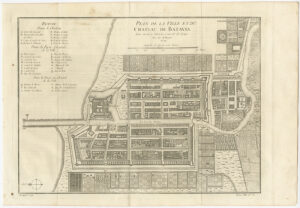
Much like Delhi, Batavia (modern-day Jakarta) also represents spatial exclusion but in a less formalised manner. The 1750 map of Batavia created by Jacques Nicolas Bellin demonstrates the alienation of the other in his representation of Batavia’s inner and outer city.[5] The map was created after the 1740 Batavia Massacre that saw the expulsion of the Chinese Batavian population outside the city walls.[6] Although they were allowed back into the walls, a sizable Chinese settlement was already formed called Glodok, directly south of the city walls.[7] The placement and representation of Glodok exemplifies Lefebvre’s notion of spatial alienation as it is applied as a tool of political and economic exclusion of the lower classes.

The placement of Glodok outside the city walls is the primary symbol of exclusion as the wall creates a physical barrier between the European and the Chinese populations.[8] From Bellin’s map, it appears that Glodok also became alienated from the formal Dutch town planning processes. The map demonstrates a stark difference between the constructions of the two districts. The inner walled city is planned in a grid-like structure with wide streets and large housing. Space is abundant, and infrastructure for transportation such as bridges between canals are frequent between blocks. Glodok appears dense with smaller plots of housing organised in a non-grid like structure. Districts are constructed to fit the geographical shape of the land in between the southern walls and the Ciliwung River. Streets appear to be narrower, and bridges between rivers are less frequent. The physical representation of Glodok highlights an alienation of the Chinese population outside both the city walls and outside the formal town planning processes of the Dutch.

Spatial alienation also appears representationally as Bellin’s map highlights a dominant trend amongst most cartographic representations of Batavia during this time period.[9] Maps are arguably political, they can be an inclusionary tool as they represent physical space for a wider audience. However, they can also be exclusionary as cartographers can oversimplify or exclude space from their representation. Bellin’s 1760 construction of Batavia follows a clear trend of exclusion as it provides a detailed representation of each district, street and river within the city walls as it represents the European community’s domestic, recreational and professional space.[10] However, Glodok and areas outside of the city walls remain anonymous. Glodok fails even to be labelled while the settlements east and west of the city walls are identically produced illustrations of plantations.[11] Outside the periphery of the European community, Glodok appears as a dead space, negligible in terms of individual agency or political and economic activity.

Although Bellin’s map is not representative of Chinese or Javanese lived space, it is valuable in presenting the effects of spatial alienation in colonial cities. Alienation appears in two forms; it exists as a physical and representational act of exclusion as it demonstrates a space that lives outside the European periphery.


Bibliography:

Primary Sources:

Bellin, Jacques, Plan de la Ville et du Chateau de Batavia (1750). Image in Bartelle Gallery (BG-11199), <https://bartelegallery.com/product/map-of-batavia-bellin-1750/> [accessed 9th October 2021].

Krevelt, A.V. Peta Batavia 1780. Image in Batavia Digital <https://bataviadigital.perpusnas.go.id/peta/?box=detail&id_record=10&npage=1&search_key=&search_val=&status_key=&dpage=1> [accessed 9th October 2021]

Pemerintah Kolonial Belanda, Peta Batavia 1672. Image in Batavia Digital <https://bataviadigital.perpusnas.go.id/peta/?box=detail&id_record=15&npage=1&search_key=&search_val=&status_key=&dpage=1> [accessed 9th October 2021].

Surjomihardjo, Abdurrachman. Peta Batavia 1650. Image in Batavia Digital, <https://bataviadigital.perpusnas.go.id/peta/?box=detail&id_record=14&npage=1&search_key=&search_val=&status_key=&dpage=1> [accessed 9th October 2021]


Secondary Sources:

Hall, Peter. Cities of Tomorrow: An Intellectual History of Urban Planning and Design since 1880 (New York, 2014).

Jingga, Fanny and Yulia Nurliani Lukito, “Ethnic Identity and its response to the growing environment in the urban space of Glodok, Jakarta.” AIP Conference Proceedings Online Volume 2376, issue 1 (2021), pp. 1-6.

Lefebvre, Henri. The Critique of Everyday Life Volume I (New York, 1948).


[1] Henri Lefebvre, The Critique of Everyday Life Volume I (New York, 1948), p. 148.

[2] Ibid., pp. 229-230.

[3] Peter Hall, Cities of Tomorrow: An Intellectual History of Urban Planning and Design since 1880 (New York, 2014), pp. 212-223.

[4] Ibid., p. 212.

[5] Jacques Bellin, Plan de la Ville et du Chateau de Batavia, (1750).

[6] Fanny Jingga and Yulia Nurliani Lukito, “Ethnic Identity and its response to the growing environment in the urban space of Glodok, Jakarta”, AIP Conference Proceedings Online Volume 2376, Issue 1 (2021), pp. 3-4.

[7] Ibid.

[8] Bellin, Chateau de Batavia.

[9] Bellin, Chateau de Batavia; Abdurrachman Surjomihardjo, Peta Batavia 1650, (Batavia Digital); A.v. Krevelt, Peta Batavia 1780 (Batavia Digital); Pemerintah Kolonial Belanda, Peta Batavia 1672, (Batavia Digital).

[10] Bellin, Chateau de Batavia.

[11] Ibid.

Malacca: Internal Diversity and the Homogenisation of the Malayan National Identity

The first chapter of Reading Bangkok explores the historical origins of Bangkok from the fall of the Ayutthaya kingdom towards the early 20th century. Ross King’s primary argument lays upon the idea that Bangkok (and by extension, Siam) holds a dualistic identity, a surface level (masked) identity and an internal identity.[1] Bangkok’s ethno-religious diversity of Buddhist Thai, Lao, Khmer, Muslim Patani, Christian-Portuguese and Chinese serve the foundation of Bangkok’s internal identity, not predicated on any singular ethno-religious background. While on the surface, rigid and homogeneous notions of a singular ‘Siamese’ identity upheld barriers to distinguish the local from the foreign in the name of European-inspired ‘modernity’.

I would argue that this phenomenon of masking diversity is evident in other cities of Southeast Asia, namely Malacca (and, by extension, Malaysia). The colonial administration encouraged the construction of separate and rigid ethno-religious identities, providing them the agency to define the parameters of a grand ‘Malayan’ identity.

Sin Yee Koh highlights that Malaysia’s ethno-religious diversity has been masked by a rigid Malay-centric vision of Malaysian identity.[2] Unlike Siam, this surface-level identity has not been applied through local, elite-driven movements towards ‘modernity’ but by British-driven efforts to homogenise Malaysia’s diverse population under an anglo-centric understanding of ‘Malayan identity’.

This is exemplified in Thomas Newbold’s 1839 Political and Statistical account of British Settlements in the Straits of Malacca, namely, Malacca. Newbold acknowledges Malacca’s ethno-religious diversity, however, it appears that his census has inconsistencies with broadly constructed identities that appear to segregate and simplify the city’s population. Newbold incorporates the diverse peninsular Malay, Acehnese, Moluccan and Bugi population under a broad Malay category.[3] But at the same time, he produces a specific ‘Javanese’ category despite its similar origins to the broadly defined ‘Malay’ ethnic group.[4] Additionally, Newbold includes both broad religious and ethnic groups within his census to categorise people of unidentifiable or fluid backgrounds. Those with South-Asian ancestry that do not fit under the ‘Chuliah’ or ‘Bengali’ categories were identified as ‘Hindoo’.[5] Those who were not identified as ‘European’ but followers of the Christian faith (no matter what ethnic group) fit under the broad Christian category.[6]

This census highlights two ideas. Firstly, the colonial administration failed to provide agency to Malacca’s internal diversity and created broad categories that compartmentalised the city’s population for easier administration. Secondly, the desire for simplification highlights a highly rigid notion of identity, one that disregards demographic fluidity for concretely define categories of identification.

The colonial administration was arguably not blind towards Malacca’s internal diversity as Newbold does acknowledge local Eurasian populations. However, this fluidity is disregarded as a form of ‘impurity’. The Portuguese-descent population, which have resided in Malacca for 400 years and are highly inter-mixed with the peninsular Malay and Chinese populations, are regarded as ‘degenerated’ and ‘impoverished’.[7] However, the Dutch population are deemed ‘respectable’ due to their ‘pure’ lineage to elite officers of the previous Dutch colonial government in Malacca.[8]

As the colonial administration engaged in the segregation of Malacca’s demographic diversity, this provided ample agency for the administration to construct an understanding of a broader ‘Malayan’ identity. Newbold creates a dichotomous relationship between the ‘native’ and the ‘foreigner’, with the peninsular Malay population labelled as ‘native’ and all other populations seen as ‘foreign’.[9] This constructed identity removes agency from the domestic population and provides power to the colonial administration to define Malayan identity for themselves.

Koh’s analysis supports this as the colonial administration’s assertion of what it meant to be ‘native’ constructed a national identity that emphasised the importance of the ‘native’ Malay over the ‘foreign’ Chinese and Indian population.[10] Much like in Siam, a homogenous identity masked Malaya’s internal demographic diversity under rigid definitions of race and religion, emphasising the indigenuity of a native ‘Malay’ population as the primary representation of Malayan identity. The ‘mask’ of the ‘native’ dominated nationalist politics and arguably dominates local Malaysian politics today.


Bibliography:

Primary Source:

Newbold, Thomas John, Political and Statistical account of the British Settlements in the Straits of Malacca, viz. Pinang, Malacca and Singapore; with a History of the Malayan States on the Peninsula of Malacca, vol. 1. (London, 1839).

Secondary Sources:

King, Ross, Reading Bangkok (Hawaii, 2011).

Koh, Sin Yee, Race, Education and Citizenship: Mobile Malaysians, British Colonial Legacies, and a Culture of Migration (New York, 2017).

[1] Ross King, Reading Bangkok (Hawaii, 2011), p. 1.
[2] Sin Yee Koh, Race, Education and Citizenship: Mobile Malaysians, British Colonial Legacies, and a Culture of Migration (New York, 2017), pp. 88-89.
[3] Thomas John Newbold, Political and Statistical account of the British Settlements in the Straits of Malacca, viz. Pinang, Malacca, and Singapore; with a History of the Malayan States on the Peninsula of Malacca, vol. 1. (London, 1839), p. 136.
[4] Ibid.
[5] Ibid., pp. 136-137.
[6] Ibid.
[7] Ibid., p. 138.
[8] Ibid., pp. 137-138.
[9] Ibid., p. 44.
[10] Koh, Mobile Malaysians, pp. 88-89.