A Multi-Cultural or Plural Society? – Burma, the Colonial State and Literati societies.

As Su Lin Lewis asserts, muti-cultural societies were nothing new to the Southeast Asia which have had long histories of the co-existence of various ethnic and religious groups. The naturalisation of having different houses of worship side by side in the streets led these cities, notably port cities to have an inherent cosmopolitan quality that fascinated colonial powers, who saw this multi-culturalism as the natural conclusion to the development of the public sphere (1). Yet, this informal system of religious tolerance was disrupted by this very colonial presence, their enforcement disrupting the generations of understanding that had been built up between the different religious and ethnic groups in the cities. In the case of Burma, religious toleration was maintained through the Buddhist kingship, monasteries provided a network of political cohesion across the country, and all tribes and ethnic groups had been treated the same under one law. After the British took control, the Burmese court was destroyed, monasteries were cut off from each other and became autonomous, the tribes from upper Burm were cut off from the Burmese and became governed under their own administrative units, and significantly British recruited different ethnic groups into their army such as Karens, Kachins, and  the Chinese to suppress Burmese resistance, thus actively creating social disintegration and ethnic tension (2). J.S Furnivall even argues that colonisation prevented the historic unification already in progress, installing not the enlightenment ideal of multi-culturalism, but a plural society. It if for this reason, that he then sought to create the Burma Research Society.


Furnivall characterised the plural society as one which is home to multi-ethnic groups who live alongside each other but rarely interact. As he remarks when discussing the research society ‘It was the first attempt to provide Europeans and Burmans a common meeting ground other than the marketplace, or the racecourse, where they met to make money out of each other.’ (3) By only interacting economically, ‘Burma was transformed from a human society into a business concern. As a business concern it flourished, but as a human society it collapsed.’ (4) To him the curse of the plural society was that it got rid of citizens collective social will, thus affecting their ability to provide social welfare. The only way to reintegrate plural society, was to increase cultural understanding between groups, and to foster Burnese nationalism.


Such goals are evident for looking at the April 1918 edition of The Journal for Burma Research Society. Immediately, by analysing the names of its 200+ members, it becomes clear that the a sizeable number of the society’s patrons were from a Southeast Asian background. While most of the core committee were British the society itself wasn’t an imposed imperial project, like the Royal Asiatic Society, but a collaboration between Indian civil service officer Furnivall and leading Burmese politician U May Oung to ‘increase the good feeling and mutual respect between Briton and Burman’, evidenced by having one of the Vice-president and the journal’s editor itself be from a Burnese background (5).


This edition, being the first one to open its meeting to the general public and link to an arts and culture exhibition, apt to explore how they encourage this cultural nationalism (6). The contents of the journal range from articles about Burnese history, linguistics, Buddhist philosophy and reviews of local literature. One article critiques Western disdain for the architecture Burmese temples (7). The society even seemed to hold regular competitions on Burmese songs, and poetry amongst its members (8). Furnivall himself appears as a contributor, highlighting the need to encourage Burmese art and culture.


Given Furnivall’s open critique of Britain’s contribution to the plural society, and the ouvert celebration and cultivation of Burmese nationalism, can we characterise multi-ethnic literati societies such as the Burma Research Society as inherently anti-colonial? While some have characterised Furnivall’s efforts as anti-colonial, Julie Pham argues against this characterisation, rooting his belief more in Fabianism. Fabianism, which was the primary form of socialism in Britain, viewed the community as a ‘social organism’ that constantly needed nurtured through different groups conversing with each other, and conducting extensive research to promote progress, reform and protection for vulnerable and colonised people But while Fabian scholars often critiqued the colonial state, they still believed in having a administrative elite to oversee the smooth running of the social organism (9). Furnivall championed Burmese nationalism, but not the strand that demanded immediate sovereignty as he didn’t believe they were ready to independent yet. In his article, his encouragement of Burmese arts was framed by Britain leading the Burmese people ‘We have led Burma to the market place…there is no reason why we should not lead it further by encouraging literature, art and science’ (10). This attitude is mirrored in other areas of the journal, most tellingly that it informs us the Lieutenant-Governor has been elected as the patron of the society (11). J. Stuart’s paper which analyses a copy of the Moulmein Chronicle from eighty years prior, is also characteristically Fabian (12). While Stuart is critical of the editor’s careless tone and apoltical coverage, what bothers Stuart most is the overestimation of economic prospects in the region which remain unfulfilled, as in the lack of progress in the region, rather than the paper’s general ignorance of the Burmese. Discussion of this paper in the society elicited similar responses of embarrassment from the British members (13). However, paradoxically the way to earn prestige in these societies was to highly informed on Burma culture and history, therefore U May Oung critiqued the article’s lack of inclusion of Burmese experience during this colonial period (14). As such, while the British members may be more conservative on their critique of the colonial state, the multi-cultural nature of the society fostered debate inherently more critical.


Ultimately, the literati societies like Burma Research Society, arose to mend the cultural gap left by the pluralisation of colonial state. They saw multi-culturalism only possible through promotion of understanding between foreign and indigenous people. These societies became a place where local nationalism was both fostered and shaped, while also understanding how these societies fit into the wider world.


(1)    Lewis, Su Lin. Cities in motion: Urban life and cosmopolitanism in Southeast Asia, 1920–1940. (Cambridge University Press, 2016), pp.100-101

(2)    Furnivall, John S. “Burma, past and present.” Far Eastern Survey 22, no. 3 (1953), pp.21-26, p.22

(3)    Cited in Lewis, ‘Cities in Motion’, p.114

(4)    Furnivall, ‘Burma’, p.23

(5) Cited in Lewis, ‘Cities in Motion’, p.115, ‘List of Members’, Journal of Burma Research Society, 9, (April, 1918), pp.75-79

(6) J.S Furnivall, ‘Sunlight and Soap’, Journal of Burma Research Society, , (April, 1918), pp.199-212, p.199

(7) G.H. Lace, ‘The Greater Temples of Pagan’, Journal of Burma Research Society, 8, (April, 1918), pp.189-198

(8) ‘Proceedings of Burma Research Society’, Journal of Burma Research Society, 8, (April, 1918), pp.69-74, p.71

(9) Julie Pham. “JS Furnivall and Fabianism: reinterpreting the ‘plural society’in Burma.” Modern Asian Studies 39, no. 2 (2005), pp.321-348, pp,325-33

(10)                             Fiurnivall, ‘Soap and Sunlight’, p.204

(11)                             ‘Proceedings’, p.72

(12)                             J. Stuart, ‘Glimpse of Burma Eighty Years Ago’, Journal of Burma Research Society, 8, (April, 1918), pp.1-8

(13)                             ‘Proceedings’, p.7
‘The Fengshui is right’: Geomancy and the ROC

Since its first encounter. Western opinion has been largely negative on the practice of Fengshui. Ernest J. Eitel in 1873 characterises it as ‘the blind gropings of the Chinese mind’, which one has ‘to overthrow’ to modernise a state.’ (1) Similarly, Edwin Dukes characterises it as a contradictory, ‘overbearing tyrant’ which will eventually be worn down and replaced by western thought and technology. (2) Beyond calling it irrational, some western scholars even characterised it as actively malevolent, posing ‘real danger and persecution’ to the missionaries. (3) By the early 20th century however, western scholarship had shifted a little, to include a few more sympathetic voices to geomancy’s case, with writers such as L.C Porter and Joseph Needham seeking to ground it in philosophy and science respectively, rather than dismissing it immediately as superstitious nonsense. (4)

This more sympathetic tone can be seen in US Congressmen Victor Murdock’s 1920 book China the Mysterious and Marvellous, which was a travel account of China and its spiritual and cultural practices. He similarly grounds Fengshui as a collected knowledge gathered over ’40 decades, ‘the science of knowing what is an auspicious place’ and an ‘ancient and revered custom’. (5)  While he argues that the new Republic should work to de-prioritise Fengshui in favour of western progressive ideas, he argues patience towards the Chinese population as asking them to change this custom is akin to asking Westerners to change something fundamental like the days of the week. (6)

What distinguishes him from both Eitel and Dukes however, is that he doesn’t just see Fengshui as a spiritual practice used by the Chinese commoners, but a wider characteristic and emblem to describe China as a whole.  In his concluding remarks  about his experience travelling through the new Republic of China he notes that ‘The Feng-shui is right…it is here, the Chinese believe in it, and it is working for the Republic.’ (7) This statement is striking for two reasons, firstly it is contradictory to the Republic’s state on the moment writing and their attitude towards Fengshui. Secondly, it highlights the conflation of two conceptions of Fengshui in Western eyes, Fengshui as something to be cultivated, and Fengshui as an omnipresent entity.

In line with Murdock’s earlier remarks in his work – that Fengshui was a longstanding, ingrained custom that the Republic’s ‘spirit of progress’ was helping to loosen its grip – the ROC policy towards geomancy was suppression. (8) The new ruling class of modern educated urban elites saw breaking popular superstition as a necessary condition to transform China and to claim the identity of a modern nation. The establishment of foreign universities and the growing interest in science led to the rise of anti-religious sentiment in the 1920s, calling for the end of rituals of popular religion. (9) Within the decade of Murdock writing this, the government produced the ‘Procedure for the Abolition of the Occupations of  Divination, Astrology, Physiognomy and Palmistry, Magic and Geomancy (1929). In this period then, the Chinese Officials and Western commentators seems to be working in tandem to undermine Fengshui. Yet despite this, Murdock still chose to characterise the Republic’s success, and future, on the existence of Fengshui.

Beyond basing their success on something that the government was actively trying to   distance themselves from, the basis he provides to evidence that Fengshui was working  in their favour seems spurious. Given that by the 1920s the Communist party was getting more of a foothold in China, and a year prior to publishing the Republic had to contend with the May Fourth movement, luck and good Fengshui are interesting qualities to characterise the new regime. He claims that the war with Japan and the Boxer uprising were fortunate events, both the workings of Fengshui which helped secure the success of the Republic. Yuan Shikai’s attempt to restore monarchy was permanently thwarted when fengshui ‘operated’ , causing his death (10). In the narrative Murdock describes, Fengshui isn’t generated or cultivated by the events, but rather it implies it cultivates the events to the fortune of the Republic. Murdock, therefore, positions this force as a spirit or omnipresent entity rather than a practice.


Both Dukes and Eitel explain, mostly disbelievingly, that Fengshui is something that can be disrupted or altered by actions, that someone can cultivate good Fengshui for themselves, or bad Fengshui for others, through distinct actions or spatial arrangements. Even beyond western interpretation, wider scholarship seems to characterise Fengshui as a more individualistic, ego-centred practice, not something working for and against a large collective such as a state. (11) Presenting it in such a way then suggests Murdock wasn’t just reviewing or critiquing Fengshui but utilising it for a distinct purpose. Murdock was working under Woodrow Wilson, whose presidency had been characterised as deploying ‘missionary diplomacy’. (12) He saw spreading Christianity and democratic ideals as his role in China, and as such worked extensively in his terms to cultivate a good relationship with the nation. As mentioned above, the educated elites were responsive to this agenda, drawing on British and American models for governance,  and in turn utilised this relationship to put pressure on Wilson to acknowledge the new regime, and securing his support in relation to their demand to have the Shandong province returned to them. (13) Murdock’s representation of the Republic, endowed with good Fengshui and somehow destined to survive, is in line with both the Republic’s and United State’s interest. By characterising a regime that had been more responsive to Western ideas and technologies as inherently lucky and auspicious, Murdock was protecting American interests. Therefore, it could be argued, in the same way that Western observers like Dukes and Eitel argued that Chinese locals used Fengshui as a way to oppose foreign influence, that Murdock saw Fengshui as a tool, and popular selling point, to bolster support and confidence around the more Western-minded Republic of China.


(1)    Ernest John Eitel, Feng Shui or the Rudiments of Natural Science in China (1873), pp.49-50

(2) Edwin Joshua Dukes. Everyday Life in China: Or, Scenes Along River and Road in Fuh-Kien. Religious Tract Society, 1885. IA Ch VIII Feng-shui: The Biggest of All Bugbears pp145-159, p.159

(3)   James E. Mills, “Western responses to feng shui.” Middle states geographer 32 (1999): 71-77, p. 72

(4) Mills, ‘Western responses’, p.73

(5) Victor Murdock, China the mysterious and marvellous. (Fleming H. Revell Company, 1920), p.134, p.137

(6) Murdock, China the mysterious, p.138

(7) Murdock, China the mysterious, p.307

(8) Murdock, China the mysterious, p.138

(9) Ole Bruun. Fengshui in China: Geomantic divination between state orthodoxy and popular religion. (University of Hawaii Press, 2003), pp.72-78

(10)  Murdock, China the mysterious, p.307

(11)   Brunn, Fengshui in Chin, p.15

(12) Eugene P. Trani, “Woodrow Wilson, China, and the Missionaries, 1913—1921.” Journal of Presbyterian History (1962-1985) 49. 4 (1971), pp. 328-351,

(13)  Trani, “Woodrow Wilson”, , p.335, pp.347-351


Ghosts, Festivals and Soujourner Identities

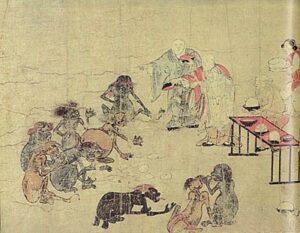
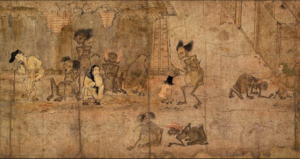
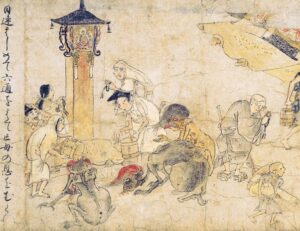
,The Yu Lan Jie (盂蘭節), or the Hungry Ghost festival provides an interesting lens to view the soujourner communities and native place associations in major Asian cities through. This can be seen in the symbolic respect of the soujourner ghost, or the community building aspect of these festivities but also the contested space itself where these festivals and rituals take place – where foreign influence and urbanisation threatened the communities’ access and claims to the land and the Yu Lan Jie celebrations.

 Playing a role in Taoism, Chinese folk religion, and Chinese Buddhism, this important festival has muiltiple reported origins, but can be traced back to an ancient Indian buddhist scripture known as Yulanpen Sutra, from which the name of the festival derives. The Sutra relays the story of Maudgalyayana, who goes on a journey to visit his deceased parents, only to find his mother in the realm of Preta, the hungry ghost. After his mother refuses his rice, Maudgalyayana is informed by Buddha that the only way he can feed and save her is by providing offerings at his monastic community during Pravarana, roughly corresponding to the 15th day of the 7th month (1). Drawing on this, the Chinese celebration falls on the 7th lunar month, considered the ghost month, where on the 15th day of that month the gates to hell and heaven open and the ghosts are believed to pass into the human realm. Rituals and offerings are given to satisfy these ghosts in both burial grounds and the house, with the intended purpose of ensuring prosperity and ward off bad luck. I bring up the origins of this festival to trace what the early depictions of this festival seem to align with, the family. In these images, celebrations seem to be more intimate and more household based rather than celebrated by guilds or communities.


This more personal setting however, applies only to one side of the festival: household celebrations were specific to ancestral ghosts, however, separate celebrations existed in the heart of the community – often in regional temples and burial grounds or marketplaces – for the ghosts with no descendants or who have been forgotten (2). Indeed, the potent image of the ‘hungry ghost’, almost animalistic in their distress, seem to align more with these forgotten, emotionally charged ghosts than the ancestral spirits. Therefore, when cities like Shanghai starting rapidly urbanising in the 19th century, the native place associations which sprang up found this festival an important event to show their regional solidarity. The ‘sojourning ghost’, as Goodman aptly puts it, and its plight as a foreign entity in the living realm, struck a cord with the lonely sojourners in the city without families (3). Indeed, a stone inscription on a Ningbo artisan association building in Shanghai seems to make this exact parallel when it says: “Living, we are guests from other parts; dead, we are ghosts from foreign territory.” (4)

The communal festivities include rituals performed by Taoist priests or Buddhist monks, – who were sometimes transported from their native regions- bonfires burning spirit money and clothes to transfer to the pauper ghosts, stage performances, costumed processions and a large collective banquet for members of the native place associations (5). These activities led to a large amount of flexibility in cultural expression, lavishness and scale, allowing a fluid framework for members to exert their regional identities through far from home. It allowed expression from across the social strata of the native place association, not just the Huiguan leaders (6). For the more )wealthy and prominent regional communities, like Guangdong and Ningbo, these processions and religious ceremonies were the perfect opportunity to exert their legitimacy and prestige as a collective.  The festivities also prompted social welfare provisions amongst the association, with cakes made for the celebration being distributed to the poorest in the group (7).  welfare did act as a point of critique of these celebrations, particularly when funds for disaster and conflict relief were being sought from those affected in their transnational communities. As a one writers chides  “The yulanpenhui is to relieve the homeless ghosts. But they are already dead. . . . Why not help the living?” (8). With the hungry ghost celebrations and public charity both important for the construction of status for the Huiguan elites and the community’s identity such a critique almost challenges an ordered hierarchy of the prestige making activities of native place associations. While public charity and mutual aid objectively seems the more worthy cause for the whole regional group, somewhat ironically it exists as the less accessible option for the lower strata to participate in than Yu Lan Jie which remained popular well into the 20th century.

The final thought I wanted to discuss about the significance of the festival was what it reflected about the ongoing struggle soujourner communities faced in regards to the burial grounds and guild halls where they would perform some of these rituals, and the very real dead they were temporarily storing before transporting them to their native regions. Rapid urbanisation of cities didn’t just lead to the rise of migrant soujourner communities in cities, but also led to the problem of relocating graveyards upon the desire to expand the boundaries of the city. In Shanghai, this problem was often characterised as a conflict between the Chinese communities and the Western powers. This could be seen generally through the western discourse of public health and plague prevention, objecting to the sojourner guilds coffin repositories in the urban areas (9). More specifically though, it is possibly most famously seen through the two conflicts between French authorities and the Ningbo people regarding the location of Siming Gongsuo and coffin repository in 1874 and 1898. While an article in the agreement between China and the international settlement specifically forbade the western powers from removing the dead from their lands without explicit permission, because said article also stated that the no new Chinese coffins should be placed within their limits, many public cemeteries quickly decided it was in their interest to agree and relocate (10). Guild graveyards proved to be more stubborn, particularly the Siming Gongsuo. Given all the discussion above, it can be understood why these locations would be more precious to the soujourner community, away from their home and family. The rise in popularity of the commercial urban graveyards in Shanghai are possibly evidence that people were feeling the distance between the city and the newly relocated, isolated graveyards. While the Ningbo riots can be characterised as examples of early popular nationalism, it’s important to contextualise these events in the broader trend of urban displacement. Thomas S. Mullaney interactive digital volume The Chinese Deathscape Grave Reform in Modern China virtually maps this phenomenon and notes that this is just as much a contemporary issue as it is historic (11). While the festivals may have spiritually marked the migration of the dead in the living realm, burial re-locations make the dead physically migrants in, what Mullaney terms, the landscape of death. This not only makes the metaphor between sojourner and ghost complete, but also indicates why such a festival has been historically so important to migrant communities, as it is not only culturally enriching but such cultural enrichment is under a continuous mounted threat from urbanisation.


(1)   Jean DeBernardi,. “The hungry ghosts festival: a convergence of religion and politics in the chinese community of Penang, Malaysia.” Asian Journal of Social Science 12, no. 2 (1984), pp.25-34, p.26

(2)  Debarnardi, “The hungry ghosts”, pp.27-29

(3)  Bryna Goodman, Native, Place, City, and Nation: regional networks and identities in Shanghai, 1853-1937, (University of California Press, 2023.), p.96

(4)  Cited in Goodman, Native, Place, City, p.96

(5)  Debarnardi, ‘The hungry ghosts’, p.27-29,

(6)  Goodman, Native, Place, City, p.100

(7)  Debarnardi, ‘The hungry ghosts’, p.28

(8)  Goodman, Native, Place, City, p.99

(9)  Ibid.p.163

(10) Christian Henriot, ‘When the Dead Go Marching in’, in Mullaney, Thomas Shawn, Christian Henriot, Jeffrey Snyder-Reinke, David William McClure, and Glen Worthey. The Chinese deathscape: Grave reform in modern china. Stanford University Press, 2019.

(11) Henriot, ‘When the Dead’.


Policing, News and Government: Public law and order from the outside.

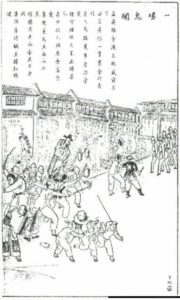
A pertinent chapter in the public order and policing of Shanghai was the 1930s when simultaneously, the looming threat of Japan led to a spike in public demonstrations in China, and Shanghai’s Public Safety Bureau came under strict anti-communist leadership who were extremely determined to eliminate radicalism from the city. This ‘red hysteria’ was so intense that the Bureau put aside its nationalist-fuelled disdain for Shanghai Municipal Police (SMP) and co-operated with them to root out radical individuals and police the mass assemblies, whether student demonstrations or public celebrations (1). SMP’s increased anxiety and involvement in intense policing may have been seen as conducive to those in the cities, but to the foreign governments who backed the council, this shift in approach likely led to some reflection on the nature and perception of public order abroad, particularly at a time when imperial powers were struggling to mitigate unrest and loss of control in colonies

A useful source in considering the official British reaction to the public order in Shanghai is an exchange in the House of Lords between Lord Marley, Chief labour Whip, and the Earl of Stanhope, Under-Secretary of State for Foreign Affairs during a Sitting on 5th of February 1936 (2). During this Sitting Marley had called for papers from Stanhope in regards to the allegations surrounding police violence during a student demonstration on the 24th of December the previous year. Drawing from witness accounts Marley outlines accusations of unprovoked police brutality and calls for further inquiry into police conflict. Stanhope contends these allegations. There are three primary areas the two figures clash over: sources, justification and nature of police violence, and finally consequences of inappropriate policing. It’s clear that both sides see business as a prime motivator to keep law and order amicable, but they differ in terms of authority, in which evidence holds it and how best to instil it in overseas settlements.

In terms of sources, Marley is largely drawing from witness accounts, although they contextualise this evidence with newspaper coverage and complaint letters to newspapers describing other demonstrations in China such as Peking. They substantiate their claims by describing their witnesses as an American who is ‘entirely trustworthy’ and a Chinese lady who is ‘well known throughout the world’ and thus ‘whose evidence cannot be but reliable’. (3) In opposition, Stanhope bases all of his opinions on newspaper reporting and questions the journalistic research of Marley ‘I am bound to add that the report which I have read in the Press on this matter differs very materially from the one he has given to you Lordships’. (4) This prioritisation of the newspaper over first-hand accounts results in an echo chamber in opinions surrounding law and order, as the SMP were closely monitoring reports on their policing. Records from their archive show them disciplining several newspapers for breaking the Chinese Press laws which relate to disparagement of public services (5). SMP made sure they were represented in line with official attitudes to policing, and foreign officials used said newspapers to justify that their policing was appropriate. The weight Stanhope puts on these pro-police accounts in English newspapers indicates not only how important the press played in overseas policy, but also why the Shanghai Municipal Council’s control over journalistic reporting was important in asserting control and confidence in overseas government.

An important element of Marley’s case is that the procession was ‘entirely peaceful’ before the police came to break it up, He highlights the age of the participants as mostly ‘children of middle school age’, who were met by a fully armed band of foreign amel British officers (6). He noted that one officer started beating protesters over the head, leaving them bloody and unconscious. He implicitly praised the patriotism of these protests in the face of Japanese aggression and argued that such protests taking place here would be praised by intellectuals. He, then, deliberately parallels the British subject to the Chinese subject, with equality in rights.

In opposition to this, Stanhope highlights that, far from being fully innocent, these protesters were disrupting the traffic and business in the railway station for at least 30 hours (7). While discussing Japan, Jordan Sand highlights why demonstrations in urban railway stations represented both an effective site of public lobbying and a source of great annoyance and disorderliness for authorities (8). According to Stanhope, if you’re causing such a disruption to travel, ‘it is quite obvious’ any government must do what they need to ‘to secure control again’ (9). He also argued that a report in the paper counters the claim that the students were armless and peaceful. While he doesn’t explicitly agree undue force was used, his argument mostly suggests that he, and suggestively the government, believe state violence is necessary.

Interestingly, where Marley and Stanhope align is their framing of why appropriate enforcement of public law and order is important. While Marley highlights the unjust harm the police have potentially caused, he doesn’t present his case as a humanitarian plea, but as a business move. He highlights that excessive force could cause tensions to escalate between the British and Chinese populations, and increase anti-British sentiment (10). He argues that this would waste the opportunity British businesses have to snatch trade that used to be Japanese. Stanhope points out that the municipal council
are largely made up of businessmen so they’d be highly aware of the optics of their police on trade and keep it in check (11). Notably, however, he doesn’t counter Marley’s claim that public order isn’t just about a moral code or power hierarchy, but also a matter of good business. This is perhaps hardly surprising given, as Frederic Wakeman highlights, disorder itself was also often about trade, in this case, Shanghai’s notorious international narcotics trade (12).

(1) Frederic Wakeman Jr., “Policing Modern Shanghai,” The China Quarterly, no. 115 (September 1, 1988), pp.408–40, pp.433-436

(2) United Kingdom, Debate, House of Lords, v.99, (05 February 1936), pp.439-446, https://api.parliament.uk/historic-hansard/lords/1936/feb/05/the-international-settlement-in-shanghai

(3) UK, Debate, House of Lords, 1936, p. 441

(4) Ibid, p.443

(5) See file D-7518 in the SMP Archive, ‘Allegations Against The Police By The Shanghai Public Daily News 1569’

https://archive.org/details/smpa-files-16/page/n1/mode/2up

(6) UK, Debate, House of Lords, 1936, p. 441

(7) Ibid, p. 443

(8) Jordan Sand, Tokyo Vernacular: Common Spaces, Local Histories, Found Objects (University of California Press, 2013), pp.42-70.

(9) UK, Debate, House of Lords, 1936, p. 443

(10) Ibid, p.442

(11) Ibid, p.444

(12) Wakeman Jr, ‘Policing Modern Shanghai’, p 409


Quantifying Our Home: Content study of an Urban Mass Housing Magazine

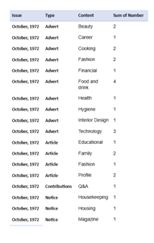
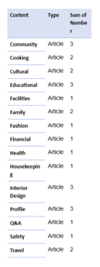
This blog explores findings from a quantitative analysis of the contents of HDB Our Home Magazine. Specifically, the first issue (October 1972), an issue in its 5th year (October, 1977), an issue in its 10th year (October, 1982), and its final issue (Aug-Sep, 1989).  ‘Our Home’ was a magazine run by the Housing and Development Board (HDB) in Singapore from 1972-1989, free to its residents (and 50 cents to non-residents) it provided articles and advice on cooking, housing and cultural topics. This study looked at the quantity and genre of different types of content in the magazine issue. Due to language limitations, only the English content is included here. Overall, the results suggest that while there was a surprising lack of dialogue between advertisements and articles; while the advertisements pushed the narrative of modernity and domesticity through products and services related to modern interior design and new technology, the editors of the magazines were far more concerned with highlighting the harmonious, diverse community of HDB.

Definitions:

Contributions – Content that included contributions from the community (e.g. Q&A, recipes, opinions)

Notice & Housekeeping – Content that is presented as important information to residents (e.g rent info, maintenance, housing reminders)

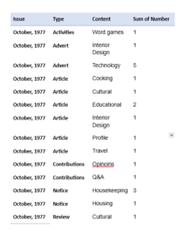
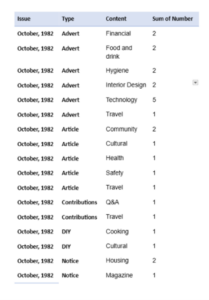
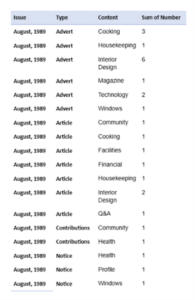
Fig. 1-4 Breakdown of the spread of different types and content topics in each of the 4 magazine issues respectively

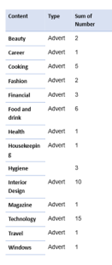
While this is a limited data sample, spaced at appropriate intervals over the magazine’s run, some insights can be gleamed. Advertisements are the category to display the most changes over the 4 issues, beginning with 10 different advert genres initially, then having an unusual year in 1977 with only 2 genres and 6 adverts in total, before stabilising at 6 different types for the next two issues. While this likely fluctuates in issues beyond the data set, I think the high number in the first issue is likely a reflection of the investors and the advertorial team not knowing what the magazine’s readership or purpose was yet. This uncertainty is present with both the adverts and articles in the featuring beauty and fashion in the first issue and abandoning them in the subsequent issues. Potentially, they realised they had broader appeal than just women, or perhaps the editorial team decided they wanted to mould the home, not the housewife. Either way, it’s clear they moved away from being a women’s magazine to being a home magazine. In terms of content the articles started to lean more consistently towards community and instructional guidance, while adverts focused on interior design and technology as their primary promotional content.


Fig. 5-6 Culminative number of different content type in advertisements and articles across the 3 magazine issues.

The breakdown of the technology adverts largely consisted of sound technology, cooking machinery and Sony products. The interior design adverts ranged from furniture salesrooms, tilers, and kitchen upgraders. While it would be tempting to use this to draw a parallel between HDB’s approach to technology and the modern home to what Tatiana Knoroz describes as an obsessive drive to keep technologically up-to-date in Japan’s mass housing of Danchi to justify its value as middle class housing, this magazine doesn’t support this link (1). While this may be the narrative of the adverts, none of these issues have an article about technology. Even in the 3 interior design article there is no push towards modern interior design, indeed in one of them compares a modern and traditional home interior and concludes they are both equally ‘cosy’ (2). Their focus is more on building community relations through profiles on people and communities, advice on living in HDB residences, and instructional articles. This is reflected in the 3 languages that the magazine is presented in. Another technique they are keen to push is community contribution to the magazine, in the contents page of the four issues, but contribution consistently remains low in this data set, perhaps indicating a lack of engagement or desire for this type of interaction.

Ultimately then, while this small quantitative study seems to mirror some narratives of modernity’s effect on post-war mass housing, the articles’ themselves don’t seem to mirror the same drive to modernise and westernise interiors and equipment. While adverts are a part of the magazine’s value system and narrative, the lack of dialogue between them in this data bears some highlighting.

Footnotes

  • Tatiana Knoroz, Dissecting the Danchi: Inside Japan’s Largest Postwar Housing Experiment. (Springer Nature, 2022), pp. 41-112
  • ‘Vast Variations’, Our Home (Singapore, House and Development Board) August-Sep, 1989, p.28

Reference list:

Our Home (Singapore, House and Development Board), October, 1972

Our Home (Singapore, House and Development Board), October, 1977

Our Home (Singapore, House and Development Board), October, 1982

Our Home (Singapore, House and Development Board), Aug-Sep, 1989


Playing the Modern Shufu: Sugoroku, Women’s Magazines and the Construction of the Ideal Modern Japanese Housewife and Home

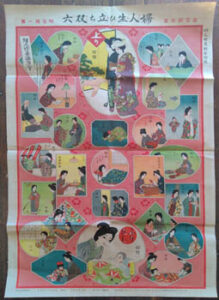
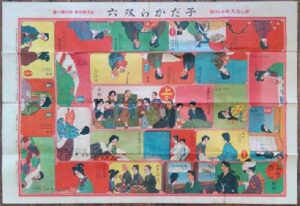
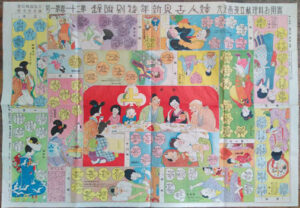
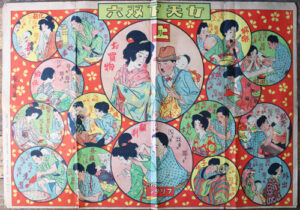
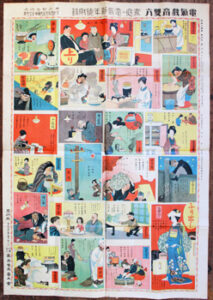
The focus of this blog post is how the traditional game sugoroku was utilised by popular Japanese women’s magazines to aid in their purpose of educating and promoting women to the ideal of the modern woman, family and hone. Both progressive and conservative in aspects, the game is ideal as an accessible educational tool as its tactile, playable   nature gives the illusion of agency and control for its players, but ultimately the boards end in one fixed, limited goal which, in the gendered context of Pre-war Japan, was being rewarded for being  a good modern housewife and mother, either with fashion or by a happy family. Largely the examples will be drawn from New Years editions of Fujin Sekai (Women’s World) from 1912-1919, however when relevant a few other sugoroku boards will referenced from a similar context.  

In the early to mid 20th century in Japan, women’s magazine acted as a key tool in shaping and promoting the idea of the modern Japanese woman and the modern Japanese home. This was articulated in a number of ways, including instructive articles, recipes, advice columns and educational illustrations and pictures. Media played an important role in controlling how modern Western ideas could fit into Japanese traditions and how Japanese cultural strategies fitted with Western practices.  Indeed, Jordan Sands comments that media potentially played an even more crucial role in the Japanese modernisation process before WW1 than the West as, unlike the latter,  modernisation was first experienced as an outside foreign influence rather than an immediate consequence of industrialisation.  Consequently, images of mass consumerism were experienced in Japan before mass consumerism itself (1).  Therefore, before WW1 these magazines acted as aspirational guides to a lifestyle in transition which were not yet fully achievable. 

The rise of these popular woman’s magazines coincided with educational policies that expanded women’s access to literacy and higher schooling. Some magazines in fact, saw their role as covering subjects which they viewed the women’s education system was lacking in. Educators and intellectuals wrote articles providing moral and intellectual guidance to higher school graduate, although they did also eventually target lower middle and working class women. One of the earliest mass circulation women’s magazines was Fujin sekai (Woman’s World, 1906) which was considered the leading magazine for the ordinary woman and, Barbara Sato argues, was the true pioneer of housewife centred magazines. focusing on women’s life after marriage, specialising in family orientated articles (2).  Given Fujin Sekai ordinary women orientated  demographic, and the reality that only a limited number of families could afford to have professional housewives, the portrayal of Shufu was largely aspirational ideal, than a grounded reality.  Indeed, a key aim of Masuda Giichi, the editor in chief of the magazine, was to promote a popularised conception of self-cultivation in his readership, one that would allow personal fulfilment through practical strategies not available through the experience of women’s education system. Evidently, this was responded to well by female readers, as a Tokyo based survey in 1922 found that 70% of participants subscribed to women’s magazines because of their focus on self-cultivation (3). While, this practical agency to shape one’s own identity might seem a progressive break in literature for women, Giichi’s overall philosophy was that women’s fulfilment was only a step in woman’s ultimate mission was to be a good wife and a mother, and thus her self-cultivation was largely contained to the space of the home (4).  This brand of controlled agency and self-expression is made manifest in their chosen medium of sugoroku. 

 To understand why sugoroku was chosen as a strategy for these magazines, its important to provide some background context on the activity. Sugoroku is a traditional game in Japan which originated in two forms. The first ban-sugoroku was a game close to backgammon imported from China in 7th century which fell into obscurity, the other was the more popular e-sugoroku which emerged in the 13th century and was a largely image-based game.  The gameplay, most closely resembling snakes and ladders, involves players beginning at singular/different start place, rolling a dice, landing on an image, and then following the instructions on said image. The aim is to end at the singular/different end points. The below examples, perhaps because they had a firm educational narrative to push, seem to have one single start and end point. Cheap and easy to make, they found popularity in the Meiji period in a variety of different magazines, covering a range of religious, historical, social and political topics. The main examples listed below are from Fujin Sekai, and the majority of them are from special New Years Day editions.  This temporal conformity is telling given that sugoroku was considered a classic New Years day pastime for all the family (5). This highlights why sugoroku should be seen as a powerful educational tool in the magazines arsenal, because it was not only a highly accessible in terms of age and literacy,  but also because it ingrained expectations of the modern housewife and the modern home not just to women readers, but to their entire family. 


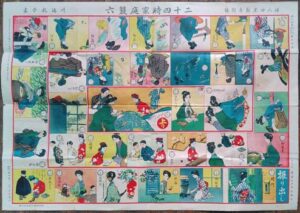
Kawabata Ryushi, Nijuyon Toki Katei, Fujin Sekai, 1912, accessed via Richard Neylon, Richard Neylon Rare Books, 12/11/2023


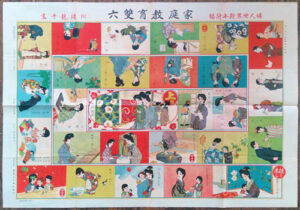
Kawabata Ryushi. Katei Kyoiku Sugoroku,  Fujin Sekai, 1915, accessed via 

Richard Neylon, Between Black Ships and B-29s (richardneylon.com) 12/11/2023 


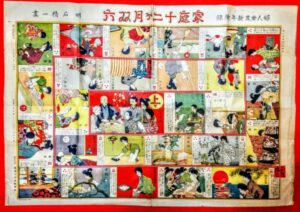
Akashi Seiichi, Katei Ju Ni Kagetsu Sugoroku, Fujin Sekai, 1917, accessed via 

Richard Neylon, Between Black Ships and B-29s (richardneylon.com) 12/11/2023

Akashi Seiichi, Fujin Nama Hi Tate Sugoroku,  Fujin Sekai, 1918 , accessed via 

Richard Neylon, Between Black Ships and B-29s (richardneylon.com) 12/11/2023

Akashi Seiichi. Kodakara Sugoroku, Fujin Sekai, 1919, accessed via 

Richard Neylon, Between Black Ships and B-29s (richardneylon.com) 12/11/2023

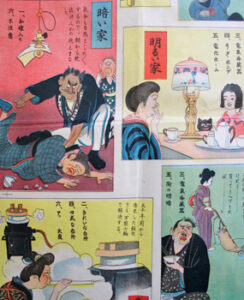
Three of the five examples are structured around the idea of the day/year of the life of a busy housewife. The two exceptions are Fujin Nama Hi Tate and Katei Kyoiku, which tracks a women’s life from birth to adulthood. These Sugoroku boards are also the only games whose end goal isn’t a happy family, but becoming a fashionable, presumably wealthy, modern woman. Before noting the similarities in games, a notable absence from all the above Sugoroku boards is any orientation in terms of location with only minimal references to home interiors. Perhaps this is because the magazine influenced interior aesthetic through other means – photographs – or at this stage interior design wasn’t yet a focus in these magazines – although intriguingly Katei Ju Ni Kagetsu board has a panel of a woman painting a surface – but the central focus here seems to be  teaching spatial practices in the home rather than instructing how to shape the home explicitly. Images that seem to appear in all of the boards are cooking (often multi-generational) cleaning (most commonly laundry or cleaning the floor), figures in windows (with activities being performed on either side of the window), and, perhaps most progressively, reading and writing and the teaching of these skills to children. Elements of modernity that can be seen through the above trends are: the cooking that seems to be being performed standing up rather than the traditional position of on the floor, and similarly in Katei Ju Ni Kagetsu and Kodakara boards, there is a practice of family tea/meal gatherings, rather than the traditional individual dinner trays for the patriarch (6). Notably however, in the case of Kodakara’s panel, while the wife appears to be above the rest of the family, ultimately only the patriarch is seated in the new furniture of the armchair. The Shufu may have been the household manager, but she was still under a patriarchal system. The imagery of the window and its emphasis of what’s inside and outside seems to play into the discourse of private and public sphere that the concept of the home initiated.  Finally, the promotion of literacy and continued education throughout a women’s life, possibly speaks most clearly to the theme of self-cultivation.

It’s worth noting three of these works are by the same artist, and so its valuable to look at examples from other artists and other publications. 


Fujimoto Katao. [Jitsuyo Oryori Kondate Manga Sugoroku]. Tokyo, Fujin Sekai 1926, accessed via Richard Neylon, Richard Neylon Rare Books, 12/11/2023 

Despite its focus on cooking, this board has many of the same elements as listed above. There are two notable elements of this design however, firstly is the presence of the dining table, a new furniture edition, and more importantly,  a panel that indicates a man’s involvement in household world (7).  Whether this is a remanent from more traditional times when household labour wasn’t so clearly divided by gender, or a reflection that such a division was unrealistic even in ‘modern’ times, it’s an noteworthy image given the strict roles established in previous boards. Indeed, it is not out of the realm of possibility Sugoroku boards were used for subversive purposes. 


Maeda Masujiro. Onna Tenko Sugoroku, Osaka 1915, accessed via  Richard Neylon, Richard Neylon Rare Books, 12/11/2023 

While graphic gender role reversals were often used for antifeminist purposes, the abject horror and disgust on the man’s face at undertaking these household tasks seems a compelling argument for the inequality of the household labour and women’s submissive role. 

 While examples like the above can be speculated on, many of the boards did seem to be conservative in tone. This was not just seen within the framework of educational women’s magazines, but also in a commercial framework. 


Shimizu Taigakubo, Denki Kyoiku Sugoroku, Katei no Denki, 1927, accessed via   Richard Neylon, Richard Neylon Rare Books, 12/11/2023

This sugoroku board by the Household Electricity magazine evidently promotes modernity through the numerous new technologies it highlights, and additionally through its emphasis of hygiene iterated through the new presence of the cleaning and cooking frock apron. More striking however, is that it doesn’t just promote this new technology through images of aspirational lifestyles, but also by the danger of not innovating. In this board more so than the others examined in this post, there is the presence of characters making right and wrong choices, Making sensible proactive steps will result in the goal of a happy family, but passivity and not staying up to date could result in a wife being beaten. This sugoroku then highlights the more brutal tactics magazines will take to achieve their agenda of modernisation and consumerism, 

Ultimately, then sugoroku could act as varied and evocative strategy in the magazines, and the wider society’s, construction of the aspirational ideal of the modern housewife and modern home. In the period before mass consumerism had fully taken shape in Japan, these games largely emphasised spatial practices for women to undertake. While the promotion of literacy and education spoke to some genuine desire to offer women opportunities of personal fulfilment, these practices largely worked to make the woman the ideal wife and mother which, amongst other strategies, included incorporating foreign ‘modern’ practices into the home – cooking standing up, cooking with an apron and collective family meals. Overall sugoroku, specifically those produced for a publication, provides a rich source of analysis about gender, family and home in 20th century Japan, particularly because it was highly accessible, and it was played as a family unit. 

(1) Jordan Sand, House and Home in Modern Japan: Reforming Everyday Life 1880-1930, (Harvard University Press, 2005), p.14

(2) Barbara Sato,  “Gender, consumerism and women’s magazines in interwar Japan.” In Routledge handbook of Japanese media (Routledge, 2018, pp. 39-50, pp.41-42

(3) Sato, ‘Gender, Consumerism’, p. 46

(4) Ibid.

(5) Flickinger, Susan, Barbara Podkowka, and Lori Snyder. “A Window into Modern Japan: Using Sugoroku Games to Promote the Ideal Japanese Subject in the Early 20th Century.” (2015), pp.1-9, p.1

(6)  Sand, House and Home, p.84, p.73-74

(7) Ibid, p.35


Exhibiting Modernity and Colonisation: What Yoshida Hatsusaburo’s map of the 1935 Taiwan Exhibition indicates about Taiwan and Japanese Imperialism.


Fig 1. ‘The 1935 Taiwan Exposition: In Commemoration of the First 40 Years of Colonial Rule’, Source: ‘Special Exhibition: Back in their times: a visual history of Taiwan from the 1930s to the 1960s’,  The 228 Memorial Foundation, accessed 9th of October 2023, Special Exhibition|Back in their times: a visual history of Taiwan from the 1930s to the 1960s|Memorial Foundation of 228.National 228 Memorial Museum

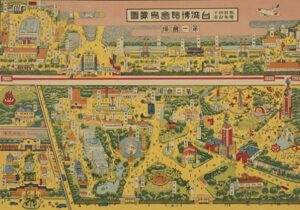
This map by famed aerial artist Hatsusaburō Yoshida of ‘The 1935 Taiwan Exposition: In Commemoration of the First 40 Years of Colonial Rule’ is representative of Japan’s desire to project their ideas of utopian modernism to the rest of the world and to mainland Japan. Their rational of modernising to protect themselves from, and surpass western empires is somewhat undercut by the fact that their concept of the modern were inherently modelled, at least spatially speaking, from said international influences. 

The map itself is keeping with a trend of colonial mapmaking that emerged in the 1930s which combines Japanese pictorialism with new photographic technology, specifically aerial photos. This genre of maps have been classified as Chōkanzu and were notable for their bird’s eye view perspective, 3 dimensional representation, colourful design and most importantly, picturesque quality (1). Looking at maps with this style it becomes quickly apparent that the intended audience for the map was not the urban planner, engineer or government official but the tourist.  As Allen asserts, it gives the localities it depicts a ‘postcard destination’ quality (2).

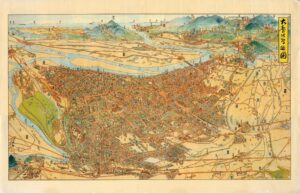
Below is another example of Taipei represented in this style on the eve of the 1935 Taiwan Exposition.


 Fig 2. ‘Bird’s Eye Map of Greater Taipei’,  Source: Keoni Everington, ”Colorful ‘Bird’s Eye View of Taipei” Japanese map circa 1935,  Taiwan News, (13th of January, 2017), Colorful ‘Bird’s Eye View of Taipei” Japanese map circa 1935 | Taiwan News | 2017-01-13 18:30:00

Between them there are distinctive similarities: the detailed architecture, the scroll labelling and iconography of both transport and industry, and of leisurely parks and nature. They both simultaneously portray an image of a cosmopolitan and prosperous nation, and a luxurious and leisurely travel destination. They exist as publicly accessible texts that visualise the city in modern and idealistic terms. While they exist as Japanese colonial propaganda, they do so in different ways. The ‘Bird’s Eye Map of Greater Taipei’ on its own encapsulates Japanese colonial ideology by its foregrounding of Japanese settlements over Chinese areas, and the fictious geographic placing over the water of Japan’s iconic Mount Fuji and other colonies – Korea and Manchukuo. As Allen asserts, this representation is one of possession and desire (3).

While this map can be seen as product of colonial ideology, the 1935 Exposition Map is reliant on the context of the Exposition and the general phenomenon of world exhibitions. As such this map can be seen as a sub product of the propaganda that was the 1935 Taiwan Exposition.  Following the 1851 Great Exhibition in London, world exhibitions took on its model of showcasing industry, architecture, and technology, mixing private, public and governmental institutions for a tourist and consumer audience. Japan was one of the nations, and the first non-western empire, to be inspired by this model. It held several exhibitions in Osaka and Tokyo between 1877 and 1911. It soon also held exhibitions in its colonial territories, including one in Taipei in 1916, however the later exposition in 1935 was considered the greatest of all the colonial exhibitions. This was at least partially a consequence of the significance of the event, the celebration of the 40th anniversary of Japanese rule in Taiwan. The island was important symbolically to Japan as its first colony; if any part of its empire was going to demonstrate the power of Japanese imperialism to the rest of the world, it was Taiwan. As Gotō Shinpei declared, Taiwan was the ‘colonization university’ and the first ‘to demonstrate that Japan was the equal of Western Imperialists’ (4). As Young asserts, this desire to modernise and compete with western nations drove much of the architecture building in later colonial projects like the Manchurian cities (5).

In order to celebrate its power, the exposition was structured over 3 main sites, two in Taipei and one in Da-Dao-Cheng. The first site centred around Taihoku City Public Auditorium (now Zhongshan Hall) and was populated with: pavilions showcasing Taiwanese industries, the Hall of Encouraging New Trade and the Hall of Prefectural Affairs which highlighted other Japanese colonies like Manchuria and Korea. The second took place in Taihoku New Park (now 228 Peace Memorial Park) focused on more social and cultural transformations in Taiwan, with an open air theatre, a cinema house, the musical hall and the First Cultural Hall, previously the Taiwan museum, which discussed the process of educated modernisation. The third site largely focused on tourism and recreational activities in Taiwan (6). Through this arrangement visitors were able to experience several dichotomies: present and future, production and consumption, governmental and private, citizen and tourist, Western and Asian, colony and colonial state.

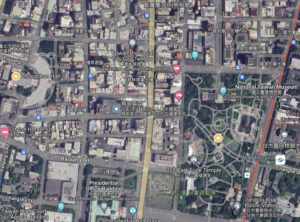
Returning to the representation of this event in the Chōkanzu map, it depicts the two main sites of the Exposition. For the sake of unity and practicality, it distorts these two sites to be spatially connected.  While close in distance, the google maps show that it skips over two blocks worth of space.


Fig 3.  Satellite Map of the two Exposition sites. Left side Taihoku City Public Auditorium (Zhongshan Hall) and site one, right star aihoku New Park (now 228 Peace Memorial Park). Source: Google Maps

This erasure of urban space is also visibly seen is the map as well, as blocks of buildings are represented as grey, formless masses. While this could have been designed to highlight relevant buildings to exposition, it does partly function to make this urban image cleaner and more spacious. This is certainly the case with the roads, which are enlarged significantly in the map. In general, wider streets and more parks were two primary goals in housing and urban reform that planners were seeking in Japan (7). This is why the decision to place an Exposition site in a park, and the exaggerated representation of nature in the map , is significant as the green spaces in colonial cities were often far greater than what the average mainland Japanese urban dweller saw. Therefore, while the Expositions were trying to make an international statement, they were also trying to indicate to Japanese that the colonies were places that could achieve the reform and progress that was thus far unachievable on the mainland.

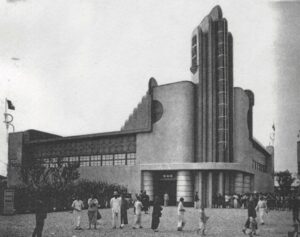
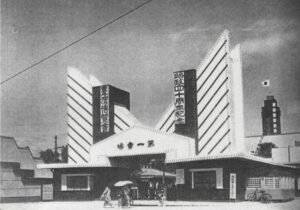
Finally, what’s important to note about this map is the architectural design visible in the Exposition buildings. While there is a mix of styles present across the map, the influence of European design is clear, specifically in two key sites of the Exposition: The Taihoku City Public Auditorium and the Taiwan Museum.  Moreover, Ping-Sheng Wu and Min-Fu Hsu assert that many of the pavilions were in the art deco style (see below), a style that some Japanese architects in Manchuria thought they should use to reflect modern trends (8).


 Fig 4. (Left) The Hall of Sugar Industry.  Fig 5. (right) The Main Gate of the First. Source: Ping-Sheng Wu, and Min-Fu Hsu. “Phantasmagoric Venues from the West to the East: Studies on the Great Exhibition (1851) and the Taiwan Exhibition (1935).” Journal of Asian Architecture and Building Engineering, 5;2, (2006), pp.237-244, p.242

While their goal was to make a statement to the international community about Asian design, ultimately Bill Sewell argued that the Japanese were generally more concerned about joining European aesthetics, than overhauling them (9). Thus, any attempt by the Japanese to prove their superiority over the West was naturally undercut by the fact they were often working within Western concepts of modernist. What’s more ironic about the development of the New Asian style in the 1930s was that much of the international ‘modern’ designs they were modelling from, were seen as increasingly irrelevant by the rest of the world.

While most of the blog post has discussed what this map tells us about Japanese Imperialism and their concept of the modern, it hasn’t yet discussed what this representation meant to the Taiwanese. This map was found amongst an online photo exhibit entitled: ‘Back in their times: a visual history of Taiwan from the 1930s to the 1960s’ on a website called the Memorial Foundation of 228 (10). The page states its last update was from 2021. What’s striking is that, despite the 20 year difference the description that Allen gives of the 1999 exhibition ‘Old Maps of Taipei and the 2004 exhibition ‘Viewing Taipei’, matches this website too –  namely that they overwhelmingly positively focus on Japanese colonial historical contributions and downplay and ridicule Chinese nationalist attempts. While attempts to appear modern to an international audience may have been slightly undercut, to the Taiwanese people at least they have cemented a place as authors of modernity and development.

Overall, as a historical document this map represents the ideals and contradictions of Japanese modernist propaganda, particularly in its presentation to mainland Japan and the rest of the world.  However, as an item in a Taiwanese historical collection, it raises questions about how Taiwanese view the Japanese colonial period, and what


(1) Joseph R. Allen,  Taipei: City of Displacements, (University of Washington Press, 2012), p.37

(2) Allen, ‘Taipei: City of Displacements, p.37

(3) Ibid, p.38

(4) Ping-Sheng Wu, and Min-Fu Hsu. “Phantasmagoric Venues from the West to the East: Studies on the Great Exhibition (1851) and the Taiwan Exhibition (1935).” Journal of Asian Architecture and Building Engineering, 5;2, (2006), pp.237-244, p.241

(5) Louise Young, Japan’s Total Empire: Manchuria and the Culture of Wartime Imperialism, Twentieth-Century Japan (Berkeley, Calif: University of California Press, 1999), pp.241-268.

(6) Wu, Hsu, “Phantasmagoric Venues’, p. 242

(7) Tucker, David “City Planning Without Cities: Order and Chaos in Utopian Manchukuo” in Mariko Asano Tamanoi ed., Crossed Histories: Manchuria in the Age of Empire,  (University of Hawaii Press, 2005.), pp.53-81, p.57

(8) Wu, Hsu, “Phantasmagoric Venues’, p. 242, and Sewell, Bill. Constructing Empire: The Japanese in Changchun, 1905–45. (UBC Press, 2019.), p. 69-71

(9) Sewell, ‘Constructing Empire’, p.71

(10) ‘Special Exhibition: Back in their times: a visual history of Taiwan from the 1930s to the 1960s’,  The 228 Memorial Foundation, accessed 9th of October 2023


‘Town Planning in British Malaya’ – Charles Reade’s Depiction of the Challenges facing Colonial Town Planning

The article entitled ‘Town Planning in British Malaya’ provides an insight into the unique challenges that faced town planners in their attempts to design new urban spaces in the colonies, particularly at a time when town planning was still considered a ‘tentative experiment’ and little legal and administrative frameworks existed to support it1. The author of the article is Charles Reade who was possibly the most active and influential figure of the first generation of town planners. Significantly he wrote this piece in 1921, at the very beginning of his appointment in the Federated States of Malaya, and published in the first, and seminal, international journal of town planning the Town Planning Review. This article then, acts as a very public documentation of an influential planner’s process. 
 
Reade may have even fancied this article as the start of a guide to planning in the region. As Robert Home points out he did see himself as somewhat of a missionary: ‘There never was a time in the history of the whole [town planning} movement when the need for enlightened missionary effort throughout the civilised world was greater…’2. Born in New Zealand, Reade initially made an impact in town planning circles in New Zealand and Australia most notably in his design of an Adelaide suburb, the Colonel Light Gardens. However, political opposition to his methods led him to leave Australia in 1921, the year the article was written, and accept the position of Government town planner in the Federated States of Malaya. As tentatively optimistic as Reade presents his prospects in the colony, his strict approach would lead him to be manoeuvred out of power. He would then go on to work in North Rhodesia and South Africa before he tragically took his own life in Johannesburg. 
 
As someone who was ‘endeavouring to apply strictly scientific, and consequently really practical methods’ to his planning, it is unsurprising that within this article he stresses the need for legislation, specifically shaped for the Colonial context: ‘Most important of all is the devising of legislation and machinery suited to the requirements of a British Protectorate or Federation of States largely peopled and worked by Malays, Chinese and various Indian Workers.’.3 As an early figure in town planning, little legislative and administrative provisions existed during Reade’s career. By 1921 two central acts existed. The first was the British Housing and Town Planning Act 1909 which most notably banned the practice of ‘back to back’ housing commonplace at the time and required that local authorities had to introduce systems of town planning.4
 
The second was the 1915 Bombay Town Planning Act, the first significant colonial town planning legislation. Building off of the 1909 Act, the 1915 legislation wanted to provide better financial provisions by the betterment levy and the integration of land pooling and redistribution practices. It is this very practice that leads Reade to invoke the Bombay Act in the article when he is describing the problem of awkwardly shaped holdings in ‘the East’ poses to those involved in the replanning process. The assumptive tone he uses when bringing up the act ‘Under the “Bombay Town Planning Act” city planners will know of the replanning schemes…’ implies that, given the international nature of the journal, this piece of legislation has already become a mainstay model in the global town planning discipline.5 Aside from these two acts, from 1917 in Malaya the provisions for town planning were largely confined to sanitary boards, which were primarily concerned with public health improvements (6). Reade acknowledges that these authorities have completed ‘much good work’ but finds an ‘inadequacy of existing powers and machinery when it comes to dealing with economic and administrative questions relating to resumption, methods of rating and valuation of land, also exchanges and redistribution of ownerships, etc’ (7). 
 
In answer to Reade’s frustration, in India, a proto-form of town planning was emerging through bodies called Improvement trusts. They primarily introduced procedures to clear slum neighbourhoods in cities. Below the plea for more legislation, Reade highlights the significance of the upcoming ordinance which will create the Singapore Improvement Trust (8). If Home is right that they acted as a form of pre-cursor to town planning legislation, and Bombay, with its influential planning act, was one of the earliest towns to have one in 1898, then we can understand why he views this as an important next step to secure more legislation (9). Certainly only 2 years after this article he introduced into Malaya the Town Planning Act of 1923 which brought together development, leasing land, town improvement and building regulations into one piece of legislation. Given that control of town planning in Malaya was reverted back to sanitary boards in 1927, one can’t draw a definite general timeline of town planning infrastructure from this example, however, it could potentially illustrate a common legislative trend in colonies. 
 
Aside from legislative concerns, Reade spends much of the article outlining specific regional considerations he has to make before he can begin the project of town planning. Broadly these concerns fall under the category of inherited problems from rapid urban growth and colonial rule. One such issue is the industry of mining, which was central to the economy of the colony, In fact as early as 1891, a government newspaper stated that mining was successful enough to be independent from the aid of the state and that the country was dependent on its resources (10). Yet Reade bemoans its environmental impact, specifically the rising river levels, the flooding, and the influx of silt that has forced some towns to be abandoned (11). Given how spatially disruptive mining can be, it follows that town planners and commercial mining enterprises might have often been at odds. Indeed, later in Reade’s career, in Northern Rhodesia, he faced tension when a mining company and the colonial authorities clashed over the nature of the town planning, with the former wanting to quickly erect a company town and the latter wishing to keep governmental functions out of private hands (12). If Reade’s generation of planners found an under-implementation of their designs, much of that derived from the local opposition from settler and commercial interest groups (13). 
 
Indeed, in this article what stands out as a major concern for Reade is negotiating the ideals of settlers during the replanning process. Reade explains that because of a common trend of awkwardly shaped holdings in Asia, a land pooling and redistribution system is necessary to allow the process of urban replanning to occur (14). However, despite its necessity, he worries that the implementation of such a strategy will be difficult due to the ideal of individualism held fiercely by Western settlers in the colonies. He indicates that even the temporary termination of individual ownership to create communal land could invoke an extreme response. He admits that without land pooling, he fears ‘that the big stride forward, so often desired, will still remain the merest shuffle in civic shoe leather.’ (15). And as Home asserts, this was the result of much of the first generation of planners’ efforts (16). 
 
Overall, aside from legislative underdevelopment and local opposition, what this frank appraisal of the issues that faced Reade in Malaya reveals is twofold. Firstly, while the city planners were integrated into the colonial machinery, they were afforded enough separation to outline concerns about the colony – such as the rubber and tin industry being in a ‘slump’ and the existence of uncooperative settlers – in a public forum – the Town Planning Review – which many government employees weren’t afforded. Secondly, it is apparent that Reade, having spent most of his career managing largely settler populations in New Zealand and Australia, views the prospect of planning a city with an added racial consideration as a problem to negotiate rather than the opportunity that a planner like Patrick Geddes saw it for. He viewed land pooling and replanning subdivisions of land as particularly problematic because the majority of the landowners are Asiatic (17). Relatedly, earlier in the article he refers to ‘incidences of racial problems’ which he urges need to be ‘studied and clearly understood’ (18). While neither of these statements are expanded on, generally there appears, returning to the quote about legislation and machinery for ‘States largely peopled and worked by Malays, Chinese and various Indian Workers’, to be an anxiety that the tools and mechanisms of city planners and the state are not equipped to handle the governance of a multi-ethnic state and the challenges it poses (19). Given that two decades later the process of decolonisation in the British Empire began, this anxiety was not completely ill-founded. 


(6) Home, Of Planting and Planning, p.182 
 
(7) Reade, ‘Town Planning’, p.162 
 
(8) Reade, ‘Town Planning’, p. 164 
 
(9) Home, Of Planting and Planning, pp. 177-179 
 
(10) ‘Notes – Planting’, The British North Borneo Herald and Monthly Record, (Sandakan, 1st of August, 1892), p.256 
 
(11) Reade, ‘Town Planning’, p. 163 
 
(12) Home, Of Planting and Planning, pp. 185-187 
 
(13) Home, Of Planting and Planning, pp.149-176, specifically p.173-174 
 
(14) Reade, ‘Town Planning’, p.165 
 
(15) Ibid. 
 
(16) Home, Of Planting and Planning, pp.149-176, specifically p.173-174 
 
(17) Reade, ‘Town Planning’, p.162, 165 
 
(18) Reade, ‘Town Planning’, p.162 
 
(19) Reade, ‘Town Planning’, p.164 

  1. 1931 Garden Cities and Town Planning article cited in Home, Robert K., Of Planting and Planning: The Making of British Colonial Cities, (Taylor & Francis, 1996), p.173 [↩]
  2. Home, Of Planting and Planning, p. 165 [↩]
  3. Charles Reade cited in, Home, Of Planting and Planning, p. 167, Charles C. Reade, ‘Town Planning in British Malaya’, Town Planning Review, 9;3, (1921), pp. 162-165, p.164 [↩]
  4. ‘The Birth of Town Planning’, UK Government, accessed 2nd of October, 2023, The birth of town planning – UK Parliament [↩]
  5. Reade, ‘Town Planning’, p.165  [↩]