Multiculturalism in Asian Port Cities

Su Lin Lewis’ chapter ‘Cosmopolitan Publics in Divided Societies’ in his book Cities in Motion: Urban Life and Cosmopolitanism in Southeast Asia, 1920–1940 articulates a wide range of examples highlighting the conjoining of different ethnic and religious communities in Asian-port cities such as Rangoon, Penang and Bangkok. Lewis’ chapter gives an excellent insight into how different ethnicities and religious communities are either united or divided through the urban planning of sacred spaces and colonial objectives of fraternity, community and international fellowship in these port cities.

I would argue that this chapter effectively highlights the cosmopolitan public life from the pre-colonial to the post-World War I period. Lewis showcases a range of empirical evidence and argues that public life in Asian-port cities was “plural and dynamic” and that the increasing transnational networks created new opportunities for an emerging middle-class.1 This blog post will give a brief overview of the argument presented and specifically analyse the author’s discussion of imperialism and colonial expansion and its effects on sacred spaces.

Lewis describes the multiculturalism experienced in Asian port cities as a phenomenon that is not new in Asia and that the cultural and religious blend is not just common but actively promoted. For example, the urban landscape of Penang by 1818 emphasises the ‘Street of Heavenly Harmony:’ the town’s central axis featuring “] a church, Chinese Buddhist temple, Hindu temple, an Indian Muslim shrine, and a large mosque nestled together in a row.”2 Moreover, the author discusses that sacred spaces in Southeast Asia were not just places of devotion and spirituality but places of commerce, networking, economic activity, and social and educational needs.3

The colonial administration’s effects on sacred spaces are discussed minimally in this chapter. The author discusses the monarchical rule and the Kings’ urban plans for sacred spaces, for example, King Mindon’s plans for Rangoon’s churches and mosques.4  Additionally, the author discusses how these spaces act as a point of unification or division within the different religious and cultural communities.5 However, Lewis only mentions in one sentence how during the colonial era, “new ideas of respectability, racial difference, secularism, and globalism” would “test” the co-existence of religious sites.6 This sentence seems to hinder the overall impact of the chapter because the lack of comparison leads to a less cohesive structure.

Therefore, although Lewis’ article is delightfully engaging, giving us a wide range of sources and ideas about local multiculturalism and transnational influences of ideas, his overall lack of comparison of sacred spaces in the pre-colonial, colonial, and probably even post-colonial periods slightly hinders the impact of his argument due to a less balanced case study.
  1. Su Lin Lewis, Cities in Motion: Urban Life and Cosmopolitanism in Southeast Asia, 1920–1940 (Cambridge, 2016), pp. 99-100. [↩]
  2. Ibid., p. 103. [↩]
  3. Ibid., p. 103. [↩]
  4. Ibid., p. 101. [↩]
  5. Ibid., pp. 100-102. [↩]
  6. Ibid., p. 106. [↩]

Place versus Non-Place

Tim Cresswell’s Place: An Introduction highlights a binary between what can be defined as a ‘Place’ versus a ‘Non-Place’ or placeless-ness. I will analyse that the binary he creates in his chapter, ‘Place in a Mobile World’ is not necessarily one that needs to exist, due to the subjectivity and individuality of the phenomenology of places.

A ‘Place’ can be defined as a heterogenous, dynamic and lively space that is continuously shaped by our social practices and processes.1 He argues that Place is significant to people, and people are significant to the place itself. In other words, Places and people simultaneously create a sense of attachment and historical meaning.2 However, Cresswell discusses that Places have been increasingly homogenised due to increased mobilisation and a consumer society, creating a sense of ‘Placeless-ness’ or ‘Non-Place’3 He describes Placeless-ness as one of inauthenticity, where the average American changes home every three years, reducing the significance of a home. He also uses the example of tourism, where people would rather travel for the sake of it, rather than caring about the actual destination.4

However, Places don’t mean the same thing to everyone: a Non-Place can be seen as a place to someone else. Individuality is taken away in Cresswell’s readings as he over generalises what a sense of place is. For example, in Japan, there is a concept called famirii resutoran or famirsu, meaning family restaurant. These family restaurants are a selection of Japanese, Chinese or Korean cuisines, or even American chain restaurants such as Denny’s, as they “cater to diners of every age, sex and degree of affluence.”5 This seemingly ‘Non-Place’ of a Denny’s, homogenous as it is a chain restaurant, can be perceived as heterogenous due to its unique placement in Japan. A restaurant such as Denny’s is given cultural significance, due to its name and Japan’s history of multiculturalism forming from a “150-year history of industrialisation, nation-state formation and imperialist expansion,” as well as the economic boom in the 1960s.6 Therefore, Cresswell’s binary of Place versus Non-Place is not necessarily true as there are places that seem homogenous on the outside but are actually dynamic places that are imbued with memories and meanings for other people.

Cresswell further highlights this binary through the ‘Disneyification’ of Places. Disneyland is used as an example of a Non-place, where every park is recreated across the world, and thus give the same experience to everyone worldwide. However, even Disneyland can create a unique and individual experience for everyone. When Tokyo Disneyland opened in 1983, it was part of a plan to facilitate more cultural exchanges between Japan and the United States.7 Tokyo Disneyland can be seen as a different experience from American Disneylands because of its different rides, attractions and food. Additionally, due to its sister park, DisneySea. DisneySea is completely unique to Japan with its own theme and attractions that allow people, especially locals, to enjoy.

In summation, the binary of Place versus Non-Place that Cresswell highlights in this chapter does not necessarily exist in its entirety. This is due to individual and subjective experiences in seemingly homogenous places.

  1. Tim Cresswell, Place: An Introduction, 2nd ed., (West Sussex, 2015), p. 68. [↩]
  2. Ibid., pp. 67-69. [↩]
  3. Ibid., pp. 75. [↩]
  4. Ibid., p. 76. [↩]
  5. Katarzyna Joanna Cwiertka, Modern Japanese Cuisine: Food, Power and National Identity (London, 2006), p. 8. [↩]
  6. Ibid., pp. 9-10. [↩]
  7. ‘Grand Opening of Tokyo Disneyland (1980 to 1983)’, OLC: 50th Anniversary, <https://web.archive.org/web/20160304055342/http://www.olc.co.jp/en/50th/03.html> [accessed 26 March 2022]. [↩]

Contested Spooky Spaces

Brenda Yeoh’s chapter ‘The Control of “Sacred” Space: Conflicts over the Chinese Burial Grounds’ in her book Contesting Space in Colonial Singapore: Power Relations and the Urban Built Environment discusses how sacred (traditional) spaces were “eroded away” to make way for a more commercial urban development in colonial Singapore. Because of the British government’s urge to reform cemeteries and their new conscious effort to increase public health standards in the late eighteenth and early nineteenth centuries, the government sought to mirror this in their colonies1 Chinese burial grounds and practices in Singapore were lost to the colonial government because their preference to hillside burial grounds were deemed unsanitary because of the fear that the springs at the bottom of the hill would be poisoned from the decay of the bodies.2 However, this was received by the Chinese as a disrespectful attack over Chinese customs and their own control over their spirituality and sacred spaces.3 Yeoh’s chapter on contested burial grounds has led me to think about other contested burial spaces in other parts of the world.

For example, Japanese burial sites in North Korea, post-World War II are sites that were often ignored, according to Mark Caprio and Mizuno Naoki. There were 71 known Japanese burial sites in North Korea between the 1940s and 50s. However, the number of burial sites and graves are unknown.4 Among the dead were Japanese military (approximately 120,000) and others were refugees from when the Soviet army invaded Manchuria (approximately 70,000).5 These spaces were contested by Soviet officials as they halted plans for Japanese repatriation to further their political movement in Korea.6 This article was highly interesting to read about the political complexities regarding burial grounds. Although, this is one example of a contested space of “enemy” or contested burial sites in East Asia, I would like to research more about the cultural effects of these enemy burial grounds in other contexts.

  1. Yeoh, Brenda S. A., Contesting Space in Colonial Singapore: Power Relations and the Urban Built Environment (Singapore, 2003), pp. 283. [↩]
  2. Ibid., p. 289. [↩]
  3. Ibid., pp. 290-291. [↩]
  4. Mark Caprio and Mizuno Naoki, ‘Stories from Beyond the Grave: Investigating Japanese Burial Grounds in North Korea 悲劇はなぜ起こったか : 朝鮮北部の日本人埋葬地が語るもの’ trans. Mark E. Caprio, The Asia Pacific Journal, 12: 9, no. 5 (March 2014), pp. 6-7. [↩]
  5. Ibid., p. 7. [↩]
  6. Ibid., pp. 8-9. [↩]

Sacredness of the Deceased

As I start to think about my long essay, I believe an intriguing space to focus on is cemeteries. The direction I want to go in, however, is unclear at this point. At the top of my head, cemeteries are sacred spaces: places of mourning, worship, connection. They are also spaces of memory. I would like to discuss two articles about cemeteries as a sacred space and as a space/place of rhetorical memory and then decide how I would like to proceed with the direction of my essay.

The first article that will be discussed is Sarkawi Husain’s article Chinese Cemeteries as a Symbol of Sacred Space: Control, Conflict, and Negotiation in Surabaya, Indonesia. This article firstly discussed how Chinese cemeteries in Surabaya, Indonesia, were closing in the 1950s due to urban development and to ‘modernise’ the city – building houses on the land or to “give the city a modern appearance,” especially to emphasise the new independence gained by the country.1 The closure upset the Chinese community, who saw cemeteries as not only a resting point for the deceased but a place of ancestor worship.2 This article highlights how modernisation threatened Chinese cemeteries and practices of Chinese worship. Although this article is an excellent case study into Chinese cemeteries in Indonesia. I believe the article would benefit more from the discussion of sacred spaces and sacred practices more. However, the author does discuss the political repercussions and discussions of the space well. Nonetheless, if I were to discuss what a sacred space was, I would say it is a dynamic space where spirituality and practices of worship ensue.3

Cemeteries as spaces or places of rhetorical memory is another potential direction I could follow for my long essay. An article entitled ‘Rhetorical Spaces in Memorial Places: The Cemetery as a Rhetorical Memory Place/Space’ by Elizabethada Wright focuses on an African American burial ground in New Hampshire, USA and discusses the “essential nature” of a cemetery as a “usual and unusual memory place.”4 Wright notes that cemeteries as a physical and spiritual place blur the lines between symbolic and physical to allow public memory that is otherwise forgotten to be remembered.5 Her article successfully analyses the connections between memory, space and rhetoric, highlighting the history and other ideas. Her inclusion of gender memory and rhetoric and how women were excluded within public spaces and only could speak within the “correct rhetorical space:” domestic spaces.6 Using Foucault’s theory of heterotopia, Wright notes that cemeteries are not usually rhetorical spaces but definitely spaces of memory. She notes that cemeteries are sacred spaces that are “real and unreal,” simultaneously a material space and a symbolic place.7 Additionally, she writes that “the cemetery is allowed to exist because it is perceived as not really existing. When bodies are covered over and they as well as their headstones decay, the cemetery will appear to be as if it never existed.”8 I believe this is an interesting point because the re-discovery of graves (such as the rediscovered African American graveyard in the article) allows memories to be saved and interpreted. Therefore, it begs the very personal question and uncertainty of how does your memory survive when you die, if not through a grave? Besides that brief existential crisis, I believe this topic is riveting.

Therefore, the direction I would go for my long essay this spring would be cemeteries as spaces of rhetorical memory. However, more research would need to go into the theoretical concepts and finding a case study. Despite this, I believe this is a good starting point.

  1. Sarkawi B. Husain, ‘Chinese Cemeteries as a Symbol of Sacred Space: Control, Conflict, and Negotiation in Surabaya, Indonesia’, in Freek Colombijn and Joost Coté (eds), Cars, Conduits, and Kampongs: The Modernization of the Indonesian City, 1920-1960 (ebook, 2015), p. 323. [↩]
  2. Ibid., p. 234. [↩]
  3. Kim Knott, ‘Spatial Theory and Spatial Methodology, Their Relationship and Application: A Transatlantic Engagement’, Journal of the American Academy of Religion, 77: 2 (June 2009), p. 420. [↩]
  4. Elizabethada A. Wright, ‘Rhetorical Spaces in Memorial Places: The Cemetery as Rhetorical Memory Place/Space’, Rhetoric Society Quarterly, 35: 4 (2005), p. 51. [↩]
  5. Ibid. [↩]
  6. Ibid., pp. 52-53. [↩]
  7. Ibid., p. 54 [↩]
  8. Ibid., pp. 54-55. [↩]

The Far Eastern Review: A Review

Working with primary sources for my long essay is vital, sure. However, the value of each source needs to be evaluated and examined thoroughly. Therefore, I will be reviewing The Far Eastern Review, which will hopefully be one source – or type of source – that I will be using for my essay on spatial histories in Manila.

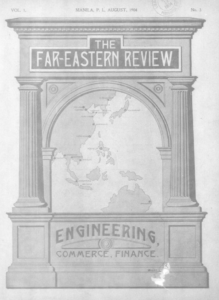
The Far Eastern Review (FER) was the first English-language Engineering, Commerce and Finance journal. It started in the Philippines (Manila-based) in 1904 and was published monthly; the publication eventually moved to Shanghai, China, with the last issue published in 1941. The editor, George Bronson Rea, also known as G. B. Rea, was the sole owner of the FER (until his death in 1936). Rea was an American engineer, journalist, publisher and later “mercenary propagandist” for the Japanese.[1]

Rea started his publication in Manila, where he was a delegate of the Philippine government, “lobbying Washington on behalf of Philippine business interests”.[2] However, when he moved the publication to Shanghai in 1906, Rea became more involved in politics, which was reflected in the publication. At first, Rea was “sympathetic” to the Chinese and resisted against foreign powers. However, during his later years, his allegiance changed, and he eventually became an adviser to Manchukuo, Japan’s puppet regime.[3] His political involvement was directly against the journal’s policy, as it stated: “We have no space for long-winded political discussions, nor for gossip”.[4]

Ultimately, while the publication proves useful and insightful for a multitude of content regarding engineering, finance, architecture and commerce, the highly politicised nature of the journal shows that one must be careful in reading its contents. This is especially true in the later issues of the journal, where Rea extends his knowledge and opinions onto his subscribers.

The Far Eastern Review 1: 3 (Manila, August 1904).

[1] Anonymous, ‘George Bronson Rea (1869-1936)’, Gwulo: Old Hong Kong, (date of published unknown). <https://gwulo.com/atom/35922> [accessed 26 October, 2021].

[2] Peter A. Crush, ‘The Far Eastern Review – Indexes & Contents’, ResearchGate (November 2020), p. 2. <https://www.researchgate.net/project/THE-FAR-EASTERN-REVIEW-INDEXES-CONTENTS-PAGES> [accessed 27 October 2021].

[3] ‘George Bronson Rea (1869-1936)’, Gwulo: Old Hong Kong.

[4] Crush, ‘The Far Eastern Review’ p. 2.

Houses and Homes in Treaty-Port China

The modern homes and houses prevalent in Treaty-Port China highlight the interconnectedness and competitiveness of global markets in these urban landscapes. Elizabeth LaCouture discusses the urban landscape of the treaty-port city of Tianjin and how the modern home was developed as a result of foreign concessions competing to form a universal model of modernity. This, therefore, allowed a Tianjin modern style to emerge, where style and taste became a measurement of social status, thus allowing a bourgeois class to form.[1] LaCouture examines the role of rugs and how these rugs were initially created for a western market. However, Chinese urbanites eventually adopted it, “incorporating American and European Orientalism into their homes”. This illustrates the complex network of global capitalism and bourgeois tastes experienced in Tianjin.[2] In this chapter, she researched the role of women’s magazines and how domestic roles for women were emphasised in Republic-era China. In addition to this, the culture capital women held in this era (facilitated through women’s magazines) allowed them to be a proprietor of knowledge, therefore gendering the knowledge of the political landscape of treaty-port Tianjin, as women made sense of the world around them; by using, buying worldly goods and designing their homes.[3]

Reading LaCouture’s chapter on designing houses and homes in Tianjin made me curious about whether other treaty ports in China were facing similar experiences through the competitive global markets due to different western concessions. Therefore, I would like to examine Shanghai’s quest for homes called lilongs and whether or not they were influenced by the global markets and foreign concessions in the way that Tianjin’s modern homes were.

A lilong is a neighbourhood alleyway. These were homes in certain alleys that were “gated, hierarchically organised compounds”, from one to four storey’s high.[4] Lilongs almost “mirrored” traditional Chinese homes; they were a bridge between the public and private spaces, where the private space of their home directly met public alleyways, where residents sat talking to their neighbours or where vendors set up stalls.[5] Lilongs were constructed due to an increased Chinese population in Shanghai, as some Chinese were fleeing Taiping rebels.[6] The lilong was therefore a way to place the increased Chinese population into Shanghai, after Westerners took advantage of the housing shortages.[7]

Although Shanghai allowed for a westernised way of life, the lilong did not share the same experience as Tianjin. Lilongs resulted from an increased Western presence and forced the Chinese population to be housed in these alleys with their extended families and neighbours, restructuring the family life and cultural praxis of the Chinese population.


[1] Elizabeth LaCouture, Dwelling in the World: Family, House, and Home in Tianjin, China, 1860–1960 (New York, 2021), p. 187.

[2] Ibid., p. 185.

[3] Ibid., p. 188.

[4] Gregory Bracken, ‘The Shanghai lilong. A new concept of home in China’, International Institute for Asian Studies, Issue 86 (Summer, 2020). <https://www.iias.asia/the-newsletter/article/shanghai-lilong-new-concept-home-china>

[5] Ibid.

[6] Renee Y. Chow. ‘In a Field of Party Walls: Drawing Shanghai’s Lilong.” Journal of the Society of Architectural Historians, 73: 1 (2014), p. 19.

[7] Ibid. pp. 20-23.

Tour Guides and Films: A look into the Spanish-American War in the Philippines

The Spanish-American War fought between two imperial powers, each disputing over Spanish colonies and the entitlement of land against native wishes, brings about some interesting sources. Looking at mainly primary sources written and spoken in English, specifically American-published sources regarding the Spanish-American War, it seems that Americans were initially trying to paint a picture as if they were non-belligerent and were only involved in the war because the Spanish coerced or pushed them to war. Films that were published highlight Americans were forced into the war after damage to their naval ship, the U.S.S Maine, exploded by a Spanish mine on Havana Harbour, implicitly connotes Americans as non-belligerent as “[they] did not start it!”. However, this was not necessarily true as time went on. In the Philippines, films and tour guides paint a slightly different picture of Americans as belligerent actors against “native” Filipinos, as they try to assimilate the Philippines into their domain after the Treaty of Paris (signed on December 10, 1898). Therefore, I will argue that films and tour guides implicitly display American agendas of either being non-belligerent actors in Cuba and after the Treaty of Paris was signed (which gave the United States the Spanish colonies of Cuba, Puerto Rico, the Philippine Islands, Guam and the West Indies), they pursued a more imperial doctrine of conquering and ‘assimilating’ Filipinos through violent means.

The first film to be discussed is a panning shot of the USS Maine destroyed by a Spanish mine on the Havana Harbour in Cuba, which ultimately led to the Spanish-American War.[1]

https://www.loc.gov/item/98500970/?

The film pans across the ship’s side to see that the ship looks ‘cut in half’, caused by an explosion. The film depicts a ‘sad loss’ of naval soldiers as the ship took countless lives. The explosion ignited a gunpowder keg of tension between the Spanish administration in Cuba and the United States. This film provides a source of documentation that not only shows us the damage by the Spanish administration but highlights the power that one act can set off a year of belligerence and brutality.[2]

During the war, Philippine Insurgents worked together with American Imperial forces against the Spanish colonisers. However, as the battle drew to a close with the Spanish forces, and after the Treaty of Paris was signed in December (which led the United States to buy the Philippine Islands from the Spanish), American forces decided to ‘benevolently assimilate’ the Philippines into their domain ‘by any means necessary’.[3] One film that highlights American belligerence is below:

https://www.loc.gov/item/98501198/?

This film shows some Filipinos retreating from American infantry after a few were gunned down. The brutality of the war is depicted here, highlighting the imperial doctrine Americans embraced to control the Philippine Islands eventually.[4]

Another clue into Americans’ brutality and their Imperial objectives are in a tour guide published in 1899. The tour guide ‘notes’ section implicitly depicts the American colonisation process. The “extraordinary circumstances” that led to the guide not mentioning a few details, including “residents of American and Spanish authorities”, are something not to be missed in this guide. The lack of studied areas in this guide also implicitly depicts that those areas were used for war and possibly other gruesome acts.[5]

In conclusion, these primary sources are nuggets of clues that indicate American objectives in the Spanish-American War. Initially, a film was produced to show Spanish damage to the U.S.S Maine. After the Treaty of Paris was signed in December 1898, the American objective changed into an imperial role of assimilating the Philippines as one of their colonies; brutally taking down Filipino men and massacring tens of thousands of civilians in the process.

[1] Paley, William Daly, “Wreck of the Battleship ‘Maine’”, Thomas Edison Inc. (United States: Edison Manufacturing Co, 1898). <https://www.loc.gov/item/98500970/?>

[2] ‘Chronology for the Philippine Islands and Guam in the Spanish American War’, The World of 1898: The Spanish-American War, (Library of Congress, 2011). https://www.loc.gov/rr/hispanic/1898/chronphil.html

[3] Ibid.

[4] James H. White and New Jersey National Guard, ‘Filipinos retreat from trenches’, Thomas Edison Inc. (United States: Edison Manufacturing Co., 1899). <https://www.loc.gov/item/98501198/?>

[5] Manila Guide For Foreigners: A Useful Book for All, (Manila, 1899).

Churches in Manila: A Start to the Long Essay

As I am thinking about potential topics for the Long Essay due in December, I have stumbled upon some interesting thoughts, two to be precise: the empirical versus the theoretical.

Firstly, a potential topic for my essay would be the discussion of Catholic spaces and general Catholicism brought into the Philippines by Spanish conquistadors versus Protestantism (and possibly other non-Catholic Christian religions) and Protestant spaces brought into the Philippines by Americans.

During my brief research, I found that the first Protestant minister, Arthur Prautsch, served as a missionary in Manila in 1899. He became a local preacher for the Methodist church in Manila for a Bishop named James M. Thoburn. Shortly after this, more missionary groups followed, and by 1916, the Methodists had “50 missionaries and 45,000 converts”, the Presbyterians had 65 missionaries with 15,700 members by 1925, the Baptists had 2,858 converts in 1925, and finally, the Disciples of Christ and the Foreign Christian Mission Society became the “third-largest non-Catholic church in the Philippines with 7,326 members” by 1925.[1]

I found the empirical research, the growing number of followers for Protestant religions to “save” Filipino’s from the “unchristian” and “corrupt” Latin Catholicism highly fascinating. The missionaries’ goal to “save” Filipinos by “preaching the Gospel and erecting churches” became noteworthy for me due to the concept of the “Church” versus churches.[2] This brings me to my second thought, the theory.

The churches built by Protestant missionaries are actual physical spaces. The spaces are physical landmarks where people interact with the space. People go inside a church; they sit on pews and listen to a sermon, light some candles, and they talk and interact with others (to be honest, I am not a churchgoer, so the technicality of what someone does in a church is still a bit lost on me). Nevertheless, what provoked me, is not just the physical space of a church; it is the concept. The Catholic Church versus the Protestant Church. The capitalisation of the letter ‘C’. The discourse surrounding it is a representation of the space rather than a representational (lived and interacted with its physicality) space. In my understanding, Lefebvre’s triad Churches are multi-dimensional spaces, and the way it is talked about can be considered just as powerful as a physical space or building.[3] The conceptualised idea of a Church holds just as much power as the actual building of a church; the conversations held around the Catholic Church versus the Protestant Church. For example, how the Protestant Church found Roman Catholics and its clergy “wealthy and corrupt [whom they] failed to promote morality, closed the Bible to the people, and based the faith also on tradition and not just on holy scripture.”[4]

To summarise my contemplations, I believe this could be an exciting topic of study for my Long Essay, with primary sources ranging from plans of churches to the discourse surrounding Churches. However, it seems quite convoluted, and the topic needs further deliberation.

[1] Jose S. Arcilla, ‘Review: Protestant Missionaries in the Philippines’, Review of “Protestant Missionaries in the Philippines, 1898-1916. An Inquiry into the American Colonial Mentality” by Kenton J. Clymer, Philippine Studies, 36: 1 (1988), p. 106.

[2] Ibid., pp. 106-107.

[3] Henri Lefebvre, The Production of Space (xx, 1974), pp. 38-39.

[4] Arcilla, ‘Review: Protestant Missionaries in the Philippines’, p. 109.