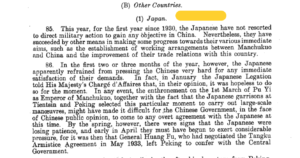
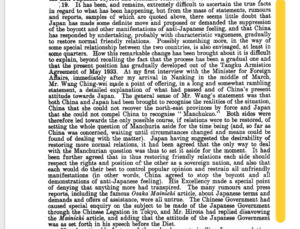
Jewish Refugees in Shanghai 1939-1942

From the 1930s, the beginning of the Nazi regime in Germany, there was always Jewish immigration from Germany into Shanghai- the first group of 12 families arriving in 1933.[1] Shanghai was a particularly appealing destination for Jewish refugees from Central Europe was because ‘it is the only place in the world where no entry visa is required’.[2] By Passover 1939, roughly 7000 Jewish refugees were living in Shanghai.[3] There were fears that the Jewish refugees were going to take the jobs of White Russians in Shanghai, and the huge influx of Jewish refugees in 1939 and Chinese war refugees in 1937 made acquiring housing in Shanghai nearly impossible.[4] These factors combined to create an increased pressure from the public to halt free acceptance of Jewish refugees into Shanghai.

The first serious restrictions were passed in August 1939- Alvin Mars uses a quote from the North China Herald, stating that ‘Jewish Refugees arriving in Shanghai after August 21 will not be permitted to live in Hongkew according to a memorandum sent to the committee in charge of Jewish refugees here’.[5] Despite this restriction, the Shanghai Municipal Police (SMP) records between 1939-1941, show an incredible amount of confusion regarding enforcement of Jewish Refugee laws.

For example, the file titled “Letter from the Harbour Master dated June 28, 1940” gives evidence for three separate authorities – the Harbour Master and River Police, Passport Officers and the SMP – arguing over whose responsibility refugee passport checks are. The Harbour Master complains that the SMP is ‘usurping the functions of either Passport Officers or the River Police’.[6] To this, the police report replies that ‘It should be emphasised that the SM Police are not concerted with any other persons than European refugees and that the passports of other persons are not examined’.[7] A further statement made on July 3, 1940 by the offending SMP officer, J.F Lovell, scathingly remarks that ‘the River Police have never shown any desire to “get a move on” when assistance is sought’.[8] There is clear confusion in regards to whose responsibility these passport checks are, and a clear lack of communication regarding whose jurisdiction and authority these checks operate under. Lovell further remarks that ‘the River Police have no conception of the value of the information secured by the Police as a result of the registration of incoming refugees’.[9]


The lack of unity amongst the authorities in relation to the refugees is very possibly the result of the fragmentary nature of Shanghai, in terms of its diverse population, its international settlements, and the authorities in charge of these settlements. This disjointed, unclear system upset many Jewish refugees. A police report titled “Article in North China Daily News Dated May 24, 1940” discusses newspaper clippings containing letters from anonymous refugees criticising the system:

‘My own application…has been filed since November 1939 without myself having received…notification as to its possible success (…) SMC issues permits on a more lenient scale with the regrettable drawback however, that the validity for some is for four months only’.[10]

However, even here the SMP refuses to take any responsibility for the issues presented in the letter. The report simply states: ‘The contents of the letter [printed in the newspaper] are fundamentally correct but do not reflect in any manner at all upon this office’.[11] Thus, although Shanghai was filled with migrants from China and the rest of the world, this seemed to reflect in a lack of a central authority in law enforcement. This is particularly true in regards to the acceptance of international refugees, which would affect the city as a whole, not simply a single settlement.

Often, the informal immigrant communities – guilds and bangs – were more effective in allowing the SMP to locate immigrants or refugees in Shanghai. In the search for a certain Ero Edmend Rosenfeld this is particularly evident. Though the report does reference their own records, noting the date and ship upon which he arrived- the key piece of information comes from Rosenfeld’s engagement with his Jewish community in Shanghai. As Goodman outlines in her article, immigrants to Shanghai tended to group not only by native place, but also by trade: by extension, businesses of one nationality supported each other.[12] ‘[Rosenfeld’s firm’s] chief business [is] conducted in the sale of boot-polish and a brand of mouthwash, both of which products are manufactured by a German Jewish refugee in Hongkew’, states the report.[13] This information concerning Rosenfeld consolidates his identity as the Jewish refugee the SMP were looking for.

Thus, despite the post-1939 utter lack of organised law enforcement from the legal authorities, the informal communities were much more effective as a system of tracking and understanding Shanghai’s growing community of refugees.


Bibliography:

Goodman, Bryna. “Introduction.” In Native, Place, City and Nation: Regional Networks and Identities 1853-1937. California: California University Press, 1995.

Mars, Alvin. “A Note on the Jewish Refugees in Shanghai.” Jewish Social Studies 31, no. 4 (October 1969): 286–91.

Shanghai Municipal Police Report. “Bernhard Fr-Udenthal – German Jew 2609,” 1940. Shanghai Municipal Police Archive.

———. “Central European Jews – Article in North China Daily News Dated May 24, 1940 2150,” 1940. Shanghai Municipal Police Archive.

———. “Central European Refugees 2144,” 1940. Shanghai Municipal Police Archive.


[1] Alvin Mars, “A Note on the Jewish Refugees in Shanghai,” Jewish Social Studies 31, no. 4 (October 1969): 286.

[2] Ibid, 287.

[3] Ibid.

[4] Ibid, 288.

[5] Ibid, 289.

[6] Shanghai Municipal Police Report, “Central European Refugees 2144” (1940), Shanghai Municipal Police Archive, 1. (Note that all page numbers are PDF numbers).

[7] Ibid.

[8] Ibid, 4.

[9] Ibid, 4-5.

[10] Shanghai Municipal Police Report, “Central European Jews – Article in North China Daily News Dated May 24, 1940 2150” (1940), Shanghai Municipal Police Archive, 2.

[11] Ibid, 1.

[12] Shanghai Municipal Police Report, “Bernhard Fr-Udenthal – German Jew 2609” (1940), Shanghai Municipal Police Archive, 30.

[13] Shanghai Municipal Police Report, “Bernhard Fr-Udenthal – German Jew 2609” (1940), Shanghai Municipal Police Archive, 4.
From the Ground Up: Police as a Modernising Force

In her chapter on the new police and urban reform, Kate Stapleton argues that the creation of a reforming, and above all, dignified police force in Chengdu was an important component in the programme to modernise China. She discusses the reforms of politician Cen Chunxuan in the creation of such a force, establishing a police academy and a training camp for constables.[1] The new police force was to be highly bureaucratic, recruited from “upright families”, literate, and follow specific rules of behaviour.[2] Constables were required to not laugh, to walk in a dignified way, to speak politely, and no not smoke, eat, drink, or purchase things while on duty.[3]

Looking at William Greener’s 1905 book “A Secret Agent in Port Arthur”, it is possible to see that these rules of Chengdu’s new police force were based on expectations of the behaviour of soldiers in imperial armies. Greener notes his impressions of the Chinese soldiers of the viceroy Yuan-shi-kai in contrast to Russian officers and troops. Of Yuan-shi-kai’s soldiers, he writes that ‘they are fine men in clean, neat uniforms; they carry Mauser magazine rifles…have plenty of ammunition and get their pay regularly’.[4] His extensive discussion of their appearance and equipment conveys the sense that the soldiers are a symbol of Chinese authority in the area. Chinese control is clearly strong and their soldiers reflect this in looking dignified and authoritative. Greener was much less impressed by Russian soldier in China, writing that ‘they drank freely, lived as well as their means permitted, and enjoyed themselves as far as circumstances allowed…they lack seriousness, refinement and education’.[5] In Greener’s eyes, the Russian soldiers clearly have no discipline, and so Russian presence in China seems weak in Greener’s writing. The soldiers represent a foreign presence in a local space—a reflection of foreign power.

Thus, it is unsurprising that in creating the new police force to reform Chengdu, Cen Chunxuan and his team placed a huge emphasis on the appearance and behaviour of their police force. The officers and constables were to be symbols of higher authority operating within the local community.

This move in Chengdu to modernise the police form seems to be part of a greater trend in early 20th c. China to create change and instigate reform from the ground up. Zhou Shanpei, the man Cen Chunxuan assigned the job of drafting regulations for police and training personnel, not only drafted a document outlining the regulations for his police bureau, but also ensured these regulations were publicised and distributed to citizens, encouraging them to report abuses by the police to the bureau.[6] In encouraging an increase in community involvement, Zhou played an important role in enforcing the idea of the new police force as a symbol of nationhood: both civilians and police played a role in enforcing the laws of their new community.

The view that true change must emerge from the people of the community, not just their leaders, is echoed in the writings of Putnam Weale, a British author and translator working in China. In Weale’s chapter on ‘Cleansing the Augean Stables’ in Sir Robert Brendon’s Three Essays on the Value of Foreign Advice in the Internal Development of China, published in 1915, he argues that true change in China must come from the bottom up. ‘Until changes enter into the very lifeblood of the people’, he writes, ‘and are the result of conviction and not of compulsion, they will have no more significance than freckles or mumps or any other minor ailment on a healthy body’.[7] Weale means this in the context of international interference in China’s development—however, his argument can be extended to the context of an actively involved local police force. Not only does true change come from within China itself, but also it must come from ‘the common man’.[8] By involving the “common men” in upholding laws and regulations alongside the police force of Chengdu, Zhou Shanpei and Cen Chunxuan reflected the broader concerns about China both internally and internationally to modernise from the ground up and to create a stronger sense of local and national identity.

[1] Kristin Stapleton, “The Key to Urban Reform: The New Police Force,” in Civilising Chengdu: Chinese Urban Reform 1895-1937 (Cambridge MA and London: Harvard University Press, 2000), 82.

[2] Ibid, 83.

[3] Ibid.

[4] William Greener, A Secret Agent in Port Arthur (London: Archibald Constable & Co Ltd., 1905),159.

[5] Ibid, 234.

[6] Stapleton, “New Police”, 83.

[7] Putnam Weale, “The Cleansing of the Augean Stables,” in Advice and Advisers: Three Essays on the Value of Foreign Advice in the Internal Development of China, by Sir Robert Brendon (Peking: Peking Gazette, 1915), 17.

[8] Ibid, 21.


Bibliography:

Greener, William. A Secret Agent in Port Arthur. London: Archibald Constable & Co Ltd., 1905.

Stapleton, Kristin. “The Key to Urban Reform: The New Police Force.” In Civilising Chengdu: Chinese Urban Reform 1895-1937. Cambridge MA and London: Harvard University Press, 2000.

Weale, Putnam. “The Cleansing of the Augean Stables.” In Advice and Advisers: Three Essays on the Value of Foreign Advice in the Internal Development of China, by Sir Robert Brendon. Peking: Peking Gazette, 1915.

Little Manila as an Exemplary Bridge

“If the door speaks where the wall is mute, the bridge speaks louder than both. It is more prone to symbolization.” –Harrison[1]


In his essay on the “Bridge and Door”, Simmel argues that bridges, roads, doors and windows all perform the function of both connecting spaces and keeping them separate.[2] Of these, the bridge, in its ability to contain multitudes of meanings and functions, is the most symbolically rich. Inspired by Simmel’s writings, Harrison argues that not only does a bridge connect a ‘place of origin to a destination’, as a road does; but that a bridge is even more psychologically impressive- it emphasizes human victory over nature, space and time.[3] Harrison writes about bridges as spaces of living and of commerce; of execution, suicide and war; as transitional spaces, and also as ‘third spaces of union’.[4] Because of its liminality, Harrison argues, the bridge makes it impossible to ‘achieve the appurtenances of social identity’ – in other words, the identity one creates on a bridge is only ever transient, temporary.[5]

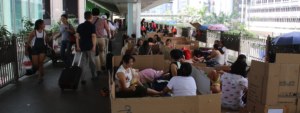
However, the opposite can be seen in the example of Hong Kong’s Little Manila. Little Manila is a social gathering that appears every Sunday, spanning a large area beneath the arches and in the overhead walkways of Norman Foster’s HSBC building, as well as in Statue Square and Chater Garden.[6] Just like the bridges discussed in Harrison’s chapter, Little Manila transforms the office buildings, walkways, and squares it occupies into spaces of separation, and of difference between the office workers who use the space during the week, and the domestic workers who occupy it on Sundays. As seen from Tomas Laurenzo’s photograph, the cardboard walls and the blankets that transform the walkway from a transient space to one filled with activity are only temporary. However, Little Manila also represents a wish for transition and bridging, for creating a more permanent identity of the migrant domestic worker from the Philippines in Hong Kong.

Photo by Tomás Laurenzo. Taken from: Laurenzo, Tomás. “Foreign Helpers.” Tomás Laurenzo: New Media Art & Research (blog), 2015. https://laurenzo.net/foreign-helpers.

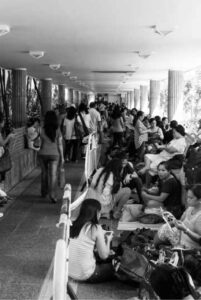
Daisy Tam summarizes that from the 1970s onwards, when Hong Kong shifted from an industry based economy to one that was service based, the demand for domestic workers increased.[7] As of 2016, the time of Tam’s article publication, 300,000 migrant workers from the Philippines worked in Hong Kong as domestic helpers.[8] As Tam argues, Little Manila represents a space of resistance where Filipina women can re-appropriate the very architecture that represents the capitalist system by which they are oppressed.[9]

Photo by Daisy Tam. Taken from: Daisy Tam, “Little Manila: The Other Central of Hong Kong,” in Messy Urbanism: Understanding the “Other” Cities of Asia, by Manish Chalana (Hong Kong: Hong Kong University Press, 2016), 127.

Little Manila becomes a space where women can reinforce their Philippine identities through sharing conversation, food, magazines, and time, as seen in the photo above. These identities are not liminal, even if the space they are practiced in is temporary, occurring only every Sunday. In creating this space of resistance, the women who use the space in this way also create a bridge. Little Manila becomes a third space: not Manila, not Hong Kong. Though it spans various types of physical spaces, from walkways to squares, Little Manila in itself becomes a bridge –a symbol of Philippine identity in Hong Kong.


Bibliography

Harrison, Thomas. 2021. Of Bridges: A Poetic and Philosophical Account. Chicago: The University of Chicago Press.

Laurenzo, Tomás. “Foreign Helpers.” Tomás Laurenzo: New Media Art & Research (blog), 2015. https://laurenzo.net/foreign-helpers.

Simmel, Georg, David Frisby, and Mike Featherstone. 1997. Simmel on Culture: Selected Writings. California: SAGE.

Tam, Daisy. 2016. “Little Manila: The Other Central of Hong Kong.” In Messy Urbanism: Understanding the “Other” Cities of Asia, by Manish Chalana. Hong Kong: Hong Kong University Press.


[1] Thomas Harrison, Of Bridges: A Poetic and Philosophical Account (Chicago: The University of Chicago Press, 2021), 7.

[2] Georg Simmel, David Frisby, and Mike Featherstone, Simmel on Culture: Selected Writings (California: SAGE, 1997), 171.

[3] Harrison, Of Bridges, 5.

[4] Ibid, 1.

[5] Ibid, 58.

[6] Daisy Tam, “Little Manila: The Other Central of Hong Kong,” in Messy Urbanism: Understanding the “Other” Cities of Asia, by Manish Chalana (Hong Kong: Hong Kong University Press, 2016), 1.

[7] Ibid, 119.

[8] Ibid.

[9] Ibid, 124.

Two Extracts of Tropical Travel Writing

James Ranald Martin opens his 1837 ‘Notes on the Medical Topography of Calcutta’, with a quote from Hippocrates on the title-page:


‘It is necessary for a Physician, when entering a city of which he knows nothing, to examine its exposure, the predominant winds, the seasons, the nature and elevation of the soil, the quantity of the waters of which the inhabitants make use, and the kind of life they follow’.1


However, rather than examining the habits and lifestyle of the inhabitants, Martin was one of many European travelers to “the Tropics” to look upon their lives with utter disdain. ‘The Foundation of an English School of Medicine’, he writes, ‘…must prove one of the most direct and impressive mores of demonstrating to the natives the superiority of European knowledge in general’ (italics in original).2 There is little of the Hippocratic call to examine and learn about the life or habits of the local population in Martin’s remarks. Instead, they reveal a sense of superiority, and a belief in the righteousness of European colonialism. Shang-Jen Li argues that as the 19th c. progressed, British medical practitioners were less and less inclined to learn from native customs or from indigenous medicine- it was now seen as a ‘loss of the white self’, as a sign of contagion.3  Tropicality, with its pseudo-scientific observations, creates the perfect environment for the cultivation of scientific racism. Unlike Orientalism, which is rooted in an interest in history, languages and cultures of South Asia, Tropicality takes its inspiration from science, nature and observation. Despite its seeming dedication to empirical evidence and interest in the environment, writings about the tropics frequently omit mention of the local population or local practices, and instead focus on discussing the discrepancies between the imagined tropics and the actual environment travelers encountered.

For instance, in Joseph Hooker’s 1855 Himalayan Journals he does little to hide his disappointment at the disparity between the tropics he had imagined in his mind, and the “tropics” he encountered. Of the Sunderbunds he writes “these exhibit no tropical luxuriance, and are, in this respect, exceedingly disappointing”.4 As David Arnold argues, despite their “scientific” backing, the Tropics were frequently romanticised. Romanticism in tropicality played the role of glorifying nature, selling travelers the idea of a wild landscape which was rarely found by the traveler upon their visitation.5 As we can see from Hooker’s memoirs, , “the tropics” for him are more a playground for the medic, the naturalist, the botanist, the geologist, rather than a place on equal grounds with Europe. The tropics in these writings exist for European observation, cultivation and improvement. Even Hooker’s desire to see true “tropical” and “wild” nature appears false. When visiting the botanic garden during his travels, he writes that instead of a beautiful tropical garden he finds ‘an unsightly wilderness, without shade (the first requirement of every tropical garden) or other beauties’.6 Clearly, the reality he was in did not match the very specific European conception of a wild, yet cultivated tropics.

Beyond his disappointment with the nature, Hooker’s account of his early travelling experience seems devoid of people. He dedicates paragraphs to describing plants he sees, or buildings he stays in, but there appears to be no mention of the native population. Therein lies the contradiction of the tropics: they must maintain wilderness, but also careful cultivation. They must be a place of novelty for the European, but the medicine, the food, and the buildings must be European in style. Most revealingly, however, travelers’ disdain for the experiences, voices, and habits of the indigenous populations of the places the visited show that tropicality was and continues to be an imagined place.


Bibliography: 

Arnold, David. 2005. The Tropics and the Traveling Gaze: India, Landscape and Science 1800-1856. Ranikhet: Permanent Black.

Hooker, Joseph Dalton. 1954. Himalayan Journals: Notes of a Naturalist. London: J. Murray.

Martin, Sir James Ranland. 1837. Notes on the Medical Topography of Calcutta. Calcutta: G.H Huttmann.

Shang-Jen, Li. 2013. “Eating Well in China: Diet and Hygiene in Nineteenth-Century Treaty Ports.” In Health and Hygiene in Chinese East Asia: Policies and Publics in the Long Twentieth Century, edited by Qizi Liang, Che Leung, Angela Ki, and Charlotte Furth. Hong Kong: Hong Kong University Press.

  1. Sir James Ranland Martin, Notes on the Medical Topography of Calcutta (Calcutta: G.H Huttmann, 1837), front cover. [↩]
  2. Martin, Notes on the Medical Topography of Calcutta, p60. [↩]
  3. Li Shang-Jen, “Eating Well in China: Diet and Hygiene in Nineteenth-Century Treaty Ports,” in Health and Hygiene in Chinese East Asia: Policies and Publics in the Long Twentieth Century, ed. Qizi Liang et al. (Hong Kong: Hong Kong University Press, 2013). p124 [↩]
  4. Joseph Dalton Hooker, Himalayan Journals: Notes of a Naturalist (London: J. Murray, 1954), p1. [↩]
  5. David Arnold, The Tropics and the Traveling Gaze: India, Landscape and Science 1800-1856 (Ranikhet: Permanent Black, 2005), pp104-5. [↩]
  6. Hooker, Himalayan Journals: Notes of a Naturalist, p2. [↩]

Westernization, Modernity and Hygiene in Shanghai

I would like to focus my long essay on spaces regarded as ‘hygienic’ and ‘non-hygienic’ in Shanghai. Throughout the late 19th and early 20th centuries, it seems that notions of sanitation and hygiene were very closely tied to Westernization, at first by missionaries and concession governments, then later by Chinese newspapers, through advertisements of new ‘hygienic’ products. I would like to investigate who pronounced a space as hygienic or not, and how conceptions of these spaces changed over time. Shanghai is an ideal place to investigate the relationship between hygienic/non-hygienic spaces because it allows us to see notions of hygiene played on the scale of entire concessions, down to specific types of shops or interiors.

From the late 19th century, British medical missionary journals consistently ‘othered’ Chinese residents in Shanghai through health and hygiene practices. Leung argues that this is particularly seen in British medical practitioners’ insistence that China was similar in climate to the tropics, despite the fact that most of China was not in a tropical zone (Leung, p.111). Leung goes on to argue that calling a place ‘the tropics’ was a Western way of defining something as ‘culturally and politically alien, as well as environmentally distinct from Europe’ (Leung, p.115). The Medical Missionary Society in 1847 reports that “the natives have of course become thoroughly acclimated, and are not affected by the climate to the same extent as the foreigners” (Chinese Repository Vol. 17, p.189). This implies that even as the first missionary hospitals are being established in Shanghai, medical practitioners dictated a different health and hygiene standard for Chinese and foreign patients. Therefore, it is easy to agree with Leung’s argument that hygienic regiments and standards were not a method of maintaining health, but rather a way to “distinguish and distance the European self from the native other”(Leung, p.124).

Particularly in Shanghai, the way in which concession governments discussed the presence of Chinese houses in their European concessions demonstrates that they regarded Chinese spaces as unclean, unsanitary, and un-modern. This is particularly evident if we look at the reports from the ‘Conseil d’Administration Municipale de la Concession Française a Changhai’. A report from the Hygiene Committee in 1923 contains a speech on the ‘rural houses’ on Route Pere Robert, stating that “it is hardly acceptable that in this quarter, that has become an important European centre, exist a cluster of constructions as dirty as these ones. These houses do not have a single drainage, excretions and debris of all sorts of nature overrun…we cannot do practically anything there, all the disinfection would be only temporary and very costly” (Sèance du Comité, p.141). The report continues, and mentions under a section titled “Houses that are un-Sanitary and un-Aesthetic” the existence of a “typical town, not drained, typically dirty, a house on the border of Avenue Joffre constructed out of bamboo … almost all the real estate is in a state of dilapidation”(Sèance du Comité, p.142), concluding that these houses are a danger to public sanitation. This report demonstrates the severe ‘other-ing’, and complete blame the French concession government placed on these houses. The French government were using sanitation to insist that nothing non-European should exist in their concession.

Rogaski also explores this desire to create parallels between hygiene, modernity and Westernization by bringing up a 1930s short story called “Etiquette and Hygiene” by Liu Na-ou, about a Chinese couple living in the international settlement. The husband of the couple takes a walk from their home to enter the Chinese neighbourhood, and immediately describes how he has entered a ‘danger zone’, filled with ‘ghastly stenches’, and ‘prostitutes soliciting customers in alleys smelling of urine’ (Rogaski, p.225). This short story demonstrates that the association between hygiene and Westernisation had been prevalent in the early 20th century, as in the late 19th century. The descriptions offered in the short story are not dissimilar to descriptions from medical missionaries in 1850, where Shanghai was described as filled with a “stench that pervaded the whole city (…) If it had been wished to invent a plan for making a district unhealthy in the highest degree (…) perhaps none could have been devised so likely to prove prejudicial to the people, or one better adapted to produce extensive disease” (Chinese Repository Vol.20, p.154).

If we investigate spaces on a smaller scale, however, the concern with hygiene increases as we near the early 20th century. For example, medical missionary William Lockhard wrote in 1861 that “At Shanghai, there are numerous bathing houses established…[that are] for the most part very commodious and clean, and much resorted to” (Lockhard, p.40). Bathhouses would have been used as a social space, and a space for physical health and cleanliness. Here, the bathhouse is seen as a clean space, encouraged for use by everyone. However, if we compare this social space to tiger stove shops in the Nanjing Decade (1927-37), the relationship with hygiene is entirely different. Tiger stove shops sold hot water for drinking and bathing, and at night functioned as a ‘tea house’, which provided shelter for the night for the price of a cup of tea. These shops, like bathhouses, performed a social and practical function. This time however, they were regarded as filthy and unregulated. Historian Lu indicates a source where the writer complains that “the authorities have paid much attention to the hygiene of restaurants and the like, but (…) there has not been a single effort to regulate the filthy tiger stove shops- this can be counted as an oddity in the concessions!” (Lu, p.291). The Nanjing decade saw an increased interest of the state in regulating shops and businesses, and this seemed to come with an increased awareness for hygienic and non-hygienic spaces, and thus an increased pull towards all things western.

So, by looking at reports of concession governments, advertisements in newspapers, and works of medical missionaries, as well as the works of historians like Hershatter, Rogaski and Lu, I hope to explore how this relationship between modernity, westernisation, and hygiene developed, both in larger spaces like concessions, and in smaller, social spaces.


Bibliography:

Primary Sources:

Lockhard, William, The Medical Missionary in China: a Narrative of Twenty Years’ Experience (London, 1861).

n.g, ‘Sèance du Comité d’Hygiène du 10 Juillet 1923’, Conseil d’Administration Municipale de la Concession Française a Changhai: Compte-Rendu de la Gestion pour l’Excercice 1923, pp141-142, <https://www.bnasie.eu/coreWeb/docReader/myReader.php?fID=bnPeriodical_ID-32_No-02.pdf> [accessed 28.10.2021]

Williams, Samuel Wells (ed.), Chinese Repository Volume XVII, (Canton, 1849).

Williams, Samuel Wells (ed.), Chinese Repository Volume XX, (Canton, 1851).

Secondary:

LaCouture, Elizabeth, Dwelling in the World: Family, House, and Home in Tianjin, China 1860-1960 (New York, 2021).

Leung, Angela Ki Che, Health and Hygiene in Chinese East Asia: Policies and Publics in the Long Twentieth Century (Durham, 2010).

Lu, Hanchao, Beyond the Neon Lights: Everyday Shanghai in the Early Twentieth Century (Oakland, 1999).

Rogaski, Ruth, Hygienic Modernity: Meanings of Health and Disease in Treaty-Port China (Berkley, 2004).


Linglong and Domesticity

The fall of Qing dynasty brought about turbulence and change, particularly in treaty-port cities like Shanghai, where, as LaCouture emphasises, dwellings held ritual significance, and physically represented systems of belief for the residents (LaCouture, Dwelling, p.124). Domesticity, and the way in which one occupied the home, became something that was taught in school systems, in subjects like home economics, or domestic management, which were taught to women and girls in particular (LaCouture, Translating, p.1285). In fact, in her article on translating domesticity, LaCouture brings up the writings of Dzung Zoh-yi, a student in such a class, who rejected what she deemed the ‘Americanised’ version of the perfect ideological home, maintained by good housekeeping and sewing, and instead embraced things like cooking and eating which symbolised a happy home for her. (LaCouture, Translating, p.1286). LaCouture uses this example to emphasise that there is a difference between the ideology of domesticity enforced in schools, and what domesticity meant to women and girls in practice. Nowhere is it more interesting to trace the boundaries between practiced and idealised domesticity than in women’s’ magazines which became abundant in the 1920s and 30s.

The magazine Linglong (which translates loosely to ‘elegance’) was a 13cm high weekly magazine published in Shanghai between 1931-1937 and targeted mainly at girls and young women. Even just by looking at the images and the loose translations provided in the archives, it is evident that though students like Dzung rejected Americanised home practices, Western influences in both personal appearance, room layouts, and furniture were abundant. In presenting images of these perfect interiors, magazines like Linglong cultivated taste in their young female readers.

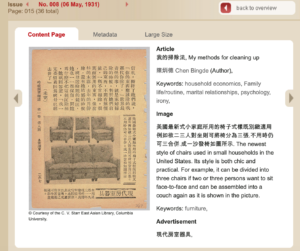
Linglong contained many advertisements for interior decoration and furniture. In Issue 8, May 1931 there is an image of a detachable sofa, advertised (as translated in the archive) as something ‘used in small households in the United States’ (p.15). Issue 45, January 1932, similarly presents a corner of a ‘smoking and drinking room’, taken from the ‘interior design of a French modern home’ (p.22). The implications of both pieces of furniture being portrayed as pinnacles of style and modernity implies that Europe and America were places to be looked up to, whose style was to be emulated. Similarly, in Issue 35, November 1931, a completely glass ‘Western-style dinner table’ is advertised as being ‘clean’, emphasising not only its fashionableness, but also its practicality: this is an item associated with neatness, cleanliness, and modernity (p.16). Here, furniture can be seen as an item to either buy or desire: wanting these Euro-American items was an action of good taste.

Issue 8, May 1931

Issue 45, January 1932

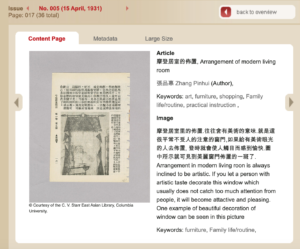
Linglong also offered images of tastefully-decorated interiors to inspire readers: Issue 5, April 1932, shows a windowsill with a glass table, a plant, and draping curtains with the caption that’s been translated as ‘if you let a person with artistic taste decorate this window…it will become attractive and pleasant to the eye’ (p.17), showing that it is taste that makes a living room modern, not necessarily the specific furnishings in it. LaCouture argues that Western-style houses and furnishings were a clear indicator of class: an annual wage for a labourer in Tianjin was equivalent to two months’ rent in the Italian concession, for example (LaCouture, Dwelling, p.149). However, magazines like Linglong were cheap and easy to circulate around treaty port cities: cultivating taste through this magazine (rather than the specific furniture in it) became a way to cultivate a shared identity through taste, even before China had a well-defined bourgeoisie.

Issue 5, 15 April 1931

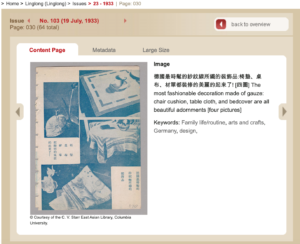
The magazine was filled with a range of furniture, objects, interiors that signified modernity and taste. Fabrics like gauze, advertised in Issue 103, July 1933 (p.30) as being both fashionable and versatile, to be used for chair cushions, table cloths, and bedcovers. The furnishings of a room themselves, like modern cupboards, recliners and tea tables made of glass as seen in Issue 70, October 1932, (p.42) all were part of this new taste, even if specific readers would not, or could not purchase this item. As LaCouture says, designing the interior became its own form of social distinction (LaCouture, Dwelling, p.156).

Issue 103, July 1933

Issue 90, October 1932

Popular magazines like Linglong, read by female students all over China targeted young women to teach them how to consume goods ‘correctly’, building knowledge about home and interiors, creating educational and cultural capital they could show off in the home. Through consuming magazines like Linglong, readers could create a shared identity, signifying that they were women of good and modern taste.

Bibliography:

Primary Sources:

Pinyin Lun, trans. Barbara Mittler and Liying Sun, ‘Cookery’, Linglong, Shanghai, 11 Nov, 1931, p.15, < https://kjc-sv034.kjc.uni-heidelberg.de/frauenzeitschriften/public/magazine/page_content.php?magazin_id=3&year=1931&issue_id=107&issue_number=035&img_issue_page=016> [accessed 26.10.2021].

Zhang Pinhui, trans. Barbara Mittler and Liying Sun, ‘Arrangement of Modern Living Room’, Linglong, Shanghai, 15 April 1931, p.17, < https://kjc-sv034.kjc.uni-heidelberg.de/frauenzeitschriften/public/magazine/page_content.php?magazin_id=3&year=1931&issue_id=5&issue_number=005&img_issue_page=17> [accessed 26.10.2021].

n.g. trans. Barbara Mittler and Liying Sun, ‘My Method for Cleaning Up’, Linglong, Shanghai, 6 May 1931, p.15, < https://kjc-sv034.kjc.uni-heidelberg.de/frauenzeitschriften/public/magazine/page_content.php?magazin_id=3&year=1931&issue_id=46&issue_number=008&img_issue_page=15> [accessed 26.10.2021].

n.g. trans. Barbara Mittler and Liying Sun, ‘Another Woman’s New Style Overcoat’, Linglong, Shanghai, 27 Jan. 1932, p.22, < https://kjc-sv034.kjc.uni-heidelberg.de/frauenzeitschriften/public/magazine/page_content.php?magazin_id=3&year=1932&issue_id=118&issue_number=045&img_issue_page=022> [accessed 26.10.2021].

n.g. trans. Barbara Mittler and Liying Sun, ‘A Cupboard; A Tea Table; A Recliner’, Linglong, Shanghai, 10 Oct. 1932, p.42, < https://kjc-sv034.kjc.uni-heidelberg.de/frauenzeitschriften/public/magazine/page_content.php?magazin_id=3&year=1932&issue_id=141&issue_number=070&img_issue_page=42> [accessed 26.10.2021].

n.g, trans. Barbara Mittler and Liying Sun, ‘The Most Fashionable Decoration’, Linglong, Shanghai, 19 July, 1933, p.30, < https://kjc-sv034.kjc.uni-heidelberg.de/frauenzeitschriften/public/magazine/page_content.php?magazin_id=3&year=1933&issue_id=100&issue_number=103&img_issue_page=030> [accessed 26.10.2021].


Secondary Sources:

LaCouture, Elizabeth, ‘Translating Domesticity in Chinese History and Historiography’, The American Historical Review, 124:4 (1 Oct. 2019), pp.1278-89

LaCouture, Elizabeth, Dwelling in the World: Family, House, and Home in Tianjin, China 1860-1960 (New York, 2021).


Understandings of Fengshui amongst Protestant Missionaries

The first Europeans to come into contact with fengshui were missionaries who spread inland in the late 1840s and 50s as a result of the Opium Wars (Brunn, p.40.). The first record of Anglo-Dutch-German-American writing on fengshui was in the Chinese Repository Volume VI, published from May 1837-April 1838 by protestant missionaries working in China, intended to inform Europeans about life in China. For the next 13 volumes of the repository, fengshui was mentioned a few more times, either under the heading ‘geomancy’, or under from a linguistic/translation angle explaining the meaning of the word ‘fung’. Tracing the linguistic and cultural understandings of fengshui reveals that missionaries engaged linguistically with Chinese spiritualism, they made absolutely no progress over 15 years in understanding the practice of fengshui.

Wright explains that the underlying belief of fengshui is that the worlds of gods and men were interconnected, and that men needed to respect forces of nature and their ancestors, who played an important role in this interconnected web (Wright, p.41). That gods and men, living and dead were all interconnected and interacting is an important belief that protestant missionaries were attempting to understand in the Chinese Repository. In Vol. XVIII published in 1849, Philo explains the “Philological Diversions, illustrating the word Fung or Wind, in its various meanings and uses as they are exhibited by Chinese Lexicographers, Poets, Historians and the Common People” (Vol. XVIII, p.470). Philo provides the results of his “leisure reading in Chinese” with the hope that they will “entertain the readers of the Chinese Repository (Vol. XVIII, p.470). He expresses much personal delight at the “poetical and harmonical uses of this remarkable character”, and proceeds to discuss its multitudes of meaning, including ‘breath’, ‘spirit’ (Vol XVIII, p.473), ‘producer of all things’, ‘messenger of heaven and earth’ (Vol XVIII, p.474). While Philo’s account does seem to be a mere exploration through literature of the various meanings of this word, his article elicited a response in Volume XIX of the Chinese repository published the following year in 1850. W.H Medhurst Sen produced ‘Animadversions on the Philological Diversions of Philo’ (Vol. XIX, p.486), where he criticized Philo for his lack of accuracy in some of his translation. Medhurst states that ‘in Philo’s estimation, the Chinese regard Heaven and Earth “the Parents of all things”, as this controlling cause, and fung as one of their active agents in this grand operation’ (Vol.XIX, p.486), thus further interpreting the word’s meaning. The implications of these two discussions of the word ‘fung’, is that clearly attempts were made, even if just from a linguistic angle, at understanding the Chinese perspective of the world. What a linguistic analysis of a word could reveal about Chinese cultural perspectives was taken up with enthusiasm, and discussed by Protestant missionaries.

The same enthusiasm and attempt to understand a cultural perspective cannot be said about the practice of fengshui itself. In its first mention in Volume VI of the Chinese Repository, published 1837-8, fengshui is called a “vain superstition”, a belief that “buildings have an influence on all things around them”, that when “in a proper state of repair” they will cause “soil to be productive, the people prosperous, and the elements (such as fire, water, &c.) submissive and obedient” (Vol. VI, p.190). It is also remarked with disappointment that it is used by both commoners and distinguished men, and that the process of building a house or burial place takes months to make a decision on the precise place. The whole process is not treated with much sympathy from the writer, and rather as a silly idiosyncrasy, an ‘unaccountable Chinese superstition’, containing very little sense (Vol. VI, p.190). Nearly 15 years later, in Volume XX of the Chinese Repository published 1851, nothing has changed about the missionaries’ understandings of fengshui, but perhaps there is even more annoyance at the existence of the practice. This time, fengshui is discussed in is titled “Prohibitions addressed to the Chinese converts of the Romish faith, translated by P.P Thoms, with notes illustrating the customs of the country” (Vol XX, p.85). Specifically, “those who cause to be engraved on the tomb-stones, that such a hill was selected; and that the person lies towards such a point of the compass, and was buried on such a propitious day, or foolishly believe the geomancy of the fung-shwui- Sin” (Vol XX, p.90). After describing the practice of fengshui as a sin, the writer calls it ‘useless’ and ‘absurd’, and that it is only the ‘minds of the simple’, who could believe it. There is a tone of complete refusal to understand why a family would go through so much trouble to find a grave, after the geomancer will “pass over the same ground twenty times over” (Vol XX, p.90). As Brenda Yeoh argues, it was simply not understandable to Western minds why burial practices were so important for the Chinese, and so they were simply labeled as a sin, and as a foolish practice for their fellow missionaries to dismiss (Yeoh, p.288).

Comparing these four passages reveals that while linguistically missionaries were eager to engage with and debate understandings and uses of the word ‘fung’, to understand how the Chinese viewed the world, they were utterly unwilling to use that same knowledge of Chinese world viewpoint to understand the practice of fengshui. It is almost surprising, that over 15 years no deeper attempts were made to understand this clearly important practice, and that fengshui was described in both entries in fairly similar terms, with the same type of annoyance. This shows that the understanding of the worldview, and the practice itself were two separated things in the Western mind, and that while one was treated as a stimulating intellectual exercise, meant to delight Western readers, the other was treated as a non-acceptance of Christianity, a sin, and a fault to be righted by the protestants.


Primary Sources

Bridgemen, James Granger (ed.), Chinese Repository Volume VI, (Canton, 1838).

Williams, Samuel Wells (ed.), Chinese Repository Volume XVIII, (Canton, 1849).

Williams, Samuel Wells (ed.), Chinese Repository Volume XIX, (Canton, 1850).

Williams, Samuel Wells (ed.), Chinese Repository Volume XX, (Canton, 1851).


Secondary Sources:

Bruun, Ole, An Introduction to Fengshui (Cambridge University Press, 2008).

Wright, Arthur, ‘The Cosmology of the Chinese City’ in G. William Skinner ed. The City in Late Imperial China (1977).

Yeoh, Brenda, Contesting Space in Colonial Singapore (NUS Press, 2003), pp.281-311.

China Political Reports: British perspective on Sino-Japanese relations

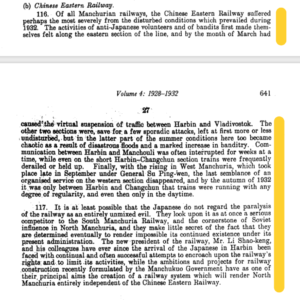
It is interesting to look into the China Political Reports from the years of the Japanese establishment of Manchukuo, not only to provide an outsider’s perspective into Sino-Japanese relations, but also to analyse how the railway was used as a non-military method of control, and how railways were used by the British to interpret the often secret negotiations between China and Japan. The extracts analysed are taken from China Political reports from two volumes: Volume 4, containing reports written between 1928-32, and Volume 5 written between 1933-36. These were confidential documents, written by two British diplomats as part of the annual reports on China, for use of the foreign office. The first extract is from the 1932, the year Japan established Manchukuo, discussing the year’s impact on the Chinese Eastern Railway. It was telegrammed to Sir John Simon in Britain from Mr. Ingram, a British consul in China. The source describes how the Chinese Eastern Railway suffered the most during these years because of anti-Japanese sentiments, bandits along the eastern sections of the line, and floods, which resulted in the suspension of traffic between Harbin and Vladivostok, two major Russian railway towns. Meanwhile, the Southern Manchurian Railway (SMR) “borrowed and surpassed” Russia’s railway plans and insisted that the SMR’s facilities were the most modern available (Buck, 75). This leads to Mr. Ingram’s hypothesis that “it is at least possible that the Japanese do not regard the paralysis of the [Chinese Eastern Railway] as an entirely unmixed evil”- it is the main competitor of the SMR as well as the “cornerstone of Russian influence in North Manchuria”. The implications of this are that with the Chinese Eastern Railway weakened; the Japanese could continue exerting their influence in Manchukuo. If, as Buck frames it, Changchun represented the “inland extension of a foreign-dominated treaty port”, then the railways were the key to exerting control in a place without direct outright military action (Buck, 65). The Japanese gained control first through the railway, and then through the establishment of a government of Manchukuo.


The next set of extracts is from Sir Alexander Cadogan to Sir John Simon as part of the annual report on China in 1934, two years following the establishment of Manchukuo. 1934 also marked the first year since 1930 that “the Japanese have not resorted to direct military action to gain any objective in China” (p.278). Cadogan then goes on to speculate that because it would be a blow to Chinese public opinion to have any outright agreements with Japan, the two countries have been conducting their affairs “gradually and without any publicity” (p.270). Many of Cadogan’s interpretations are based on analysis of the railway traffic going between Manchukuo and China: it is in this way that China was able to negotiate a relationship with Japan without needing to publicly recognise the government of Manchukuo. The railway and the towns attached to them become important levers in establishing a peaceful relationship between the two countries.


A further report on the “subsequent developments in the general political situation between China and Japan” (p.331) were provided by Cadogan again on May 17, 1935. He states, with hints of personal annoyance, that it is “difficult to ascertain the true facts in regards to what has been happening” (p.336) between China and Japan, and that China was acting “with characteristic vagueness” (p.336) to meet Japanese demands and restore normal friendly relations. Cadogan’s annoyance here is probably indicative of the increased secrecy of negotiations between China and Japan, and an increased reliance on railways, infrastructure, and other elements of modernisation to protect Japan and China from Western aggression (245, Louise Young). Young argues that the railway exemplified just one method of building modernity within Japan and its empire, without needing any assistance from the West. Cadogan goes on to describe the “long and somewhat rambling statement” of the Minister of Foreign Affairs Wang Ching-wei, stating that both China and Japan have seemingly set aside the question of Manchukuo. Meanwhile, Japan was determined to increase the Japanese population in Manchuria while planning a highly ambitious development programme for their new territory, including the development of the railway, highways, air transport and communications networks (Tucker, 53). Japan would continue exerting control over Manchukuo through its commercial drive: by the end of 1936 there were countless Japanese shops, restaurants, hotels and other small businesses in railway towns throughout Manchuria (Young, 254). This is evidence that Japan was continuously asserting its dominance in Manchukuo, and that China was appeasing these demands, without the need for overt military force from either side. So, it is through no coincidence that these foreign reports on Sino-Japanese relations rely on railways and other commercial agreements to speculate on what diplomatic agreements were being reached by both countries- they often reveal more than official military or diplomatic discussions.


Bibliography:


‘Mr. Ingram to Sir John Simon: Annual Report, 1932’, in Robert L. Jarman (ed.), China Political Reports 1911-1960, Vol. 4 (Chippenham, 2001), pp.640-1.


‘Sir A. Cadogan to Sir John Simon: Annual Report 1934’, in Robert L. Jarman (ed.), China Political Reports 1911-1960, Vol. 5 (Chippenham, 2001), pp.269-336.


Buck, David D. “Railway City and National Capital: Two Faces of the Modern in Changchun” in Railway City and National Capital: Two Faces of the Modern in Changchun, pp.65-89.


Tucker, David “City Planning Without Cities: Order and Chaos in Utopian Manchukuo” in Mariko Asano Tamanoi ed., Crossed Histories: Manchuria in the Age of Empire, pp.53-81.


Young, Louise, Japan’s Total Empire: Manchuria and the Culture of Wartime Imperialism, Twentieth-Century Japan (Berkeley, Calif: University of California Press, 1999), “Brave New Empire: Utopian Vision and the Intelligentsia” pp.241-268.