Keeping Cool: Investigating Air-Conditioning in South East Asia

The searing heat and high humidity of most of South East Asia (SEA) make it at the best of times, a challenging environment to live and work in. From my personal experience in these perpetual summers, the amount that one sweats simply just from walking is impressive. With salt lines forming down shirts and sweat dripping down arms, the most ubiquitous form of reprieve comes in the form of air-conditioning (AC). When did AC become the norm for many public places in SEA? From trains to shopping malls, restaurants to private homes, they provide comfort for millions every day. The technology and story surrounding AC tell a fascinating story of how people reconceptualised their relationship with the natural environment and how economic factors and the accessibility of technology made cooling through AC commonplace in SEA.

The history behind air-conditioning in South East Asia is the most well documented in Singapore, or at the time the Federation of Malaya. Newspaper clippings from the late 1930s provide a wealth of insight into the trends surrounding air conditioning at the time. The Sunday Tribune, a newspaper that ran between 1931-1951 ran numerous articles extolling the virtues of cool and humidity-free air. [1] Most of the articles pointed to the benefits of comfort in homes and public spaces and even benefits to industry. Despite the generous suggestions that all spaces would soon be air-conditioned, first-hand accounts gleaned from older Singaporeans born before the 1970s suggest that despite the invention of AC technology many decades earlier; It took a great deal of time before they were implemented in the private home. [2] The main reason quoted for this was due to the cost of electricity and the general acclimatisation that many older Singaporeans had to the heat. Fans, open windows and ventilation holes in walls were much more common in private homes during this period.

So, when did air conditioning transition from the public to the home? While the evidence is quite lacking in Singaporean and SEA accounts, a detailed economic study of home AC units based on energy consumption trends in the United States points out a few interesting trends. Jeff Biddle examines the uptake of ‘residential AC’ in the US from the mid-1950s to 1980s and remarks that a change in income, climate, and average electricity rates led to the uptake of AC in homes. [3] One of his key findings was that by the late 1980s the vast majority of Americans had ‘residential AC’. Although the form of economic history he conducts focuses more on macro-economic trends rather than the individual experiences of homeowners, it nonetheless provides a starting point from which we can discuss the uptake of AC in other parts of the globe. One of the key technological improvements Biddle discusses is the competing types of AC, namely central and unit inverters. Where the first required a lot more foresight in terms of installation, the second functioned similarly to any other household appliance and was essentially ‘plug and go’. Essentially the convenience of these inverter units was crucial to the uptake of in-home AC units. The uptake of AC in the home changed the way that people lived quite significantly. Despite its lack of prevalence the possibility in quality of life changes were discussed in newspapers as early as the late 1930s. [4] Taking a public health standpoint, these primary sources cogently pick apart the issues of drastic shifts between indoor and outdoor spaces with the advent of AC.

In the February 10th issue of the Sunday Tribune, the author expresses the concerns of a certain Prof. K. Black, that proposes that the sudden transition from a “refrigerated room” into the tropical heat and vice versa would cause health issues. [5] The author rebukes this claim by arguing that AC merely changes the indoor atmosphere by a few crucial degrees. A claim that is not quite true in the modern-day. Marlyne Sahakian conducted some fascinating research using phenomenological techniques (interviews) to better understand modern societal perspectives and practices regarding AC in the Philippines. In a short section detailing the author’s personal experience as a pregnant woman, she expressed that moving from an intensely air-conditioned room into a warmer space put a strain on her personally. In a few succinct words, “it’s freezing!” she describes the feeling whenever she was in her parent’s or friends’ houses. [6] Sahakian cleverly intersperses these phenomenological accounts (whether personal or other) with solid evidence on historical cooling techniques and the slow evolution of cooling technology in different climates and geographic locations. This sort of social and technological history is precisely what is required in the study of artificial cooling as a phenomenon. Her cogent comments on global standards of ‘comfort’ link well to the existing debates on perceptions of heat and acclimatisation in tropical environments, a topic that is the central debate of Jiat-Hwee Chiang in her book on tropical architecture.

In Jiat-Hwee Chang’s, A Genealogy of Tropical Architecture, she comments on the power dynamics that presupposes many architectural decisions made in SEA. Although her work is at times difficult to understand, she illustrates the key problem of a priori tropicality logic that runs through architectural concepts in tropical environments. [7] Her arguments about these presumptions are quite accurate, but arguably fail to capture the actual human practices that surround cooling. Despite this, Sahakian’s idea that there is a lack of consensus on global standards of comfort synchronises well with Chang’s concepts that ‘tropical architecture’ should not be dominated by western ideas. After all, acclimatisation and adaptation mean that people suited to living in tropical climates perceive heat differently, and buildings and dwellings, should in theory reflect this. [8]

The seemingly hodgepodge of sources presented are but a preliminary survey of accounts that have been gathered in the process of research for a much larger piece of work. The crux of this entire project on cooling rests both on the perceptions of comfort concerning cooling, and how society changed during the period where fans were replaced by AC units. This should raise some interesting questions on changing perceptions of comfort, and the influence that it has had on society. Quite curiously, it also delves into concepts of tropicality, and whether AC supports or subverts its key tenets. Ultimately, a research topic that appears to be worthy of closer examination.

Sources

[1] National Library of Singapore, Reel N1452, Sunday Tribune, entry 10 February 1935, page 10.

[2] Chiang, interviewed by Roger Loh, 8th March 2022, interview 1.

[3] Jeff Biddle, ‘Explaining the Spread of Residential Air Conditioning, 1955-1980’, Explorations in Economic History, 45:4, (September 2008), p. 2.

[4] National Library of Singapore, Reel N1452, Sunday Tribune, entry 10 February 1935, page 10.

[5] Ibid.

[6] Marlyne Sahakian, Keeping Cool in South East Asia: Energy Consumption and Urban Air-Conditioning, (London, 2014), p. 66.

[7] Jiat-Hwee Chang A Genealogy of Tropical Architecture: Colonial Network, Nature and Technoscience, (London, 2016)

[8] Ibid.
Hakka Noodle: The Story of the Kolkata Chinese

A dish that bears little resemblance to many of the Hakka dishes found throughout East and South East Asia. A symbol of cultural fusion. The Hakka Noodle. This dish is commonly found throughout India as representative of Indo-Chinese and indeed Chinese cuisine. Despite its name, Hakka Noodles don’t actually exist anywhere else outside of India. Recipes for Hakka Noodle are also strangely devoid of any particular “Hakka” characteristic. Featuring soy sauce, rice vinegar, garlic and ginger; this dish appears more to be a facsimile of what people thought was Chinese food.


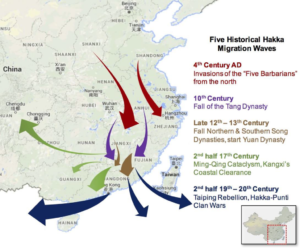
The namesake of the dish “Hakka” (Kè Jiā, 客家), refers to a linguistic and cultural diasporic group that internally migrated throughout China in 5 major migrational waves from the 5th Century AD to the second half of the 19th Century. [1] The Hakka mostly settled throughout Southern China, most notably in Guangdong and Fujian. The history of Hakka is inherently tied to that of migration and movement. Large numbers of Hakka migrants emigrated from mainland China to South East Asia, Taiwan. India, especially Kolkota, saw smaller waves of Chinese Immigrants that arrived in smaller numbers compared to the SEA region, to curious effect. [2] The Chinese in Kolkata are most commonly found in two areas, Tiretta Bazaar and Tangra. “Chinatowns” are typically formed as giant, open enclaves where Chinese businesses and communities resided. The vast majority of these settlements formed in the 18th to 19th Centuries when Chinese migrants first arrived and settled in places as far off as Liverpool (1830). [3] Kolkata’s experience with Chinese communities began around the late 18th Century, centred around the tanning industry, in the district of Tangra and the surrounding areas of central Kolkata. [4]


Tanning was typically seen as an undesirable occupation that was fulfilled by lower caste individuals. This was due to the smelly and often dirty nature of the trade. In what Shivani Kapoor calls ‘Sensory Politics’, he describes the literal stench of the leatherworker and the industry as a whole influencing how society treated the profession. [5] Although this concept for Shivani was applied to the Untouchable caste tanners in Uttar Pradesh. Parallels can be drawn to tanners in Kolkata. As Vernon Briggs notes, it has long been understood that immigrants take the unwanted and often “dirty” jobs in their host country. [6] This was especially true in Kolkata, where Hakka migrants flocked to the tanning industry not because there weren’t any jobs available for them, but because they were willing to take on the jobs that no one else wanted. There was a massive demand for the luxury of leather goods, but very few were willing to supply that demand. Apparently free from the social dynamics of caste, the Hakka could take up these jobs that paid very well.

Kolkata’s Chinatown has many of the distinct elements that most others do, with Chinese style gates, businesses, and temples. What is most curious is the incredibly central location that this particular Chinatown occupies. In comparison to San Francisco, London and Tokyo’s Chinatown, which is relatively central but occupies only a small part of the city. Tangra occupies a comparatively large area in the Eastern part of Kolkata, in close proximity to important landmarks such as the Victoria memorial hall and central railway station. [7] There are assertions that Tangra was not the ‘original’ space that the Chinese occupied in Kolkata. Various other central districts such as Dharamtallah and Kasoitollah also featured important Chinese temples and businesses. Which indicates that the Chinese presence in Kolkata was even more important in centuries past.


The curious case of the Chinese tanner raises certain questions about how the Chinese immigrant community occupied such a prominent social and spatial position in the city. One could very well accept an application of Kapoor’s assertion of the politics of smell in the tanning trade, combine it with Brigg’s understanding of immigrant “dirty labour” and assume that the Chinese in Kolkata was a community that faced marginalisation and discrimination. [8] However, this did not seem to be the case. The earliest sources on the Chinese immigrant community to Kolkata pointed to a small number of Hakka migrants that occupied a central part of the city and appeared to be well established under the East India Company’s purview. [9] Did the supposed “otherness” of the Chinese allow them to avoid the restrictions of caste? Or were caste associations with the profession of tanning so strong that the social status of the Chinese community was impacted? These are some of the interesting questions that arise from this particular case study that don’t have answers at the moment, but that I hope to find through my research. These kinds of questions are not limited to just a study of social structure in India. It raises a whole host of further questions on how significant Diaspora populations integrated or found a place in the social structure of a particular state or even urban space. It questions the relationship between professions and social status. In the particular case of Chinatowns, it even questions the social and spatial fabric of a city’s present and historical reality.

The leather tanning industry in Tangra is still alive today and although the community has dwindled due to the Sino-Indian War of 1965 and the redevelopment of Tangra itself. Tiretti Bazaar and Tangra are still the heart of a vibrant Chinese food market. On the street, you can get momos shaomai (烧卖) and Baozi (包子). In restaurants, Pork with Mustard Greens, fish ball soup and sweet and sour pork. The Hakka have left their mark on Kolkata, in their profession, their culture and most of all, in their noodles.


Sources

[1] Hsieh Ting Yu, ‘Origin and Migration of the Hakkas’, 1929, <https://pages.ucsd.edu/~dkjordan/chin/HsiehHakkaHistory.html>[accessed 26 February 2022]

[2] Ibid

[3] Ibid

[4] Map of Tangra, Google Maps

[5] Shivani Kapoor, ‘The Violence of Odors: The Sensory Politics of Caste’, The Senses and Society, p. 164-176. 

[6] Vernon M. Briggs Jr., ‘Immigrant Labor and the Issue of “Dirty Work” in Advanced Industrial Societies’, Population and Environment, 14:6 (July, 1993), p. 503.

[7] Umang Sharma, ‘Open at 5am, Tiretti Bazaar In Kolkata Is A Paradise For Every Authentic Chinese Food Lover’, India Times, 2nd July 2017, <https://www.indiatimes.com/culture/food/open-at-5am-tiretti-bazaar-in-kolkata-is-a-paradise-for-every-authentic-chinese-food-lover-321337.html> [accessed 2 February 2022].

[9] Ibid

Sato and Sand: A Curious Case of Primary Sources and Japanese Kitchens

Just as I cook rice in a rice cooker, some choose to use a pot over a gas stove. Japan is one such country that has transitioned from traditional wood fires, to gas, and finally electric rice cookers in the short span of two centuries. Although the rice cooker is now a quintessential item in many parts of East Asia, its history is often quite obscure and difficult to trace. Historical scholarship on the rice cooker, especially in English, appears to be quite sparse, save for Jordan Sand’s impressive account of Japanese kitchens in the Meiji Era.

A researcher on the topic would be hard pressed to turn to Japanese language sources, and rightly so. The famous insularity of Japanese research, and indeed Japanese publications as a whole means that much of the Japanese research done on the evolution of their kitchen culture is locked behind a language barrier. The result of this research existing in different realms to that of the rest of the world has produced some interesting results. Both Jordan Sand and the author of a short Japanese article in Jūtaku Kenchiku, The Housing Journal for Builders and Designers, written by Keisuke Sato (佐藤敬介) draw on similar sources to give the reader a snapshot of the kinds of technology available in kitchens during the Meiji and Taisho eras, alongside the technological innovations that changed the Japanese kitchen during this period. [1] At some points of the cross analysis of these two sources, I had to stop and question whether these were the same authors with different names, or even the possibility that Sato (due to his article being written in 2012 as opposed to Sand in 2005), had either read Sand’s work and taken inspiration or just plain plagiarised it. It only after taking a closer look at the latter parts of Sato’s article that made it apparent that both authors had chanced upon the same sources and used them in each of their respective works. Even so, it was quite startling that the narrative trajectories that each author took were so similar. From references to similar articles, to discussions of gas technology in the kitchen, and even the changing spatial nature of the “sitting to standing” role of the cook in the kitchen. It was completely flabbergasting to see almost the same topics being discussed, just in slightly different ways.

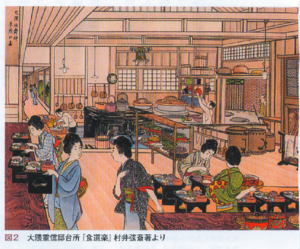
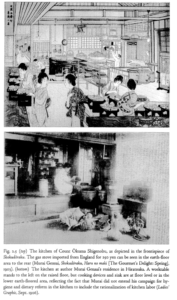
Analyzing a 2012 Japanese publication of Jūtaku Kenchiku, provided interesting insight into how kitchen technologies as a whole shifted significantly during different periods of Japan’s modernization. Sato does some excellent primary source research based on first-hand accounts of interviews and images taken from magazines throughout the Meiji and Taisho Era. Curiously, both Sato and Sand cite “Shokudōdraku” and use the exact same image from the kitchen of a certain Count Ōkuma Shigenobu. Funnily enough, the only difference in the image is that the 2012 Japanese rendering has colour, whereas Sand’s does not. Both took note that there was a large UK imported gas cooker and the implications that had on the function of this kitchen and of the shifting spatial forms in the Japanese kitchen in this era. [2] It is likely that the reason why both authors chose the image was because it was the best representation of the inner workings of a Meiji Era kitchen in an aristocratic household and provided insight into the types of appliances that were used. Perhaps it was just sheer chance that they came upon the exact same source and image, or perhaps this particular subfield of the spatial history of kitchens in Japan is so sparse that they there are few good examples to choose from. Whichever it is, it is most curious that both secondary sources converge at this specific image.

Sato’s use of ōkuma’s kitchen


Sand’s use of ōkuma’s kitchen

 
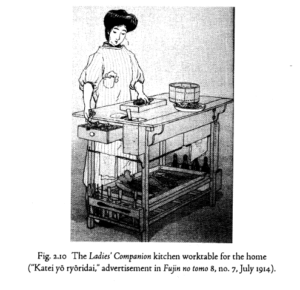
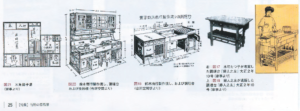
Whereas Sand comments on the bourgeoise nature of consumption. Sato appears to take a much more empirical and indeed personal approach to these representations in the kitchen, instead commenting on how specific appliances seem to have made the lives on housewives easier, alongside specific measurements in the form of Tsubo (the size of about 2 tatami mats) for the kitchen. [3] The easiest way to explain the differences in explanation for the exact same source would simply be the audience each author was writing for. Sand would be more interested in creating an account that was more consistent with academic forms of research that required theoretical analysis, whereas Sato was more interested in creating a practical account for those that wanted to draw inspiration from historical forms of the kitchen. You can see the split between the historical analysis and the contemporary comments on how to structure your kitchen based on change in content about halfway through Sato’s article.

Curiously, Sato appears to delve more into the quotidian aspects of kitchen life in his accounts. He took his research a step further by introducing accounts of a certain 工學博士清水家 (The House of Shimizu, Doctor of Engineering) during the Taisho era. Commenting on specific developments in gas technology that allowed “meals to be put in front of 17 people within the span of 30 minutes”. [4] These kinds of empirical accounts seemed to be of less interest to Sand as they didn’t serve to support the overarching narrative of the transformation of the Japanese woman in the kitchen. Sand’s concerns regarding the “laboratisation” of the kitchen was something that wasn’t quite discussed as much in Sato’s account, as well as accounts by other articles on kitchens that were present in an earlier 1981 article published in Jūtaku Kenchiku.

While both took different approaches to spatial practices in the kitchen and the various forms this took, there was a marked interest in gas as an innovation in kitchen technology and the transition from “sitting to standing” in the kitchen. Sato’s introduction of gas focused more on the gradual integration in Japanese society, from street-lamps in Ginza, to the advent of the gas water heater in the 35th year of Meiji. [5] Once again, similar references to gas appliance manuals and the ability of gas technology being “lit by a single match” appears. This section of Sato’s article is the only part that vaguely comments on the cleanliness of gas as an energy and cooking source, citing the lack of soot and dirt being healthier to the organs and eyes. Sand on the other hand, focuses on how gas appliances could replace the “unhygienic maid” in the search for modernity. [6] The transformation of the kitchen from a sitting to standing space was something that both authors paid very close attention towards. Sand discussed differences in the Kantō and Kansai kitchens and how the two stepped kitchens of many older models and rural environments. [7] The way that he comments on the “streamlining” of the kitchen from many individuals (such as maids and other helpers) to the single housewife was somewhat echoed by Sato, in much less specific forms. Specific references to “Taylorism” were even made by both authors as justifications for making the kitchen a space that was more “laboratory like” (to borrow Sand’s term). 


The point at which the two authors begin to diverge is in discussions of the applications of these innovations to the modern kitchen. Sato draws on his own experiences in modelling kitchens from the late 1970s to the modern day and makes certain references to an ideal “kitchen triangle” between the stove, sink and fridge in the modern home. [7] Sand ends his chapter with the main narrative point of the transformation of the kitchen as a space in Meiji Japan being a reflection of the bourgeoisie, hygiene and educational norms that were beginning to pervade throughout Japanese society. [8] The comparisons of these two pieces of research has aroused a certain sense of uncanniness that is sure to be of interest to any historian. The kinder hypothesis would be that both authors chanced upon the same primary sources and analysed them in different ways. This is possible as Sato intersperses primary source research from other accounts throughout his article. The much harsher criticism would be that Sand’s original analysis was used and repackaged for a domestic journal on kitchen design by Sato.

[1] Keisuke Sato, Daitokoro no Rekishi, Jūtaku Kenchiku, 432: 4 (April 2012) pp. 23-27.

[2] Jordan Sand, House and Home in Modern Japan: Architecture, Domestic Space and Bourgeois Culture, 1880-1930. (Massachusetts, 2004.)

[3] Keisuke Sato, ‘Daitokoro no Rekishi’, p. 23.

[4] Ibid, p. 23.

[5] Ibid, p. 25.

[6] Sand, House and Home, p. 78

[7] Keisuke Sato, ‘Daitokoro no Rekishi’, p. 25

[8] Sand, House and Home, p. 79


Newspaper Advertisements and the Promise of Hygienic Modernity

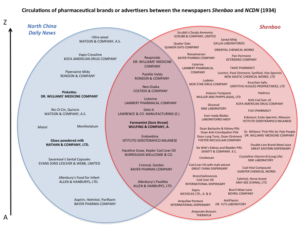
One of the most eye-catching aspects of newspapers, no matter what era, are advertisements. Ever since the advent of mass production and commercial sales, enterprising businessmen have attempted to sell a whole panoply of products. Chinese newspapers seem to have a penchant for advertising pharmaceutical products. A curious collection of diagrams published in 2017 highlights the overlaps between ads in the Shenbao and North China Daily News (NCDN) triggered an interesting deep dive into the appearance of specific ads in Chinese newspaper sources of the early 1900s. [1] These diagrams highlight an interesting evolution in the types of advertisements that appeared in Chinese Newspapers as perspectives on health evolved. Newspaper advertisements are powerful indicators of the zeitgeist of a region. In the case of pharmaceutical advertisements, it represented a powerful shift in the discourses surrounding hygiene and health in China. This was especially true in treaty ports, where increased accessibility to commodified drugs changed the nature of what health or weisheng (衛生) meant.


We begin with the primary source accounts found in newspapers from the early 1910s to the late 1940s, which denoted a marked shift in the number of pharmaceutical advertisements found in China-based newspapers. Shenbao in particular seems to have an eclectic mixture of pharmaceutical companies from Japan, the UK, the US and Germany. From 1914 to 1949, Bayer was commonly featured in both Shenbao and NCDN selling Aspirin and Cresival. While Aspirin is a household name in today’s day and age, used for the treatment of headaches and as a blood thinner. In the specific case of the Jiangsheng Bao (literally the sound of River Newspaper) a newspaper produced in Xiamen from 1918 to 1951, these pharmaceutical advertisements are so ubiquitous that most daily papers had at least one mention of medication. Once again, we see Bayer with a fairly large ad for Eldoform (anti-diarrheal) Mitigal (an ointment used to treat scabies) and Cresival. Of the many drugs advertised, Cresival seems to be the most mysterious. In the Jiangsheng Bao’s account of this medicine, it claims to clear phlegm and be the foremost cure for cough. In essence, a very good cough syrup. Bayer’s significant investment in Chinese newspaper advertisements seems quite unusual when taken out of context. Why would a German pharmaceutical company be interested in selling minor medications to people halfway across the globe?

Bayer Advertisement in 06/09/1932 Issue of Jiangsheng Bao [2]


The increased mentions of this medicine and for that matter, all types of medication indicated a significant shift in how Chinese people saw health as acquirable and consumable. In Ruth Rogaski’s Hygenic Modernity, she highlights how introduction to western culture increased the accessibility of ready-made remedies. [3] She discusses the wider adoption of Western hygienic norms throughout the 1920s and 30s in Treaty Ports throughout China: “For one and a half yuan, one could obtain weisheng in a pill.” Rogaski focuses most on the aggressive advertising of “Dr William’s Pink Pills for Pale People” a drug that was advertised heavily in the Shebao and NCDN from 1914 to 1949. [4] This pill was sold as a miracle cure for everything from “insomnia to intestinal worms”. She cogently comments on how these newspaper advertisements adapted themselves to the Chinese context, targeting a variety of figures such as the traditional male head of the household and their wifely counterparts. The ailments that these pills targeted were relevant to the discourses surrounding modernity and medicine at the time. [5]

The marked shift in how hygiene was seen as easily consumable and a mark of modernity drove pharmaceutical companies to set up shop in treaty ports such as Shanghai. Bayer set up its first Chinese factory producing Aspirin in 1936. [6] It seems that alongside the aggressive advertising in newspapers, Bayer was capitalising on this weisheng revolution and finding a market for commodified health. Their increased presence in newspaper advertisements across China was quite intentional. As the social discourse surrounding hygiene and modernity in China grew, so did the consumption of these “health consumables” that could improve not just the general health of the average Chinese person, but the health of the overall state and civilisation. These pharmaceutical newspaper advertisements in the Shenbao, North China Daily News and Jiangsheng Bao reflected on the rapidly evolving ideas on health and modernity in China that pervaded that period.

[1] ‘Circulations of pharmaceutical brands between the newspapers Shenbao and North China Daily News (1914-1949)’, MADSPACE, 5 May 2017,  <https://madspace.org/cooked/Drawings?ID=128> [accessed 5 February 2022].

[2] ‘Jiangsheng Bao’, Archive.org, 06/09/1932, <https://archive.org/details/jiangshengbao-1932.09.06/page/n6/mode/2up> [accessed 5 February 2022].

[3] Ruth Rogaski, Hygenic Modernity: Meanings of Health and Disease in Treaty-Port China (London, 2004), p. 227.

[4] Ibid, p. 229..

[5] Ibid, p. 230.

[6] Bayer, ‘Bayer China History’ <https://www.bayer.com.cn/index.php/AboutBayer/BayerChina/2nd/History?l=en-us> [accessed 5 February 2022].

Hell on Earth: Spatial Representations of Pain as a Moral Deterrent

My investigation into the 10 Courts of Hell as part of my long essay has led me down some interesting paths looking at various depictions of hell in parks and temples within the East Asian and South-East Asian context. In the European context, hell and various forms of the underworld are most often depicted in the form of art, essentially a 2D rendering, and lacks a physical and spatial representation. Although Buddhist and Daoist conceptions of hell do exist in a similar artistic form, it appears that many have made the jump from canvas to statue, and from statue to entire walk-in spaces. Both Haw Par Villa’s ‘Ten Courts of Hell’ (which is quite ironically being renovated to be air-conditioned) and Thailand’s Wat Mae Kaet Noi, both have explicit spatial depictions of hell, in park form that are ripe for analysis.

When I visited Haw Par Villa this summer, it was a shame that the Hell portion was closed for renovations. However, this particular part of the park is what exists in the living memory of many Singaporeans as being the most unsettling part of it. The purpose of this Chinese (in a mostly Daoist way) depiction of Hell had a clear moral purpose. Firstly, depictions of hell generally are seen as warnings and deterrents. As a writer from the New Yorker quite eloquently put it “The afterlife is an old room in the house of the human imagination”. Both Haw Par Villa and Wat Mae Kaet Noi’s spatial depiction of Hell fills this room with images of unimaginable pain and torture to those who commit sins or acts that are deemed immoral by society. This form of guiding morality through spatial representation has been used more positively, for instance in certain parts of Beijing’s parks in the Republican period. Where Republican ideals are enshrined in statues and poems on walls. However, perhaps the creators of this park understood that often fear is a more powerful motivator than the promise of reward.

This form of moral education through deterrent was applied to specific immoral acts that had corresponding punishments. In the case of Wat Mae Kaet Noi, that depicts a Buddhist conception of hell, Naraka. We see graphic representations of adulterers and promiscuous individuals experiencing the most severe forms of genital mutilation, scenes of badly-behaved schoolchildren having their tongues pulled out of their bodies and the sort of gore that would be perfectly at home in a horror film.

Haw Par Villa’s approach to depicting the punishments for specific crimes are done in a much more structured way. Each of the Ten Courts of Hell is meant to judge different sins and the strong Legalist undercurrent that pervades through Chinese culture is evident here. In each court presides a Yama (यम)a Hindu and Buddhist deity of the underworld. In both instances, they act as lawgivers, enforcers of the Dharma and punishers of wrongdoing. This concept must have appealed to existing Confucian concepts of fair judgement and punishment even in the afterlife and incorporated into Chinese conceptions of Hell.

After an initial trial in the First Court, which determines whether the virtuous acts in your life outweigh the evil. A person will either be sent across a “bridge” to reach paradise or to a corresponding Court of Hell that will mete out their punishment. The different crimes that each Court is responsible for are seemingly quite disparately organized, with rapists and rumour mongers being sent to the same Seventh Court. At the Tenth Court, offenders are handed a magical cup of tea and reincarnated. Similarly, to Wat Mae Kaet Noi, there are also grisly depictions of amputation, decapitation and being boiled alive. Neither parks are for the faint of heart and are intended to be as gruesome as possible.

One key aspect of both representations of Hell is that they are both cyclical. Whereas Christian conceptions of Hell are that of a terminus, Buddhist Hell may be considered more as purgatory if seen from a Western perspective. The existence of the Wheel of Reincarnation (related to the Buddhist concept of Nirvana) simply sees hell as a transitionary place where individuals go to receive punishment for their crimes before moving on to either paradise, whether in a 極楽 (Gokuraku) Pure Land Sense, or a Nirvana sense. In each instance, there is always hope for redemption. This strong soteriological message suggests that the fundamental conceptions of life and death, crime and punishment, in societies influenced by Buddhism was different.

Both depictions of Hell encourage virtuousness and morality in the current life that one is living in by graphically depicting what will happen if they don’t. More importantly, the existence of these depictions in the form of dioramas and parks were to convey this message to those that couldn’t read. Despite the original intention of these depictions being for the illiterate, they still serve as a powerful reminder to those that can. Showing, rather than telling us what may happen if we don’t lead a virtuous life.

Note: As the images are too graphic to be displayed on this blog, below are the links to both parks:

Ten Courts of Hell: Haw Par Villa, https://www.wheresidewalksend.com/court-of-hell/
Wat Mae Kaet Noi: https://matadornetwork.com/read/scariest-temple-thailand/

Haw Par Villa’s Starving and Triple Buddhas: A Perplexing Diorama

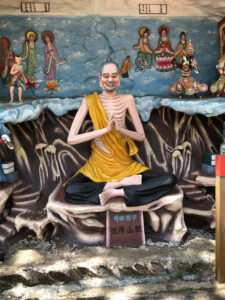
Starving Buddha


Having realized that I erroneously wrote two blog postings on secondary sources (because of how interesting the ideas that they offered were), I will do my penance and analyse a primary source that I gathered myself over the summer. The image in question is sourced from Haw Par Villa, one of the zaniest places in Singapore with the most cursed energy I have ever seen from a recreational space. The park itself was the pet project of the two brothers, Aw Boon Haw (胡文虎) and Aw Boon Par (胡文) that founded and ran a lucrative empire selling Tiger Balm, a medicinal salve that is still popular throughout Southeast Asia today.

Due to the sheer chaos that is the nature of this source, I am unsure as to whether it’s even possible to make a clear analytical point. One could discuss the synthesis of Daoist and Buddhist iconography in having Bodhisattvas, Buddhas, what I would assume to be Nezha and Dharmapalas (protectors of the Dharma) in the same image or even just the artistic choice of how these figures were depicted. As such, I have decided to focus purely on the significance of the Buddhas and Bodhisattvas depicted in the image.

The diorama appears to be attributed to the Lingshan Buddhist Group (霊山佛祖) based in Chaozhou (中国潮州). Further investigation showed that the place is indeed close to the city of Chaozhou, but is still a fair distance from it. Historical records of this particular Buddhist group are likely to be fairly scarce, and may have indicated that they paid for the particular diorama. Even the character for “Ling” is difficult to find and seems to either have been miswritten, or no longer exists in the current Chinese lexicon so much so that I was unable to input the exact character into my phone or computer.

The main figure depicted is an emaciated Buddha, a reference to the Gautama Buddha’s experience starving himself when he first left royal life. This form of voluntary starvation was seen as a form of ascetism and a symbol of how a person could gain ultimate control over their body (to the point of rejecting sustenance). The quite hilariously done, poorly-installed cord linking the larger statue to a smaller bowing figure in the background is a depiction of him achieving enlightenment (shown as ascendance) and meeting what I would assume to be the Buddhas of the Three Ages.

Typical descriptions of the Buddhas of the Three Ages would include Maitreya (representing the Future) and Gautama Buddha (who is notably absent in this depiction). The Prajnaparamita Sutra refers to the Buddhas of the Three ages in a single phrase (tryadhva-sarva-buddhāḥ) perhaps suggesting that the three are one reincarnated. It is without a doubt that the choice of these three specific Buddhas are deliberate and have enormous significance to story, but at a level that I cannot discern nor understand.

Maitreya is clearly depicted with his massive earlobes and belly, and Bodhisattva Guanyin with her classic hairstyle and vase. However, there is a Buddha that is difficult to discern based purely on appearance. The mysterious third Bodhisattva with a Ruyi (Chinese Sceptre). The plaques right above them is meant to clarify which Buddhas are being depicted, with Maitreya and Guanyin being fairly recognizable as “弥勒佛”and “观世音菩萨” respectively. The middle name, seemingly depicting the figure on the far right “世济佛菩萨” is mentioned in many Mahayana scriptures but is unknown to me.

The reasoning choice of Buddhas in this specific diorama may reflect which Buddhas the artists considered culturally important in this era. Or it may be an entirely arbitrary choice. Whichever it is, it certainly a fascinating and curious piece of historical Buddhist art.

Fengshui’s Conception of Space: The Material and Metaphysical Divide in Practice

A thought that has been brewing in my head since MO3354 (East Asian Intellectual History) was the nature of the Ontic/Epistemic divide in Eastern Philosophies. In my limited study of Buddhism, I believe that they can bridge this gap through the concept of Enlightenment (barring the Yogachara School). This divide is even more difficult to understand in the context of the Yi Ching and Fengshui. As Feuchtwang describes it, “Fengshui offers plausible hypothesis, but never proofs”. [1] It is possible that practitioners of Fengshui aren’t concerned with the epistemology of their craft, much less the ontic/epistemic divide. To look at Fengshui under this split draw away from the issues that scholars of the Yi Ching and Fengshui deem important. To consider the ontic/epistemic divide in Fengshui is not necessarily important, rather we should look at the material/metaphysical divide that is more evident in ancient and modern debates in different schools of Fengshui.

The most obvious split between more materialist and metaphysical perspectives on Fengshui is between the School of Forms and Orientations. The School of Forms emphasizes concrete topological features and draws an interpretation from material phenomena to decide whether a place has good Fengshui or not. The School of Directions is much more complicated and encompasses cosmological aspects including the Five Elements, Numerology based on the Bāgùa, and even planetary alignments. [2] What we can see here is a clear split between how Fengshui is conceptualized. The School of Forms sees Fengshui in a materialistic light, where the School of Orientations looks at it in a more metaphysical sense. This divide between emphasis on the material and metaphysical has interesting implications on the practical applications of Fengshui on spaces. There appear to be fewer examples of specific modern practices based on the School of Forms compared to Orientations. This is likely due to the intrinsic adaptability of each School’s basic principles.

In terms of application, the materialist leaning of the School of Forms has lent itself well to larger-scale planning and in areas where space is abundant. For instance, Ming Dynasty Beijing’s city planning seems to follow principles from the School of Forms. With their dragon-shaped city planning and the artificial hill behind the Forbidden City. The central line of the city forms a giant winding dragon from north to south, with two large gates as its eyes. [3] We also see the rules in the School of Forms being especially strictly adhered to in burial practices, particularly in places such as Taiwan; where space constraints are less severe and topological features abundant. Entire south-facing hillsides in areas north of Taipei are dotted with mausoleums and horseshoe-shaped graves. Based on these examples, it is evident that the School of Forms and subsequent schools that follow a materialist interpretation of Fengshui are more suited towards the planning of larger areas, incorporating and using topology on a larger scale.

On the other hand, the School of Orientations with its various modern interpretations such as the Bāgùa and Flying Star Schools has found itself being applied much more generously in places such as an office or household context. The Flying Star School, with its heavier focus on numerology, can be adapted towards floor planning. With favourable number combinations used for bedrooms and offices, and less favourable combinations for less important spaces. [4] There are also examples of small Bāgùa panels with a mirror in the centre being hung above main doors. In the Chinese diaspora of Singapore and Hong Kong, household Fengshui seems to be informed by general practices in the School of Orientation, especially in the placement and direction of furniture; especially beds. The emphasis on the metaphysical rather than the material meant that the School of Orientations’ practices were much better suited to modern adaptations and interpretations.

Thus, the divide in the School of Forms and Orientations has resulted in varied applications of Fengshui in spaces. With practices from the School of Orientations and its derivatives dominating modern approaches to Fengshui. It would be interesting to read further into Fengshui practices and the Yi Ching. Especially, to determine which Schools and their derivatives have been propagated more widely.

[1] Ole Brunn, An Introduction to Fengshui (2008), p. 90

[2] Ibid, p. 151

[3] Madeleine YueDong and Reginald E. Zelnik, Republican Beijing: The City and its Histories, (2003), p. 8

[4] Ole Brunn, An Introduction to Fengshui (2008), p. 52

Between the Municipal and Inhabitant: The Push and Pull of Power

The battle for power expression and control between the municipality and their inhabitants is a recurring theme in many of the stories that discuss cities and their development. These groups are by no means monolithic and many have substantial splits in their interests, however, as analytic units, it is fair to categorise them as such. From Shanghai to Singapore, Beijing to Changchun, there were also, subtle interplays of power and class that hint towards wider power structures. It is this combination of push and pulls between the municipality and its inhabitants, and the way that power was negotiated that is the main subject of this post.

In the case of Shanghai, an often hilarious but deeply saddening state of affairs was the segregation of Chinese and European populations. The imagined signposts saying “No dogs or Chinese”, although more a myth than reality, is a reminder that many European municipal councils had clear ideas over specific racial usages of space. [1] In the Shanghalander case especially, desires to enforce extraterritoriality and full sovereign control would have meant within these “European spaces” whether represented or real, were backed by real expressions of power.

For Singapore, the representations and usage of space laid out by the plan strongly indicated that colonial and later municipal authorities struggled to identify and assert control over the various Malay “Kampungs” (living areas). This was mostly because many lived outside of the main areas that were of interest to Raffles and Farquhar and that language provided a formidable barrier to understanding these places. [2] The Chinese areas were also dominated by various bāngqún (幫群) organisations that represented the inhabitant population. These “bāng” held considerable power that sometimes ran against colonial designs for the city. [3]

For both of these cities, there were clear examples where attempts to assert municipal or colonial control were either subverted or resisted. Although there has not been much mention of Malay or Indian resistance towards certain municipal policies. The Chinese community in Singapore, being larger in size and power, did actively mobilise their influence. In response to the unilateral passing of Police Acts in 1857, the entire Chinese community went on strike, effectively halting the economy for a few days. Despite this strike not being an act of open and violent revolt. It nonetheless serves as an example where local inhabitants expressed power through shockingly effective strategies. For Shanghai, unarmed demonstrations against what was presumably the exclusion of Chinese from public parks and spaces amongst other measures is a good example of inhabitant resistance towards assertions of municipal power. Furthermore, Chinese requests for better municipal representation could also be counted as legitimate bids to integrate inhabitant interests into municipal decision making.

That being said, the case of Shanghai is unique, as what qualified someone as an “inhabitant” was quite nebulous. Did the community of White Shanghailanders count as inhabitants? Or was this definition limited to the Chinese. The somewhat cop-out answer of “both”, makes the most sense. While local Chinese were most definitely counted as the original inhabitants of the city, many Europeans eventually were considered ‘local’ inhabitants of the area. The main difference was that often Europeans were allowed to actively participate in the decision-making processes that ran through the SMC, while the Chinese struggled to acquire that privilege. [4] Singapore’s definition for “inhabitant” was often a lot clearer, the existing Chinese, Malay, Indian and Orang Laut settlements created a distinct divide between European colonisers and local communities.

This leads us to the interesting intersection of class and race in both Singapore and Shanghai. In both cases, English educated and typically Chinese businessmen were sometimes permitted to join the ranks of municipal decision-makers. This was more so the case in Singapore where businessmen of considerable stature such as Seah Liang Seah, founder of the Ngee Ann Kongsi and Choa Giang Thye, also a prominent member of the Chinese Chamber of Commerce, actively participated in municipal politics and advocated for the Chinese Community as early as 1857. [5] The English language ability of these higher-class Chinese businessmen afforded them access to the primarily European sphere of politics. They often acted as interlocutors for local populations, albeit only to a degree. Their lack of sustained and direct involvement in Clan and Bāng organisations may have impacted their ability to fully represent their constituent compatriots. In Shanghai, SMC postings were barred to the Chinese until 1920, the ‘virulent racism’ of Shanghailanders often prevented even prominent Chinese businessmen from entering the municipal sphere.

In conclusion, throughout any spatial story, there was often a battle for power expression and control between the municipality and their inhabitants. This was sometimes mediated by prominent members of the inhabitant community (often Chinese) that could communicate in English and thus partially enter into municipal decision-making. The reality is that the interests of municipal bodies and the actual inhabitants did not always coincide, whether due to racism or language (mostly racism). Although the impacts of this are not necessarily felt today, we can certainly see the struggles of the voiceless coolie, or hawker store vendor, that rarely had a voice in how their city was run.

[1] Robert Bickers ‘Shanghailanders: The Formation and Identity of the British Settler Community in Shanghai 1843-1937’ Past and Present (May, 1998), p. 205 

[2] The Jackson Plan (Singapore, National Library of Singapore, 1822

[3] Brenda Yeoh Contesting Space in Colonial Singapore (Singapore, 2003) p. 39

[4]Robert Bickers ‘Shanghailanders: The Formation and Identity of the British Settler Community in Shanghai 1843-1937’ Past and Present (May, 1998), p. 205

[5] Brenda Yeoh Contesting Space in Colonial Singapore (Singapore, 2003) p. 61